Primate Social Behavior Are Chimps Like Us?
Why Study Primate Behavior? Sociobiology: Do genes govern our behavior? Ant society as genetically determined “ Instincts” among nonprimate mammals Humans are guided by culture Product of learning Involves language, lacking in all other species Can nonhuman primate behavior give us a clue to our own?
Primatology: Basic Concepts Ethology : Study of any animal’s behavior   Primatology:  Study of nonhuman primates; subfield of ethology Field Research:  To avoid influencing primate behavior Provisioning:  Providing food to primates to shorten time in field Drawback:  Provisioning does influence primate behavior
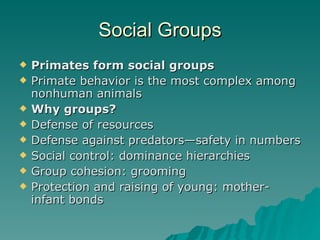
Social Groups Primates form social groups Primate behavior is the most complex among nonhuman animals Why groups? Defense of resources Defense against predators—safety in numbers Social control: dominance hierarchies Group cohesion: grooming Protection and raising of young: mother-infant bonds
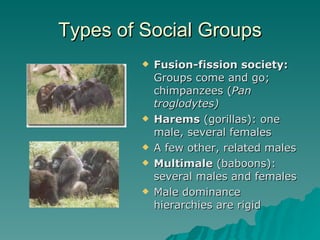
Types of Social Groups Fusion-fission society:  Groups come and go; chimpanzees ( Pan troglodytes) Harems  (gorillas): one male, several females A few other, related males  Multimale  (baboons): several males and females Male dominance hierarchies are rigid
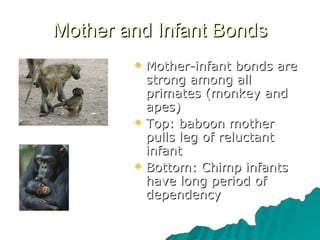
Mother and Infant Bonds Mother-infant bonds are strong among all primates (monkey and apes) Top: baboon mother pulls leg of reluctant infant Bottom: Chimp infants have long period of dependency
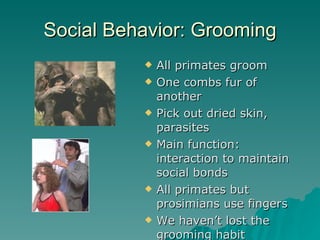
Social Behavior: Grooming All primates groom One combs fur of another Pick out dried skin, parasites Main function: interaction to maintain social bonds All primates but prosimians use fingers We haven’t lost the grooming habit
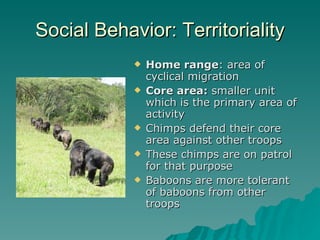
Social Behavior: Territoriality Home range : area of cyclical migration Core area:  smaller unit which is the primary area of activity Chimps defend their core area against other troops These chimps are on patrol for that purpose Baboons are more tolerant of baboons from other troops
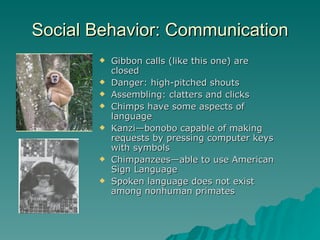
Social Behavior: Communication Gibbon calls (like this one) are closed Danger: high-pitched shouts Assembling: clatters and clicks Chimps have some aspects of language Kanzi—bonobo capable of making requests by pressing computer keys with symbols Chimpanzees—able to use American Sign Language Spoken language does not exist among nonhuman primates
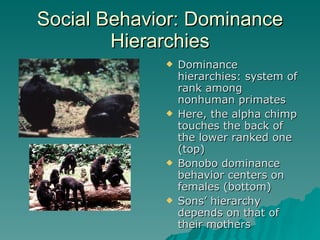
Social Behavior: Dominance Hierarchies Dominance hierarchies: system of rank among nonhuman primates Here, the alpha chimp touches the back of the lower ranked one (top) Bonobo dominance behavior centers on females (bottom) Sons’ hierarchy depends on that of their mothers
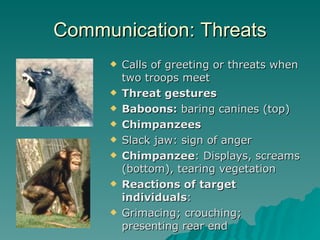
Communication: Threats Calls of greeting or threats when two troops meet  Threat gestures Baboons:  baring canines (top) Chimpanzees Slack jaw: sign of anger Chimpanzee : Displays, screams (bottom), tearing vegetation Reactions of target individuals : Grimacing; crouching; presenting rear end
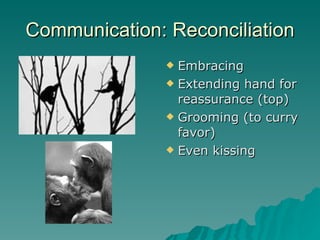
Communication: Reconciliation Embracing Extending hand for reassurance (top) Grooming (to curry favor) Even kissing
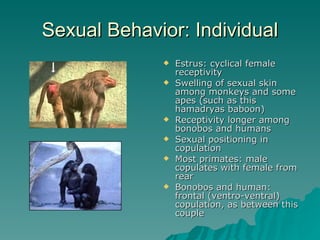
Sexual Behavior: Individual Estrus: cyclical female receptivity Swelling of sexual skin among monkeys and some apes (such as this hamadryas baboon) Receptivity longer among bonobos and humans Sexual positioning in copulation Most primates: male copulates with female from rear Bonobos and human: frontal (ventro-ventral) copulation, as between this couple
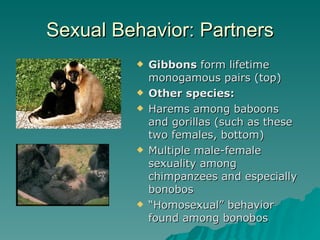
Sexual Behavior: Partners Gibbons  form lifetime monogamous pairs (top) Other species: Harems among baboons and gorillas (such as these two females, bottom) Multiple male-female sexuality among chimpanzees and especially bonobos “ Homosexual” behavior found among bonobos
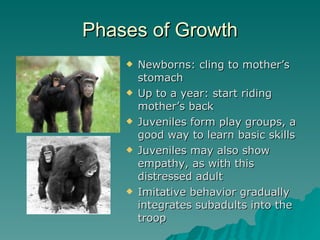
Phases of Growth Newborns: cling to mother’s stomach Up to a year: start riding mother’s back Juveniles form play groups, a good way to learn basic skills Juveniles may also show empathy, as with this distressed adult Imitative behavior gradually integrates subadults into the troop
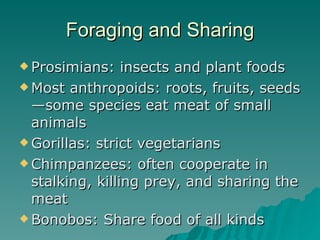
Foraging and Sharing Prosimians: insects and plant foods Most anthropoids: roots, fruits, seeds—some species eat meat of small animals Gorillas: strict vegetarians Chimpanzees: often cooperate in stalking, killing prey, and sharing the meat Bonobos: Share food of all kinds
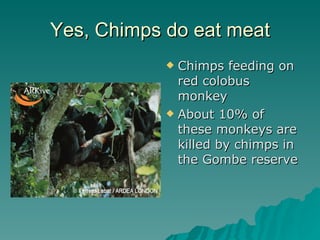
Yes, Chimps do eat meat Chimps feeding on red colobus monkey About 10% of these monkeys are killed by chimps in the Gombe reserve
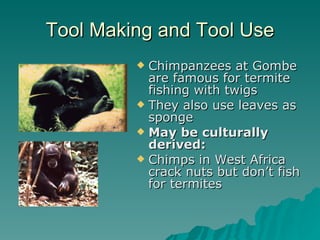
Tool Making and Tool Use Chimpanzees at Gombe are famous for termite fishing with twigs They also use leaves as sponge May be culturally derived:   Chimps in West Africa crack nuts but don’t fish for termites
Tool Making and Use: Other species: Bonobos make rain hats from leaves Orangutans also use tools Gorillas and gibbons do not make or use tools—so far as we know!
Agonistic Behavior and Warfare Agonistic behavior characteristic of all species mostly over mating females competing for dominance Primates were once thought incapable of killing their own kind.
Conflict: Comparing Chimps and Bonobos Chimpanzees Warfare actually was observed between one troop and a breakaway group.  Cannibalism observed and reported Bonobos Philosophy: “Make love, not war” Frequent sexual contact between sexes and within one sex
Primate Behavior and Fossil Hominid Behavior Inferring the past Similarities between nonhuman primate and human behavior Tool making before the Paleolithic Interaction without language: kinesics and paralanguage When did language become necessary?
Interpreting the evidence Nature of prehominid and early hominid society Child rearing techniques Was hierarchy inevitable? Was warfare inevitable? Bonobos versus chimps

Primate Social Behavior

  • 1.
    Primate Social BehaviorAre Chimps Like Us?
  • 2.
    Why Study PrimateBehavior? Sociobiology: Do genes govern our behavior? Ant society as genetically determined “ Instincts” among nonprimate mammals Humans are guided by culture Product of learning Involves language, lacking in all other species Can nonhuman primate behavior give us a clue to our own?
  • 3.
    Primatology: Basic ConceptsEthology : Study of any animal’s behavior Primatology: Study of nonhuman primates; subfield of ethology Field Research: To avoid influencing primate behavior Provisioning: Providing food to primates to shorten time in field Drawback: Provisioning does influence primate behavior
  • 4.
    Social Groups Primatesform social groups Primate behavior is the most complex among nonhuman animals Why groups? Defense of resources Defense against predators—safety in numbers Social control: dominance hierarchies Group cohesion: grooming Protection and raising of young: mother-infant bonds
  • 5.
    Types of SocialGroups Fusion-fission society: Groups come and go; chimpanzees ( Pan troglodytes) Harems (gorillas): one male, several females A few other, related males Multimale (baboons): several males and females Male dominance hierarchies are rigid
  • 6.
    Mother and InfantBonds Mother-infant bonds are strong among all primates (monkey and apes) Top: baboon mother pulls leg of reluctant infant Bottom: Chimp infants have long period of dependency
  • 7.
    Social Behavior: GroomingAll primates groom One combs fur of another Pick out dried skin, parasites Main function: interaction to maintain social bonds All primates but prosimians use fingers We haven’t lost the grooming habit
  • 8.
    Social Behavior: TerritorialityHome range : area of cyclical migration Core area: smaller unit which is the primary area of activity Chimps defend their core area against other troops These chimps are on patrol for that purpose Baboons are more tolerant of baboons from other troops
  • 9.
    Social Behavior: CommunicationGibbon calls (like this one) are closed Danger: high-pitched shouts Assembling: clatters and clicks Chimps have some aspects of language Kanzi—bonobo capable of making requests by pressing computer keys with symbols Chimpanzees—able to use American Sign Language Spoken language does not exist among nonhuman primates
  • 10.
    Social Behavior: DominanceHierarchies Dominance hierarchies: system of rank among nonhuman primates Here, the alpha chimp touches the back of the lower ranked one (top) Bonobo dominance behavior centers on females (bottom) Sons’ hierarchy depends on that of their mothers
  • 11.
    Communication: Threats Callsof greeting or threats when two troops meet Threat gestures Baboons: baring canines (top) Chimpanzees Slack jaw: sign of anger Chimpanzee : Displays, screams (bottom), tearing vegetation Reactions of target individuals : Grimacing; crouching; presenting rear end
  • 12.
    Communication: Reconciliation EmbracingExtending hand for reassurance (top) Grooming (to curry favor) Even kissing
  • 13.
    Sexual Behavior: IndividualEstrus: cyclical female receptivity Swelling of sexual skin among monkeys and some apes (such as this hamadryas baboon) Receptivity longer among bonobos and humans Sexual positioning in copulation Most primates: male copulates with female from rear Bonobos and human: frontal (ventro-ventral) copulation, as between this couple
  • 14.
    Sexual Behavior: PartnersGibbons form lifetime monogamous pairs (top) Other species: Harems among baboons and gorillas (such as these two females, bottom) Multiple male-female sexuality among chimpanzees and especially bonobos “ Homosexual” behavior found among bonobos
  • 15.
    Phases of GrowthNewborns: cling to mother’s stomach Up to a year: start riding mother’s back Juveniles form play groups, a good way to learn basic skills Juveniles may also show empathy, as with this distressed adult Imitative behavior gradually integrates subadults into the troop
  • 16.
    Foraging and SharingProsimians: insects and plant foods Most anthropoids: roots, fruits, seeds—some species eat meat of small animals Gorillas: strict vegetarians Chimpanzees: often cooperate in stalking, killing prey, and sharing the meat Bonobos: Share food of all kinds
  • 17.
    Yes, Chimps doeat meat Chimps feeding on red colobus monkey About 10% of these monkeys are killed by chimps in the Gombe reserve
  • 18.
    Tool Making andTool Use Chimpanzees at Gombe are famous for termite fishing with twigs They also use leaves as sponge May be culturally derived: Chimps in West Africa crack nuts but don’t fish for termites
  • 19.
    Tool Making andUse: Other species: Bonobos make rain hats from leaves Orangutans also use tools Gorillas and gibbons do not make or use tools—so far as we know!
  • 20.
    Agonistic Behavior andWarfare Agonistic behavior characteristic of all species mostly over mating females competing for dominance Primates were once thought incapable of killing their own kind.
  • 21.
    Conflict: Comparing Chimpsand Bonobos Chimpanzees Warfare actually was observed between one troop and a breakaway group. Cannibalism observed and reported Bonobos Philosophy: “Make love, not war” Frequent sexual contact between sexes and within one sex
  • 22.
    Primate Behavior andFossil Hominid Behavior Inferring the past Similarities between nonhuman primate and human behavior Tool making before the Paleolithic Interaction without language: kinesics and paralanguage When did language become necessary?
  • 23.
    Interpreting the evidenceNature of prehominid and early hominid society Child rearing techniques Was hierarchy inevitable? Was warfare inevitable? Bonobos versus chimps

Editor's Notes

  • #3 One major subfield of physical anthropology is primatology, the study of nonhuman primates (monkeys and apes, including gibbons and orangutans of Southeast Asia and the gorillas, chimpanzees, and bonobos of Africa. Why are they relevant to cultural anthropology.. Well, apart from jokes about monkey wrenches and Bonzo (remember Bonzo? Didn’t think so.) their behavior parallels our own in many ways. They do have features of language, and some have used sign language derived from ASL. There is evidence they have protoculture; they can use tools, and the kind of tools they use differ by region. Gombe (Tanzania) chimps fish for termites, those in Tai (Ivory Coast) scoop up army ants and crack open nuts using stones or heavy tree braches, suggesting different cultures.
  • #4 Here are some concepts. Ethology (not to be confused with ethnology, study of cultures) is the study of animal behavior. Primatology is a sub-branch of ethology that involves the study of nonhuman primates. One big issue is whether researchers should wait months until they can get close enough to the primates to study—which can take months—or should lure them with food, called provisioning, which shortens the time for study, but also involves influencing their behavior. Americans and Britons tend to wait it out; Japanese primatologists have traditionally practice provisioning. You decide from the takes we will view.
  • #5 As noted earlier, all primates (including us) form groups. Groups involve such cohesive (bonding) activities such as grooming and mother-infant bonding. It is a way to defend resources against intruders and to fend off predators, such as leopards that inhabit the forests. Group behavior among primates is the most complex among all gregarious animals (animals that form groups, which also include gazelles, cattle, bison, zebras, and others).
  • #6 There are different kinds of groups Chimps form fusion-fission societies, in which some chimps join, and others leave. Gorillas form harems: a dominant male silverback (those with white hair, showing age), two or three nondominant males, and several females. Baboons form multi-male troops—several males and females, with a very rigid male dominant hierarchy.
  • #7 Mother-infant bonds are found in all primate societies. Above, you see a mother baboon pulling the leg of an infant who has its own idea of where it wants to go. Periods of dependence varies. Among chimps, infants are dependent on their mothers for up to five years.
  • #8 All primates groom, from prosimians to monkeys to apes to us. They have cleaning functions, but among nonhuman primates, their primary function seems to reinforce bonds. Among chimps, grooming may entail currying favor from dominant males. As you can see in the lower photo, humans have not lost the grooming habit, as can be seen in every barbershop or beauty salon worldwide.
  • #9 We seem not to have lost the territorial habit either. Here, a line of males patrol the boundaries of their territory in search of intruders. There is a core area, in which individuals conduct their main activities—hunting, foraging for food, sleeping, and so on. There is also a home range, within which they migrate on a cyclical basis. Baboons are more tolerant of other troops than chimps are.
  • #10 Nonhuman primates communicate, but in various ways. Gibbons, like this one, have calls, but the communication system is closed. High-pitched shouts, for example, indicate danger, whereas clatters and clicks might mean “come here, boys!” They cannot be combined to create a third meaning. On the other hand, chimps and gorillas are able to use their variant of American Sign Language, and can create new signals with new meaning—their system is open, although limited. Koko the gorilla, Kanzi the bonobo, and Washoe the chimp are three classic examples of apes using language.
  • #11 All primates have dominance hierarchies of some short. In the top photo, one chimp asserts its lordship over another individual. Chimps do shift in who is the top chimp. In Gombe, Freud was the alpha male, then his brother Frodo use bullying to displace Freud, who was getting ill. Then, having had enough bullying, the other chimps kicked out Frodo. Baboons have more rigid hierarchies. Bonobos (below) have another system. The females form a hierarchy, and they pass it down to their sons. Yet, ironically, sisterhood is not possible. For one thing, there is no sisterhood. Females leave their troops to join another one, and the hierarchy is formed among total strangers.
  • #12 Hoe do primates get their way. They do so, often by threats. Baboons threaten each other with an open “yawn” baring their canines (above). Among chimps, threats may involve screaming (below), staring at an adversary, and/or rushing about tearing vegetation and generally scaring the others. Submission may be indicating with a grimace, crouching, or presenting the rear end to the victor.
  • #13 After an encounter, chimps seek reconciliation, even the dominant male. Above, one chip extends his hand to offer friendship to the other one. Below, two chimps literally kiss and make up. Grooming is another part of the repertoire of reconciliation.
  • #14 Like all mammals, primates reproduce sexually. In some species, such as baboons, females in estrus (i.e. in heat) are visibly so. Here, this female baboon’s rear end is red and swollen. Mating is seasonal. In other species, like bonobos, the female is almost always receptive. As you can see n the lower photo, bonobos copulate front-to-front, as humans do. Sex is one way to defuse tension among bonobos, and it is often homosexual as well as heterosexual.
  • #15 Sexual partnerships run the spectrum. Gibbons are monogamou s, as the upper photo shows; they form lifetime pairs. Baboons and gorillas both form harems: one male, two or more females, as shown in the lower photograph. Still others are promiscuous; chimpanzee and especially bonobos. Some may practice homosexuality; bonobos can be either, and usually are.
  • #16 Typically, among both monkeys and ape, newborns learn to cling to the mother’s stomach; after a year or so, infants ride on their mother’s back, jockey fashion (upper photograph). As infants become juveniles, they do what human juveniles do—they play. Play behavior, especially in groups, helps them to learn basic skills and to become part of the troop. As the bottom photo shows, juveniles are not without empathy; here, a juvenile tries to console a distressed adult.
  • #17 All primates, including our ancestors up to 10,000 years ago, forage for food. Some hunt, but most of the diet consists of nuts, fruits, roots, leafy greens, and others. Gorillas, despite their fearsome appearance to some people, are strict vegetarians. Chimpanzees, on the other hand, are omnivores : they eat both meat and plant foods When they hunt, they often cooperate in groups (see next slide). Bonobos are also omnivores, but do not eat the volume of meat that chimps do.
  • #18 Chimps in both east and west Africa have made hunting monkeys, especially red colobus monkeys (photo) a fine science. Primatologists have described two hunting styles: a somewhat cooperative free-for-all in Gombe, whereby everyone cooperates, but out of self-interest. As many as 70 colobus monkeys are taken every year. In the western rainforest of Tai, chimps are organized into those who case the monkeys while others block the escape routes. The density of the forest require better organization.
  • #19 Chimps are also tool makers and users. When she first started observing the chimps at Gombe, Jane Goodall discovered that chimps fish for termites at mounds the insects construct. The tool making showed their ability to plan ahead: strip a twig of its leaves, insert the stick into the hill, then extract the stick with the termites clinging onto it and lick them off. Chimps in Tai, on the other hand, do not fish for termites, but rather crack nuts using rocks or heavy branches; Gombe chimps do not crack nuts, though termites and nuts are abundant in both places. This suggests that chimps have at least the rudiments of culture.
  • #20 Tool-making behavior of other species are various. Bonobos make rain hats; orangutans use tools as well. However, neither gibbons nor gorillas have been observed to make or use tools.
  • #21 All species of primate (including us—are you shocked?} engage in conflict ; agonistic behavior has been observed for all species of primates, and, for that matter, almost all animals. Among primates, the conflict is mostly over females or for dominance. Fights are rarely fatal; sooner or later, one gives up the fight. Until 1975, it was thought that chimps, among other primates, were in capable of killing their own kind. .
  • #22 In the past, chimpanzees were thought to be gentle, if rambunctious creatures. Then in 1973, the troop Goodall was observing spit into two groups. Two years later, the larger group hunted down the smaller troop and over the next two years, exterminated it. Another development is cannibalism, also observed by Goodall and in another troop in Mihale, located south of Gombe. In contract, bonobos use another technique to settle conflicts; they use sex rather than fighting to settle issues. Male-male, male-female, or female-female—it makes no difference; all three types of pairs mate.
  • #23 These and other behaviors raise the question as to what our own ancestors were like. Did they start making tools long before the Lower Paleolithic? When did our ancestors acquire language, in light of sign languages that all three of the African great apes have been observed using. Were our ancestors inherently violent, or did they find ways to settle their differences. These, and many other questions, are now being investigated.
  • #24 So the question left behind for all studies of primate behavior entail interpretation. Can we humans learn from the chimps about rearing children. The case of Flint in relation to his mother shows that even male chimps can become a mama’s boy. Do the presence of dominance hierarchies among nonhuman primates suggest that social differences are unavoidable among human primates as well? How about warfare. Are we genetically determined to fight, or do bonobos suggest we can become a peaceable species as well? All these questions and more remain open.