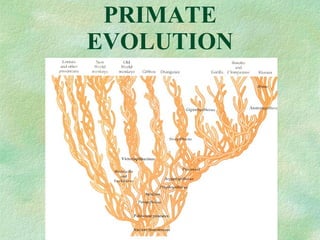
PRIMATE EVOLUTION
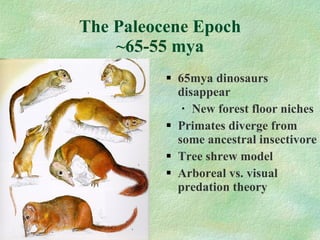
The Paleocene Epoch ~65-55 mya 65mya dinosaurs disappear New forest floor niches Primates diverge from some ancestral insectivore Tree shrew model Arboreal vs. visual predation theory
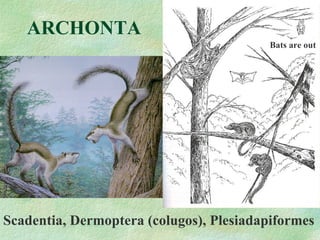
ARCHONTA Scadentia, Dermoptera (colugos),   Plesiadapiformes Bats are out
Eocene Epoch (~55-35 mya) Earliest fossils Majority in North America & Europe but also Asia Prosimian radiation Angiosperm adaptive radiation / P-E thermal maximum
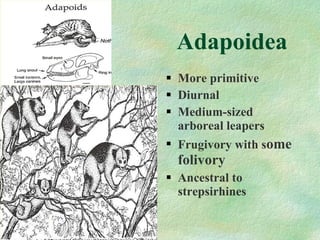
Adapoidea More primitive Diurnal Medium-sized arboreal leapers Frugivory with s ome folivory Ancestral to strepsirhines
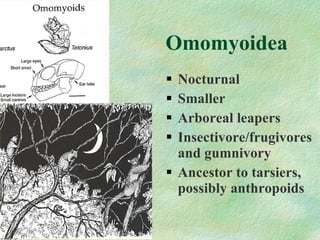
Omomyoidea Nocturnal Smaller Arboreal leapers Insectivore/frugivores and gumnivory Ancestor to tarsiers, possibly anthropoids
Prosimians spread into Africa Motor to Madagascar Shangiladida!...until humans migrate
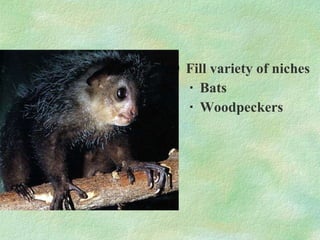
Fill variety of niches Bats Woodpeckers
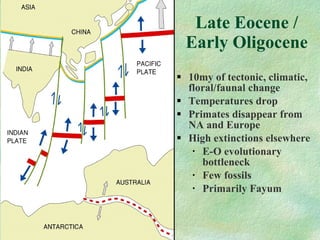
Late Eocene / Early Oligocene 10my of tectonic, climatic, floral/faunal change Temperatures drop Primates disappear from NA and Europe High extinctions elsewhere E-O evolutionary bottleneck Few fossils Primarily Fayum
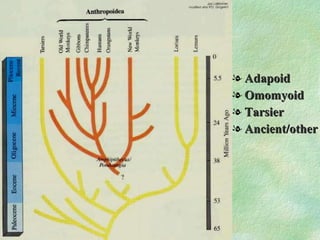
Adapoid Omomyoid Tarsier Ancient/other
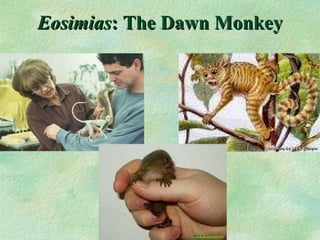
ASIA OR NORTH AFRICA? Siamopithecus Eosimias
Eosimias : The Dawn Monkey
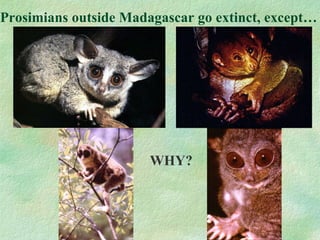
Prosimians outside Madagascar go extinct, except… WHY?
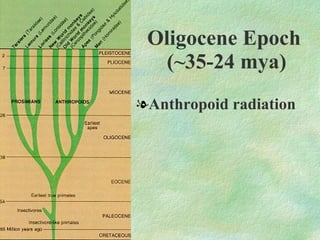
Oligocene Epoch  (~35-24 mya) Anthropoid radiation
 
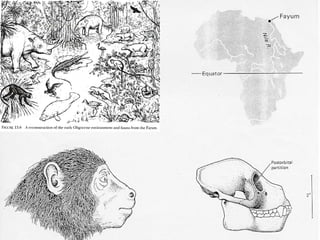
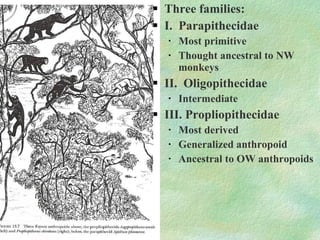
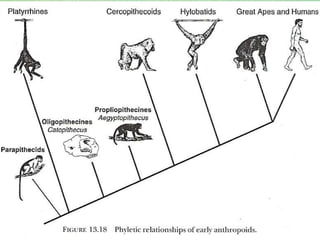
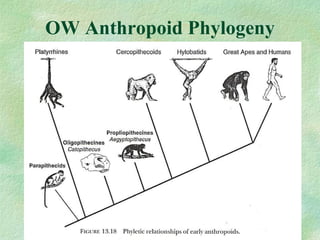
Three families: I.  Parapithecidae Most primitive Thought ancestral to NW monkeys II.  Oligopithecidae Intermediate  III. Propliopithecidae  Most derived Generalized anthropoid Ancestral to OW anthropoids
 
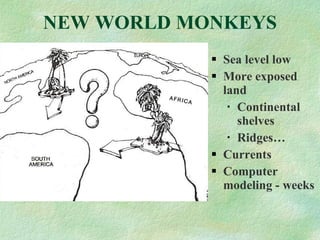
Sea level low More exposed land Continental shelves Ridges… Currents Computer modeling - weeks  NEW WORLD MONKEYS
Small, squirrel-sized, leaping arboreal quadruped Apidium 2-1-3-3 dental formula
Precede appearance in New World by 10mya Rodents in NW appear around same time and resemble African porcupine
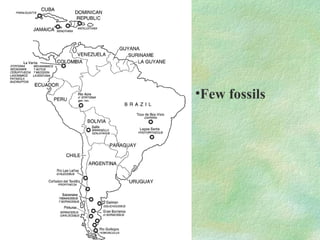
Few fossils
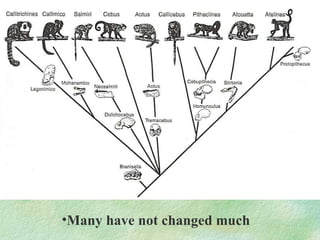
Many have not changed much
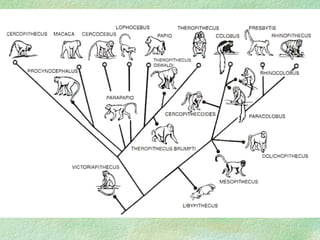
OW Anthropoid Phylogeny
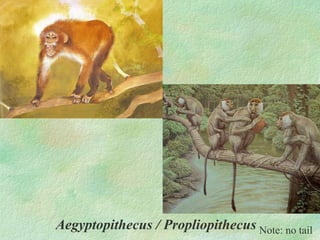
Aegyptopithecus / Propliopithecus Note: no tail
 
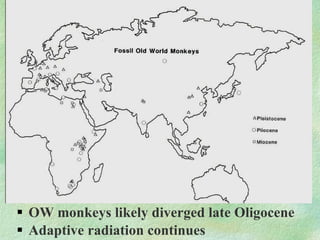
OW monkeys likely diverged late Oligocene Adaptive radiation continues
 
During early period, apes successful and radiation of OW monkeys was slow Begin to flourish after apes begin to decline More generalized/successful Derived terrestriality Shorter life stages Not as tied to forest so survive when apes die out in late Miocene May have contributed to ape decline
Miocene Epoch (~24-5 mya) Hominoid Radiation
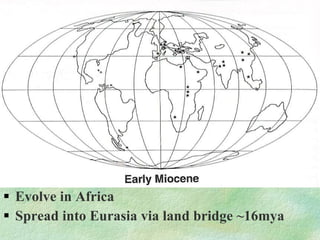
Evolve in Africa Spread into Eurasia via land bridge ~16mya
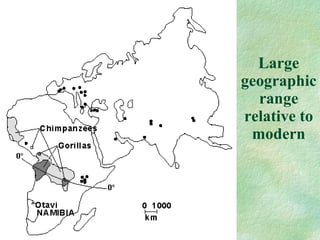
Large geographic range relative to modern
 
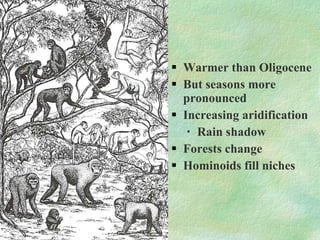
Warmer than Oligocene But seasons more pronounced Increasing aridification Rain shadow Forests change Hominoids fill niches
Early Miocene (24-16mya) African Hominoids Fossils primarily from Kenya and Uganda Multiple genera
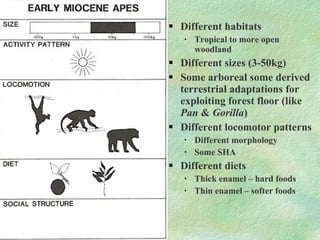
Different habitats Tropical to more open woodland Different sizes (3-50kg) Some arboreal some derived terrestrial adaptations for exploiting forest floor (like  Pan  &  Gorilla ) Different locomotor patterns Different morphology Some SHA Different diets Thick enamel – hard foods Thin enamel – softer foods
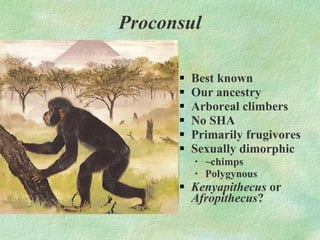
Best known Our ancestry Arboreal climbers No SHA Primarily frugivores Sexually dimorphic ~chimps Polygynous Kenyapithecus  or  Afropithecus ? Proconsul
HAND/FOREARM OF  P. HESELONI LOWER LEG  P.HESELONI, PAN ,  and  P. NYANZAE Links to modern hominoids (long bones, no tail) but so primitive, difficult to trace ancestry through any of these early apes. Proconsul
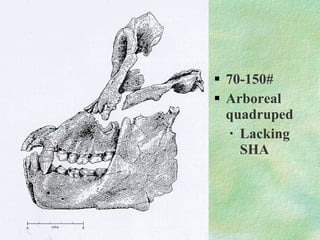
70-150# Arboreal quadruped Lacking SHA
Gigantopithecus (Size of  ♀ gorilla?)
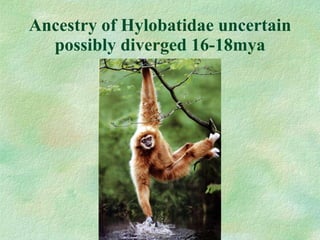
Ancestry of Hylobatidae uncertain possibly diverged 16-18mya
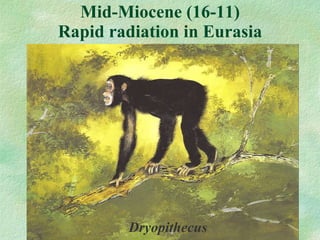
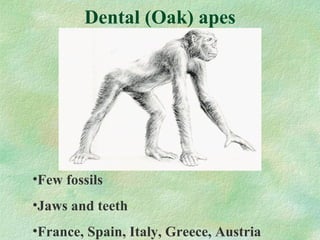
Mid-Miocene (16-11) Rapid radiation in Eurasia Dryopithecus
Dental (Oak) apes Few fossils Jaws and teeth France, Spain, Italy, Greece, Austria
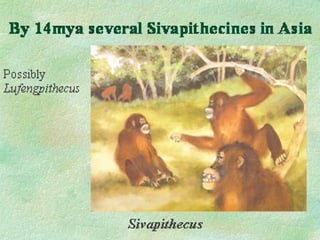
LATE MIOCENE (11-5mya) Greatest diversity of hominoids Europe:  Dryopithecus ,  Oreopithecus ,  Oaranopithecus Asia:  Ankarapithecus  (Turkey),  Sivapithecus  (Pakistan),  Lufengpithecus  (China) Africa:  Otavipithecus  (Namibia)
NEWSFLASH!!! Nakalipithecus nakayamai   Kenya ~10mya Possible missing link

Primate evolution

Editor's Notes

  • #10 10my of tectonic, climatic, floral/faunal change Temperatures drop Primates disappear from NA and Europe
  • #11 By late Eocene, earliest anthropoids are though to have diverged
  • #12 Fayum Beds – no intermediates Asia earlier and more primitive but anthropoids? Now more primitive specimens from NW Africa
  • #13 ~4oz size of pygmy marmoset, diurnal, insectivore/frugivore
  • #40 Orangs former range