BIOCULTURAL
EVOLUTION
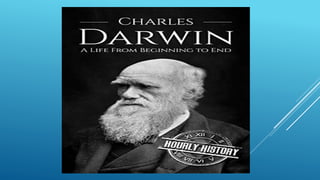
Charles Darwin
Darwin’s theory of evulotion and natural
selection declared that species survived through
a process called “Natural Selection,” where those
that successfully adapted, or evolved, to meet
the changing requirements of thier natural
habitat thrived, while those that failed to
evovled and reproduce died off.
The Biological and Cultural Evolution
 Ember (2002) explains that one of the most
controversial aspects of Darwin’s theory was
the suggestion that one species could, over
time, evolve into another.
 A species is a population that consists of
organisms’s able inter-breed and produce
fertile and viable offspring.
The Hominids
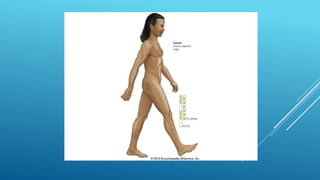
It is one of the erliest members of the
primate family hominidae, containing
humans, their immediate ancestors, and
close extinct relatives.
Note:A hominid is any member of the biological family Hominidae. These are the
"great apes", living and extinct. At present there are humans, chimpanzees, gorillas,
and orangutans.
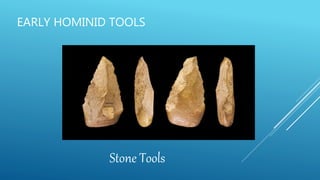
EARLY HOMINID TOOLS
Stone Tools
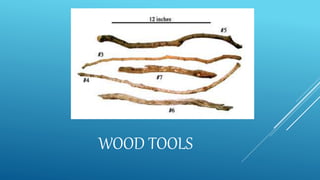
WOOD TOOLS
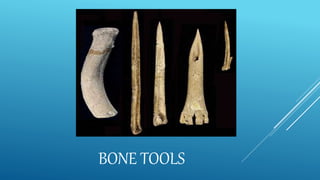
BONE TOOLS
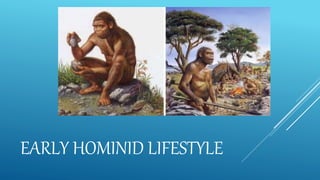
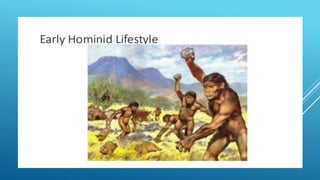
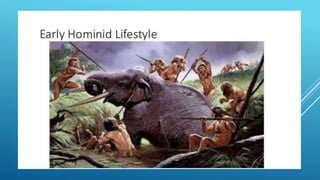
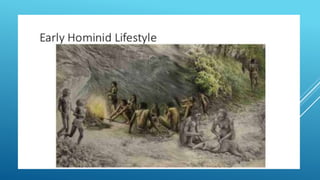
EARLY HOMINID LIFESTYLE
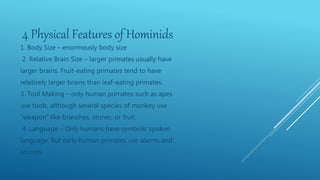
4 Physical Features of Hominids
1. Body Size – enormously body size
2. Relative Brain Size – larger primates usually have
larger brains. Fruit-eating primates tend to have
relatively larger brains than leaf-eating primates.
3. Tool Making – only human primates such as apes
use tools, although several species of monkey use
“weapon” like branches, stones, or fruit.
4. Language – Only humans have symbolic spoken
language. But early human primates use alarms and
sounds.
TYPES
OF
HOMINIDS
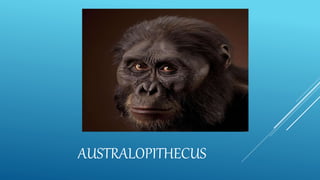
AUSTRALOPITHECUS
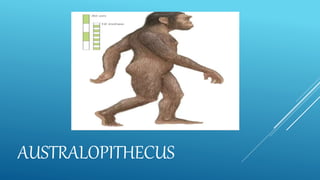
AUSTRALOPITHECUS
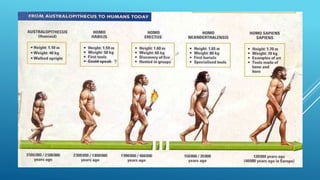
Australopithecus
 •The First Definite Hominid
 •Existed 3.6 million years ago
 •Capable of climbing and moving trees
 •Bipedalism – They have the ability to
walk on two legs
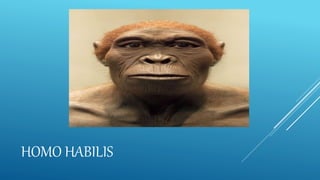
HOMO HABILIS
Homo Habilis
 •Came from Tanzania, Kenya, and South
Africa.
 •Known to exist around 2 million years ago.
 •Developed tools primarily for their use in
scavenging
 •Considered to be the more intelligent and
organized than the hominids
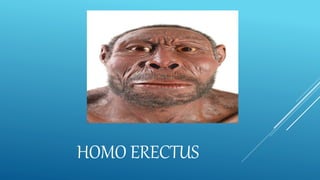
HOMO ERECTUS
Homo Erectus
•First found in Java, later in China, and still later in
Africa
•Meaning “erect ape man”
•Evolved after Homo habilis
•Existed 1.8 million years ago
•They moved from Africa to Asia
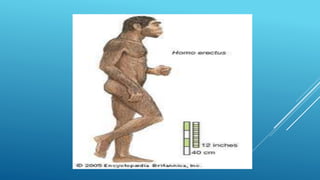
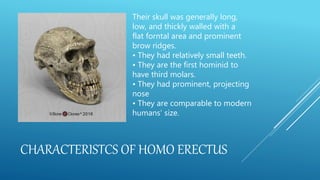
CHARACTERISTCS OF HOMO ERECTUS
Their skull was generally long,
low, and thickly walled with a
flat forntal area and prominent
brow ridges.
• They had relatively small teeth.
• They are the first hominid to
have third molars.
• They had prominent, projecting
nose
• They are comparable to modern
humans’ size.
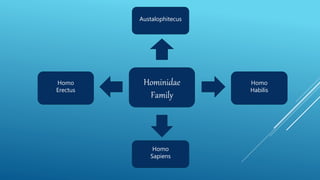
Hominidae
Family
Austalophitecus
Homo
Habilis
Homo
Sapiens
Homo
Erectus
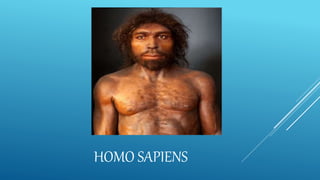
HOMO SAPIENS
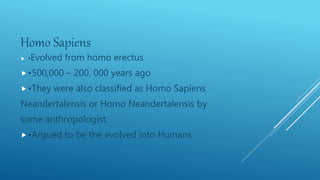
Homo Sapiens
 •Evolved from homo erectus
•500,000 – 200, 000 years ago
•They were also classified as Homo Sapiens
Neandertalensis or Homo Neandertalensis by
some anthropologist.
•Argued to be the evolved into Humans
Enumeration
1. What are the tools that early hominids used?
2. Enumerate the Four (4) Physical Features of
Hominids.
3. Identify the four (4) Hominidae Family.

Biocultural Evolution

  • 1.
  • 3.
    Charles Darwin Darwin’s theoryof evulotion and natural selection declared that species survived through a process called “Natural Selection,” where those that successfully adapted, or evolved, to meet the changing requirements of thier natural habitat thrived, while those that failed to evovled and reproduce died off.
  • 4.
    The Biological andCultural Evolution  Ember (2002) explains that one of the most controversial aspects of Darwin’s theory was the suggestion that one species could, over time, evolve into another.  A species is a population that consists of organisms’s able inter-breed and produce fertile and viable offspring.
  • 5.
    The Hominids It isone of the erliest members of the primate family hominidae, containing humans, their immediate ancestors, and close extinct relatives. Note:A hominid is any member of the biological family Hominidae. These are the "great apes", living and extinct. At present there are humans, chimpanzees, gorillas, and orangutans.
  • 6.
  • 7.
  • 8.
  • 9.
  • 14.
    4 Physical Featuresof Hominids 1. Body Size – enormously body size 2. Relative Brain Size – larger primates usually have larger brains. Fruit-eating primates tend to have relatively larger brains than leaf-eating primates. 3. Tool Making – only human primates such as apes use tools, although several species of monkey use “weapon” like branches, stones, or fruit. 4. Language – Only humans have symbolic spoken language. But early human primates use alarms and sounds.
  • 15.
  • 16.
  • 17.
  • 18.
    Australopithecus  •The FirstDefinite Hominid  •Existed 3.6 million years ago  •Capable of climbing and moving trees  •Bipedalism – They have the ability to walk on two legs
  • 19.
  • 20.
    Homo Habilis  •Camefrom Tanzania, Kenya, and South Africa.  •Known to exist around 2 million years ago.  •Developed tools primarily for their use in scavenging  •Considered to be the more intelligent and organized than the hominids
  • 21.
  • 23.
    Homo Erectus •First foundin Java, later in China, and still later in Africa •Meaning “erect ape man” •Evolved after Homo habilis •Existed 1.8 million years ago •They moved from Africa to Asia
  • 24.
    CHARACTERISTCS OF HOMOERECTUS Their skull was generally long, low, and thickly walled with a flat forntal area and prominent brow ridges. • They had relatively small teeth. • They are the first hominid to have third molars. • They had prominent, projecting nose • They are comparable to modern humans’ size.
  • 25.
  • 26.
  • 28.
    Homo Sapiens  •Evolvedfrom homo erectus •500,000 – 200, 000 years ago •They were also classified as Homo Sapiens Neandertalensis or Homo Neandertalensis by some anthropologist. •Argued to be the evolved into Humans
  • 30.
    Enumeration 1. What arethe tools that early hominids used? 2. Enumerate the Four (4) Physical Features of Hominids. 3. Identify the four (4) Hominidae Family.