Medieval Era in the Arts, Sculpture, and Architecture Themes of Christianity
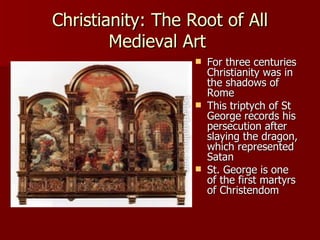
Christianity: The Root of All Medieval Art  For three centuries Christianity was in the shadows of Rome This triptych of St George records his persecution after slaying the dragon, which represented Satan St. George is one of the first martyrs of Christendom
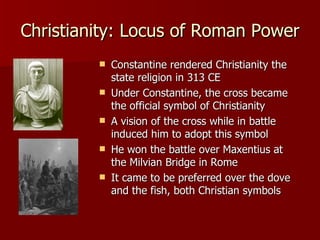
Christianity: Locus of Roman Power Constantine rendered Christianity the  state religion in 313 CE Under Constantine, the cross became the official symbol of Christianity A vision of the cross while in battle induced him to adopt this symbol He won the battle over Maxentius at the Milvian Bridge in Rome  It came to be preferred over the dove and the fish, both Christian symbols
Christianity and the Scriptures New Testament is divided into three sections with one subdivision Gospels (Good News) : the life of Jesus according to St. Matthew, St. Mark, St. Luke, and St. John Acts: The spread of Christianity by the 12 Apostles who taught the Gospels Epistles, mostly of St. Paul, whose letters entail the interpretation of Christian doctrine Apocalypse: the end of the earth, the return of Christ to preside over Judgment Day, and the formation of the New Heaven and New Earth
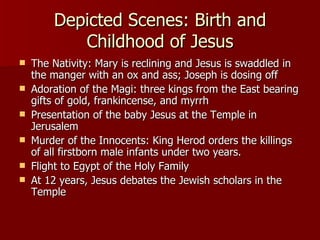
Depicted Scenes: Birth and Childhood of Jesus The Nativity: Mary is reclining and Jesus is swaddled in the manger with an ox and ass; Joseph is dosing off Adoration of the Magi: three kings from the East bearing gifts of gold, frankincense, and myrrh Presentation of the baby Jesus at the Temple in Jerusalem Murder of the Innocents: King Herod orders the killings of all firstborn male infants under two years. Flight to Egypt of the Holy Family At 12 years, Jesus debates the Jewish scholars in the Temple
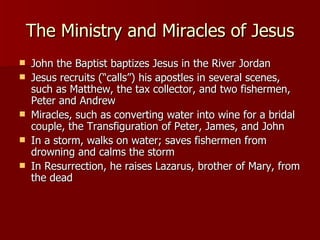
The Ministry and Miracles of Jesus John the Baptist baptizes Jesus in the River Jordan Jesus recruits (“calls”) his apostles in several scenes, such as Matthew, the tax collector, and two fishermen, Peter and Andrew Miracles, such as converting water into wine for a bridal couple, the Transfiguration of Peter, James, and John In a storm, walks on water; saves fishermen from drowning and calms the storm In Resurrection, he raises Lazarus, brother of Mary, from the dead
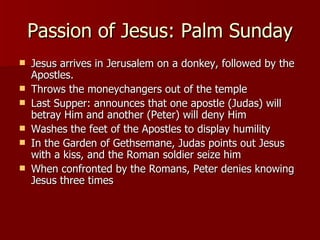
Passion of Jesus: Palm Sunday Jesus arrives in Jerusalem on a donkey, followed by the Apostles. Throws the moneychangers out of the temple Last Supper: announces that one apostle (Judas) will betray Him and another (Peter) will deny Him Washes the feet of the Apostles to display humility In the Garden of Gethsemane, Judas points out Jesus with a kiss, and the Roman soldier seize him When confronted by the Romans, Peter denies knowing Jesus three times
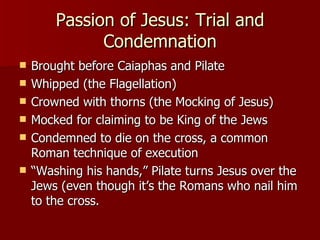
Passion of Jesus: Trial and Condemnation Brought before Caiaphas and Pilate Whipped (the Flagellation)  Crowned with thorns (the Mocking of Jesus) Mocked for claiming to be King of the Jews Condemned to die on the cross, a common Roman technique of execution “ Washing his hands,” Pilate turns Jesus over the Jews (even though it’s the Romans who nail him to the cross.
Passion of Jesus: The Crucifixion Jesus carries his own cross to Calvary (aka Golgotha) There he is nailed at the cross in the presence of Mary He is taken down from the cross and his followers mourn him (Lamentation) Pieta: Mary mourning the dead Jesus lying across her lap
The Resurrection Entombment: Jesus is laid inside a cave and a boulder rolled against the entrance Enters part of Hell (Limbo) and leads certain souls to salvation Rises from his tomb after three days, the Resurrection Mary Magdalene tries to touch him but he refuses to be touched  Shares meal with two apostles (Supper at Emmaus) Ascension: Rises to heaven in presence of his mother and the apostles Pentecost: gives the apostles the gift of tongues, enabling them to preach the message throughout the world.
The Annunciation  and Nativity The Archangel Gabriel announces to the Virgin Mary that she will bear the Saviour Upper Left: The Annunciation by A. Lorzetti Lower Left: The Nativity In other scenes, the Christ child is depicted with the ox and ass Joseph is often depicting napping in the background
Flight to Egypt and Jesus among the Elders Flight to Egypt after Herod ordered the killing of male infants Upper Left: a Giselbertus relief of the flight in typical Romanesque style Lower Left:  Jesus Among the Doctors   by Giotto He debates with the elders
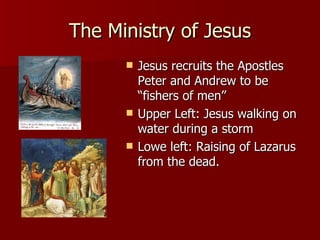
The Ministry of Jesus Jesus recruits the Apostles Peter and Andrew to be “fishers of men” Upper Left: Jesus walking on water during a storm Lowe left: Raising of Lazarus from the dead.
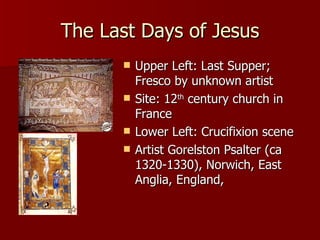
The Last Days of Jesus Upper Left: Last Supper; Fresco by unknown artist Site: 12 th  century church in France Lower Left: Crucifixion scene Artist Gorelston Psalter (ca 1320-1330), Norwich, East Anglia, England,
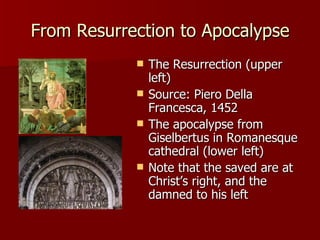
From Resurrection to Apocalypse The Resurrection (upper left) Source: Piero Della Francesca, 1452 The apocalypse from Giselbertus in Romanesque cathedral (lower left) Note that the saved are at Christ’s right, and the damned to his left
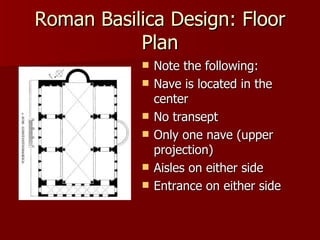
Roman Basilica Design: Floor Plan Note the following: Nave is located in the center No transept Only one nave (upper projection) Aisles on either side Entrance on either side
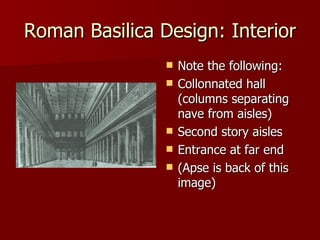
Roman Basilica Design: Interior Note the following: Collonnated hall (columns separating nave from aisles) Second story aisles Entrance at far end (Apse is back of this image)
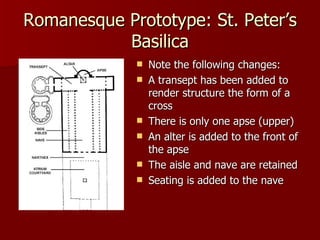
Romanesque Prototype: St. Peter’s Basilica Note the following changes: A transept has been added to render structure the form of a cross There is only one apse (upper) An alter is added to the front of the apse The aisle and nave are retained Seating is added to the nave
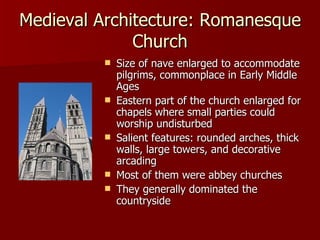
Medieval Architecture: Romanesque Church Size of nave enlarged to accommodate pilgrims, commonplace in Early Middle Ages Eastern part of the church enlarged for chapels where small parties could worship undisturbed Salient features: rounded arches, thick walls, large towers, and decorative arcading Most of them were abbey churches They generally dominated the countryside
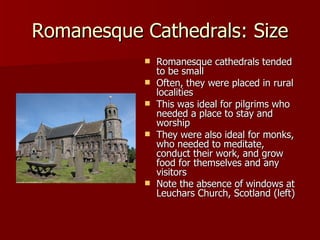
Romanesque Cathedrals: Size Romanesque cathedrals tended to be small Often, they were placed in rural localities This was ideal for pilgrims who needed a place to stay and worship They were also ideal for monks, who needed to meditate, conduct their work, and grow food for themselves and any visitors Note the absence of windows at Leuchars Church, Scotland (left)
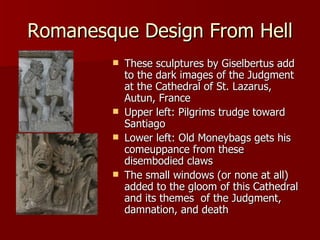
Romanesque Design From Hell These sculptures by Giselbertus add to the dark images of the Judgment at the Cathedral of St. Lazarus, Autun, France Upper left: Pilgrims trudge toward Santiago  Lower left: Old Moneybags gets his comeuppance from these disembodied claws The small windows (or none at all) added to the gloom of this Cathedral and its themes  of the Judgment, damnation, and death
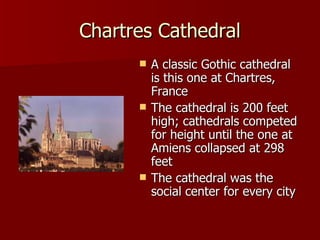
Chartres Cathedral A classic Gothic cathedral is this one at Chartres, France The cathedral is 200 feet high; cathedrals competed for height until the one at Amiens collapsed at 298 feet The cathedral was the social center for every city
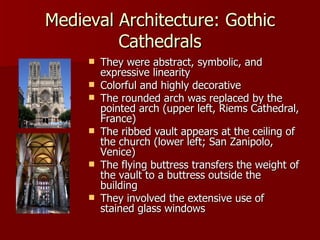
Medieval Architecture: Gothic Cathedrals They were abstract, symbolic, and expressive linearity Colorful and highly decorative The rounded arch was replaced by the pointed arch (upper left, Riems Cathedral, France) The ribbed vault appears at the ceiling of the church (lower left; San Zanipolo, Venice) The flying buttress transfers the weight of the vault to a buttress outside the building They involved the extensive use of stained glass windows
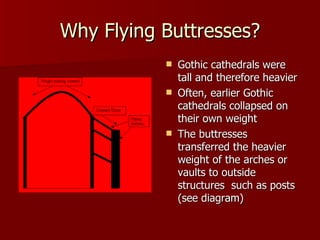
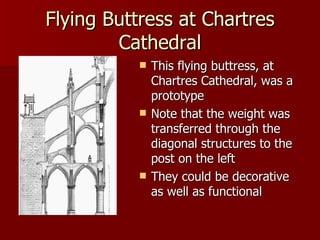
Why Flying Buttresses? Gothic cathedrals were tall and therefore heavier Often, earlier Gothic cathedrals collapsed on their own weight The buttresses transferred the heavier weight of the arches or vaults to outside structures  such as posts (see diagram)
Flying Buttress at Chartres Cathedral This flying buttress, at Chartres Cathedral, was a prototype Note that the weight was transferred through the  diagonal structures to the post on the left They could be decorative as well as functional
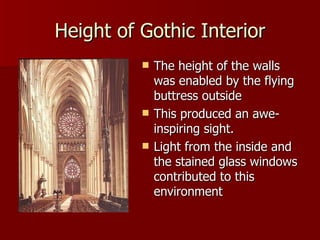
Height of Gothic Interior The height of the walls was enabled by the flying buttress outside  This produced an awe-inspiring sight. Light from the inside and the stained glass windows contributed to this environment
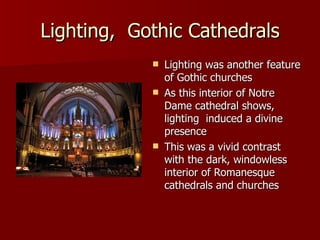
Lighting,  Gothic Cathedrals Lighting was another feature of Gothic churches As this interior of Notre Dame cathedral shows, lighting  induced a divine presence  This was a vivid contrast with the dark, windowless interior of Romanesque cathedrals and churches
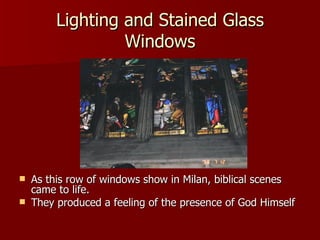
Lighting and Stained Glass Windows As this row of windows show in Milan, biblical scenes came to life.  They produced a feeling of the presence of God Himself
Conclusion Artwork was thematic of the Scriptures and Life of Christ Your book and the samples illustrate these themes, which continued into the early Renaissance The cathedrals had a function Romanesque accommodated the pilgrims from France to Santiago in Spain They also became the residences of monks, starting with the Benedictine order Gothic cathedrals became the centers of city activity, as reflected in their height and lighting.

Medieval Era in the Arts

  • 1.
    Medieval Era inthe Arts, Sculpture, and Architecture Themes of Christianity
  • 2.
    Christianity: The Rootof All Medieval Art For three centuries Christianity was in the shadows of Rome This triptych of St George records his persecution after slaying the dragon, which represented Satan St. George is one of the first martyrs of Christendom
  • 3.
    Christianity: Locus ofRoman Power Constantine rendered Christianity the state religion in 313 CE Under Constantine, the cross became the official symbol of Christianity A vision of the cross while in battle induced him to adopt this symbol He won the battle over Maxentius at the Milvian Bridge in Rome It came to be preferred over the dove and the fish, both Christian symbols
  • 4.
    Christianity and theScriptures New Testament is divided into three sections with one subdivision Gospels (Good News) : the life of Jesus according to St. Matthew, St. Mark, St. Luke, and St. John Acts: The spread of Christianity by the 12 Apostles who taught the Gospels Epistles, mostly of St. Paul, whose letters entail the interpretation of Christian doctrine Apocalypse: the end of the earth, the return of Christ to preside over Judgment Day, and the formation of the New Heaven and New Earth
  • 5.
    Depicted Scenes: Birthand Childhood of Jesus The Nativity: Mary is reclining and Jesus is swaddled in the manger with an ox and ass; Joseph is dosing off Adoration of the Magi: three kings from the East bearing gifts of gold, frankincense, and myrrh Presentation of the baby Jesus at the Temple in Jerusalem Murder of the Innocents: King Herod orders the killings of all firstborn male infants under two years. Flight to Egypt of the Holy Family At 12 years, Jesus debates the Jewish scholars in the Temple
  • 6.
    The Ministry andMiracles of Jesus John the Baptist baptizes Jesus in the River Jordan Jesus recruits (“calls”) his apostles in several scenes, such as Matthew, the tax collector, and two fishermen, Peter and Andrew Miracles, such as converting water into wine for a bridal couple, the Transfiguration of Peter, James, and John In a storm, walks on water; saves fishermen from drowning and calms the storm In Resurrection, he raises Lazarus, brother of Mary, from the dead
  • 7.
    Passion of Jesus:Palm Sunday Jesus arrives in Jerusalem on a donkey, followed by the Apostles. Throws the moneychangers out of the temple Last Supper: announces that one apostle (Judas) will betray Him and another (Peter) will deny Him Washes the feet of the Apostles to display humility In the Garden of Gethsemane, Judas points out Jesus with a kiss, and the Roman soldier seize him When confronted by the Romans, Peter denies knowing Jesus three times
  • 8.
    Passion of Jesus:Trial and Condemnation Brought before Caiaphas and Pilate Whipped (the Flagellation) Crowned with thorns (the Mocking of Jesus) Mocked for claiming to be King of the Jews Condemned to die on the cross, a common Roman technique of execution “ Washing his hands,” Pilate turns Jesus over the Jews (even though it’s the Romans who nail him to the cross.
  • 9.
    Passion of Jesus:The Crucifixion Jesus carries his own cross to Calvary (aka Golgotha) There he is nailed at the cross in the presence of Mary He is taken down from the cross and his followers mourn him (Lamentation) Pieta: Mary mourning the dead Jesus lying across her lap
  • 10.
    The Resurrection Entombment:Jesus is laid inside a cave and a boulder rolled against the entrance Enters part of Hell (Limbo) and leads certain souls to salvation Rises from his tomb after three days, the Resurrection Mary Magdalene tries to touch him but he refuses to be touched Shares meal with two apostles (Supper at Emmaus) Ascension: Rises to heaven in presence of his mother and the apostles Pentecost: gives the apostles the gift of tongues, enabling them to preach the message throughout the world.
  • 11.
    The Annunciation and Nativity The Archangel Gabriel announces to the Virgin Mary that she will bear the Saviour Upper Left: The Annunciation by A. Lorzetti Lower Left: The Nativity In other scenes, the Christ child is depicted with the ox and ass Joseph is often depicting napping in the background
  • 12.
    Flight to Egyptand Jesus among the Elders Flight to Egypt after Herod ordered the killing of male infants Upper Left: a Giselbertus relief of the flight in typical Romanesque style Lower Left: Jesus Among the Doctors by Giotto He debates with the elders
  • 13.
    The Ministry ofJesus Jesus recruits the Apostles Peter and Andrew to be “fishers of men” Upper Left: Jesus walking on water during a storm Lowe left: Raising of Lazarus from the dead.
  • 14.
    The Last Daysof Jesus Upper Left: Last Supper; Fresco by unknown artist Site: 12 th century church in France Lower Left: Crucifixion scene Artist Gorelston Psalter (ca 1320-1330), Norwich, East Anglia, England,
  • 15.
    From Resurrection toApocalypse The Resurrection (upper left) Source: Piero Della Francesca, 1452 The apocalypse from Giselbertus in Romanesque cathedral (lower left) Note that the saved are at Christ’s right, and the damned to his left
  • 16.
    Roman Basilica Design:Floor Plan Note the following: Nave is located in the center No transept Only one nave (upper projection) Aisles on either side Entrance on either side
  • 17.
    Roman Basilica Design:Interior Note the following: Collonnated hall (columns separating nave from aisles) Second story aisles Entrance at far end (Apse is back of this image)
  • 18.
    Romanesque Prototype: St.Peter’s Basilica Note the following changes: A transept has been added to render structure the form of a cross There is only one apse (upper) An alter is added to the front of the apse The aisle and nave are retained Seating is added to the nave
  • 19.
    Medieval Architecture: RomanesqueChurch Size of nave enlarged to accommodate pilgrims, commonplace in Early Middle Ages Eastern part of the church enlarged for chapels where small parties could worship undisturbed Salient features: rounded arches, thick walls, large towers, and decorative arcading Most of them were abbey churches They generally dominated the countryside
  • 20.
    Romanesque Cathedrals: SizeRomanesque cathedrals tended to be small Often, they were placed in rural localities This was ideal for pilgrims who needed a place to stay and worship They were also ideal for monks, who needed to meditate, conduct their work, and grow food for themselves and any visitors Note the absence of windows at Leuchars Church, Scotland (left)
  • 21.
    Romanesque Design FromHell These sculptures by Giselbertus add to the dark images of the Judgment at the Cathedral of St. Lazarus, Autun, France Upper left: Pilgrims trudge toward Santiago Lower left: Old Moneybags gets his comeuppance from these disembodied claws The small windows (or none at all) added to the gloom of this Cathedral and its themes of the Judgment, damnation, and death
  • 22.
    Chartres Cathedral Aclassic Gothic cathedral is this one at Chartres, France The cathedral is 200 feet high; cathedrals competed for height until the one at Amiens collapsed at 298 feet The cathedral was the social center for every city
  • 23.
    Medieval Architecture: GothicCathedrals They were abstract, symbolic, and expressive linearity Colorful and highly decorative The rounded arch was replaced by the pointed arch (upper left, Riems Cathedral, France) The ribbed vault appears at the ceiling of the church (lower left; San Zanipolo, Venice) The flying buttress transfers the weight of the vault to a buttress outside the building They involved the extensive use of stained glass windows
  • 24.
    Why Flying Buttresses?Gothic cathedrals were tall and therefore heavier Often, earlier Gothic cathedrals collapsed on their own weight The buttresses transferred the heavier weight of the arches or vaults to outside structures such as posts (see diagram)
  • 25.
    Flying Buttress atChartres Cathedral This flying buttress, at Chartres Cathedral, was a prototype Note that the weight was transferred through the diagonal structures to the post on the left They could be decorative as well as functional
  • 26.
    Height of GothicInterior The height of the walls was enabled by the flying buttress outside This produced an awe-inspiring sight. Light from the inside and the stained glass windows contributed to this environment
  • 27.
    Lighting, GothicCathedrals Lighting was another feature of Gothic churches As this interior of Notre Dame cathedral shows, lighting induced a divine presence This was a vivid contrast with the dark, windowless interior of Romanesque cathedrals and churches
  • 28.
    Lighting and StainedGlass Windows As this row of windows show in Milan, biblical scenes came to life. They produced a feeling of the presence of God Himself
  • 29.
    Conclusion Artwork wasthematic of the Scriptures and Life of Christ Your book and the samples illustrate these themes, which continued into the early Renaissance The cathedrals had a function Romanesque accommodated the pilgrims from France to Santiago in Spain They also became the residences of monks, starting with the Benedictine order Gothic cathedrals became the centers of city activity, as reflected in their height and lighting.