Taitou A Chinese Peasant Village
Introduction Taitou is (or was) a village of independent peasants It was part of a region of 20 communities dominated by a market town Unlike Mesoamerica, there was no leveling device such as obligatory service entailing financial expenditures Though stratified, wealthy families might break down into smaller, less wealthy families All families were highly entrepreneurial
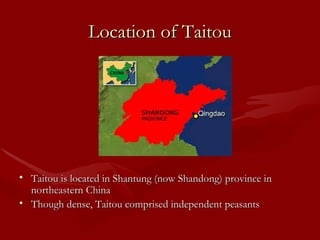
Location of Taitou Taitou is located in Shantung (now Shandong) province in northeastern China Though dense, Taitou comprised independent peasants
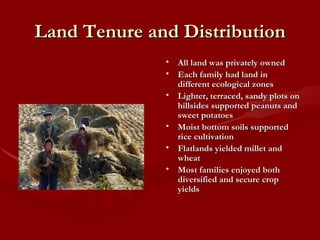
Land Tenure and Distribution All land was privately owned Each family had land in different ecological zones Lighter, terraced, sandy plots on hillsides supported peanuts and sweet potatoes Moist bottom soils supported rice cultivation  Flatlands yielded millet and wheat Most families enjoyed both diversified and secure crop yields
Intensive Cultivation Techniques With ample labor and small plots, every plot involved multiple cropping with some fallowing Fertilizer was required for all crops and had to be acquired from all sources possible: animal and human waste, ashes from fires, all put into compost All families owned a few animals, also intensely used for plowing and harrowing
Wealth Distinctions Land ownership: a few with 20  acres, a smaller number with 10, and the majority with 2. All families has the same diet, but the better off enjoyed fish and bread Stratification was deemphasized However, the wealthier did display their wealth in the form of multi-roomed houses, fine clothing, and fat oxen These differences provoked envy, but unlike Mesoamerica, these differences were not hidden
Family Structure Taitou is based mostly on nuclear families Family may be extended to include one married son—a stem family Other sons leave to form their own family Gender division of labor: women handling domestic chores, men doing agriculture or engaged in commercial trade and politics All members contribute to household by performing different jobs
Village Division of Labor All households produce for the market: pigs, peanuts, soy beans Women bought cotton and spun it for themselves, but they hired dyers and weavers Specialists made and repaired tools Other specialists: soy oil pressers, carpenter, masons,  schoolteacher, public officials
Markets and Market Town Taitou was one of 20 towns within the sphere of a market town, Hsinanchen This town was larger than the other villages and contained shops, from bakeries to bookstores A large market place opened upon regular market days  Market days were  coordinated with those in other market towns in the region so itinerant traders could trade in all of them
Functions of Market Towns Traders, all men, bought and sold They also met in tea or wine shops to exchange information about the regional economic conditions and opportunities Men obtained credit from shops essential to maintaining their own production Even if men had nothing to buy or sell, they went to town with empty baskets to exchange information and maintain their credit
Regional Markets and Economic Elites Market towns were part of a wider network  Elites formed part of this network Central places formed even wider hierarchies No patron-client relationship existed The elite were economic rather than political, although there were administrative centers
Marriage and Family Relations All marriages were arranged, and the couple might not see each other until the wedding Marriage set strategic alliances between families Bride labor was common: before marriage, the betrothed male worked for the wife’s family, turning all earnings over to the bride-to-be’s  father Residence was patrilocal, and the son continued to turn all his income over to his father Daughter-in-law was under the control of their mother-in-law
Family Formation Gradually, the son’s loyalty to family eroded and he sought to obtain land for his own farm The father was authoritarian, and the son sought to escape this arrangement The daughter-in-law also encouraged the split, being that the mother-in-law was very strict toward her Daughters and daughters in law had their own financial sources from odd jobs that were theirs to keep That eliminated the father’s absolute domination over the couple
Advantages of Extended Families Enforced frugality to increase savings and assets Division of labor into specialized economic activities One example: one son would work the land; other sons took up commerce, trade, farm workers for others, crafts and the arts Ability to obtain more land
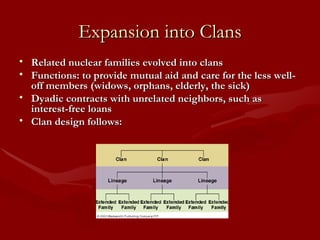
Expansion into Clans Related nuclear families evolved into clans Functions: to provide mutual aid and care for the less well-off members (widows, orphans, elderly, the sick) Dyadic contracts with unrelated neighbors, such as interest-free loans Clan design follows:
Village Level Functions Village was united for common purpose In 1945, the village was united to defend against bandits United because of weakness of national government  (There was a civil war going on between Nationalists and Communist) Set up barricades and night patrols Developed alliances with neighboring villages Hired full-time crop watchers to defend crops against pests and thieves
Leadership and Social Control Social control maintained by gossip, “loss of face” (public shame), and ostracism Legal proceedings and appeals to public officials were rare Disputes were resolved by village elders honored for their wealth and proper behavior rather than government officials Governmental officials were ranked lowest in the village hierarchy. Patron client relations existed between the wealthy and the poor, kin or not.
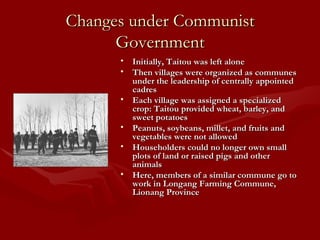
Changes under Communist Government Initially, Taitou was left alone Then villages were organized as communes under the leadership of centrally appointed cadres Each village was assigned a specialized crop: Taitou provided wheat, barley, and sweet potatoes Peanuts, soybeans, millet, and fruits and vegetables were not allowed Householders could no longer own small plots of land or raised pigs and other animals Here, members of a similar commune go to work in Longang Farming Commune, Lionang Province
Communist Policies: Impacts Soy oil pressers forced to close as the result of prohibition of soybean production During the 1966 Cultural Revolution, carpentry shops were closed as “capitalist roaders.” By the 1980s, the village enjoyed moderate prosperity from its grain production Opening of a nearby factory provided added employment (but no investment technology) Taitou was passed over for the status of a “model village.” in favor of a nearby impoverished village
Communist Policies: Liberalization In 1980 and after, Taitou was allowed greater autonomy Private plots were allowed, and “sideline” production increased in livestock, poultry, and crops Small shops appeared, and some men were hired for construction projects outside the village Liberalization had an important impact on village income
Liberalization: Results Householders felt themselves to be more in control of their economy—”a rice bowl of their own” replaced the “iron rice bowl” of official policy Women had greater economic independence Cadre influence declined in favor of household autonomous management Redistribution is again being replaced by reciprocity and exchange Television and other media are providing households with alternative sources of information and entertainment
Conclusion Despite a Communist hiatus, the household remains the basic social economic unit of Taitou Although envy is evident, there are no leveling mechanisms that characterized Mesoamerican peasant There is a strong emphasis on entrepreneurship Wealth distinctions remain predominant

Taitou: A Chinese Peasant Community

  • 1.
    Taitou A ChinesePeasant Village
  • 2.
    Introduction Taitou is(or was) a village of independent peasants It was part of a region of 20 communities dominated by a market town Unlike Mesoamerica, there was no leveling device such as obligatory service entailing financial expenditures Though stratified, wealthy families might break down into smaller, less wealthy families All families were highly entrepreneurial
  • 3.
    Location of TaitouTaitou is located in Shantung (now Shandong) province in northeastern China Though dense, Taitou comprised independent peasants
  • 4.
    Land Tenure andDistribution All land was privately owned Each family had land in different ecological zones Lighter, terraced, sandy plots on hillsides supported peanuts and sweet potatoes Moist bottom soils supported rice cultivation Flatlands yielded millet and wheat Most families enjoyed both diversified and secure crop yields
  • 5.
    Intensive Cultivation TechniquesWith ample labor and small plots, every plot involved multiple cropping with some fallowing Fertilizer was required for all crops and had to be acquired from all sources possible: animal and human waste, ashes from fires, all put into compost All families owned a few animals, also intensely used for plowing and harrowing
  • 6.
    Wealth Distinctions Landownership: a few with 20 acres, a smaller number with 10, and the majority with 2. All families has the same diet, but the better off enjoyed fish and bread Stratification was deemphasized However, the wealthier did display their wealth in the form of multi-roomed houses, fine clothing, and fat oxen These differences provoked envy, but unlike Mesoamerica, these differences were not hidden
  • 7.
    Family Structure Taitouis based mostly on nuclear families Family may be extended to include one married son—a stem family Other sons leave to form their own family Gender division of labor: women handling domestic chores, men doing agriculture or engaged in commercial trade and politics All members contribute to household by performing different jobs
  • 8.
    Village Division ofLabor All households produce for the market: pigs, peanuts, soy beans Women bought cotton and spun it for themselves, but they hired dyers and weavers Specialists made and repaired tools Other specialists: soy oil pressers, carpenter, masons, schoolteacher, public officials
  • 9.
    Markets and MarketTown Taitou was one of 20 towns within the sphere of a market town, Hsinanchen This town was larger than the other villages and contained shops, from bakeries to bookstores A large market place opened upon regular market days Market days were coordinated with those in other market towns in the region so itinerant traders could trade in all of them
  • 10.
    Functions of MarketTowns Traders, all men, bought and sold They also met in tea or wine shops to exchange information about the regional economic conditions and opportunities Men obtained credit from shops essential to maintaining their own production Even if men had nothing to buy or sell, they went to town with empty baskets to exchange information and maintain their credit
  • 11.
    Regional Markets andEconomic Elites Market towns were part of a wider network Elites formed part of this network Central places formed even wider hierarchies No patron-client relationship existed The elite were economic rather than political, although there were administrative centers
  • 12.
    Marriage and FamilyRelations All marriages were arranged, and the couple might not see each other until the wedding Marriage set strategic alliances between families Bride labor was common: before marriage, the betrothed male worked for the wife’s family, turning all earnings over to the bride-to-be’s father Residence was patrilocal, and the son continued to turn all his income over to his father Daughter-in-law was under the control of their mother-in-law
  • 13.
    Family Formation Gradually,the son’s loyalty to family eroded and he sought to obtain land for his own farm The father was authoritarian, and the son sought to escape this arrangement The daughter-in-law also encouraged the split, being that the mother-in-law was very strict toward her Daughters and daughters in law had their own financial sources from odd jobs that were theirs to keep That eliminated the father’s absolute domination over the couple
  • 14.
    Advantages of ExtendedFamilies Enforced frugality to increase savings and assets Division of labor into specialized economic activities One example: one son would work the land; other sons took up commerce, trade, farm workers for others, crafts and the arts Ability to obtain more land
  • 15.
    Expansion into ClansRelated nuclear families evolved into clans Functions: to provide mutual aid and care for the less well-off members (widows, orphans, elderly, the sick) Dyadic contracts with unrelated neighbors, such as interest-free loans Clan design follows:
  • 16.
    Village Level FunctionsVillage was united for common purpose In 1945, the village was united to defend against bandits United because of weakness of national government (There was a civil war going on between Nationalists and Communist) Set up barricades and night patrols Developed alliances with neighboring villages Hired full-time crop watchers to defend crops against pests and thieves
  • 17.
    Leadership and SocialControl Social control maintained by gossip, “loss of face” (public shame), and ostracism Legal proceedings and appeals to public officials were rare Disputes were resolved by village elders honored for their wealth and proper behavior rather than government officials Governmental officials were ranked lowest in the village hierarchy. Patron client relations existed between the wealthy and the poor, kin or not.
  • 18.
    Changes under CommunistGovernment Initially, Taitou was left alone Then villages were organized as communes under the leadership of centrally appointed cadres Each village was assigned a specialized crop: Taitou provided wheat, barley, and sweet potatoes Peanuts, soybeans, millet, and fruits and vegetables were not allowed Householders could no longer own small plots of land or raised pigs and other animals Here, members of a similar commune go to work in Longang Farming Commune, Lionang Province
  • 19.
    Communist Policies: ImpactsSoy oil pressers forced to close as the result of prohibition of soybean production During the 1966 Cultural Revolution, carpentry shops were closed as “capitalist roaders.” By the 1980s, the village enjoyed moderate prosperity from its grain production Opening of a nearby factory provided added employment (but no investment technology) Taitou was passed over for the status of a “model village.” in favor of a nearby impoverished village
  • 20.
    Communist Policies: LiberalizationIn 1980 and after, Taitou was allowed greater autonomy Private plots were allowed, and “sideline” production increased in livestock, poultry, and crops Small shops appeared, and some men were hired for construction projects outside the village Liberalization had an important impact on village income
  • 21.
    Liberalization: Results Householdersfelt themselves to be more in control of their economy—”a rice bowl of their own” replaced the “iron rice bowl” of official policy Women had greater economic independence Cadre influence declined in favor of household autonomous management Redistribution is again being replaced by reciprocity and exchange Television and other media are providing households with alternative sources of information and entertainment
  • 22.
    Conclusion Despite aCommunist hiatus, the household remains the basic social economic unit of Taitou Although envy is evident, there are no leveling mechanisms that characterized Mesoamerican peasant There is a strong emphasis on entrepreneurship Wealth distinctions remain predominant