An Introduction to Cultural Anthropology On Strange Customs--Strange to Us, That Is
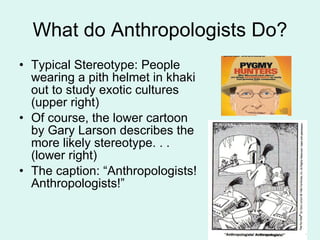
What do Anthropologists Do? Typical Stereotype: People wearing a pith helmet in khaki out to study exotic cultures (upper right) Of course, the lower cartoon by Gary Larson describes the more likely stereotype. . . (lower right) The caption: “Anthropologists! Anthropologists!”
Do Anthropologist Wear Beards? Stereotypically, male anthropologists wear beards  I didn’t—but in Guatemala back in 1969-70, if you looked like Fidel Castro [upper right], they shot first and didn’t bother to ask questions later. “No quarter for  comunistas , you see.” In 1970, Carlos Arana Osorio, the so-called Butcher of Zacapa, was elected president (lower right; in the second photo, that’s him to the right, consulting with U.S. military advisors in Zacapa). So you can guess I was squeaky clean when it came to shaving, except for a mustache!
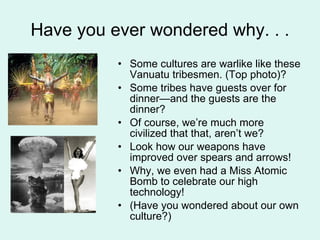
Have you ever wondered why. . . Some cultures are warlike like these Vanuatu tribesmen. (Top photo)? Some tribes have guests over for dinner—and the guests are the dinner? Of course, we’re much more civilized that that, aren’t we? Look how our weapons have improved over spears and arrows! Why, we even had a Miss Atomic Bomb to celebrate our high technology! (Have you wondered about our own culture?)
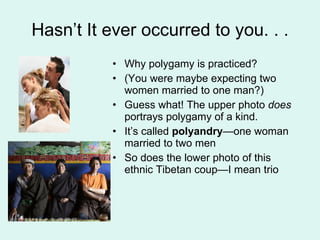
Hasn’t It ever occurred to you. . . Why polygamy is practiced? (You were maybe expecting two women married to one man?) Guess what! The upper photo  does  portrays polygamy of a kind.  It’s called  polyandry —one woman married to two men  So does the lower photo of this ethnic Tibetan coup—I mean trio
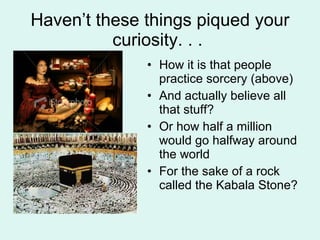
Haven’t these things piqued your curiosity. . .  How it is that people practice sorcery (above) And actually believe all that stuff? Or how half a million would go halfway around the world For the sake of a rock called the Kabala Stone?
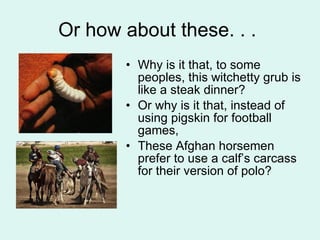
Or how about these. . .  Why is it that, to some peoples, this witchetty grub is like a steak dinner?  Or why is it that, instead of using pigskin for football games,  These Afghan horsemen prefer to use a calf’s carcass for their version of polo?
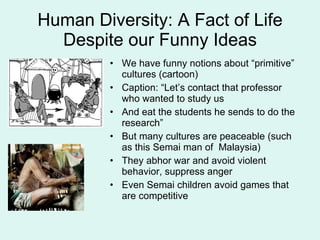
Human Diversity: A Fact of Life Despite our Funny Ideas We have funny notions about “primitive” cultures (cartoon) Caption: “Let’s contact that professor who wanted to study us And eat the students he sends to do the research” But many cultures are peaceable (such as this Semai man of  Malaysia)  They abhor war and avoid violent behavior, suppress anger Even Semai children avoid games that are competitive
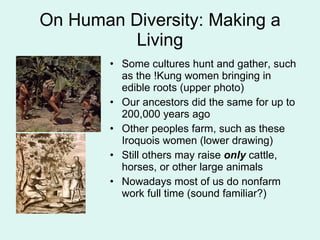
On Human Diversity: Making a Living Some cultures hunt and gather, such as the !Kung women bringing in edible roots (upper photo)  Our ancestors did the same for up to 200,000 years ago Other peoples farm, such as these Iroquois women (lower drawing) Still others may raise  only  cattle, horses, or other large animals Nowadays most of us do nonfarm work full time (sound familiar?)
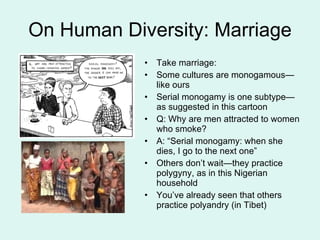
On Human Diversity: Marriage Take marriage: Some cultures are monogamous—like ours Serial monogamy is one subtype—as suggested in this cartoon Q: Why are men attracted to women who smoke? A: “Serial monogamy: when she dies, I go to the next one” Others don’t wait—they practice polygyny, as in this Nigerian household You’ve already seen that others practice polyandry (in Tibet)
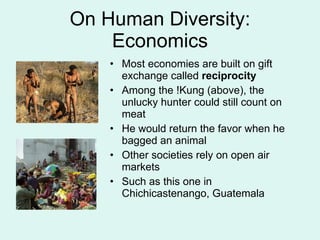
On Human Diversity: Economics Most economies are built on gift exchange called  reciprocity Among the !Kung (above), the unlucky hunter could still count on meat  He would return the favor when he bagged an animal Other societies rely on open air markets Such as this one in Chichicastenango, Guatemala
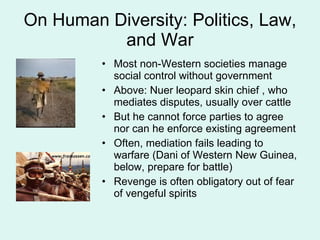
On Human Diversity: Politics, Law, and War Most non-Western societies manage social control without government Above: Nuer leopard skin chief , who mediates disputes, usually over cattle But he cannot force parties to agree nor can he enforce existing agreement Often, mediation fails leading to warfare (Dani of Western New Guinea, below, prepare for battle) Revenge is often obligatory out of fear of vengeful spirits
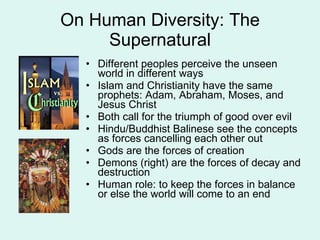
On Human Diversity: The Supernatural Different peoples perceive the unseen world in different ways Islam and Christianity have the same prophets: Adam, Abraham, Moses, and Jesus Christ Both call for the triumph of good over evil Hindu/Buddhist Balinese see the concepts as forces cancelling each other out Gods are the forces of creation Demons (right) are the forces of decay and destruction Human role: to keep the forces in balance or else the world will come to an end
What Anthropologists Do Explaining diversity and similarities is the job of anthropologists Why do some peoples have one spouse while others have many? Why do some cultures have governments and their codified laws while others manage without them? Why do some peoples share their resources while others do not? These are all questions that anthropologists address .
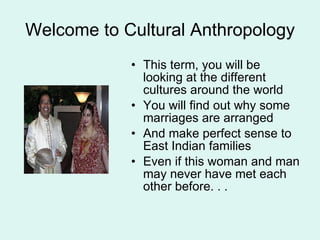
Welcome to Cultural Anthropology This term, you will be looking at the different cultures around the world You will find out why some marriages are arranged And make perfect sense to East Indian families Even if this woman and man may never have met each other before. . .
So What is Anthropology? Glad you asked! Let’s look at the etymology. . . “ Anthropology” is derived from two Greek terms: Anthropos:  “man” or by extension “human” Logos:  “study of” or “science of” But any field from medicine to law to history is about humans So we have to narrow the term down a bit
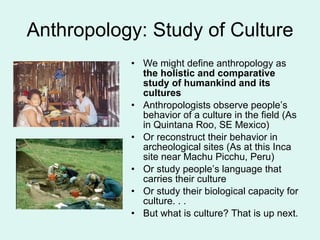
Anthropology: Study of Culture We might define anthropology as  the holistic and comparative study of humankind and its cultures Anthropologists observe people’s behavior of a culture in the field (As in Quintana Roo, SE Mexico) Or reconstruct their behavior in archeological sites (As at this Inca site near Machu Picchu, Peru) Or study people’s language that carries their culture  Or study their biological capacity for culture. . .  But what is culture? That is up next.

An Introduction to Anthropology

  • 1.
    An Introduction toCultural Anthropology On Strange Customs--Strange to Us, That Is
  • 2.
    What do AnthropologistsDo? Typical Stereotype: People wearing a pith helmet in khaki out to study exotic cultures (upper right) Of course, the lower cartoon by Gary Larson describes the more likely stereotype. . . (lower right) The caption: “Anthropologists! Anthropologists!”
  • 3.
    Do Anthropologist WearBeards? Stereotypically, male anthropologists wear beards I didn’t—but in Guatemala back in 1969-70, if you looked like Fidel Castro [upper right], they shot first and didn’t bother to ask questions later. “No quarter for comunistas , you see.” In 1970, Carlos Arana Osorio, the so-called Butcher of Zacapa, was elected president (lower right; in the second photo, that’s him to the right, consulting with U.S. military advisors in Zacapa). So you can guess I was squeaky clean when it came to shaving, except for a mustache!
  • 4.
    Have you everwondered why. . . Some cultures are warlike like these Vanuatu tribesmen. (Top photo)? Some tribes have guests over for dinner—and the guests are the dinner? Of course, we’re much more civilized that that, aren’t we? Look how our weapons have improved over spears and arrows! Why, we even had a Miss Atomic Bomb to celebrate our high technology! (Have you wondered about our own culture?)
  • 5.
    Hasn’t It everoccurred to you. . . Why polygamy is practiced? (You were maybe expecting two women married to one man?) Guess what! The upper photo does portrays polygamy of a kind. It’s called polyandry —one woman married to two men So does the lower photo of this ethnic Tibetan coup—I mean trio
  • 6.
    Haven’t these thingspiqued your curiosity. . . How it is that people practice sorcery (above) And actually believe all that stuff? Or how half a million would go halfway around the world For the sake of a rock called the Kabala Stone?
  • 7.
    Or how aboutthese. . . Why is it that, to some peoples, this witchetty grub is like a steak dinner? Or why is it that, instead of using pigskin for football games, These Afghan horsemen prefer to use a calf’s carcass for their version of polo?
  • 8.
    Human Diversity: AFact of Life Despite our Funny Ideas We have funny notions about “primitive” cultures (cartoon) Caption: “Let’s contact that professor who wanted to study us And eat the students he sends to do the research” But many cultures are peaceable (such as this Semai man of Malaysia) They abhor war and avoid violent behavior, suppress anger Even Semai children avoid games that are competitive
  • 9.
    On Human Diversity:Making a Living Some cultures hunt and gather, such as the !Kung women bringing in edible roots (upper photo) Our ancestors did the same for up to 200,000 years ago Other peoples farm, such as these Iroquois women (lower drawing) Still others may raise only cattle, horses, or other large animals Nowadays most of us do nonfarm work full time (sound familiar?)
  • 10.
    On Human Diversity:Marriage Take marriage: Some cultures are monogamous—like ours Serial monogamy is one subtype—as suggested in this cartoon Q: Why are men attracted to women who smoke? A: “Serial monogamy: when she dies, I go to the next one” Others don’t wait—they practice polygyny, as in this Nigerian household You’ve already seen that others practice polyandry (in Tibet)
  • 11.
    On Human Diversity:Economics Most economies are built on gift exchange called reciprocity Among the !Kung (above), the unlucky hunter could still count on meat He would return the favor when he bagged an animal Other societies rely on open air markets Such as this one in Chichicastenango, Guatemala
  • 12.
    On Human Diversity:Politics, Law, and War Most non-Western societies manage social control without government Above: Nuer leopard skin chief , who mediates disputes, usually over cattle But he cannot force parties to agree nor can he enforce existing agreement Often, mediation fails leading to warfare (Dani of Western New Guinea, below, prepare for battle) Revenge is often obligatory out of fear of vengeful spirits
  • 13.
    On Human Diversity:The Supernatural Different peoples perceive the unseen world in different ways Islam and Christianity have the same prophets: Adam, Abraham, Moses, and Jesus Christ Both call for the triumph of good over evil Hindu/Buddhist Balinese see the concepts as forces cancelling each other out Gods are the forces of creation Demons (right) are the forces of decay and destruction Human role: to keep the forces in balance or else the world will come to an end
  • 14.
    What Anthropologists DoExplaining diversity and similarities is the job of anthropologists Why do some peoples have one spouse while others have many? Why do some cultures have governments and their codified laws while others manage without them? Why do some peoples share their resources while others do not? These are all questions that anthropologists address .
  • 15.
    Welcome to CulturalAnthropology This term, you will be looking at the different cultures around the world You will find out why some marriages are arranged And make perfect sense to East Indian families Even if this woman and man may never have met each other before. . .
  • 16.
    So What isAnthropology? Glad you asked! Let’s look at the etymology. . . “ Anthropology” is derived from two Greek terms: Anthropos: “man” or by extension “human” Logos: “study of” or “science of” But any field from medicine to law to history is about humans So we have to narrow the term down a bit
  • 17.
    Anthropology: Study ofCulture We might define anthropology as the holistic and comparative study of humankind and its cultures Anthropologists observe people’s behavior of a culture in the field (As in Quintana Roo, SE Mexico) Or reconstruct their behavior in archeological sites (As at this Inca site near Machu Picchu, Peru) Or study people’s language that carries their culture Or study their biological capacity for culture. . . But what is culture? That is up next.