Defining Culture The Central Concept of Anthropology
Culture: The Original Definition  E.B. Tylor , anthropology’s founder, gave a definition to start with:  “ That complex whole  which includes Knowledge, beliefs, arts, morals, law, custom And any other  capabilities and habits Acquired by  man  [both genders] As a member of society”
Tylor’s Definition: Knowledge, Beliefs, and How They Fit “ That Complex Whole”  We study all aspects of a culture, from making a living to organization of families and larger groups to its supernatural beliefs “ Knowledge”  People of all cultures rely on knowledge, whether of the sources of food and how to get and prepare it, of shelter construction, or of their surrounding environment. “ Beliefs”  All cultures have a world view of the unseen, including the creator(s) of the world, the gods, spirits, and forces of the supernatural, myths, and much else. That includes us Westerners, who have one religion or another—even no religion is a confession of faith in no god or gods.
Tylor’s Definition: Skills to Values to Social Control “ Arts”  Everyone in a culture has skills, whether hunting, gathering plants, cultivating crops, constructing shelter, and much else “ Morals”  Every culture has its morality. Even the warlike Yanomamö are very conscientious about reciprocity; stinginess is punishable by their version of Hell. “ Law”  Every culture has its own means of social control “ Custom”  Every culture has its own way of doing things, from family values to norms of behavior
Tylor’s Definition: Shared Behavior “ Capabilities and Habits Acquired by Man:  Culture is a  human  feature, although certain apes may also have something resembling culture “ As a Member of Society:  We all belong to a network or structure of social relations, from family to band to tribe to nation-state .
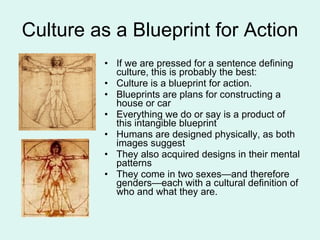
Culture as a Blueprint for Action If we are pressed for a sentence defining culture, this is probably the best: Culture is a blueprint for action. Blueprints are plans for constructing a house or car Everything we do or say is a product of this intangible blueprint Humans are designed physically, as both images suggest They also acquired designs in their mental patterns They come in two sexes—and therefore genders—each with a cultural definition of who and what they are.
Characteristics Of Cultures All cultures have at least five characteristics in common:  Culture is  learned Culture is based on  symbols Culture is  shared Culture is  patterned  or  integrated Culture is usually  adaptive
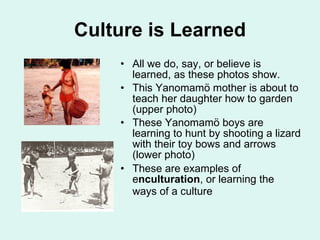
Culture is Learned All we do, say, or believe is learned, as these photos show. This Yanomamö mother is about to teach her daughter how to garden (upper photo) These Yanomamö boys are learning to hunt by shooting a lizard with their toy bows and arrows (lower photo) These are examples of e nculturation , or learning the ways of a culture
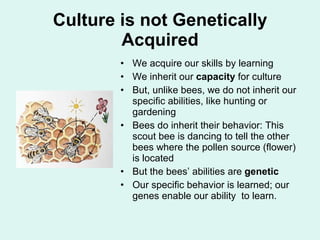
Culture is not Genetically Acquired We acquire our skills by learning We inherit our  capacity  for culture But, unlike bees, we do not inherit our specific abilities, like hunting or gardening Bees do inherit their behavior: This scout bee is dancing to tell the other bees where the pollen source (flower) is located But the bees’ abilities are  genetic Our specific behavior is learned; our genes enable our ability  to learn.
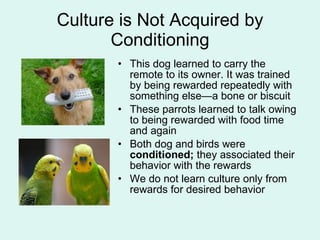
Culture is Not Acquired by Conditioning This dog learned to carry the remote to its owner. It was trained by being rewarded repeatedly with something else—a bone or biscuit These parrots learned to talk owing to being rewarded with food time and again Both dog and birds were  conditioned;  they associated their behavior with the rewards We do not learn culture only from rewards for desired behavior
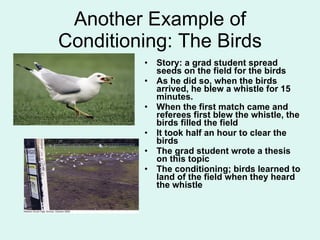
Another Example of Conditioning: The Birds Story: a grad student spread seeds on the field for the birds As he did so, when the birds arrived, he blew a whistle for 15 minutes. When the first match came and referees first blew the whistle, the birds filled the field It took half an hour to clear the birds The grad student wrote a thesis on this topic The conditioning; birds learned to land of the field when they heard the whistle
Culture is Symbolic Culture is based on symbols, including the following: Language Objects with meaning Events with Significance What do these items have in common? They are each a symbol, or o bject or event that is Intrinsically unrelated to another object  or event to which it refers
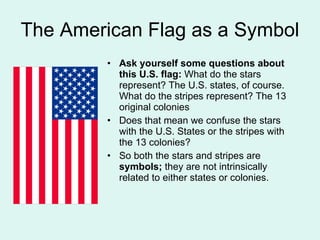
The American Flag as a Symbol Ask yourself some questions about this U.S. flag:  What do the stars represent? The U.S. states, of course. What do the stripes represent? The 13 original colonies Does that mean we confuse the stars with the U.S. States or the stripes with the 13 colonies? So both the stars and stripes are  symbols;  they are not intrinsically related to either states or colonies.
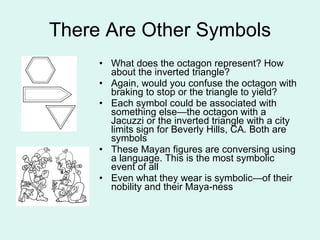
There Are Other Symbols What does the octagon represent? How about the inverted triangle? Again, would you confuse the octagon with braking to stop or the triangle to yield? Each symbol could be associated with something else—the octagon with a Jacuzzi or the inverted triangle with a city limits sign for Beverly Hills, CA. Both are symbols These Mayan figures are conversing using a language. This is the most symbolic event of all Even what they wear is symbolic—of their nobility and their Maya-ness
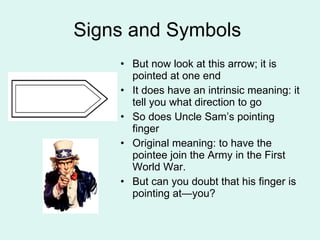
Signs and Symbols  But now look at this arrow; it is pointed at one end It does have an intrinsic meaning: it tell you what direction to go  So does Uncle Sam’s pointing finger Original meaning: to have the pointee join the Army in the First World War. But can you doubt that his finger is pointing at—you?
Cultures are Based on Symbolism Called Language Expression “cat” comprises 3 sounds: C-a-t or in International Phonetic Alphabet [k æ t]: IPA is designed for one letter, one sound [k] means nothing, nor do [æ] or [t] Put together, they mean a feline animal (which one?) But you wouldn’t confuse “cat” with the symbol
The Flexibility of Language Symbols   Switch the symbols around and you have [æ k t] “act” Switch them again and you have [t æ k], “tack” Bottom line: none of the three sounds has any meaning, in and of itself But they can be combined to mean many things in English That is why language is so flexible and is called an open communication system.
Symbolism and Culture Symbols are the root of all culture Bees cannot change their behavior Dogs cannot be trained except by imitation and reward But humans can change behavior at will or when forced to do so Evidence: Cultures are diverse Evidence: Cultures can and do change (Just as language can and does change)
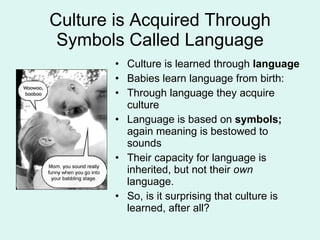
Culture is Acquired Through Symbols Called Language Culture is learned through  language Babies learn language from birth: Through language they acquire culture Language is based on  symbols;  again meaning is bestowed to sounds Their capacity for language is inherited, but not their  own  language. So, is it surprising that culture is learned, after all?
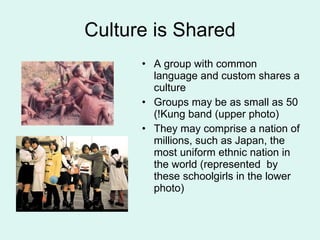
Culture is Shared A group with common language and custom shares a culture Groups may be as small as 50 (!Kung band (upper photo) They may comprise a nation of millions, such as Japan, the most uniform ethnic nation in the world (represented  by these schoolgirls in the lower photo)
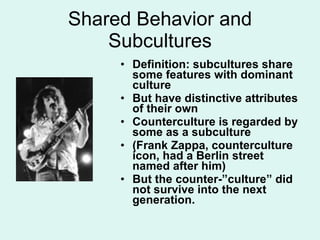
Shared Behavior and Subcultures Definition: subcultures share some features with dominant culture But have distinctive attributes of their own Counterculture is regarded by some as a subculture (Frank Zappa, counterculture icon, had a Berlin street named after him) But the counter-”culture” did not survive into the next generation.
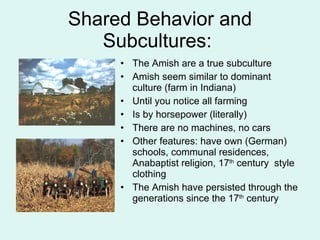
Shared Behavior and Subcultures:  The Amish are a true subculture Amish seem similar to dominant culture (farm in Indiana) Until you notice all farming Is by horsepower (literally) There are no machines, no cars Other features: have own (German) schools, communal residences, Anabaptist religion, 17 th  century  style clothing The Amish have persisted through the generations since the 17 th  century
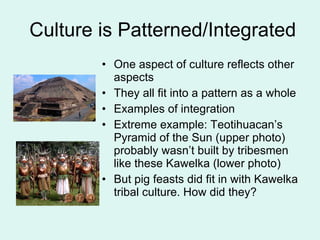
Culture is Patterned/Integrated One aspect of culture reflects other aspects They all fit into a pattern as a whole Examples of integration Extreme example: Teotihuacan’s Pyramid of the Sun (upper photo) probably wasn’t built by tribesmen like these Kawelka (lower photo) But pig feasts did fit in with Kawelka tribal culture. How did they?
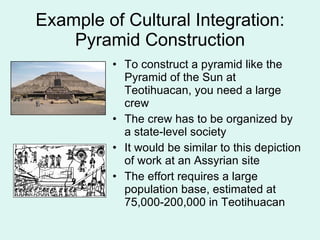
Example of Cultural Integration: Pyramid Construction To construct a pyramid like the Pyramid of the Sun at Teotihuacan, you need a large crew The crew has to be organized by a state-level society It would be similar to this depiction of work at an Assyrian site The effort requires a large population base, estimated at 75,000-200,000 in Teotihuacan
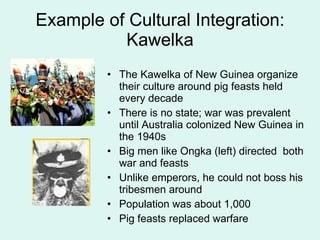
Example of Cultural Integration: Kawelka The Kawelka of New Guinea organize their culture around pig feasts held every decade There is no state; war was prevalent until Australia colonized New Guinea in the 1940s Big men like Ongka (left) directed  both war and feasts Unlike emperors, he could not boss his tribesmen around Population was about 1,000 Pig feasts replaced warfare
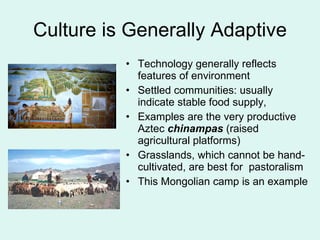
Culture is Generally Adaptive Technology generally reflects features of environment Settled communities: usually indicate stable food supply,  Examples are the very productive Aztec  chinampas  (raised agricultural platforms) Grasslands, which cannot be hand-cultivated, are best for  pastoralism This Mongolian camp is an example
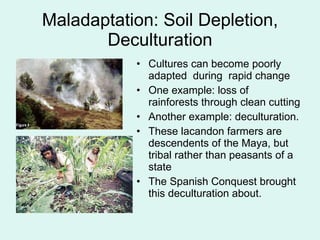
Maladaptation: Soil Depletion, Deculturation Cultures can become poorly adapted  during  rapid change One example: loss of rainforests through clean cutting Another example: deculturation. These lacandon farmers are descendents of the Maya, but tribal rather than peasants of a state The Spanish Conquest brought this deculturation about.
Conclusion: Cultures and Their Features Cultures are learned and the product of symbols, especially language They comprise groups from 40-50 to millions of people who share common languages and customs In more complex societies, subcultures may develop, like the Amish They are generally integrated and adaptive Exceptions occur when resources become exhausted or they are forced into rapid changes For several definitions of culture, log on to this website: www.wsu.edu/gened/learn-modules/top_culture/culture-index.html

Defining Culture

  • 1.
    Defining Culture TheCentral Concept of Anthropology
  • 2.
    Culture: The OriginalDefinition E.B. Tylor , anthropology’s founder, gave a definition to start with: “ That complex whole which includes Knowledge, beliefs, arts, morals, law, custom And any other capabilities and habits Acquired by man [both genders] As a member of society”
  • 3.
    Tylor’s Definition: Knowledge,Beliefs, and How They Fit “ That Complex Whole” We study all aspects of a culture, from making a living to organization of families and larger groups to its supernatural beliefs “ Knowledge” People of all cultures rely on knowledge, whether of the sources of food and how to get and prepare it, of shelter construction, or of their surrounding environment. “ Beliefs” All cultures have a world view of the unseen, including the creator(s) of the world, the gods, spirits, and forces of the supernatural, myths, and much else. That includes us Westerners, who have one religion or another—even no religion is a confession of faith in no god or gods.
  • 4.
    Tylor’s Definition: Skillsto Values to Social Control “ Arts” Everyone in a culture has skills, whether hunting, gathering plants, cultivating crops, constructing shelter, and much else “ Morals” Every culture has its morality. Even the warlike Yanomamö are very conscientious about reciprocity; stinginess is punishable by their version of Hell. “ Law” Every culture has its own means of social control “ Custom” Every culture has its own way of doing things, from family values to norms of behavior
  • 5.
    Tylor’s Definition: SharedBehavior “ Capabilities and Habits Acquired by Man: Culture is a human feature, although certain apes may also have something resembling culture “ As a Member of Society: We all belong to a network or structure of social relations, from family to band to tribe to nation-state .
  • 6.
    Culture as aBlueprint for Action If we are pressed for a sentence defining culture, this is probably the best: Culture is a blueprint for action. Blueprints are plans for constructing a house or car Everything we do or say is a product of this intangible blueprint Humans are designed physically, as both images suggest They also acquired designs in their mental patterns They come in two sexes—and therefore genders—each with a cultural definition of who and what they are.
  • 7.
    Characteristics Of CulturesAll cultures have at least five characteristics in common: Culture is learned Culture is based on symbols Culture is shared Culture is patterned or integrated Culture is usually adaptive
  • 8.
    Culture is LearnedAll we do, say, or believe is learned, as these photos show. This Yanomamö mother is about to teach her daughter how to garden (upper photo) These Yanomamö boys are learning to hunt by shooting a lizard with their toy bows and arrows (lower photo) These are examples of e nculturation , or learning the ways of a culture
  • 9.
    Culture is notGenetically Acquired We acquire our skills by learning We inherit our capacity for culture But, unlike bees, we do not inherit our specific abilities, like hunting or gardening Bees do inherit their behavior: This scout bee is dancing to tell the other bees where the pollen source (flower) is located But the bees’ abilities are genetic Our specific behavior is learned; our genes enable our ability to learn.
  • 10.
    Culture is NotAcquired by Conditioning This dog learned to carry the remote to its owner. It was trained by being rewarded repeatedly with something else—a bone or biscuit These parrots learned to talk owing to being rewarded with food time and again Both dog and birds were conditioned; they associated their behavior with the rewards We do not learn culture only from rewards for desired behavior
  • 11.
    Another Example ofConditioning: The Birds Story: a grad student spread seeds on the field for the birds As he did so, when the birds arrived, he blew a whistle for 15 minutes. When the first match came and referees first blew the whistle, the birds filled the field It took half an hour to clear the birds The grad student wrote a thesis on this topic The conditioning; birds learned to land of the field when they heard the whistle
  • 12.
    Culture is SymbolicCulture is based on symbols, including the following: Language Objects with meaning Events with Significance What do these items have in common? They are each a symbol, or o bject or event that is Intrinsically unrelated to another object or event to which it refers
  • 13.
    The American Flagas a Symbol Ask yourself some questions about this U.S. flag: What do the stars represent? The U.S. states, of course. What do the stripes represent? The 13 original colonies Does that mean we confuse the stars with the U.S. States or the stripes with the 13 colonies? So both the stars and stripes are symbols; they are not intrinsically related to either states or colonies.
  • 14.
    There Are OtherSymbols What does the octagon represent? How about the inverted triangle? Again, would you confuse the octagon with braking to stop or the triangle to yield? Each symbol could be associated with something else—the octagon with a Jacuzzi or the inverted triangle with a city limits sign for Beverly Hills, CA. Both are symbols These Mayan figures are conversing using a language. This is the most symbolic event of all Even what they wear is symbolic—of their nobility and their Maya-ness
  • 15.
    Signs and Symbols But now look at this arrow; it is pointed at one end It does have an intrinsic meaning: it tell you what direction to go So does Uncle Sam’s pointing finger Original meaning: to have the pointee join the Army in the First World War. But can you doubt that his finger is pointing at—you?
  • 16.
    Cultures are Basedon Symbolism Called Language Expression “cat” comprises 3 sounds: C-a-t or in International Phonetic Alphabet [k æ t]: IPA is designed for one letter, one sound [k] means nothing, nor do [æ] or [t] Put together, they mean a feline animal (which one?) But you wouldn’t confuse “cat” with the symbol
  • 17.
    The Flexibility ofLanguage Symbols Switch the symbols around and you have [æ k t] “act” Switch them again and you have [t æ k], “tack” Bottom line: none of the three sounds has any meaning, in and of itself But they can be combined to mean many things in English That is why language is so flexible and is called an open communication system.
  • 18.
    Symbolism and CultureSymbols are the root of all culture Bees cannot change their behavior Dogs cannot be trained except by imitation and reward But humans can change behavior at will or when forced to do so Evidence: Cultures are diverse Evidence: Cultures can and do change (Just as language can and does change)
  • 19.
    Culture is AcquiredThrough Symbols Called Language Culture is learned through language Babies learn language from birth: Through language they acquire culture Language is based on symbols; again meaning is bestowed to sounds Their capacity for language is inherited, but not their own language. So, is it surprising that culture is learned, after all?
  • 20.
    Culture is SharedA group with common language and custom shares a culture Groups may be as small as 50 (!Kung band (upper photo) They may comprise a nation of millions, such as Japan, the most uniform ethnic nation in the world (represented by these schoolgirls in the lower photo)
  • 21.
    Shared Behavior andSubcultures Definition: subcultures share some features with dominant culture But have distinctive attributes of their own Counterculture is regarded by some as a subculture (Frank Zappa, counterculture icon, had a Berlin street named after him) But the counter-”culture” did not survive into the next generation.
  • 22.
    Shared Behavior andSubcultures: The Amish are a true subculture Amish seem similar to dominant culture (farm in Indiana) Until you notice all farming Is by horsepower (literally) There are no machines, no cars Other features: have own (German) schools, communal residences, Anabaptist religion, 17 th century style clothing The Amish have persisted through the generations since the 17 th century
  • 23.
    Culture is Patterned/IntegratedOne aspect of culture reflects other aspects They all fit into a pattern as a whole Examples of integration Extreme example: Teotihuacan’s Pyramid of the Sun (upper photo) probably wasn’t built by tribesmen like these Kawelka (lower photo) But pig feasts did fit in with Kawelka tribal culture. How did they?
  • 24.
    Example of CulturalIntegration: Pyramid Construction To construct a pyramid like the Pyramid of the Sun at Teotihuacan, you need a large crew The crew has to be organized by a state-level society It would be similar to this depiction of work at an Assyrian site The effort requires a large population base, estimated at 75,000-200,000 in Teotihuacan
  • 25.
    Example of CulturalIntegration: Kawelka The Kawelka of New Guinea organize their culture around pig feasts held every decade There is no state; war was prevalent until Australia colonized New Guinea in the 1940s Big men like Ongka (left) directed both war and feasts Unlike emperors, he could not boss his tribesmen around Population was about 1,000 Pig feasts replaced warfare
  • 26.
    Culture is GenerallyAdaptive Technology generally reflects features of environment Settled communities: usually indicate stable food supply, Examples are the very productive Aztec chinampas (raised agricultural platforms) Grasslands, which cannot be hand-cultivated, are best for pastoralism This Mongolian camp is an example
  • 27.
    Maladaptation: Soil Depletion,Deculturation Cultures can become poorly adapted during rapid change One example: loss of rainforests through clean cutting Another example: deculturation. These lacandon farmers are descendents of the Maya, but tribal rather than peasants of a state The Spanish Conquest brought this deculturation about.
  • 28.
    Conclusion: Cultures andTheir Features Cultures are learned and the product of symbols, especially language They comprise groups from 40-50 to millions of people who share common languages and customs In more complex societies, subcultures may develop, like the Amish They are generally integrated and adaptive Exceptions occur when resources become exhausted or they are forced into rapid changes For several definitions of culture, log on to this website: www.wsu.edu/gened/learn-modules/top_culture/culture-index.html