Dr. Manju Gehlawat Hooda
Assistant Professor
C. R. College of Education, Rohtak
PRAGMATISM IN
EDUCATION
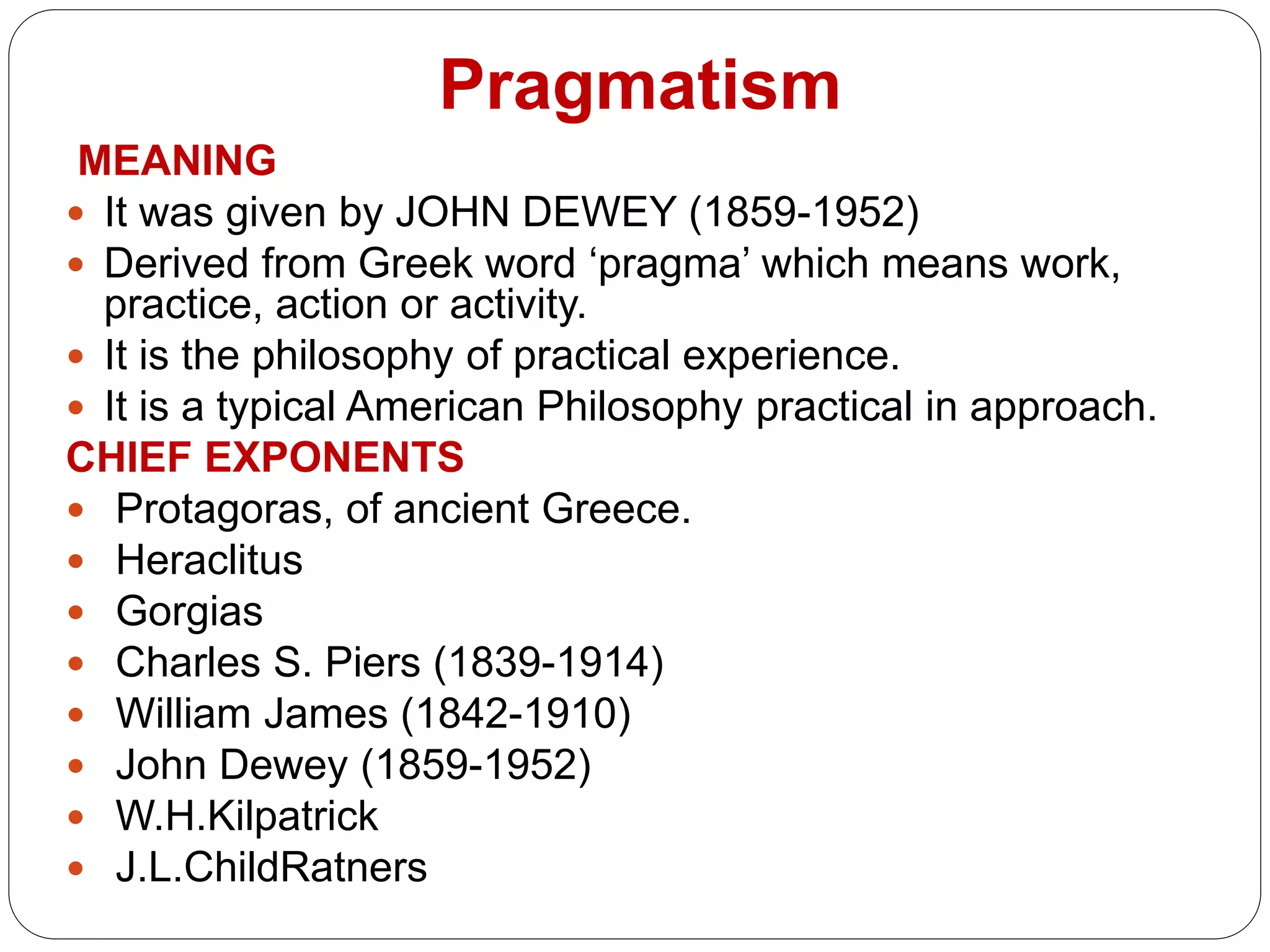
Pragmatism
MEANING
 It was given by JOHN DEWEY (1859-1952)
 Derived from Greek word ‘pragma’ which means work,
practice, action or activity.
 It is the philosophy of practical experience.
 It is a typical American Philosophy practical in approach.
CHIEF EXPONENTS
 Protagoras, of ancient Greece.
 Heraclitus
 Gorgias
 Charles S. Piers (1839-1914)
 William James (1842-1910)
 John Dewey (1859-1952)
 W.H.Kilpatrick
 J.L.ChildRatners
BASIC PRINCIPLES
• Gives importance to action.
• Gives importance to experience.
• Believes in change.
• No belief in permanent values.
• Gives emphasis on experimentation.
• A practical philosophy.
• A humanistic philosophy.
• Pragmatists believe on present.
• Believe that growth and development takes place
through interaction and environment.
• Deep faith in democracy.
• Emphasis on means not on ‘end’.
METAPHYSICS
• Rejects metaphysics as an area of philosophical enquiry.
• Reality is determined by individual’s sense experience –
Man can know nothing beyond his experience.
• Any conclusion we make about life after death is merely
guess.
• Does not believe in anything spiritual or transcendental
values.
• Reality is constantly changing.
EPISTEMOLOGY
• Knowledge based on experience is true.
• Phenomenon are constantly changing to knowledge about
truth must change accordingly.
• They emphasize on functional knowledge and
understanding.
AXIOLOGY
• Does not believe on standard permanent and external
values.
• Man, being a part of society, the consequences of his
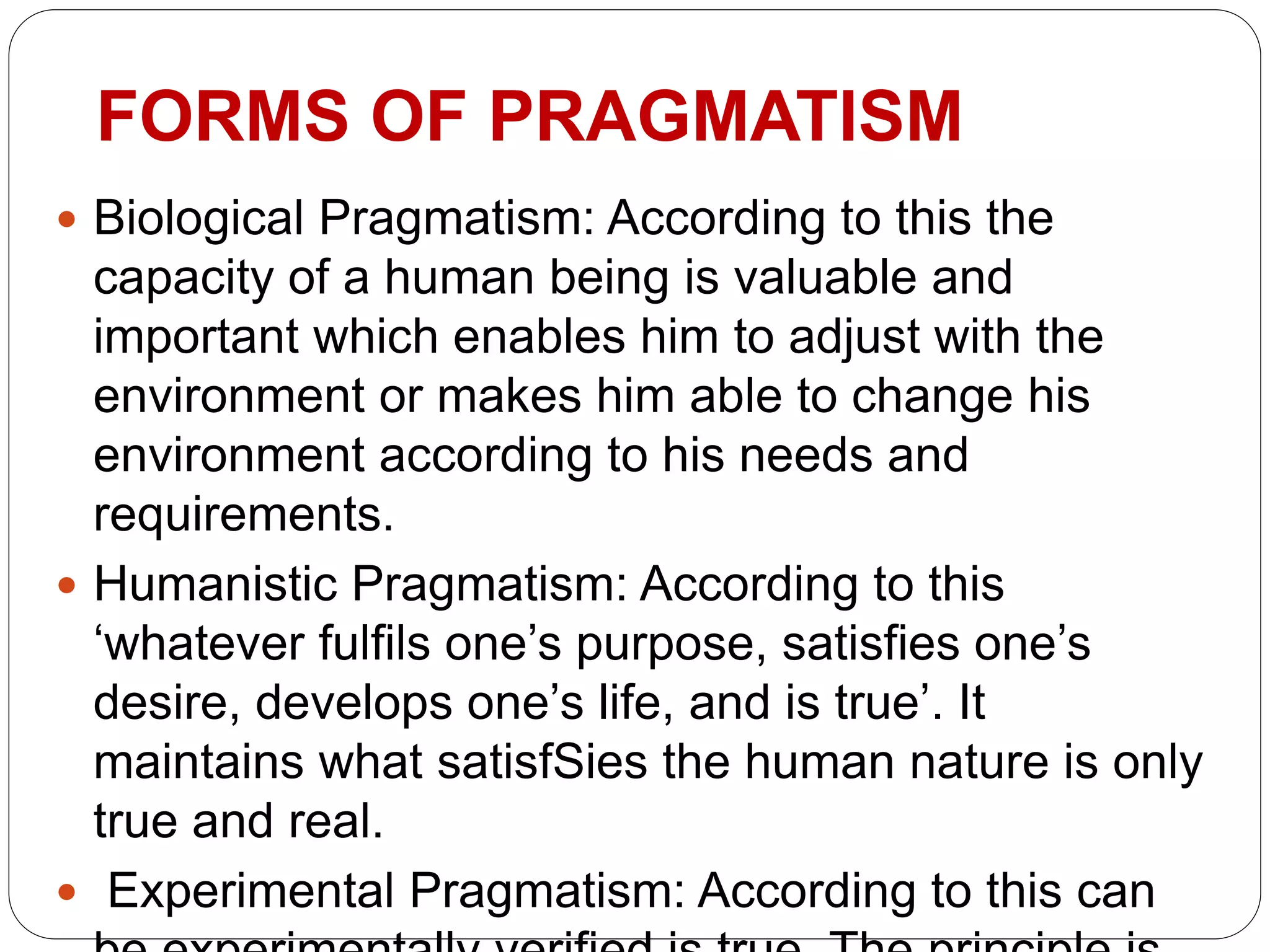
FORMS OF PRAGMATISM
 Biological Pragmatism: According to this the
capacity of a human being is valuable and
important which enables him to adjust with the
environment or makes him able to change his
environment according to his needs and
requirements.
 Humanistic Pragmatism: According to this
‘whatever fulfils one’s purpose, satisfies one’s
desire, develops one’s life, and is true’. It
maintains what satisfSies the human nature is only
true and real.
 Experimental Pragmatism: According to this can
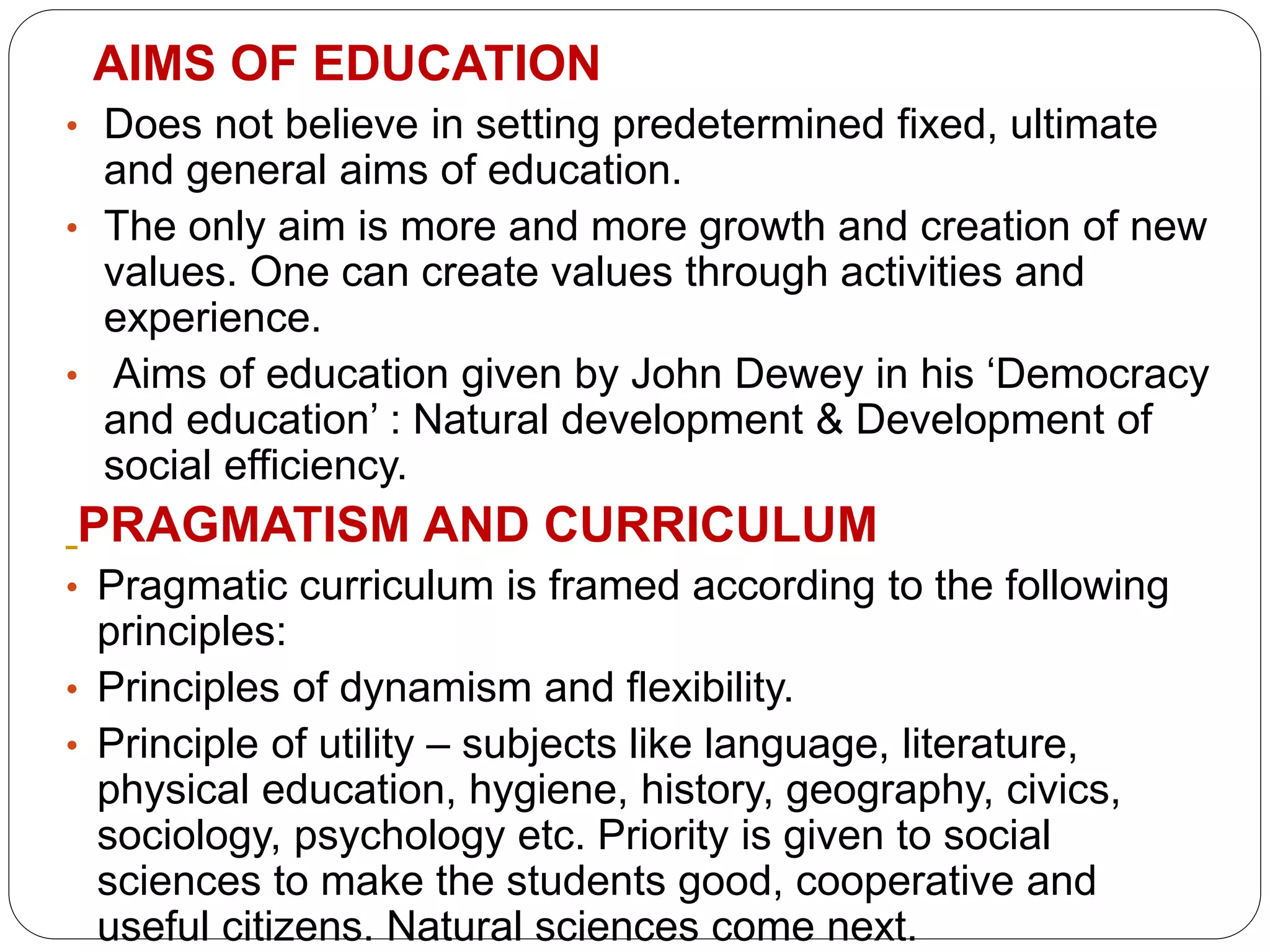
AIMS OF EDUCATION
• Does not believe in setting predetermined fixed, ultimate
and general aims of education.
• The only aim is more and more growth and creation of new
values. One can create values through activities and
experience.
• Aims of education given by John Dewey in his ‘Democracy
and education’ : Natural development & Development of
social efficiency.
PRAGMATISM AND CURRICULUM
• Pragmatic curriculum is framed according to the following
principles:
• Principles of dynamism and flexibility.
• Principle of utility – subjects like language, literature,
physical education, hygiene, history, geography, civics,
sociology, psychology etc. Priority is given to social
sciences to make the students good, cooperative and
useful citizens. Natural sciences come next.
METHODS OF TEACHING
• Against out dated, lifeless and rigidly traditional methods
of teaching.
• Methods to be formulated on the basis of following
principles : -Principles of purposive process of learning. -
Principle of learning by doing. -Principle of integration.
• Project method by Kilpatrick.
• Experimental method.
• It also encourages: Discussion as a method-laboratory
work. Personal reference in the library. Educational tows
and excursions.
TEACHER
• As a friend, philosopher and guide.
• Not a dictator but only a leader of a group.
• Should have knowledge of student’s interest and provide
them social environment.
• Should believe in democratic values.
• Should have knowledge of social conditioning.
DISCIPLINE
• Freedom as an important element.
• Promotes self discipline.
• Condemn enforced discipline and advocate social discipline
based on child’s interest, activities and a sense of social
responsibility.
• According to pragmatists, “Discipline is primarily social and
it emerges through active participation in group and
purposeful activity.”
SCHOOL
• Any social environment which inspires children for
experimentation constitutes a school for them.
• A social institution which develops in child a social sense
and sense of duty towards society and nation.
• According to John Dewey : “School is the embryo of
community.” “School is a miniature society.” “An instrument
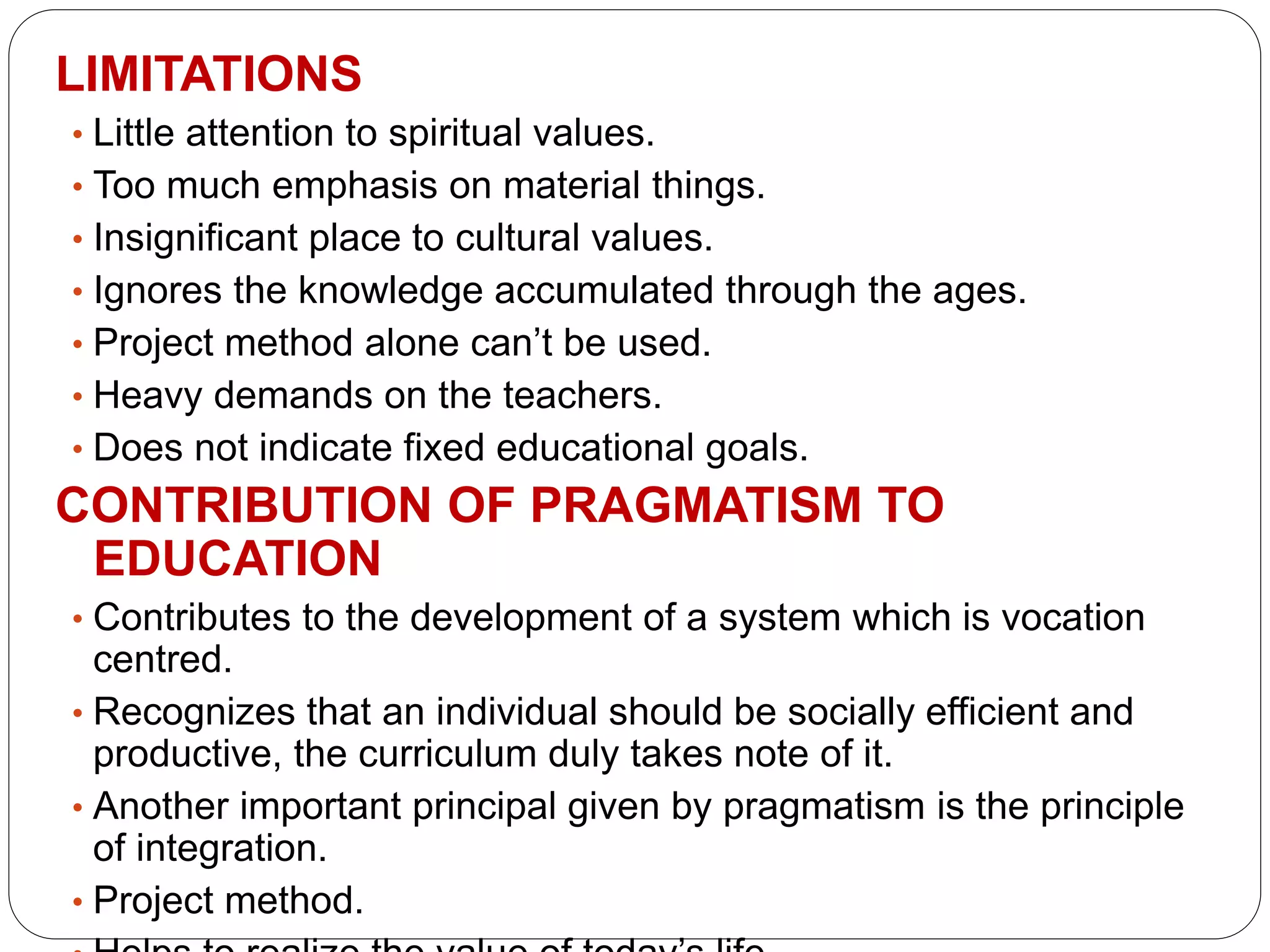
LIMITATIONS
• Little attention to spiritual values.
• Too much emphasis on material things.
• Insignificant place to cultural values.
• Ignores the knowledge accumulated through the ages.
• Project method alone can’t be used.
• Heavy demands on the teachers.
• Does not indicate fixed educational goals.
CONTRIBUTION OF PRAGMATISM TO
EDUCATION
• Contributes to the development of a system which is vocation
centred.
• Recognizes that an individual should be socially efficient and
productive, the curriculum duly takes note of it.
• Another important principal given by pragmatism is the principle
of integration.
• Project method.
CONCLUSION
Pragmatism is characteristic of current educational
thought and it is representative of progressive trends in
education. Progressive education lays emphasis on
learning by doing, and involving the child actively in the
learning process. Too much restrain will retard the
natural growth of children. The child must be given
educative freedom to express and develop himself. In
the knowledge gaining process, observation and
experimentation are the basic tools and knowledge is of
the nature of a hypothesis.
The truth of something is, knowing whether a
given generalization is obtained as a result of scientific
experimentation or an observation, whether it has
served purpose or not. If it works then it is true,
otherwise it is not. Secondly because of the principle of
change, which is one of the important tenets of

Pragmatism in education

  • 1.
    Dr. Manju GehlawatHooda Assistant Professor C. R. College of Education, Rohtak PRAGMATISM IN EDUCATION
  • 2.
    Pragmatism MEANING  It wasgiven by JOHN DEWEY (1859-1952)  Derived from Greek word ‘pragma’ which means work, practice, action or activity.  It is the philosophy of practical experience.  It is a typical American Philosophy practical in approach. CHIEF EXPONENTS  Protagoras, of ancient Greece.  Heraclitus  Gorgias  Charles S. Piers (1839-1914)  William James (1842-1910)  John Dewey (1859-1952)  W.H.Kilpatrick  J.L.ChildRatners
  • 3.
    BASIC PRINCIPLES • Givesimportance to action. • Gives importance to experience. • Believes in change. • No belief in permanent values. • Gives emphasis on experimentation. • A practical philosophy. • A humanistic philosophy. • Pragmatists believe on present. • Believe that growth and development takes place through interaction and environment. • Deep faith in democracy. • Emphasis on means not on ‘end’.
  • 4.
    METAPHYSICS • Rejects metaphysicsas an area of philosophical enquiry. • Reality is determined by individual’s sense experience – Man can know nothing beyond his experience. • Any conclusion we make about life after death is merely guess. • Does not believe in anything spiritual or transcendental values. • Reality is constantly changing. EPISTEMOLOGY • Knowledge based on experience is true. • Phenomenon are constantly changing to knowledge about truth must change accordingly. • They emphasize on functional knowledge and understanding. AXIOLOGY • Does not believe on standard permanent and external values. • Man, being a part of society, the consequences of his
  • 5.
    FORMS OF PRAGMATISM Biological Pragmatism: According to this the capacity of a human being is valuable and important which enables him to adjust with the environment or makes him able to change his environment according to his needs and requirements.  Humanistic Pragmatism: According to this ‘whatever fulfils one’s purpose, satisfies one’s desire, develops one’s life, and is true’. It maintains what satisfSies the human nature is only true and real.  Experimental Pragmatism: According to this can
  • 6.
    AIMS OF EDUCATION •Does not believe in setting predetermined fixed, ultimate and general aims of education. • The only aim is more and more growth and creation of new values. One can create values through activities and experience. • Aims of education given by John Dewey in his ‘Democracy and education’ : Natural development & Development of social efficiency. PRAGMATISM AND CURRICULUM • Pragmatic curriculum is framed according to the following principles: • Principles of dynamism and flexibility. • Principle of utility – subjects like language, literature, physical education, hygiene, history, geography, civics, sociology, psychology etc. Priority is given to social sciences to make the students good, cooperative and useful citizens. Natural sciences come next.
  • 7.
    METHODS OF TEACHING •Against out dated, lifeless and rigidly traditional methods of teaching. • Methods to be formulated on the basis of following principles : -Principles of purposive process of learning. - Principle of learning by doing. -Principle of integration. • Project method by Kilpatrick. • Experimental method. • It also encourages: Discussion as a method-laboratory work. Personal reference in the library. Educational tows and excursions. TEACHER • As a friend, philosopher and guide. • Not a dictator but only a leader of a group. • Should have knowledge of student’s interest and provide them social environment. • Should believe in democratic values. • Should have knowledge of social conditioning.
  • 8.
    DISCIPLINE • Freedom asan important element. • Promotes self discipline. • Condemn enforced discipline and advocate social discipline based on child’s interest, activities and a sense of social responsibility. • According to pragmatists, “Discipline is primarily social and it emerges through active participation in group and purposeful activity.” SCHOOL • Any social environment which inspires children for experimentation constitutes a school for them. • A social institution which develops in child a social sense and sense of duty towards society and nation. • According to John Dewey : “School is the embryo of community.” “School is a miniature society.” “An instrument
  • 9.
    LIMITATIONS • Little attentionto spiritual values. • Too much emphasis on material things. • Insignificant place to cultural values. • Ignores the knowledge accumulated through the ages. • Project method alone can’t be used. • Heavy demands on the teachers. • Does not indicate fixed educational goals. CONTRIBUTION OF PRAGMATISM TO EDUCATION • Contributes to the development of a system which is vocation centred. • Recognizes that an individual should be socially efficient and productive, the curriculum duly takes note of it. • Another important principal given by pragmatism is the principle of integration. • Project method.
  • 10.
    CONCLUSION Pragmatism is characteristicof current educational thought and it is representative of progressive trends in education. Progressive education lays emphasis on learning by doing, and involving the child actively in the learning process. Too much restrain will retard the natural growth of children. The child must be given educative freedom to express and develop himself. In the knowledge gaining process, observation and experimentation are the basic tools and knowledge is of the nature of a hypothesis. The truth of something is, knowing whether a given generalization is obtained as a result of scientific experimentation or an observation, whether it has served purpose or not. If it works then it is true, otherwise it is not. Secondly because of the principle of change, which is one of the important tenets of