1
Subject : INCLUSIVE EDUCATION
Topic : Discrimination based on
Gender and Caste
Submitted to :
Ms. Wahida Ma ‘am
Submitted by:
MAHIMA SRIVASTAVA
Content
● Discrimination
● Forms of gender Discrimination
● Types of Gender Inequality
● Factors Responsible For Gender
Inequality
● Causes of gender Discrimination
● Discrimination BASED on GENDER
● Measures to remove gender
discrimination
● Discrimination based on caste
● Evils of caste system
● Constitutional provisions
2
What is Discrimination ?
● Discrimination means the unfair treatment of a person or
group on the basis of prejudice.
● It is an act or series of actions taken against a targeted group
with the intention of preventing, devaluing,negating,or
humiliating them.
3
Discrimination Based on Gender
❖ Gender discrimination means discrimination based on a gender or
sex of a person,which more often affects girls and women .
❖ Because of it girls and women do not have the same opportunities
as boys and men for education or meaningful careers ,economic
advancement.
❖ High gender disparities found in parts of Bihar,South
Orissa,Madhya pradesh, Jharkhand.
4
TYPES OF
Gender Inequality
● Inequality in family
● Natality inequality
● Professional inequality
● Ownership inequality
● Household inequality
5
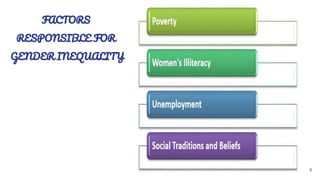
FACTORS
RESPONSIBLE FOR
GENDER INEQUALITY
6
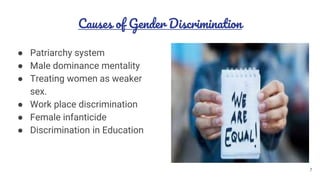
Causes of Gender Discrimination
● Patriarchy system
● Male dominance mentality
● Treating women as weaker
sex.
● Work place discrimination
● Female infanticide
● Discrimination in Education
7
Measures to remove
Gender discrimination
● Raising awareness about women rights
and increasing access to education
through schemes such as Beti Bachao
and Beti Padhao.
● Increasing representation of women by
reserving seats in legislature, increasing
the reservation of seats to 50% in rural
and urban self government.
● The Equal Remuneration Act,1976 must
be strictly enforced to reduce the existing
wage gaps.
● Strict punishment should be handed out to
people promoting female foeticide.
● Helping them become tech -savvy.
● Promote gender equality in schools.
● Focus on girls education.
9
CONT….
➔ In the pristine Vedic form, the caste system had its
validity in the modern, fast changing times;
➔ it is, however, not India’s monopoly. It existed, and
still exists in parts of Egypt and Europe, though in a
wilder form.
10
Discrimination
based on Caste
11
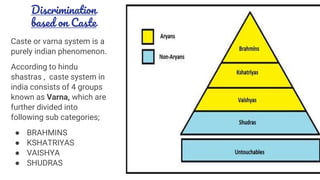
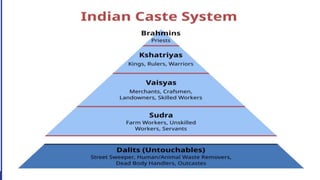
Caste or varna system is a
purely indian phenomenon.
According to hindu
shastras , caste system in
india consists of 4 groups
known as Varna, which are
further divided into
following sub categories;
● BRAHMINS
● KSHATRIYAS
● VAISHYA
● SHUDRAS
12
Evils of caste system
● J.H. Hutton is of the opinion that social stratification on the basis of caste in India
owes its origin to the Aryan invaders. It has never died, only changed its from and
manifestation form time to time.
● Since caste is based on tradition and custom, the worker is denied of his freedom to
choose an occupation of his choice.
● Talent and merit are sacrificed at the altar of casteism, leading to immobility, and
inefficiency of labour which results in economic backwardness.
● As Sir Henry Main maintains, a transition from status to contract is essential for
political as well as economic progress of the society.
13
Constitutional Provision
The deep concern of the framers of the Constitution for the uplift of the Scheduled Castes
and Scheduled Tribes and Other Backward Classes is reflected in the elaborate
constitutional mechanism set-up for their uplift.
★ Article 17 abolishes Untouchability.
★ Article 46 requires the State ‘to promote with special care the educational and
economic interests of the weaker sections of the people, and, in particular, of the
Scheduled Castes and the Scheduled Tribes, and to protect them from social injustice
and all forms of exploitation.
14
Cont…
★ CONSTITUTIONAL EMPOWERS the
state to make provisions for
reservation in educational institution
[ Article 15 (4) & { 5 }
★ And in appointments for post in
favour of SCs [Article 16 (4), 16 (4A)
16 (4B) and Article [335]
★ S0CIAL REFORMERS such as RAJA
RAM MOHAN ROY ,DR. B.R
.AMBEDKAR who devoted their lives
for upliftment of these downtrodden
people to abolish the caste system.
15
REFERENCES
● Bartlett, L. D., Weisentein, G.R. (2003)
Successful inclusion for educational
leaders, Prentice Hall, New Jersey.
● Bhargava, M. (1994), Introduction to
exceptional Children, Sterling
Publishers
● https://www.britannica.com/place/Ind
ia/Caste
● https://ncert.nic.in/dgs/pdf/overallrep
ortDGS_24_8_17.pdf
16
17

DISCRIMINATION BASED ON GENDER AND CASTE.pptx

  • 1.
    1 Subject : INCLUSIVEEDUCATION Topic : Discrimination based on Gender and Caste Submitted to : Ms. Wahida Ma ‘am Submitted by: MAHIMA SRIVASTAVA
  • 2.
    Content ● Discrimination ● Formsof gender Discrimination ● Types of Gender Inequality ● Factors Responsible For Gender Inequality ● Causes of gender Discrimination ● Discrimination BASED on GENDER ● Measures to remove gender discrimination ● Discrimination based on caste ● Evils of caste system ● Constitutional provisions 2
  • 3.
    What is Discrimination? ● Discrimination means the unfair treatment of a person or group on the basis of prejudice. ● It is an act or series of actions taken against a targeted group with the intention of preventing, devaluing,negating,or humiliating them. 3
  • 4.
    Discrimination Based onGender ❖ Gender discrimination means discrimination based on a gender or sex of a person,which more often affects girls and women . ❖ Because of it girls and women do not have the same opportunities as boys and men for education or meaningful careers ,economic advancement. ❖ High gender disparities found in parts of Bihar,South Orissa,Madhya pradesh, Jharkhand. 4
  • 5.
    TYPES OF Gender Inequality ●Inequality in family ● Natality inequality ● Professional inequality ● Ownership inequality ● Household inequality 5
  • 6.
  • 7.
    Causes of GenderDiscrimination ● Patriarchy system ● Male dominance mentality ● Treating women as weaker sex. ● Work place discrimination ● Female infanticide ● Discrimination in Education 7
  • 8.
    Measures to remove Genderdiscrimination ● Raising awareness about women rights and increasing access to education through schemes such as Beti Bachao and Beti Padhao. ● Increasing representation of women by reserving seats in legislature, increasing the reservation of seats to 50% in rural and urban self government. ● The Equal Remuneration Act,1976 must be strictly enforced to reduce the existing wage gaps. ● Strict punishment should be handed out to people promoting female foeticide. ● Helping them become tech -savvy. ● Promote gender equality in schools. ● Focus on girls education.
  • 9.
  • 10.
    CONT…. ➔ In thepristine Vedic form, the caste system had its validity in the modern, fast changing times; ➔ it is, however, not India’s monopoly. It existed, and still exists in parts of Egypt and Europe, though in a wilder form. 10
  • 11.
    Discrimination based on Caste 11 Casteor varna system is a purely indian phenomenon. According to hindu shastras , caste system in india consists of 4 groups known as Varna, which are further divided into following sub categories; ● BRAHMINS ● KSHATRIYAS ● VAISHYA ● SHUDRAS
  • 12.
  • 13.
    Evils of castesystem ● J.H. Hutton is of the opinion that social stratification on the basis of caste in India owes its origin to the Aryan invaders. It has never died, only changed its from and manifestation form time to time. ● Since caste is based on tradition and custom, the worker is denied of his freedom to choose an occupation of his choice. ● Talent and merit are sacrificed at the altar of casteism, leading to immobility, and inefficiency of labour which results in economic backwardness. ● As Sir Henry Main maintains, a transition from status to contract is essential for political as well as economic progress of the society. 13
  • 14.
    Constitutional Provision The deepconcern of the framers of the Constitution for the uplift of the Scheduled Castes and Scheduled Tribes and Other Backward Classes is reflected in the elaborate constitutional mechanism set-up for their uplift. ★ Article 17 abolishes Untouchability. ★ Article 46 requires the State ‘to promote with special care the educational and economic interests of the weaker sections of the people, and, in particular, of the Scheduled Castes and the Scheduled Tribes, and to protect them from social injustice and all forms of exploitation. 14
  • 15.
    Cont… ★ CONSTITUTIONAL EMPOWERSthe state to make provisions for reservation in educational institution [ Article 15 (4) & { 5 } ★ And in appointments for post in favour of SCs [Article 16 (4), 16 (4A) 16 (4B) and Article [335] ★ S0CIAL REFORMERS such as RAJA RAM MOHAN ROY ,DR. B.R .AMBEDKAR who devoted their lives for upliftment of these downtrodden people to abolish the caste system. 15
  • 16.
    REFERENCES ● Bartlett, L.D., Weisentein, G.R. (2003) Successful inclusion for educational leaders, Prentice Hall, New Jersey. ● Bhargava, M. (1994), Introduction to exceptional Children, Sterling Publishers ● https://www.britannica.com/place/Ind ia/Caste ● https://ncert.nic.in/dgs/pdf/overallrep ortDGS_24_8_17.pdf 16
  • 17.