Mobile IP
Prepared by: Purvik Rana Mihir Patel Nidhi Patel
Yagnesh Shinde Nirali Rana
Outline
 Mobility and IP
 Mobile IP
 Foreign Agent Discovery
 Home Agent Registration
 Tunneling and Encapsulation
 Route Optimization
2
Mobility
 With invention of the wireless technology the mobile
user live in the environment which provide services
 Anytime
 Anywhere
 Two Kinds of Mobility
 Seamless Mobility
 Mobility is totally transparent to application
 Portability Mobility
 Mobility is not transparent to applications when we move, but we can still access
the network at a new place
3
Problems
 We have seen that mobile users can change point of
attachment
 In a cellular network, a mobile changes base station.
 A mobile user can work at office and at home at different in a
day
 We want our applications not to be disturbed from
mobility
 We want to continue to talk with our cell-phone when we
change base-stations
4
What is Mobile IP?
 Mobile IP is an Internet Engineering Task Force(IETF) standard
protocols
 Designed to allow mobile device users to move from one network
to another while maintaining a permanent IP address
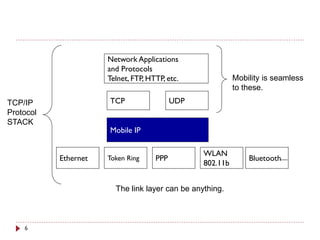
 Mobile IP is a layer-3 (network layer) mobility solution
 Support mobile users (laptops,PC etc) in the Internet in a seamless
manner.
 Higher protocol layers (TCP, UDP, RTP, etc) and applications are not
aware of mobility
 Mobile stations change physical point of attachments at the Physical layer
 Mobile IP is a solution that is independent of the physical and data-link
layers
5
Mobile IP
Ethernet Token Ring PPP
WLAN
802.11b
Bluetooth
TCP UDP
Network Applications
and Protocols
Telnet, FTP, HTTP, etc. Mobility is seamless
to these.
....
The link layer can be anything.
TCP/IP
Protocol
STACK
6
Why We Need Mobile IP?
 It is recognized that Mobile IP lacks flexibility with respect
to the transparent and mandatory mobility support to
various applications
 When multiple interfaces are available to one user device
to access heterogeneous networks flow level traffic
control is needed in addition to device level methods
7
Mobile IP Approach
 Mobile IP Uses twoTypes of address
 A fixed Home Address
 Used for Identification
 A Care- of Address
 Used for Routing
8
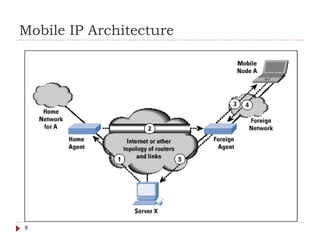
Mobile IP Architecture
9
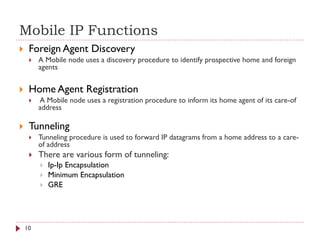
Mobile IP Functions
 Foreign Agent Discovery
 A Mobile node uses a discovery procedure to identify prospective home and foreign
agents
 Home Agent Registration
 A Mobile node uses a registration procedure to inform its home agent of its care-of
address
 Tunneling
 Tunneling procedure is used to forward IP datagrams from a home address to a care-
of address
 There are various form of tunneling:
 Ip-Ip Encapsulation
 Minimum Encapsulation
 GRE
10
Foreign Agent Discovery And
Home Agent Registration
Home Agent And Foreign Agent
 Home Agent
 is a router on a mobile node's home network that maintains
information
 the device's current location, as identified in its care-of address.
 Foreign Agent
 is a router serving as a mobility agent for a mobile node
 it works in conjunction with a home agent to support Internet
traffic forwarding - from any location other than its home
network of Mobile Node
12
Mobile Agent Discovery
 How a mobile node discovers the home and foreign
agents when it travels?
 Agents periodically broadcast their presence
(advertisement) on a link
 Agent advertisement messages.
 A mobile node receiving the advertisement understand
from the IP addresses included in the advertisement:
 Whether it is in the home network or not?
 Whether it has moved to new location or not.
13
Agent Advertisement Message
 Mobile nodes use agent advertisements to determine
 their current point of attachment to the Internet
 Its an Internet Control Message Protocol (ICMP) router
advertisement
 Extended to also carry a mobility agent advertisement extension
 A foreign agent can be too busy to serve additional mobile
nodes
 Must continue to send agent advertisements
 Already registered mobile nodes will know that they have not
moved out of range of the foreign agent and that the foreign
agent has not failed.
14
Registration
 Through agent advertisements, mobile nodes detect when
they have moved from one network to another
 Getting Agent Advertisement Message, Registration begin
which include,
 The mobile node registers through the foreign agent
 Even when the mobile node might be able to acquire its own
co-located care-of address
 Registration procedure consists of two type messages
 Registration Request
 Registration Reply
15
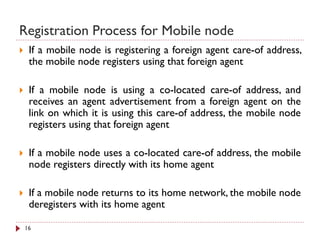
Registration Process for Mobile node
 If a mobile node is registering a foreign agent care-of address,
the mobile node registers using that foreign agent
 If a mobile node is using a co-located care-of address, and
receives an agent advertisement from a foreign agent on the
link on which it is using this care-of address, the mobile node
registers using that foreign agent
 If a mobile node uses a co-located care-of address, the mobile
node registers directly with its home agent
 If a mobile node returns to its home network, the mobile node
deregisters with its home agent
16
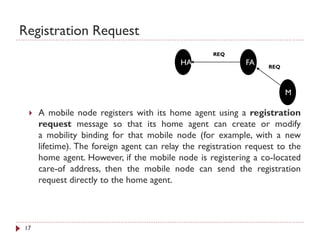
Registration Request
 A mobile node registers with its home agent using a registration
request message so that its home agent can create or modify
a mobility binding for that mobile node (for example, with a new
lifetime). The foreign agent can relay the registration request to the
home agent. However, if the mobile node is registering a co-located
care-of address, then the mobile node can send the registration
request directly to the home agent.
HA FA
M
REQ
REQ
17
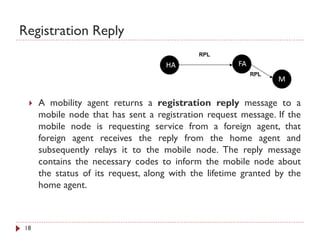
Registration Reply
 A mobility agent returns a registration reply message to a
mobile node that has sent a registration request message. If the
mobile node is requesting service from a foreign agent, that
foreign agent receives the reply from the home agent and
subsequently relays it to the mobile node. The reply message
contains the necessary codes to inform the mobile node about
the status of its request, along with the lifetime granted by the
home agent.
18
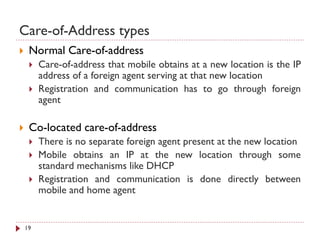
Care-of-Address types
 Normal Care-of-address
 Care-of-address that mobile obtains at a new location is the IP
address of a foreign agent serving at that new location
 Registration and communication has to go through foreign
agent
 Co-located care-of-address
 There is no separate foreign agent present at the new location
 Mobile obtains an IP at the new location through some
standard mechanisms like DHCP
 Registration and communication is done directly between
mobile and home agent
19
Security
 Security Problem
 Fraud Registration should be detected.
 Three Authentication Extension defined for the Mobile IP
 The mobile-home authentication extension.
 The mobile-foreign authentication extension.
 The foreign-home authentication extension
20
Tunnelling with Encapsulation
Tunneling
 The home agent will intercept datagram intended for the mobile
node
 When a correspondent host sends an IP packet to a mobile (to its
home address)
 packet is routed first to home agent of mobile through normal
routing
 Home agent intercepts the packet and encapsulates it and tunnels
it to the care-of-address of the mobile.
 The encapsulated packet is delivered to the care-of-address
using normal routing
22
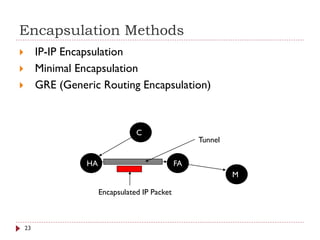
Encapsulation Methods
 IP-IP Encapsulation
 Minimal Encapsulation
 GRE (Generic Routing Encapsulation)
HA FA
M
C
Encapsulated IP Packet
Tunnel
23
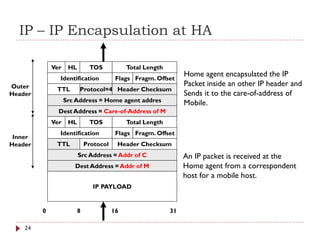
IP – IP Encapsulation at HA
Dest Address = Addr of M
Src Address = Addr of C
TTL Protocol Header Checksum
Identification Fragm. OffsetFlags
Total LengthTOSVer HL
0 8 16 31
IP PAYLOAD
Dest Address = Care-of-Address of M
Src Address = Home agent addres
TTL Protocol=4 Header Checksum
Identification Fragm. OffsetFlags
Total LengthTOSVer HL
An IP packet is received at the
Home agent from a correspondent
host for a mobile host.
Home agent encapsulated the IP
Packet inside an other IP header and
Sends it to the care-of-address of
Mobile.
Inner
Header
Outer
Header
24
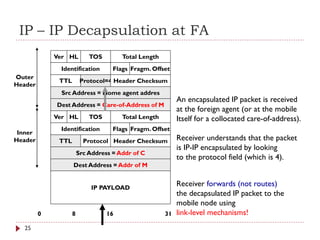
IP – IP Decapsulation at FA
Dest Address = Addr of M
Src Address = Addr of C
TTL Protocol Header Checksum
Identification Fragm. OffsetFlags
Total LengthTOSVer HL
0 8 16 31
IP PAYLOAD
Dest Address = Care-of-Address of M
Src Address = Home agent addres
TTL Protocol=4 Header Checksum
Identification Fragm. OffsetFlags
Total LengthTOSVer HL
An encapsulated IP packet is received
at the foreign agent (or at the mobile
Itself for a collocated care-of-address).
Receiver understands that the packet
is IP-IP encapsulated by looking
to the protocol field (which is 4).
Inner
Header
Outer
Header
Receiver forwards (not routes)
the decapsulated IP packet to the
mobile node using
link-level mechanisms!
25
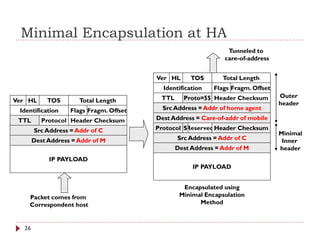
Minimal Encapsulation at HA
Dest Address = Addr of M
Src Address = Addr of C
TTL Protocol Header Checksum
Identification Fragm. OffsetFlags
Total LengthTOSVer HL
IP PAYLOAD
Dest Address = Addr of M
Src Address = Addr of C
Protocol ReservedHeader Checksum
IP PAYLOAD
S
Dest Address = Care-of-addr of mobile
Src Address = Addr of home agent
TTL Proto=55 Header Checksum
Identification Fragm. OffsetFlags
Total LengthTOSVer HL
Outer
header
Minimal
Inner
header
Packet comes from
Correspondent host
Encapsulated using
Minimal Encapsulation
Method
Tunneled to
care-of-address
26
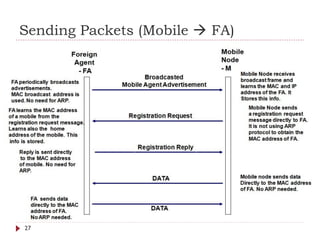
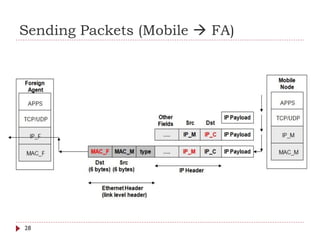
Sending Packets (Mobile  FA)
27
Sending Packets (Mobile  FA)
28
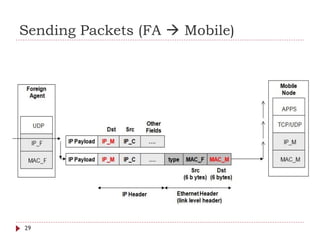
Sending Packets (FA  Mobile)
29
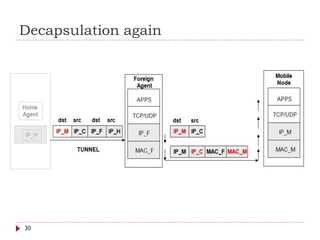
Decapsulation again
30
Route Optimization
What it is?
 Enable direct notification of the corresponding host
 Direct tunneling from the corresponding host to the
mobile host
 Binding cache maintained at corresponding host
32
Three mobility scenarios addressed by
Route Optimization
 MN traverses from its home domain to the foreign
domain with open communication sessions.
 MN initiates new communication sessions when it is in
the foreign domain
 MN moves from one foreign domain to another with
open communication sessions
33
Route Optimization Messages
 4 types of messages
 Binding update
 Binding request
 Binding warning
 Binding acknowledge
34
Binding Update
 When a home agent receives a packet to be tunneled
to a mobile host, it sends a binding update message to
the corresponding host
 When a home agent receives a binding request
message, it replies with a binding update message
 Also used in the smooth-handoffs optimization
35
 The current mobility management protocol Mobile IP
(MIP) specifies the use of a Home Agent (HA) in
forwarding datagram's to/from the Mobile Node (MN)
 Either triangular routing
 Reverse tunneling
 Additional delay in data transmission.
36
Route Optimization Techniques
 FA to forward the datagrams destined for the MN to its
new care-of address for a short duration
37
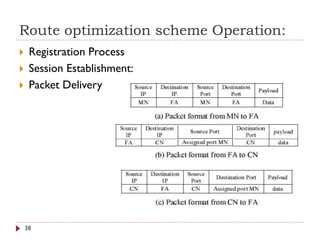
Route optimization scheme Operation:
 Registration Process
 Session Establishment:
 Packet Delivery
38
Advantages of Route Optimization
 Allows the shortest communications path to be used
 Eliminates congestion at the mobile node's home agent
and home link
 The impact of any possible failure of the home agent or
networks on the path to or from it is reduced
 Route optimization scheme attempts to reduce the
overhead and delay involved with traditional mobile
communication
39
References
o http://www.ee.sunysb.edu/~xwang/public/readings/ieee-
mobileip98.pdf
o http://home.deib.polimi.it/capone/rmd/materiale_tarr/4-
mobile-ip/Perkins-book-chapter.pdf
o http://www.tcpipguide.com/free/t_MobileIPDataEncapsula
tionandTunneling.htm
o http://www.cs.colorado.edu/~rhan/CSCI_7143_001_Fall_
2002/Papers/Perkins_Tutorial_Mobile_IP.htm
40
Cont…
 Port AddressTranslation Based Route Optimization for
Mobile IP D Badami, NThanthry,T Best, R Bhagavathula,
and R Pendse Department of Electrical and Computer
EngineeringWichita State University 1845 Fairmount,
Wichita KS 67260 USA (0-7803-8521-7/04/$20.00 ©
2004 IEEE)
 Route Optimization in Network Mobility:Abu Zafar M.
Shahriar, Mohammed Atiquzzaman, Senior Member, IEEE,
andWilliam Ivancic(1553-877X/10/$25.00 c 2010 IEEE)
41

Mobile ip group_3

  • 1.
    Mobile IP Prepared by:Purvik Rana Mihir Patel Nidhi Patel Yagnesh Shinde Nirali Rana
  • 2.
    Outline  Mobility andIP  Mobile IP  Foreign Agent Discovery  Home Agent Registration  Tunneling and Encapsulation  Route Optimization 2
  • 3.
    Mobility  With inventionof the wireless technology the mobile user live in the environment which provide services  Anytime  Anywhere  Two Kinds of Mobility  Seamless Mobility  Mobility is totally transparent to application  Portability Mobility  Mobility is not transparent to applications when we move, but we can still access the network at a new place 3
  • 4.
    Problems  We haveseen that mobile users can change point of attachment  In a cellular network, a mobile changes base station.  A mobile user can work at office and at home at different in a day  We want our applications not to be disturbed from mobility  We want to continue to talk with our cell-phone when we change base-stations 4
  • 5.
    What is MobileIP?  Mobile IP is an Internet Engineering Task Force(IETF) standard protocols  Designed to allow mobile device users to move from one network to another while maintaining a permanent IP address  Mobile IP is a layer-3 (network layer) mobility solution  Support mobile users (laptops,PC etc) in the Internet in a seamless manner.  Higher protocol layers (TCP, UDP, RTP, etc) and applications are not aware of mobility  Mobile stations change physical point of attachments at the Physical layer  Mobile IP is a solution that is independent of the physical and data-link layers 5
  • 6.
    Mobile IP Ethernet TokenRing PPP WLAN 802.11b Bluetooth TCP UDP Network Applications and Protocols Telnet, FTP, HTTP, etc. Mobility is seamless to these. .... The link layer can be anything. TCP/IP Protocol STACK 6
  • 7.
    Why We NeedMobile IP?  It is recognized that Mobile IP lacks flexibility with respect to the transparent and mandatory mobility support to various applications  When multiple interfaces are available to one user device to access heterogeneous networks flow level traffic control is needed in addition to device level methods 7
  • 8.
    Mobile IP Approach Mobile IP Uses twoTypes of address  A fixed Home Address  Used for Identification  A Care- of Address  Used for Routing 8
  • 9.
  • 10.
    Mobile IP Functions Foreign Agent Discovery  A Mobile node uses a discovery procedure to identify prospective home and foreign agents  Home Agent Registration  A Mobile node uses a registration procedure to inform its home agent of its care-of address  Tunneling  Tunneling procedure is used to forward IP datagrams from a home address to a care- of address  There are various form of tunneling:  Ip-Ip Encapsulation  Minimum Encapsulation  GRE 10
  • 11.
    Foreign Agent DiscoveryAnd Home Agent Registration
  • 12.
    Home Agent AndForeign Agent  Home Agent  is a router on a mobile node's home network that maintains information  the device's current location, as identified in its care-of address.  Foreign Agent  is a router serving as a mobility agent for a mobile node  it works in conjunction with a home agent to support Internet traffic forwarding - from any location other than its home network of Mobile Node 12
  • 13.
    Mobile Agent Discovery How a mobile node discovers the home and foreign agents when it travels?  Agents periodically broadcast their presence (advertisement) on a link  Agent advertisement messages.  A mobile node receiving the advertisement understand from the IP addresses included in the advertisement:  Whether it is in the home network or not?  Whether it has moved to new location or not. 13
  • 14.
    Agent Advertisement Message Mobile nodes use agent advertisements to determine  their current point of attachment to the Internet  Its an Internet Control Message Protocol (ICMP) router advertisement  Extended to also carry a mobility agent advertisement extension  A foreign agent can be too busy to serve additional mobile nodes  Must continue to send agent advertisements  Already registered mobile nodes will know that they have not moved out of range of the foreign agent and that the foreign agent has not failed. 14
  • 15.
    Registration  Through agentadvertisements, mobile nodes detect when they have moved from one network to another  Getting Agent Advertisement Message, Registration begin which include,  The mobile node registers through the foreign agent  Even when the mobile node might be able to acquire its own co-located care-of address  Registration procedure consists of two type messages  Registration Request  Registration Reply 15
  • 16.
    Registration Process forMobile node  If a mobile node is registering a foreign agent care-of address, the mobile node registers using that foreign agent  If a mobile node is using a co-located care-of address, and receives an agent advertisement from a foreign agent on the link on which it is using this care-of address, the mobile node registers using that foreign agent  If a mobile node uses a co-located care-of address, the mobile node registers directly with its home agent  If a mobile node returns to its home network, the mobile node deregisters with its home agent 16
  • 17.
    Registration Request  Amobile node registers with its home agent using a registration request message so that its home agent can create or modify a mobility binding for that mobile node (for example, with a new lifetime). The foreign agent can relay the registration request to the home agent. However, if the mobile node is registering a co-located care-of address, then the mobile node can send the registration request directly to the home agent. HA FA M REQ REQ 17
  • 18.
    Registration Reply  Amobility agent returns a registration reply message to a mobile node that has sent a registration request message. If the mobile node is requesting service from a foreign agent, that foreign agent receives the reply from the home agent and subsequently relays it to the mobile node. The reply message contains the necessary codes to inform the mobile node about the status of its request, along with the lifetime granted by the home agent. 18
  • 19.
    Care-of-Address types  NormalCare-of-address  Care-of-address that mobile obtains at a new location is the IP address of a foreign agent serving at that new location  Registration and communication has to go through foreign agent  Co-located care-of-address  There is no separate foreign agent present at the new location  Mobile obtains an IP at the new location through some standard mechanisms like DHCP  Registration and communication is done directly between mobile and home agent 19
  • 20.
    Security  Security Problem Fraud Registration should be detected.  Three Authentication Extension defined for the Mobile IP  The mobile-home authentication extension.  The mobile-foreign authentication extension.  The foreign-home authentication extension 20
  • 21.
  • 22.
    Tunneling  The homeagent will intercept datagram intended for the mobile node  When a correspondent host sends an IP packet to a mobile (to its home address)  packet is routed first to home agent of mobile through normal routing  Home agent intercepts the packet and encapsulates it and tunnels it to the care-of-address of the mobile.  The encapsulated packet is delivered to the care-of-address using normal routing 22
  • 23.
    Encapsulation Methods  IP-IPEncapsulation  Minimal Encapsulation  GRE (Generic Routing Encapsulation) HA FA M C Encapsulated IP Packet Tunnel 23
  • 24.
    IP – IPEncapsulation at HA Dest Address = Addr of M Src Address = Addr of C TTL Protocol Header Checksum Identification Fragm. OffsetFlags Total LengthTOSVer HL 0 8 16 31 IP PAYLOAD Dest Address = Care-of-Address of M Src Address = Home agent addres TTL Protocol=4 Header Checksum Identification Fragm. OffsetFlags Total LengthTOSVer HL An IP packet is received at the Home agent from a correspondent host for a mobile host. Home agent encapsulated the IP Packet inside an other IP header and Sends it to the care-of-address of Mobile. Inner Header Outer Header 24
  • 25.
    IP – IPDecapsulation at FA Dest Address = Addr of M Src Address = Addr of C TTL Protocol Header Checksum Identification Fragm. OffsetFlags Total LengthTOSVer HL 0 8 16 31 IP PAYLOAD Dest Address = Care-of-Address of M Src Address = Home agent addres TTL Protocol=4 Header Checksum Identification Fragm. OffsetFlags Total LengthTOSVer HL An encapsulated IP packet is received at the foreign agent (or at the mobile Itself for a collocated care-of-address). Receiver understands that the packet is IP-IP encapsulated by looking to the protocol field (which is 4). Inner Header Outer Header Receiver forwards (not routes) the decapsulated IP packet to the mobile node using link-level mechanisms! 25
  • 26.
    Minimal Encapsulation atHA Dest Address = Addr of M Src Address = Addr of C TTL Protocol Header Checksum Identification Fragm. OffsetFlags Total LengthTOSVer HL IP PAYLOAD Dest Address = Addr of M Src Address = Addr of C Protocol ReservedHeader Checksum IP PAYLOAD S Dest Address = Care-of-addr of mobile Src Address = Addr of home agent TTL Proto=55 Header Checksum Identification Fragm. OffsetFlags Total LengthTOSVer HL Outer header Minimal Inner header Packet comes from Correspondent host Encapsulated using Minimal Encapsulation Method Tunneled to care-of-address 26
  • 27.
  • 28.
  • 29.
    Sending Packets (FA Mobile) 29
  • 30.
  • 31.
  • 32.
    What it is? Enable direct notification of the corresponding host  Direct tunneling from the corresponding host to the mobile host  Binding cache maintained at corresponding host 32
  • 33.
    Three mobility scenariosaddressed by Route Optimization  MN traverses from its home domain to the foreign domain with open communication sessions.  MN initiates new communication sessions when it is in the foreign domain  MN moves from one foreign domain to another with open communication sessions 33
  • 34.
    Route Optimization Messages 4 types of messages  Binding update  Binding request  Binding warning  Binding acknowledge 34
  • 35.
    Binding Update  Whena home agent receives a packet to be tunneled to a mobile host, it sends a binding update message to the corresponding host  When a home agent receives a binding request message, it replies with a binding update message  Also used in the smooth-handoffs optimization 35
  • 36.
     The currentmobility management protocol Mobile IP (MIP) specifies the use of a Home Agent (HA) in forwarding datagram's to/from the Mobile Node (MN)  Either triangular routing  Reverse tunneling  Additional delay in data transmission. 36
  • 37.
    Route Optimization Techniques FA to forward the datagrams destined for the MN to its new care-of address for a short duration 37
  • 38.
    Route optimization schemeOperation:  Registration Process  Session Establishment:  Packet Delivery 38
  • 39.
    Advantages of RouteOptimization  Allows the shortest communications path to be used  Eliminates congestion at the mobile node's home agent and home link  The impact of any possible failure of the home agent or networks on the path to or from it is reduced  Route optimization scheme attempts to reduce the overhead and delay involved with traditional mobile communication 39
  • 40.
    References o http://www.ee.sunysb.edu/~xwang/public/readings/ieee- mobileip98.pdf o http://home.deib.polimi.it/capone/rmd/materiale_tarr/4- mobile-ip/Perkins-book-chapter.pdf ohttp://www.tcpipguide.com/free/t_MobileIPDataEncapsula tionandTunneling.htm o http://www.cs.colorado.edu/~rhan/CSCI_7143_001_Fall_ 2002/Papers/Perkins_Tutorial_Mobile_IP.htm 40
  • 41.
    Cont…  Port AddressTranslationBased Route Optimization for Mobile IP D Badami, NThanthry,T Best, R Bhagavathula, and R Pendse Department of Electrical and Computer EngineeringWichita State University 1845 Fairmount, Wichita KS 67260 USA (0-7803-8521-7/04/$20.00 © 2004 IEEE)  Route Optimization in Network Mobility:Abu Zafar M. Shahriar, Mohammed Atiquzzaman, Senior Member, IEEE, andWilliam Ivancic(1553-877X/10/$25.00 c 2010 IEEE) 41