MITOCHONDRIA
1
2
3
Mitochondria The organelle that releases energy
in the cell. (The powerhouse of the cell)
Mitochondria produce ATP using energy stored in
food molecules.
Mitochondria are the primary energy producers in
cells.
Structure
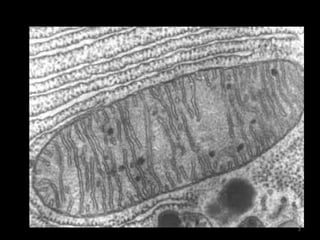
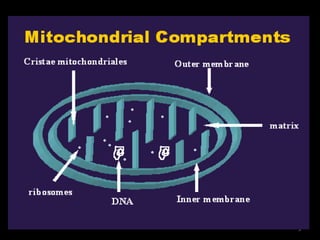
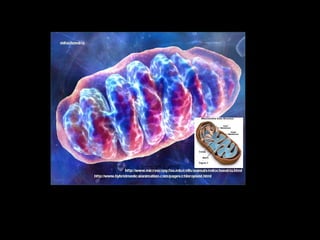
• Mitochondria have a double membrane
structure
• There is a single outer membrane and a folded
inner membrane
6
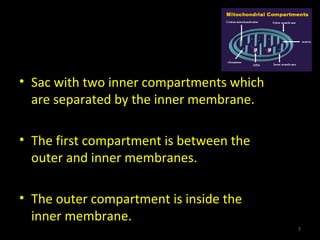
• Sac with two inner compartments which
are separated by the inner membrane.
• The first compartment is between the
outer and inner membranes.
• The outer compartment is inside the
inner membrane.
7
• The outer mitochondrial membrane is
composed of about 50% phospholipids by
weight and contains a variety of enzymes
involved in such diverse activities as the
elongation of fatty acids, oxidation of
epinephrine (adrenaline), and the degradation
of tryptophan.
8
• The inner membrane contains proteins with three
types of functions [Alberts, 1994]:
• those that carry out the oxidation reactions of the
respiratory chain
• ATP synthase, which makes ATP in the matrix
• specific transport proteins that regulate the passage
of metabolites into and out of the matrix.
9
Function
• Energy production the mitochondria has
been called the "powerhouse of the cell".
• They use complex molecules and oxygen to
produce a high energy molecule know as ATP
(Adenosine Triphosphate)
• process called aerobic respiration
• Mitochondria are very abundant in cells that
require lots of energy.
• Ex:- Muscle
10
Unique
• Mitochondria are very unique in several
regards
– have their own circular DNA
– have their own Ribosomes.
(The DNA in the cell nucleus does not code for the
construction of mitochondria. )
11
• All the mitochondria in your body came
from your mother.
• Mitochondria are not part of the genetic
code in the nucleus of your cells.
12
• Fathers only give genes to their children.
• Mothers give genes and cytoplasm to their
children in their egg cells.
• Since mitochondria are in the cytoplasm and
reproduce themselves .
• Geneticists have used this curious feature of
mitochondria to study maternal family lines
and rates of evolution.
13
• Although the primary function of mitochondria is to
convert organic materials into cellular energy in the
form of ATP, mitochondria play an important role in
many metabolic tasks, such as:
• Apoptosis-Programmed cell death
• Glutamate-mediated excitotoxic neuronal injury
• Cellular proliferation
• Regulation of the cellular redox state
• Heme synthesis
• Steroid synthesis
14
• Heat production (enabling the organism to stay
warm).
• Some mitochondrial functions are performed only
in specific types of cells. For example,
mitochondria in liver cells contain enzymes that
allow them to detoxify ammonia, a waste product
of protein metabolism. A mutation in the genes
regulating any of these functions can result in a
variety of mitochondrial diseases.
15
Plastids
In most plant cells structures called plastids are found. They are found
in the cytoplasmic matrix of plant cells only. These structures are
generally spherical or ovoid in shape and they are clearly visible in living
cells. We will discuss 3 types of plastids found in plant cells:
Chromoplasts
Chromoplasts are red, yellow or orange in color and are
found in petals of flowers and in fruit. Their color is due to
two pigments, carotene and xanthophylls.
Functions
•the primary function in the cells of flowers is to attract
agents of pollination,
•and in fruit to attract agents of dispersal.
Leucoplasts
Leucoplasts are colourless plastids and occur in
plant cells not exposed to light, such as roots
and seeds. They are colourless due the absent
of pigments.
Functions
•leucoplasts are the centers of starch grain
formation;
•they are also involved in the synthesis of oils
and proteins.
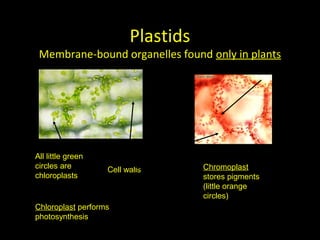
Plastids
Membrane-bound organelles found only in plants
Chloroplast performs
photosynthesis
Chromoplast
stores pigments
(little orange
circles)
All little green
circles are
chloroplasts
Cell walls
Chloroplasts
Chloroplasts are probably the most important among the plastids
since they are directly involved in photosynthesis. They are usually
situated near the surface of the cell and occur in those parts that
receive sufficient light, e.g. the palisade cells of leaves. The green
colour of chloroplasts is caused by the green pigment chlorophyll.
Functions
•chloroplasts are the sites for photosynthesis;
•they contain enzymes and co-enzymes necessary for the
process of photosynthesis.
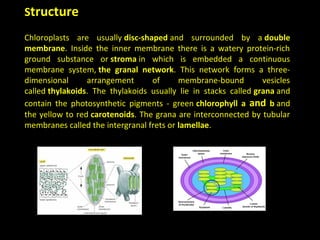
Structure
Chloroplasts are usually disc-shaped and surrounded by a double
membrane. Inside the inner membrane there is a watery protein-rich
ground substance or stroma in which is embedded a continuous
membrane system, the granal network. This network forms a three-
dimensional arrangement of membrane-bound vesicles
called thylakoids. The thylakoids usually lie in stacks called grana and
contain the photosynthetic pigments - green chlorophyll a and b and
the yellow to red carotenoids. The grana are interconnected by tubular
membranes called the intergranal frets or lamellae.
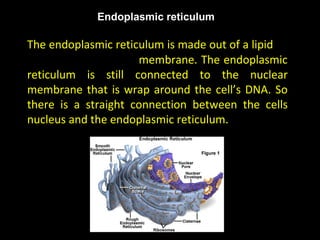
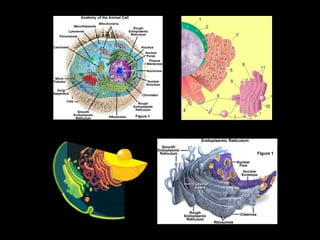
The endoplasmic reticulum is made out of a lipid
membrane. The endoplasmic
reticulum is still connected to the nuclear
membrane that is wrap around the cell’s DNA. So
there is a straight connection between the cells
nucleus and the endoplasmic reticulum.
 Endoplasmic reticulum
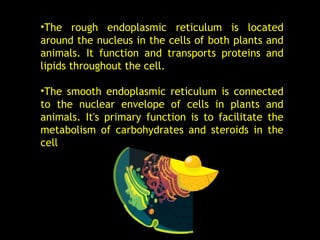
•The rough endoplasmic reticulum is located
around the nucleus in the cells of both plants and
animals. It function and transports proteins and
lipids throughout the cell.
•The smooth endoplasmic reticulum is connected
to the nuclear envelope of cells in plants and
animals. It's primary function is to facilitate the
metabolism of carbohydrates and steroids in the
cell
The endoplasmic reticulum is a eukaryotic organelle
that forms an interconnected network of tubules,
vesicles, and cisternae within cells.
Rough endoplasmic reticula synthesize proteins, while
smooth endoplasmic reticula synthesize lipids and
steroids, metabolize carbohydrates and steroids, and
regulate calcium concentration, drug detoxification,
and attachment of receptors on cell membrane
proteins. Sarcoplasmic reticula solely regulate
calcium levels.
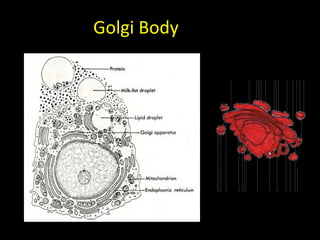
Golgi Body
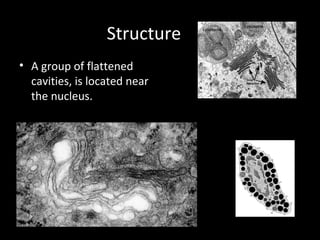
Structure
• A group of flattened
cavities, is located near
the nucleus.
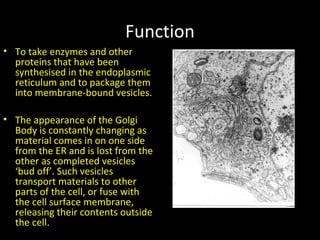
Function
• To take enzymes and other
proteins that have been
synthesised in the endoplasmic
reticulum and to package them
into membrane-bound vesicles.
• The appearance of the Golgi
Body is constantly changing as
material comes in on one side
from the ER and is lost from the
other as completed vesicles
‘bud off’. Such vesicles
transport materials to other
parts of the cell, or fuse with
the cell surface membrane,
releasing their contents outside
the cell.
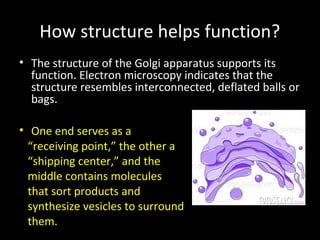
How structure helps function?
• The structure of the Golgi apparatus supports its
function. Electron microscopy indicates that the
structure resembles interconnected, deflated balls or
bags.
• One end serves as a
“receiving point,” the other a
“shipping center,” and the
middle contains molecules
that sort products and
synthesize vesicles to surround
them.
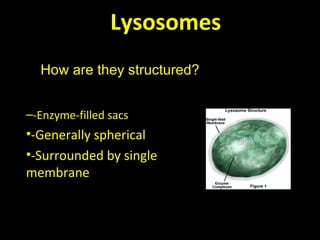
Lysosomes
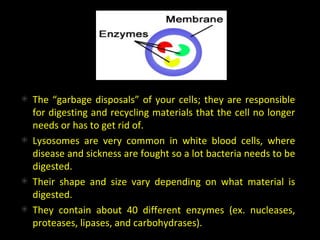
–-Enzyme-filled sacs
•-Generally spherical
•-Surrounded by single
membrane
How are they structured?
The “garbage disposals” of your cells; they are responsible
for digesting and recycling materials that the cell no longer
needs or has to get rid of.
Lysosomes are very common in white blood cells, where
disease and sickness are fought so a lot bacteria needs to be
digested.
Their shape and size vary depending on what material is
digested.
They contain about 40 different enzymes (ex. nucleases,
proteases, lipases, and carbohydrases).
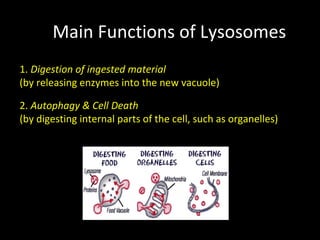
Main Functions of Lysosomes
1. Digestion of ingested material
(by releasing enzymes into the new vacuole)
2. Autophagy & Cell Death
(by digesting internal parts of the cell, such as organelles)
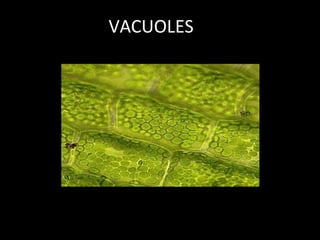
VACUOLES
Source 15
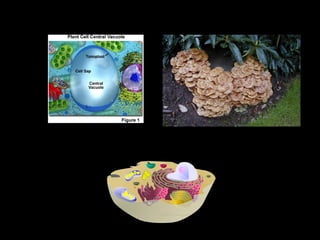
Vacuoles are organelles found in cells.
They store various substances essential
to the life of the cell. They also store
waste to later remove from the cell.
Vacuoles, like vacuums, remove waste
products harmful to the cell. In addition,
they store water and essential nutrients for
later use. For this reason, they are called
“storage bubbles "or “storage bins”.
Microbodies/Peroxisome
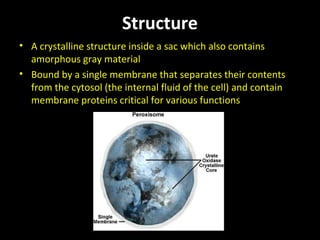
Structure
• A crystalline structure inside a sac which also contains
amorphous gray material
• Bound by a single membrane that separates their contents
from the cytosol (the internal fluid of the cell) and contain
membrane proteins critical for various functions

Mitochodria

  • 1.
  • 2.
  • 3.
  • 5.
    Mitochondria The organellethat releases energy in the cell. (The powerhouse of the cell) Mitochondria produce ATP using energy stored in food molecules. Mitochondria are the primary energy producers in cells.
  • 6.
    Structure • Mitochondria havea double membrane structure • There is a single outer membrane and a folded inner membrane 6
  • 7.
    • Sac withtwo inner compartments which are separated by the inner membrane. • The first compartment is between the outer and inner membranes. • The outer compartment is inside the inner membrane. 7
  • 8.
    • The outermitochondrial membrane is composed of about 50% phospholipids by weight and contains a variety of enzymes involved in such diverse activities as the elongation of fatty acids, oxidation of epinephrine (adrenaline), and the degradation of tryptophan. 8
  • 9.
    • The innermembrane contains proteins with three types of functions [Alberts, 1994]: • those that carry out the oxidation reactions of the respiratory chain • ATP synthase, which makes ATP in the matrix • specific transport proteins that regulate the passage of metabolites into and out of the matrix. 9
  • 10.
    Function • Energy productionthe mitochondria has been called the "powerhouse of the cell". • They use complex molecules and oxygen to produce a high energy molecule know as ATP (Adenosine Triphosphate) • process called aerobic respiration • Mitochondria are very abundant in cells that require lots of energy. • Ex:- Muscle 10
  • 11.
    Unique • Mitochondria arevery unique in several regards – have their own circular DNA – have their own Ribosomes. (The DNA in the cell nucleus does not code for the construction of mitochondria. ) 11
  • 12.
    • All themitochondria in your body came from your mother. • Mitochondria are not part of the genetic code in the nucleus of your cells. 12
  • 13.
    • Fathers onlygive genes to their children. • Mothers give genes and cytoplasm to their children in their egg cells. • Since mitochondria are in the cytoplasm and reproduce themselves . • Geneticists have used this curious feature of mitochondria to study maternal family lines and rates of evolution. 13
  • 14.
    • Although theprimary function of mitochondria is to convert organic materials into cellular energy in the form of ATP, mitochondria play an important role in many metabolic tasks, such as: • Apoptosis-Programmed cell death • Glutamate-mediated excitotoxic neuronal injury • Cellular proliferation • Regulation of the cellular redox state • Heme synthesis • Steroid synthesis 14
  • 15.
    • Heat production(enabling the organism to stay warm). • Some mitochondrial functions are performed only in specific types of cells. For example, mitochondria in liver cells contain enzymes that allow them to detoxify ammonia, a waste product of protein metabolism. A mutation in the genes regulating any of these functions can result in a variety of mitochondrial diseases. 15
  • 16.
    Plastids In most plantcells structures called plastids are found. They are found in the cytoplasmic matrix of plant cells only. These structures are generally spherical or ovoid in shape and they are clearly visible in living cells. We will discuss 3 types of plastids found in plant cells: Chromoplasts Chromoplasts are red, yellow or orange in color and are found in petals of flowers and in fruit. Their color is due to two pigments, carotene and xanthophylls. Functions •the primary function in the cells of flowers is to attract agents of pollination, •and in fruit to attract agents of dispersal.
  • 17.
    Leucoplasts Leucoplasts are colourlessplastids and occur in plant cells not exposed to light, such as roots and seeds. They are colourless due the absent of pigments. Functions •leucoplasts are the centers of starch grain formation; •they are also involved in the synthesis of oils and proteins.
  • 18.
    Plastids Membrane-bound organelles foundonly in plants Chloroplast performs photosynthesis Chromoplast stores pigments (little orange circles) All little green circles are chloroplasts Cell walls
  • 19.
    Chloroplasts Chloroplasts are probablythe most important among the plastids since they are directly involved in photosynthesis. They are usually situated near the surface of the cell and occur in those parts that receive sufficient light, e.g. the palisade cells of leaves. The green colour of chloroplasts is caused by the green pigment chlorophyll. Functions •chloroplasts are the sites for photosynthesis; •they contain enzymes and co-enzymes necessary for the process of photosynthesis.
  • 20.
    Structure Chloroplasts are usuallydisc-shaped and surrounded by a double membrane. Inside the inner membrane there is a watery protein-rich ground substance or stroma in which is embedded a continuous membrane system, the granal network. This network forms a three- dimensional arrangement of membrane-bound vesicles called thylakoids. The thylakoids usually lie in stacks called grana and contain the photosynthetic pigments - green chlorophyll a and b and the yellow to red carotenoids. The grana are interconnected by tubular membranes called the intergranal frets or lamellae.
  • 21.
    The endoplasmic reticulumis made out of a lipid membrane. The endoplasmic reticulum is still connected to the nuclear membrane that is wrap around the cell’s DNA. So there is a straight connection between the cells nucleus and the endoplasmic reticulum.  Endoplasmic reticulum
  • 22.
    •The rough endoplasmicreticulum is located around the nucleus in the cells of both plants and animals. It function and transports proteins and lipids throughout the cell. •The smooth endoplasmic reticulum is connected to the nuclear envelope of cells in plants and animals. It's primary function is to facilitate the metabolism of carbohydrates and steroids in the cell
  • 23.
    The endoplasmic reticulumis a eukaryotic organelle that forms an interconnected network of tubules, vesicles, and cisternae within cells. Rough endoplasmic reticula synthesize proteins, while smooth endoplasmic reticula synthesize lipids and steroids, metabolize carbohydrates and steroids, and regulate calcium concentration, drug detoxification, and attachment of receptors on cell membrane proteins. Sarcoplasmic reticula solely regulate calcium levels.
  • 25.
  • 26.
    Structure • A groupof flattened cavities, is located near the nucleus.
  • 27.
    Function • To takeenzymes and other proteins that have been synthesised in the endoplasmic reticulum and to package them into membrane-bound vesicles. • The appearance of the Golgi Body is constantly changing as material comes in on one side from the ER and is lost from the other as completed vesicles ‘bud off’. Such vesicles transport materials to other parts of the cell, or fuse with the cell surface membrane, releasing their contents outside the cell.
  • 28.
    How structure helpsfunction? • The structure of the Golgi apparatus supports its function. Electron microscopy indicates that the structure resembles interconnected, deflated balls or bags. • One end serves as a “receiving point,” the other a “shipping center,” and the middle contains molecules that sort products and synthesize vesicles to surround them.
  • 29.
  • 30.
    The “garbage disposals”of your cells; they are responsible for digesting and recycling materials that the cell no longer needs or has to get rid of. Lysosomes are very common in white blood cells, where disease and sickness are fought so a lot bacteria needs to be digested. Their shape and size vary depending on what material is digested. They contain about 40 different enzymes (ex. nucleases, proteases, lipases, and carbohydrases).
  • 31.
    Main Functions ofLysosomes 1. Digestion of ingested material (by releasing enzymes into the new vacuole) 2. Autophagy & Cell Death (by digesting internal parts of the cell, such as organelles)
  • 32.
  • 33.
    Vacuoles are organellesfound in cells. They store various substances essential to the life of the cell. They also store waste to later remove from the cell.
  • 34.
    Vacuoles, like vacuums,remove waste products harmful to the cell. In addition, they store water and essential nutrients for later use. For this reason, they are called “storage bubbles "or “storage bins”.
  • 36.
  • 37.
    Structure • A crystallinestructure inside a sac which also contains amorphous gray material • Bound by a single membrane that separates their contents from the cytosol (the internal fluid of the cell) and contain membrane proteins critical for various functions

Editor's Notes