Management information systemThird Year Information TechnologyPart 07Expert SystemsTushar B Kute,Department of Information Technology,Sandip Institute of Technology and Research Centre, Nashikhttp://www.tusharkute.com
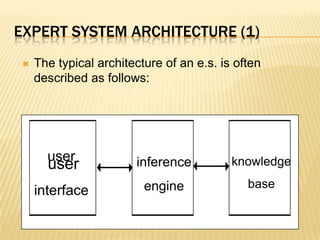
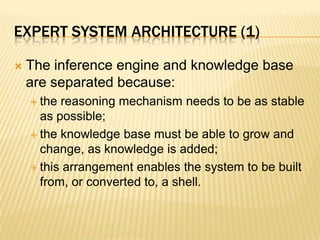
Expert system architecture (1)The typical architecture of an e.s. is often described as follows:userinterfaceuserinferenceengineknowledgebase
Expert system architecture (1)The inference engine and knowledge base are separated because:the reasoning mechanism needs to be as stable as possible;the knowledge base must be able to grow and change, as knowledge is added;this arrangement enables the system to be built from, or converted to, a shell.
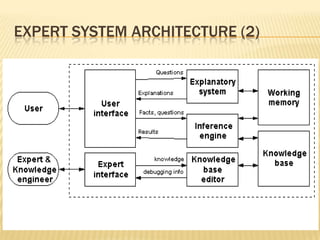
Expert system architecture (2) It is reasonable to produce a richer, more elaborate, description of the typical expert system.A more elaborate description, which still includes the components that are to be found in almost any real-world system, would look like this:
Expert system architecture (2)
The system holds a collection of general principles which can potentially be applied to any problem - these are stored in the knowledge base.The system also holds a collection of specific details that apply to the current problem (including details of how the current reasoning process is progressing) - these are held in working memory.Both these sorts of information are processed by the inference engine.Expert system architecture (2)
Expert system architecture (2)Any practical expert system needs an explanatory facility. It is essential that an expert system should be able to explain its reasoning.
Expert & Knowledge-Based SystemsOne of AI’s greatest areas of success was the development of large-scale problem solving systemsOriginally called expert systems, they would mimic the problem solving processes of domain expertsSuch as doctors performing diagnosis, or engineers performing design, or wall street analysts selecting stock transactionsExpert systems were originally developed by handAnd most commonly in some Lisp dialectIt was discovered that many problems were being solved by chaining through rules (if-then statements) that would operate on a collection of facts and partial conclusionsCalled working memoryThese rule-based systems led to the first AI tools or shellsToday, to simplify expert system creation, most people use these AI shells – you just fill in the knowledge, the problem solving processes are already implemented
Introduction:  DendralThe Dendral system (DENDRiticALgorithm) was the first expert system, developed in the 1960sThe idea was, given mass spectrogram data, determine what the chemical composition wasThe approach:  plan-generate-and-test with human feedbackThis is a constrained search techniqueGenerate a hypothesis:  a possible chemical compoundTest the hypothesis:  use a series of heuristics and subprograms to determine if the chemical compound generated is plausible given the dataIf so, show it to the user – the user can steer the direction that DENDRAL takes next by suggesting what chemical elements should be added or removed from the generated hypothesis compoundDENDRAL repeats until an answer is found acceptable that does not violate the constraints as dictated by the data
Pattern MatchingExpert Systems consisted of two major componentsA knowledge baseThe knowledge that the system would use to come to conclusionsIn Dendral, this would be chemical elements, compounds, the mass spectrogram data that could arise from any elementIn Mycin, this would be bacteriological infection knowledgeAn inference engineHow to apply the knowledgeFor Dendral, this was done by generate-and-test, a very weak form of searchMycin would perform backward chaining through rulesMore generically though, the inference engine would embody some form of pattern matchingOne of the first systems that clearly demonstrated pattern matching was ElizaEliza was a spoof of an expert system but the code will show us how pattern matching works
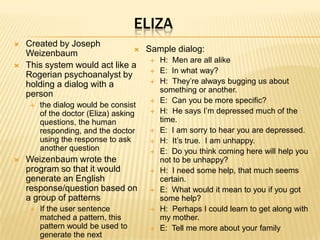
ElizaCreated by Joseph WeizenbaumThis system would act like a Rogerian psychoanalyst by holding a dialog with a personthe dialog would be consist of the doctor (Eliza) asking questions, the human responding, and the doctor using the response to ask another questionWeizenbaum wrote the program so that it would generate an English response/question based on a group of patternsIf the user sentence matched a pattern, this pattern would be used to generate the next sentence/questionSample dialog:H:  Men are all alikeE:  In what way?H:  They’re always bugging us about something or another.E:  Can you be more specific?H:  He says I’m depressed much of the time.E:  I am sorry to hear you are depressed.H:  It’s true.  I am unhappy.E:  Do you think coming here will help you not to be unhappy?H:  I need some help, that much seems certain.E:  What would it mean to you if you got some help?H:  Perhaps I could learn to get along with  my mother.E:  Tell me more about your family
How Eliza WorksRepeatInput a sentenceFind a rule in the Eliza knowledge-base that matches the patternAttempt to perform pattern match (see next slide)Attempt to perform segment match (see two slides)If rule found, select one of the responses randomly (each pattern will have at least one response)Fill in any variablesSubstitute values (you for I, I for you, me for you, am for are, etc)RespondUntil user quitsMost of the work goes on in the pattern match and segment match functions
Artificial intelligence systemsIt falls into three basic categories:Expert systems.Natural Language ProcessingPerception Systems.AI is a software technique applied to the non-numeric data expressed in terms of symbols, statements and patterns.It uses methods of symbolic processing, social and scientific reasoning and conceptual modeling for solving the problems.
Categories of AIArtificial Intelligence SystemNatural LanguageExpertPerceptionUsesUsesUsesNative Language KnowledgeKnowledgeSize, Shape, Image, VoiceAppliesAppliesAppliesLanguage Reasoning Human Like Reasoning Sensing Abilities for Reasoning
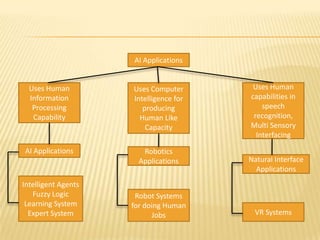
AI ApplicationsUses Human Information Processing CapabilityUses Computer Intelligence for producing Human Like CapacityUses Human capabilities in speech recognition, Multi Sensory InterfacingAI ApplicationsRobotics ApplicationsNatural Interface ApplicationsIntelligent AgentsFuzzy LogicLearning SystemExpert SystemRobot Systems for doing Human JobsVR Systems
Knowledge based expert systemsDecision making or problem solving is a unique situation riddled with uncertainty and complexity, dominated by resource constraints and a possibility of several goals. In such cases, flexible systems (open systems) are required to solve the problems. Most of such situations, termed as the unstructured situations, adopt two methods of problem solving, generalized or the knowledge based expert systems.
KBESTo build a KBES, certain prerequisites are required. The first prerequisite is that a person with the ability to solve the problem with knowledge based reasoning should be available.Second prerequisite is that, such an expert should be able to articulate the knowledge to the specific problem characteristics.Knowledge in KBES is defined as a mix of theory of the subject, knowledge of its application, organized information and the data of problems and its solutions.
referenceWamanJawadekar, "Management Information Systems” , 4th Edition, Tata McGraw-Hill Publishing Company Limited.

MIS 07 Expert Systems

  • 1.
    Management information systemThirdYear Information TechnologyPart 07Expert SystemsTushar B Kute,Department of Information Technology,Sandip Institute of Technology and Research Centre, Nashikhttp://www.tusharkute.com
  • 2.
    Expert system architecture(1)The typical architecture of an e.s. is often described as follows:userinterfaceuserinferenceengineknowledgebase
  • 3.
    Expert system architecture(1)The inference engine and knowledge base are separated because:the reasoning mechanism needs to be as stable as possible;the knowledge base must be able to grow and change, as knowledge is added;this arrangement enables the system to be built from, or converted to, a shell.
  • 4.
    Expert system architecture(2) It is reasonable to produce a richer, more elaborate, description of the typical expert system.A more elaborate description, which still includes the components that are to be found in almost any real-world system, would look like this:
  • 5.
  • 6.
  • 7.
    The system holdsa collection of general principles which can potentially be applied to any problem - these are stored in the knowledge base.The system also holds a collection of specific details that apply to the current problem (including details of how the current reasoning process is progressing) - these are held in working memory.Both these sorts of information are processed by the inference engine.Expert system architecture (2)
  • 8.
    Expert system architecture(2)Any practical expert system needs an explanatory facility. It is essential that an expert system should be able to explain its reasoning.
  • 9.
    Expert & Knowledge-BasedSystemsOne of AI’s greatest areas of success was the development of large-scale problem solving systemsOriginally called expert systems, they would mimic the problem solving processes of domain expertsSuch as doctors performing diagnosis, or engineers performing design, or wall street analysts selecting stock transactionsExpert systems were originally developed by handAnd most commonly in some Lisp dialectIt was discovered that many problems were being solved by chaining through rules (if-then statements) that would operate on a collection of facts and partial conclusionsCalled working memoryThese rule-based systems led to the first AI tools or shellsToday, to simplify expert system creation, most people use these AI shells – you just fill in the knowledge, the problem solving processes are already implemented
  • 10.
    Introduction: DendralTheDendral system (DENDRiticALgorithm) was the first expert system, developed in the 1960sThe idea was, given mass spectrogram data, determine what the chemical composition wasThe approach: plan-generate-and-test with human feedbackThis is a constrained search techniqueGenerate a hypothesis: a possible chemical compoundTest the hypothesis: use a series of heuristics and subprograms to determine if the chemical compound generated is plausible given the dataIf so, show it to the user – the user can steer the direction that DENDRAL takes next by suggesting what chemical elements should be added or removed from the generated hypothesis compoundDENDRAL repeats until an answer is found acceptable that does not violate the constraints as dictated by the data
  • 11.
    Pattern MatchingExpert Systemsconsisted of two major componentsA knowledge baseThe knowledge that the system would use to come to conclusionsIn Dendral, this would be chemical elements, compounds, the mass spectrogram data that could arise from any elementIn Mycin, this would be bacteriological infection knowledgeAn inference engineHow to apply the knowledgeFor Dendral, this was done by generate-and-test, a very weak form of searchMycin would perform backward chaining through rulesMore generically though, the inference engine would embody some form of pattern matchingOne of the first systems that clearly demonstrated pattern matching was ElizaEliza was a spoof of an expert system but the code will show us how pattern matching works
  • 12.
    ElizaCreated by JosephWeizenbaumThis system would act like a Rogerian psychoanalyst by holding a dialog with a personthe dialog would be consist of the doctor (Eliza) asking questions, the human responding, and the doctor using the response to ask another questionWeizenbaum wrote the program so that it would generate an English response/question based on a group of patternsIf the user sentence matched a pattern, this pattern would be used to generate the next sentence/questionSample dialog:H: Men are all alikeE: In what way?H: They’re always bugging us about something or another.E: Can you be more specific?H: He says I’m depressed much of the time.E: I am sorry to hear you are depressed.H: It’s true. I am unhappy.E: Do you think coming here will help you not to be unhappy?H: I need some help, that much seems certain.E: What would it mean to you if you got some help?H: Perhaps I could learn to get along with my mother.E: Tell me more about your family
  • 13.
    How Eliza WorksRepeatInputa sentenceFind a rule in the Eliza knowledge-base that matches the patternAttempt to perform pattern match (see next slide)Attempt to perform segment match (see two slides)If rule found, select one of the responses randomly (each pattern will have at least one response)Fill in any variablesSubstitute values (you for I, I for you, me for you, am for are, etc)RespondUntil user quitsMost of the work goes on in the pattern match and segment match functions
  • 14.
    Artificial intelligence systemsItfalls into three basic categories:Expert systems.Natural Language ProcessingPerception Systems.AI is a software technique applied to the non-numeric data expressed in terms of symbols, statements and patterns.It uses methods of symbolic processing, social and scientific reasoning and conceptual modeling for solving the problems.
  • 15.
    Categories of AIArtificialIntelligence SystemNatural LanguageExpertPerceptionUsesUsesUsesNative Language KnowledgeKnowledgeSize, Shape, Image, VoiceAppliesAppliesAppliesLanguage Reasoning Human Like Reasoning Sensing Abilities for Reasoning
  • 16.
    AI ApplicationsUses HumanInformation Processing CapabilityUses Computer Intelligence for producing Human Like CapacityUses Human capabilities in speech recognition, Multi Sensory InterfacingAI ApplicationsRobotics ApplicationsNatural Interface ApplicationsIntelligent AgentsFuzzy LogicLearning SystemExpert SystemRobot Systems for doing Human JobsVR Systems
  • 17.
    Knowledge based expertsystemsDecision making or problem solving is a unique situation riddled with uncertainty and complexity, dominated by resource constraints and a possibility of several goals. In such cases, flexible systems (open systems) are required to solve the problems. Most of such situations, termed as the unstructured situations, adopt two methods of problem solving, generalized or the knowledge based expert systems.
  • 18.
    KBESTo build aKBES, certain prerequisites are required. The first prerequisite is that a person with the ability to solve the problem with knowledge based reasoning should be available.Second prerequisite is that, such an expert should be able to articulate the knowledge to the specific problem characteristics.Knowledge in KBES is defined as a mix of theory of the subject, knowledge of its application, organized information and the data of problems and its solutions.
  • 19.
    referenceWamanJawadekar, "Management InformationSystems” , 4th Edition, Tata McGraw-Hill Publishing Company Limited.