Structured Knowledge
Representation
By - Er. Suraj Awal
Representation and Mapping
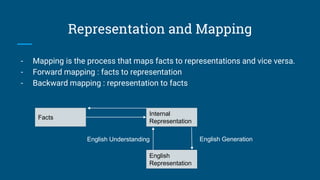
- Mapping is the process that maps facts to representations and vice versa.
- Forward mapping : facts to representation
- Backward mapping : representation to facts
Facts
Internal
Representation
English
Representation
English GenerationEnglish Understanding
Properties of Good Knowledge
Representation
1. Represential Adequacy : Ability to represent all knowledge needed in the
domain
2. Inferential Adequacy : Ability to manipulate knowledge to derive new
structures inferred from old
3. Inferential Efficiency : Ability to perform inference in the most efficient
directions
4. Acquisitional Efficiency : Ability to acquire new information easily
Semantic Nets
- Graphical representation of knowledge in terms of nodes and the arcs
connecting them
- Nodes represents objects
- Arcs represent links or relationships
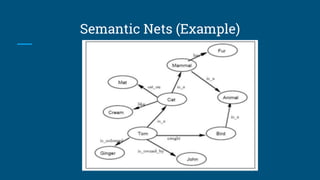
Semantic Nets (Example)
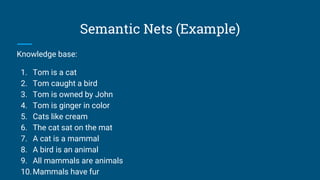
Knowledge base:
1. Tom is a cat
2. Tom caught a bird
3. Tom is owned by John
4. Tom is ginger in color
5. Cats like cream
6. The cat sat on the mat
7. A cat is a mammal
8. A bird is an animal
9. All mammals are animals
10.Mammals have fur
Semantic Nets (Example)
Semantic Nets (Advantage)
- Natural and modular
- Efficient, simple and understandable
- Translatable to PROLOG without difficulty
- Meaning is simple to generate
Semantic Nets (Disadvantage)
- No standard definition
- Not intelligent
- Depends on the designer
- Creates confusion on same network created by multiple people
- Nodes representing class and object look same
- Negation and Disjunction can not be expressed easily
Frames
- Schema representation that provides structure for knowledge
representation
- Contains frame name, slots and slot fillers.
- Slots correspond to fields and fillers correspond to values.
- Frame provides 3D representation of knowledge to semantic nets by
allowing nodes to have structure
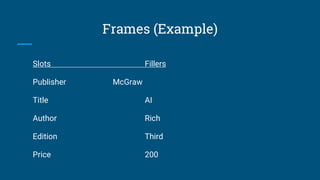
Frames (Example)
Slots Fillers
Publisher McGraw
Title AI
Author Rich
Edition Third
Price 200
Conceptual Dependency
- Represent knowledge acquired from natural language input
- If two or more sentences are identical in meaning, there should be only one
representation
- Sentences are represented as a series of diagrams depicting actions
- Agents and objects are represented
- ATRANS, PTRANS, MTRANS, MBUILD, SPEAK, ATTEND, PROPEL, MOVE,
GRASP, EXPEL, INGEST
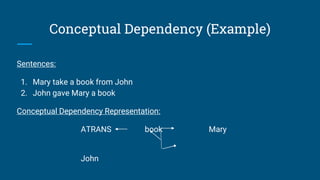
Conceptual Dependency (Example)
Sentences:
1. Mary take a book from John
2. John gave Mary a book
Conceptual Dependency Representation:
ATRANS book Mary
John
Script
- Structured representation describing a sequence of events in a particular
context
- Extended frames by representing expectations of actions and state changes
The End
Would you recommend this slide?
Like, Comment and Share!

Structured Knowledge Representation

  • 1.
  • 2.
    Representation and Mapping -Mapping is the process that maps facts to representations and vice versa. - Forward mapping : facts to representation - Backward mapping : representation to facts Facts Internal Representation English Representation English GenerationEnglish Understanding
  • 3.
    Properties of GoodKnowledge Representation 1. Represential Adequacy : Ability to represent all knowledge needed in the domain 2. Inferential Adequacy : Ability to manipulate knowledge to derive new structures inferred from old 3. Inferential Efficiency : Ability to perform inference in the most efficient directions 4. Acquisitional Efficiency : Ability to acquire new information easily
  • 4.
    Semantic Nets - Graphicalrepresentation of knowledge in terms of nodes and the arcs connecting them - Nodes represents objects - Arcs represent links or relationships
  • 5.
    Semantic Nets (Example) Knowledgebase: 1. Tom is a cat 2. Tom caught a bird 3. Tom is owned by John 4. Tom is ginger in color 5. Cats like cream 6. The cat sat on the mat 7. A cat is a mammal 8. A bird is an animal 9. All mammals are animals 10.Mammals have fur
  • 6.
  • 7.
    Semantic Nets (Advantage) -Natural and modular - Efficient, simple and understandable - Translatable to PROLOG without difficulty - Meaning is simple to generate
  • 8.
    Semantic Nets (Disadvantage) -No standard definition - Not intelligent - Depends on the designer - Creates confusion on same network created by multiple people - Nodes representing class and object look same - Negation and Disjunction can not be expressed easily
  • 9.
    Frames - Schema representationthat provides structure for knowledge representation - Contains frame name, slots and slot fillers. - Slots correspond to fields and fillers correspond to values. - Frame provides 3D representation of knowledge to semantic nets by allowing nodes to have structure
  • 10.
    Frames (Example) Slots Fillers PublisherMcGraw Title AI Author Rich Edition Third Price 200
  • 11.
    Conceptual Dependency - Representknowledge acquired from natural language input - If two or more sentences are identical in meaning, there should be only one representation - Sentences are represented as a series of diagrams depicting actions - Agents and objects are represented - ATRANS, PTRANS, MTRANS, MBUILD, SPEAK, ATTEND, PROPEL, MOVE, GRASP, EXPEL, INGEST
  • 12.
    Conceptual Dependency (Example) Sentences: 1.Mary take a book from John 2. John gave Mary a book Conceptual Dependency Representation: ATRANS book Mary John
  • 13.
    Script - Structured representationdescribing a sequence of events in a particular context - Extended frames by representing expectations of actions and state changes
  • 14.
    The End Would yourecommend this slide? Like, Comment and Share!