

Wahab Khan
Sarhad University Peshawar
Department of CS/IT
 Expert Systems at the forefront of AI rebirth.
 Realization in the late 60 that the general framework of
problem solving was not enough to solve all kinds of
problem.
 Realization that specialized knowledge is a very
important component of practical systems.
 People observed that systems that were designed for
well-focused problems and domains, out performed
more ‘general’ systems.
 Importance of expert systems as the earliest AI systems
and the most used systems practically.
 One of the pioneering systems: DENDRAL (1960’s)
 developed at Stanford for NASA
 Chemical analysis of Martian soil for space mission
 Given mass spectral data, determine molecular structure.
 In the laboratory, generate and test method used: various
possible hypothesis (molecular structures) are generated
and tested (matched to data)
 Early realization that experts use certain heuristics to
rule out certain options. Encode that knowledge in the
system
 Moral: ‘Intelligent behavior is dependent, not so much
on the methods of reasoning, but on the knowledge
one has to reason with’ Durkin
 MYCIN( mid 70s)
 Developed at Stanford to aid physicians in diagnosing
and treating patients with a particular blood disease.
 Motivation for MYCIN
 Few experts, availability constraints
 Immediate expertise often needed, life-threatening condition
 Tested in 1982. diagnosis on ten selected cases, along
with a panel of human experts. Scored higher than
human experts
 Importance:
 Demonstrated that expert systems could be used for solving
practical problems
 R1/XCON (late 80s) one of the most cited ES.
 Developed by DEC( Digital Equipment
Corporation)
 Computer configuration assistant
 One of the most successful expert systems in
routine use.
 Estimated saving is $25million per year
 What characterizes an ‘Expert’
 Specialized knowledge in a certain area
 Experience in the given area
 Explanation of decisions
 A skill set that enables the expert to translate the
specilized knowledge gained through experience into
solutions.
 e.g. Skin specialist, heart specialist, car mechanic,
architect, software designer.
 “A computer program designed to model the
problem solving ability of a human expert”
Aspects of the human expert that we wish to
model
 Knowledge
 Reasoning
 Knowledge-based expert systems or simply expert systems
 An expert system is software that attempts to reproduce the
performance of one or more human experts, most commonly
in a specific problem domain (Wikipedia)
 Use human knowledge to solve problems that normally
would require human intelligence
 Embody some non-algorithmic expertise
 Represent the expertise knowledge as data or rules within the
computer
 Can be called upon when needed to solve problems
 Example: medical ES modelling a doctor, discuss
each of the following issues in that context.
 The ES outperforms the ‘average’ doctor and is
available in regions where people may not have
access to any medical care at all otherwise.
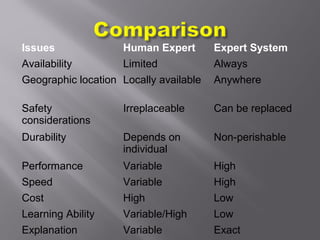
Issues Human Expert Expert System
Availability Limited Always
Geographic location Locally available Anywhere
Safety
considerations
Irreplaceable Can be replaced
Durability Depends on
individual
Non-perishable
Performance Variable High
Speed Variable High
Cost High Low
Learning Ability Variable/High Low
Explanation Variable Exact
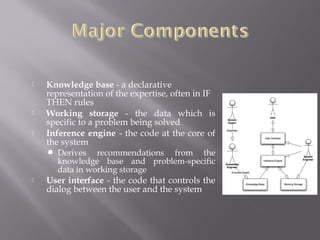
 Knowledge base - a declarative
representation of the expertise, often in IF
THEN rules
 Working storage - the data which is
specific to a problem being solved
 Inference engine - the code at the core of
the system
 Derives recommendations from the
knowledge base and problem-specific
data in working storage
 User interface - the code that controls the
dialog between the user and the system
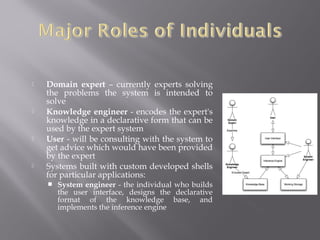
 Domain expert – currently experts solving
the problems the system is intended to
solve 
 Knowledge engineer - encodes the expert's
knowledge in a declarative form that can be
used by the expert system 
 User - will be consulting with the system to
get advice which would have been provided
by the expert 
 Systems built with custom developed shells
for particular applications: 
 System engineer - the individual who builds
the user interface, designs the declarative
format of the knowledge base, and
implements the inference engine
 Shell - a piece of software which contains:
 The user interface
 A format for declarative knowledge in the knowledge base
 An inference engine
 Major advantage of a customized shell: the format of the knowledge base can be
designed to facilitate the knowledge engineering process
 Knowledge engineer and the system engineer might be the same person
 Depending on the size of the project
 One of the major bottlenecks - knowledge engineering process:
 The coding of the expertise into the declarative rule format can be a difficult and
tedious task
 The semantic gap between the expert's representation of the knowledge and the
representation in the knowledge base should be minimized
 Example - This rules identifies birds:
IF
family is albatross and
color is white
 
THEN
bird is Laysan albatross
 
IF
family is albatross and
color is dark
 
THEN
bird is black footed albatross
 The following rule is one that satisfies the family sub-goal:
IF
order is tubenose and
size large and
wings long narrow
 
THEN
family is albatross

Chapter 6 expert system

  • 1.
    Wahab Khan Sarhad UniversityPeshawar Department of CS/IT
  • 2.
     Expert Systemsat the forefront of AI rebirth.  Realization in the late 60 that the general framework of problem solving was not enough to solve all kinds of problem.  Realization that specialized knowledge is a very important component of practical systems.  People observed that systems that were designed for well-focused problems and domains, out performed more ‘general’ systems.  Importance of expert systems as the earliest AI systems and the most used systems practically.
  • 3.
     One ofthe pioneering systems: DENDRAL (1960’s)  developed at Stanford for NASA  Chemical analysis of Martian soil for space mission  Given mass spectral data, determine molecular structure.  In the laboratory, generate and test method used: various possible hypothesis (molecular structures) are generated and tested (matched to data)  Early realization that experts use certain heuristics to rule out certain options. Encode that knowledge in the system  Moral: ‘Intelligent behavior is dependent, not so much on the methods of reasoning, but on the knowledge one has to reason with’ Durkin
  • 4.
     MYCIN( mid70s)  Developed at Stanford to aid physicians in diagnosing and treating patients with a particular blood disease.  Motivation for MYCIN  Few experts, availability constraints  Immediate expertise often needed, life-threatening condition  Tested in 1982. diagnosis on ten selected cases, along with a panel of human experts. Scored higher than human experts  Importance:  Demonstrated that expert systems could be used for solving practical problems
  • 5.
     R1/XCON (late80s) one of the most cited ES.  Developed by DEC( Digital Equipment Corporation)  Computer configuration assistant  One of the most successful expert systems in routine use.  Estimated saving is $25million per year
  • 6.
     What characterizesan ‘Expert’  Specialized knowledge in a certain area  Experience in the given area  Explanation of decisions  A skill set that enables the expert to translate the specilized knowledge gained through experience into solutions.  e.g. Skin specialist, heart specialist, car mechanic, architect, software designer.
  • 7.
     “A computerprogram designed to model the problem solving ability of a human expert” Aspects of the human expert that we wish to model  Knowledge  Reasoning
  • 8.
     Knowledge-based expertsystems or simply expert systems  An expert system is software that attempts to reproduce the performance of one or more human experts, most commonly in a specific problem domain (Wikipedia)  Use human knowledge to solve problems that normally would require human intelligence  Embody some non-algorithmic expertise  Represent the expertise knowledge as data or rules within the computer  Can be called upon when needed to solve problems
  • 9.
     Example: medicalES modelling a doctor, discuss each of the following issues in that context.  The ES outperforms the ‘average’ doctor and is available in regions where people may not have access to any medical care at all otherwise.
  • 10.
    Issues Human ExpertExpert System Availability Limited Always Geographic location Locally available Anywhere Safety considerations Irreplaceable Can be replaced Durability Depends on individual Non-perishable Performance Variable High Speed Variable High Cost High Low Learning Ability Variable/High Low Explanation Variable Exact
  • 11.
     Knowledge base- a declarative representation of the expertise, often in IF THEN rules  Working storage - the data which is specific to a problem being solved  Inference engine - the code at the core of the system  Derives recommendations from the knowledge base and problem-specific data in working storage  User interface - the code that controls the dialog between the user and the system
  • 12.
     Domain expert– currently experts solving the problems the system is intended to solve   Knowledge engineer - encodes the expert's knowledge in a declarative form that can be used by the expert system   User - will be consulting with the system to get advice which would have been provided by the expert   Systems built with custom developed shells for particular applications:   System engineer - the individual who builds the user interface, designs the declarative format of the knowledge base, and implements the inference engine
  • 13.
     Shell -a piece of software which contains:  The user interface  A format for declarative knowledge in the knowledge base  An inference engine  Major advantage of a customized shell: the format of the knowledge base can be designed to facilitate the knowledge engineering process  Knowledge engineer and the system engineer might be the same person  Depending on the size of the project  One of the major bottlenecks - knowledge engineering process:  The coding of the expertise into the declarative rule format can be a difficult and tedious task  The semantic gap between the expert's representation of the knowledge and the representation in the knowledge base should be minimized
  • 14.
     Example -This rules identifies birds: IF family is albatross and color is white   THEN bird is Laysan albatross   IF family is albatross and color is dark   THEN bird is black footed albatross  The following rule is one that satisfies the family sub-goal: IF order is tubenose and size large and wings long narrow   THEN family is albatross

Editor's Notes

  • #6 XCON first went into use in 1980 in DEC's plant in Salem, New Hampshire. It eventually had about 2500 rules. By 1986, it had processed 80,000 orders, and achieved 95-98% accuracy. It was estimated to be saving DEC $25M a year by reducing the need to give customers free components when technicians made errors, by speeding the assembly process, and by increasing customer satisfaction. Before XCON, when ordering a VAX from DEC, every cable, connection, and bit of software had to be ordered separately. (Computers and peripherals were not sold complete in boxes as they are today). The sales people were not always very technically expert, so customers would find that they had hardware without the correct cables, printers without the correct drivers, a processor without the correct language chip, and so on. This meant delays and caused a lot of customer dissatisfaction and resultant legal action. XCON interacted with the sales person, asking critical questions before printing out a coherent and workable system specification/order slip. XCON's success led DEC to rewrite XCON as XSEL- a version of XCON intended for use by DEC's salesforce to aid a customer in properly configuring their VAX (so they wouldn't, say, choose a computer too large to fit through their doorway or choose too few cabinets for the components to fit in). Location problems and configuration were handled by yet another expert system, XSITE.
  • #7 Discuss how each of these human experts develops into an expert. e.g. a doctor Gains some formal education Observations through experience Forms a set of distinctions on how to link facts to produce solutions
  • #8 Extending the idea of a human expert to an expert system….Link the aspects of the expert to the framework we developed in KRR. All of the concept we learnt there will apply here and will be used to build practical systems.