CHAPTER TEN
Expert Systems
Expert Systems
• In artificial intelligence, an expert system is a computer system
emulating the decision-making ability of a human expert.
• Expert Systems are computer programs that exhibit intelligent
behavior.
• They are concerned with the concepts and methods of symbolic
inference, or reasoning, by a computer, and how the knowledge used
to make those inferences will be represented.
• Expert systems are designed to solve complex problems by reasoning
through bodies of knowledge, represented mainly as if–then rules
rather than through conventional procedural code.
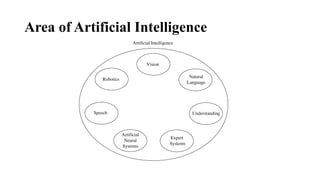
Area of Artificial Intelligence
Expert system technology
• Special expert system languages .
• Programs
• Hardware designed to facilitate the implementation of those systems
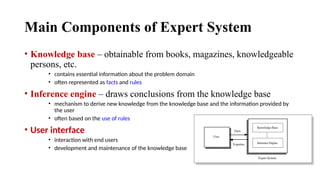
Main Components of Expert System
• Knowledge base – obtainable from books, magazines, knowledgeable
persons, etc.
• contains essential information about the problem domain
• often represented as facts and rules
• Inference engine – draws conclusions from the knowledge base
• mechanism to derive new knowledge from the knowledge base and the information provided by
the user
• often based on the use of rules
• User interface
• interaction with end users
• development and maintenance of the knowledge base
Components of Knowledge Base
• The knowledge base store both, factual and heuristic knowledge.
• Factual Knowledge − It is the information widely accepted by the
Knowledge Engineers and scholars in the task domain.
• Heuristic Knowledge − It is about practice, accurate judgement, one’s
ability of evaluation, and guessing.
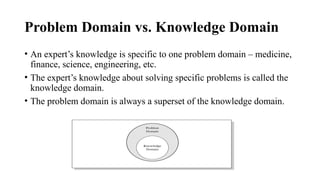
Problem Domain vs. Knowledge Domain
• An expert’s knowledge is specific to one problem domain – medicine,
finance, science, engineering, etc.
• The expert’s knowledge about solving specific problems is called the
knowledge domain.
• The problem domain is always a superset of the knowledge domain.
Characteristics of Expert Systems
Knowledge acquisition
• transfer of knowledge from humans to computers
• sometimes knowledge can be acquired directly from the environment
• machine learning, neural networks
Knowledge representation
• suitable for storing and processing knowledge in computers
• The knowledge of an expert system can be represented in a number of ways, including IF-THEN rules: IF
you are hungry THEN eat
Inference
• mechanism that allows the generation of new conclusions from existing knowledge in a
computer
Explanation
• illustrates to the user how and why a particular solution was generated
Knowledge Engineering
• Knowledge engineering refers to all technical, scientific and social
aspects involved in building, maintaining and using knowledge-based
systems.
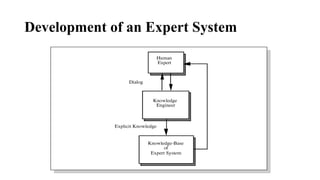
• The process of building an expert system:
1. The knowledge engineer establishes a dialog with the human expert
to elicit knowledge.
2. The knowledge engineer codes the knowledge explicitly in the
knowledge base.
3. The expert evaluates the expert system and gives a analysis to the
knowledge engineer
Development of an Expert System
Elements of an Expert System
• User interface – mechanism by which user and system communicate.
• Exploration facility – explains reasoning of expert system to user.
• Working memory – global database of facts used by rules.
• Inference engine – makes inferences deciding which rules are satisfied and
prioritizing.
• Agenda – a prioritized list of rules created by the inference engine, whose
patterns are satisfied by facts or objects in working memory.
• Knowledge acquisition facility – automatic way for the user to enter
knowledge in the system bypassing the explicit coding by knowledge
engineer.
Artificial Neural Systems
In the 1980s, a new development in programming paradigms appeared
called artificial neural systems (ANS).
• Based on the way the brain processes information.
• Models solutions by training simulated neurons connected in a
network.
• ANS are found in face recognition, medical diagnosis, games, and
speech recognition
ANS Characteristics
• A complex pattern recognition problem –computing the shortest route
through a given list of cities.
• ANS is similar to an analog computer using simple processing
elements connected in a highly parallel manner.
• Processing elements perform Boolean / arithmetic functions in the
inputs
• Key feature is associating weights with each element.
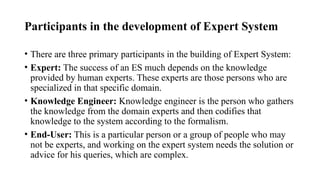
Participants in the development of Expert System
• There are three primary participants in the building of Expert System:
• Expert: The success of an ES much depends on the knowledge
provided by human experts. These experts are those persons who are
specialized in that specific domain.
• Knowledge Engineer: Knowledge engineer is the person who gathers
the knowledge from the domain experts and then codifies that
knowledge to the system according to the formalism.
• End-User: This is a particular person or a group of people who may
not be experts, and working on the expert system needs the solution or
advice for his queries, which are complex.
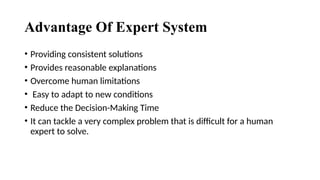
Advantage Of Expert System
• Providing consistent solutions
• Provides reasonable explanations
• Overcome human limitations
• Easy to adapt to new conditions
• Reduce the Decision-Making Time
• It can tackle a very complex problem that is difficult for a human
expert to solve.
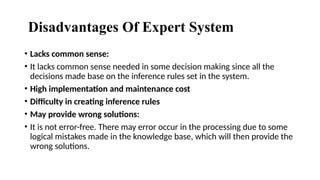
Disadvantages Of Expert System
• Lacks common sense:
• It lacks common sense needed in some decision making since all the
decisions made base on the inference rules set in the system.
• High implementation and maintenance cost
• Difficulty in creating inference rules
• May provide wrong solutions:
• It is not error-free. There may error occur in the processing due to some
logical mistakes made in the knowledge base, which will then provide the
wrong solutions.

Decision Support System CHapter one.pptx

  • 1.
  • 2.
    Expert Systems • Inartificial intelligence, an expert system is a computer system emulating the decision-making ability of a human expert. • Expert Systems are computer programs that exhibit intelligent behavior. • They are concerned with the concepts and methods of symbolic inference, or reasoning, by a computer, and how the knowledge used to make those inferences will be represented. • Expert systems are designed to solve complex problems by reasoning through bodies of knowledge, represented mainly as if–then rules rather than through conventional procedural code.
  • 3.
    Area of ArtificialIntelligence
  • 4.
    Expert system technology •Special expert system languages . • Programs • Hardware designed to facilitate the implementation of those systems
  • 5.
    Main Components ofExpert System • Knowledge base – obtainable from books, magazines, knowledgeable persons, etc. • contains essential information about the problem domain • often represented as facts and rules • Inference engine – draws conclusions from the knowledge base • mechanism to derive new knowledge from the knowledge base and the information provided by the user • often based on the use of rules • User interface • interaction with end users • development and maintenance of the knowledge base
  • 6.
    Components of KnowledgeBase • The knowledge base store both, factual and heuristic knowledge. • Factual Knowledge − It is the information widely accepted by the Knowledge Engineers and scholars in the task domain. • Heuristic Knowledge − It is about practice, accurate judgement, one’s ability of evaluation, and guessing.
  • 7.
    Problem Domain vs.Knowledge Domain • An expert’s knowledge is specific to one problem domain – medicine, finance, science, engineering, etc. • The expert’s knowledge about solving specific problems is called the knowledge domain. • The problem domain is always a superset of the knowledge domain.
  • 8.
    Characteristics of ExpertSystems Knowledge acquisition • transfer of knowledge from humans to computers • sometimes knowledge can be acquired directly from the environment • machine learning, neural networks Knowledge representation • suitable for storing and processing knowledge in computers • The knowledge of an expert system can be represented in a number of ways, including IF-THEN rules: IF you are hungry THEN eat Inference • mechanism that allows the generation of new conclusions from existing knowledge in a computer Explanation • illustrates to the user how and why a particular solution was generated
  • 9.
    Knowledge Engineering • Knowledgeengineering refers to all technical, scientific and social aspects involved in building, maintaining and using knowledge-based systems. • The process of building an expert system: 1. The knowledge engineer establishes a dialog with the human expert to elicit knowledge. 2. The knowledge engineer codes the knowledge explicitly in the knowledge base. 3. The expert evaluates the expert system and gives a analysis to the knowledge engineer
  • 10.
    Development of anExpert System
  • 11.
    Elements of anExpert System • User interface – mechanism by which user and system communicate. • Exploration facility – explains reasoning of expert system to user. • Working memory – global database of facts used by rules. • Inference engine – makes inferences deciding which rules are satisfied and prioritizing. • Agenda – a prioritized list of rules created by the inference engine, whose patterns are satisfied by facts or objects in working memory. • Knowledge acquisition facility – automatic way for the user to enter knowledge in the system bypassing the explicit coding by knowledge engineer.
  • 12.
    Artificial Neural Systems Inthe 1980s, a new development in programming paradigms appeared called artificial neural systems (ANS). • Based on the way the brain processes information. • Models solutions by training simulated neurons connected in a network. • ANS are found in face recognition, medical diagnosis, games, and speech recognition
  • 13.
    ANS Characteristics • Acomplex pattern recognition problem –computing the shortest route through a given list of cities. • ANS is similar to an analog computer using simple processing elements connected in a highly parallel manner. • Processing elements perform Boolean / arithmetic functions in the inputs • Key feature is associating weights with each element.
  • 15.
    Participants in thedevelopment of Expert System • There are three primary participants in the building of Expert System: • Expert: The success of an ES much depends on the knowledge provided by human experts. These experts are those persons who are specialized in that specific domain. • Knowledge Engineer: Knowledge engineer is the person who gathers the knowledge from the domain experts and then codifies that knowledge to the system according to the formalism. • End-User: This is a particular person or a group of people who may not be experts, and working on the expert system needs the solution or advice for his queries, which are complex.
  • 16.
    Advantage Of ExpertSystem • Providing consistent solutions • Provides reasonable explanations • Overcome human limitations • Easy to adapt to new conditions • Reduce the Decision-Making Time • It can tackle a very complex problem that is difficult for a human expert to solve.
  • 17.
    Disadvantages Of ExpertSystem • Lacks common sense: • It lacks common sense needed in some decision making since all the decisions made base on the inference rules set in the system. • High implementation and maintenance cost • Difficulty in creating inference rules • May provide wrong solutions: • It is not error-free. There may error occur in the processing due to some logical mistakes made in the knowledge base, which will then provide the wrong solutions.