Expert Systems
2
What is an expert system?
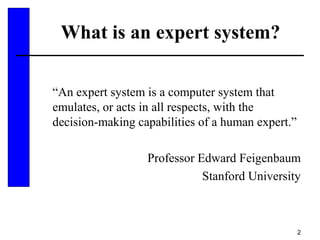
“An expert system is a computer system that
emulates, or acts in all respects, with the
decision-making capabilities of a human expert.”
Professor Edward Feigenbaum
Stanford University
3
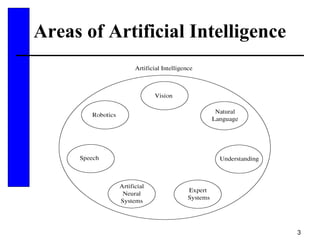
Areas of Artificial Intelligence
4
Expert system technology
may include:
• Special expert system languages – CLIPS
• Programs
• Hardware designed to facilitate the
implementation of those systems
5
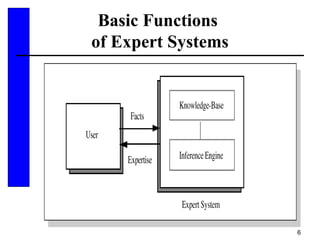
Expert System Main Components
• Knowledge base – obtainable from books,
magazines, knowledgeable persons, etc.
• Inference engine – draws conclusions from the
knowledge base
6
Basic Functions
of Expert Systems
7
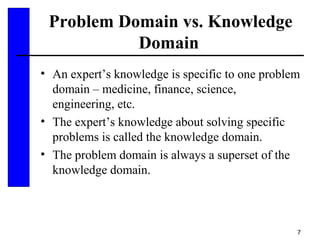
Problem Domain vs. Knowledge
Domain
• An expert’s knowledge is specific to one problem
domain – medicine, finance, science,
engineering, etc.
• The expert’s knowledge about solving specific
problems is called the knowledge domain.
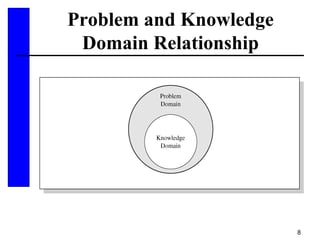
• The problem domain is always a superset of the
knowledge domain.
8
Problem and Knowledge
Domain Relationship
9
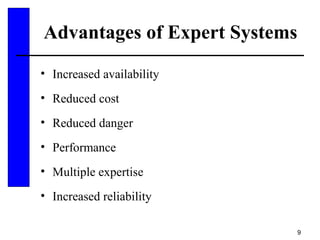
Advantages of Expert Systems
• Increased availability
• Reduced cost
• Reduced danger
• Performance
• Multiple expertise
• Increased reliability
10
Advantages Continued
• Explanation
• Fast response
• Steady, unemotional, and complete responses at
all times
• Intelligent tutor
• Intelligent database
11
Representing the Knowledge
The knowledge of an expert system can be
represented in a number of ways, including IF-
THEN rules:
IF you are hungry THEN eat
12
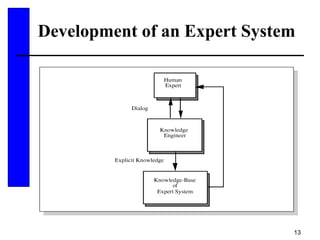
Knowledge Engineering
The process of building an expert system:
1. The knowledge engineer establishes a dialog
with the human expert to elicit knowledge.
2. The knowledge engineer codes the knowledge
explicitly in the knowledge base.
3. The expert evaluates the expert system and
gives a critique to the knowledge engineer.
13
Development of an Expert System
14
The Role of AI
• An algorithm is an ideal solution guaranteed to
yield a solution in a finite amount of time.
• When an algorithm is not available or is
insufficient, we rely on artificial intelligence
(AI).
• Expert system relies on inference – we accept a
“reasonable solution.”
15
Uncertainty
• Both human experts and expert systems must be
able to deal with uncertainty.
• It is easier to program expert systems with
shallow knowledge than with deep knowledge.
• Shallow knowledge – based on empirical and
heuristic knowledge.
• Deep knowledge – based on basic structure,
function, and behavior of objects.
16
Limitations of Expert Systems
• Typical expert systems cannot generalize through
analogy to reason about new situations in the way
people can.
• A knowledge acquisition bottleneck results from
the time-consuming and labor intensive task of
building an expert system.
17
Early Expert Systems
• DENDRAL – used in chemical mass
spectroscopy to identify chemical constituents
• MYCIN – medical diagnosis of illness
• DIPMETER – geological data analysis for oil
• PROSPECTOR – geological data analysis for
minerals
• XCON/R1 – configuring computer systems
18
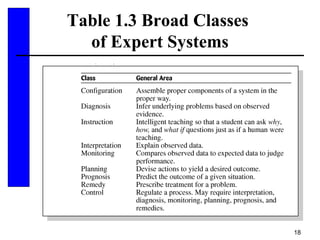
Table 1.3 Broad Classes
of Expert Systems
19
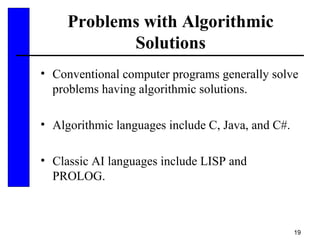
Problems with Algorithmic
Solutions
• Conventional computer programs generally solve
problems having algorithmic solutions.
• Algorithmic languages include C, Java, and C#.
• Classic AI languages include LISP and
PROLOG.
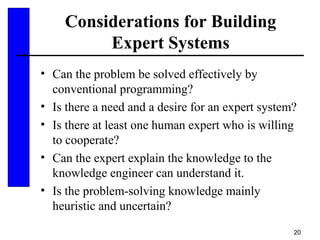
20
Considerations for Building
Expert Systems
• Can the problem be solved effectively by
conventional programming?
• Is there a need and a desire for an expert system?
• Is there at least one human expert who is willing
to cooperate?
• Can the expert explain the knowledge to the
knowledge engineer can understand it.
• Is the problem-solving knowledge mainly
heuristic and uncertain?
21
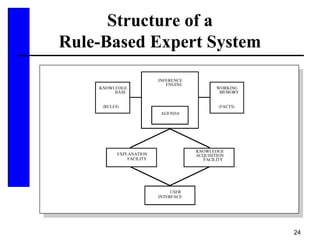
Elements of an Expert System
• User interface – mechanism by which user and
system communicate.
• Working memory – global database of facts used
by rules.
• Inference engine – makes inferences deciding
which rules are satisfied and prioritizing.
22
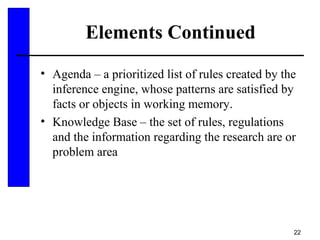
Elements Continued
• Agenda – a prioritized list of rules created by the
inference engine, whose patterns are satisfied by
facts or objects in working memory.
• Knowledge Base – the set of rules, regulations
and the information regarding the research are or
problem area
23
Production Rules
• Knowledge base is also called production
memory.
• Production rules can be expressed in IF-THEN
pseudocode format.
• In rule-based systems, the inference engine
determines which rule antecedents are satisfied
by the facts.
24
Structure of a
Rule-Based Expert System
25
Summary
• During the 20th
Century various definitions of AI
were proposed.
• In the 1960s, a special type of AI called expert
systems dealt with complex problems in a narrow
domain, e.g., medical disease diagnosis.
• Today, expert systems are used in a variety of
fields.
• Expert systems solve problems for which there
are no known algorithms.
26
Summary Continued
• Expert systems are knowledge-based – effective
for solving real-world problems.
• Expert systems are not suited for all applications.
• Future advances in expert systems will hinge on
the new quantum computers and those with
massive computational abilities in conjunction
with computers on the Internet.

Expert systems 1

  • 1.
  • 2.
    2 What is anexpert system? “An expert system is a computer system that emulates, or acts in all respects, with the decision-making capabilities of a human expert.” Professor Edward Feigenbaum Stanford University
  • 3.
  • 4.
    4 Expert system technology mayinclude: • Special expert system languages – CLIPS • Programs • Hardware designed to facilitate the implementation of those systems
  • 5.
    5 Expert System MainComponents • Knowledge base – obtainable from books, magazines, knowledgeable persons, etc. • Inference engine – draws conclusions from the knowledge base
  • 6.
  • 7.
    7 Problem Domain vs.Knowledge Domain • An expert’s knowledge is specific to one problem domain – medicine, finance, science, engineering, etc. • The expert’s knowledge about solving specific problems is called the knowledge domain. • The problem domain is always a superset of the knowledge domain.
  • 8.
  • 9.
    9 Advantages of ExpertSystems • Increased availability • Reduced cost • Reduced danger • Performance • Multiple expertise • Increased reliability
  • 10.
    10 Advantages Continued • Explanation •Fast response • Steady, unemotional, and complete responses at all times • Intelligent tutor • Intelligent database
  • 11.
    11 Representing the Knowledge Theknowledge of an expert system can be represented in a number of ways, including IF- THEN rules: IF you are hungry THEN eat
  • 12.
    12 Knowledge Engineering The processof building an expert system: 1. The knowledge engineer establishes a dialog with the human expert to elicit knowledge. 2. The knowledge engineer codes the knowledge explicitly in the knowledge base. 3. The expert evaluates the expert system and gives a critique to the knowledge engineer.
  • 13.
    13 Development of anExpert System
  • 14.
    14 The Role ofAI • An algorithm is an ideal solution guaranteed to yield a solution in a finite amount of time. • When an algorithm is not available or is insufficient, we rely on artificial intelligence (AI). • Expert system relies on inference – we accept a “reasonable solution.”
  • 15.
    15 Uncertainty • Both humanexperts and expert systems must be able to deal with uncertainty. • It is easier to program expert systems with shallow knowledge than with deep knowledge. • Shallow knowledge – based on empirical and heuristic knowledge. • Deep knowledge – based on basic structure, function, and behavior of objects.
  • 16.
    16 Limitations of ExpertSystems • Typical expert systems cannot generalize through analogy to reason about new situations in the way people can. • A knowledge acquisition bottleneck results from the time-consuming and labor intensive task of building an expert system.
  • 17.
    17 Early Expert Systems •DENDRAL – used in chemical mass spectroscopy to identify chemical constituents • MYCIN – medical diagnosis of illness • DIPMETER – geological data analysis for oil • PROSPECTOR – geological data analysis for minerals • XCON/R1 – configuring computer systems
  • 18.
    18 Table 1.3 BroadClasses of Expert Systems
  • 19.
    19 Problems with Algorithmic Solutions •Conventional computer programs generally solve problems having algorithmic solutions. • Algorithmic languages include C, Java, and C#. • Classic AI languages include LISP and PROLOG.
  • 20.
    20 Considerations for Building ExpertSystems • Can the problem be solved effectively by conventional programming? • Is there a need and a desire for an expert system? • Is there at least one human expert who is willing to cooperate? • Can the expert explain the knowledge to the knowledge engineer can understand it. • Is the problem-solving knowledge mainly heuristic and uncertain?
  • 21.
    21 Elements of anExpert System • User interface – mechanism by which user and system communicate. • Working memory – global database of facts used by rules. • Inference engine – makes inferences deciding which rules are satisfied and prioritizing.
  • 22.
    22 Elements Continued • Agenda– a prioritized list of rules created by the inference engine, whose patterns are satisfied by facts or objects in working memory. • Knowledge Base – the set of rules, regulations and the information regarding the research are or problem area
  • 23.
    23 Production Rules • Knowledgebase is also called production memory. • Production rules can be expressed in IF-THEN pseudocode format. • In rule-based systems, the inference engine determines which rule antecedents are satisfied by the facts.
  • 24.
  • 25.
    25 Summary • During the20th Century various definitions of AI were proposed. • In the 1960s, a special type of AI called expert systems dealt with complex problems in a narrow domain, e.g., medical disease diagnosis. • Today, expert systems are used in a variety of fields. • Expert systems solve problems for which there are no known algorithms.
  • 26.
    26 Summary Continued • Expertsystems are knowledge-based – effective for solving real-world problems. • Expert systems are not suited for all applications. • Future advances in expert systems will hinge on the new quantum computers and those with massive computational abilities in conjunction with computers on the Internet.