

MANAGEMENT
INFORMATION
SYSTEMS (MIS):

ADVANTAGES

Presentation for honorary:
Board of Directors (BOD)

Presentation by
Mihir Busa
Management Information Systems (MIS)
• MIS stipulates managers with information and support for effective

 decision making along with delivering feedback on daily operations

• Output or reports are usually generated through accumulation of

 transactions processing data

• Each MIS is an integrated collection of subsystems, which are

 typically organized along functional lines with an organization


                            By Mihir Busa                             2
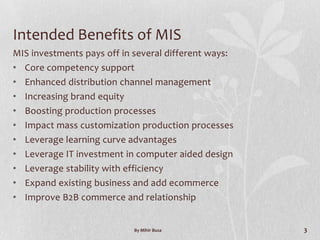
Intended Benefits of MIS
MIS investments pays off in several different ways:
• Core competency support
• Enhanced distribution channel management
• Increasing brand equity
• Boosting production processes
• Impact mass customization production processes
• Leverage learning curve advantages
• Leverage IT investment in computer aided design
• Leverage stability with efficiency
• Expand existing business and add ecommerce
• Improve B2B commerce and relationship


                            By Mihir Busa             3
FIVE ELEMENTS OF
MIS USABILITY


•     Timeliness
•     Accuracy
•     Consistency
•     Completeness
•     Relevance

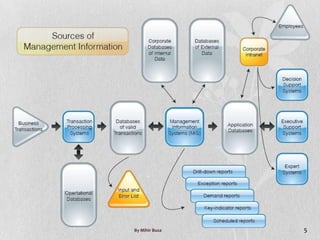
    Please see see following illustrations for further explanation


By Mihir Busa                                                        4
By Mihir Busa   5
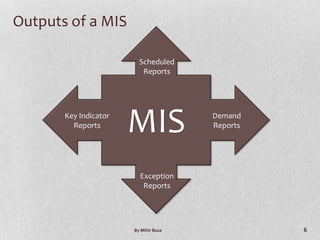
Outputs of a MIS

                         Scheduled
                          Reports


       Key Indicator
         Reports
                       MIS             Demand
                                       Reports


                         Exception
                          Reports


                       By Mihir Busa             6
Outputs of a MIS (continued)
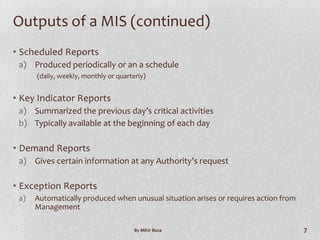
• Scheduled Reports
 a) Produced periodically or an a schedule
      (daily, weekly, monthly or quarterly)


• Key Indicator Reports
 a) Summarized the previous day’s critical activities
 b) Typically available at the beginning of each day

• Demand Reports
 a) Gives certain information at any Authority’s request

• Exception Reports
 a)   Automatically produced when unusual situation arises or requires action from
      Management

                                       By Mihir Busa                                 7
Characteristics of a well planned MIS
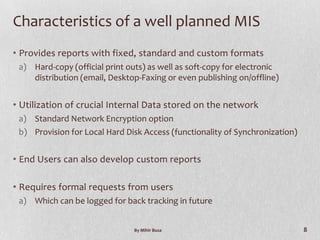
• Provides reports with fixed, standard and custom formats
 a) Hard-copy (official print outs) as well as soft-copy for electronic
    distribution (email, Desktop-Faxing or even publishing on/offline)


• Utilization of crucial Internal Data stored on the network
 a) Standard Network Encryption option
 b) Provision for Local Hard Disk Access (functionality of Synchronization)


• End Users can also develop custom reports

• Requires formal requests from users
 a) Which can be logged for back tracking in future


                                By Mihir Busa                                 8
MIS for Competitive Advantage
• Provides supports to Managers as they work to achieve corporate
  goals per Manufacturing / Sales / Marketing / Strategic

• Enables Managers to compare results to established company goals
  and identify problem areas as well as opportunities for
  improvements

• Enables auto-alerts when problems areas arises and further
  flagging, prompting and demanding immediate action to resolve

• Enables auto-alerts when opportunities areas are discovered


                            By Mihir Busa                           9
MIS and Web (online) Technology
• Data and reports may be set from Management Information System
  on company’s secure intranet (network) for access

• Employees can utilize frontend program UI or built-in web browser
  on their Desktop / Laptops / Tablets / Smartphones to login and gain
  secure access to that same data

• Increases:
  • Productivity,
  • Collaboration,
  • Team work synchronization and
  • Turn over time for business transactions


                                  By Mihir Busa                     10
Functional Aspects of MIS
• Management Information System is an integrated collection of
  functional information systems combined, along with each
  individual supporting functional areas

• Including:
   • Business Transactions,
   • Transactions Processing Systems (TPS),
   • Primarily from 2 sources: Internet and Extranet
   • Databases Input for validity checks,
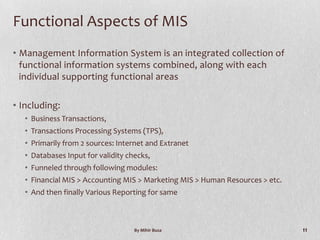
   • Funneled through following modules:
   • Financial MIS > Accounting MIS > Marketing MIS > Human Resources > etc.
   • And then finally Various Reporting for same


                                    By Mihir Busa                              11
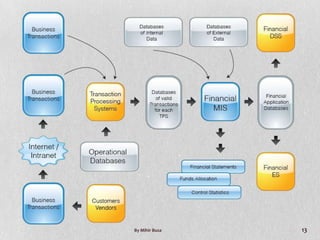
Financial MIS
• Provides financial information to all Financial
  Managers within an organization
• Including Senior Management

Complete with:
    Financial Data Security Standard (DSS) and
    Financial Enterprise Solutions (ES)

 Please see see following illustration for further explanation


                                       By Mihir Busa             12
By Mihir Busa   13
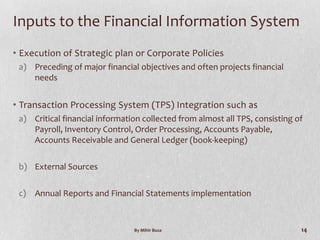
Inputs to the Financial Information System
• Execution of Strategic plan or Corporate Policies
 a) Preceding of major financial objectives and often projects financial
    needs


• Transaction Processing System (TPS) Integration such as
 a) Critical financial information collected from almost all TPS, consisting of
    Payroll, Inventory Control, Order Processing, Accounts Payable,
    Accounts Receivable and General Ledger (book-keeping)

 b) External Sources

 c) Annual Reports and Financial Statements implementation


                                By Mihir Busa                                 14
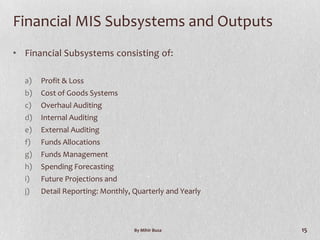
Financial MIS Subsystems and Outputs
• Financial Subsystems consisting of:

  a)   Profit & Loss
  b)   Cost of Goods Systems
  c)   Overhaul Auditing
  d)   Internal Auditing
  e)   External Auditing
  f)   Funds Allocations
  g)   Funds Management
  h)   Spending Forecasting
  i)   Future Projections and
  j)   Detail Reporting: Monthly, Quarterly and Yearly


                                  By Mihir Busa          15
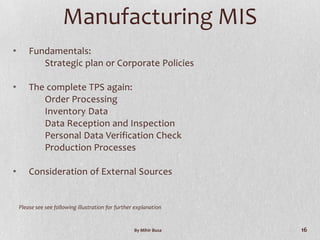
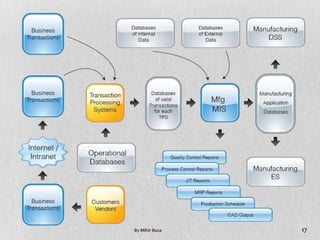
Manufacturing MIS
•       Fundamentals:
           Strategic plan or Corporate Policies

•       The complete TPS again:
           Order Processing
           Inventory Data
           Data Reception and Inspection
           Personal Data Verification Check
           Production Processes

•       Consideration of External Sources


    Please see see following illustration for further explanation


                                                     By Mihir Busa   16
By Mihir Busa   17
Manufacturing MIS Subsystems and Outputs

•   Design and Engineering
•   Master Production Scheduling
•   Inventory Control
•   Manufacturing Resource Planning
•   Just-in-Time (JIT) Inventory and Manufacturing
•   Process Control
•   Computer-integrated Manufacturing (CIM) which allows
•   Computer-aided Design (CAD)
•   Quality Control and Testing


                           By Mihir Busa                   18
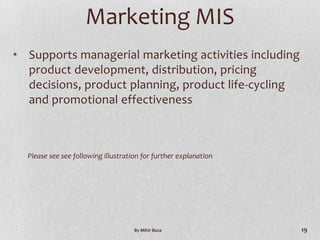
Marketing MIS
• Supports managerial marketing activities including
  product development, distribution, pricing
  decisions, product planning, product life-cycling
  and promotional effectiveness


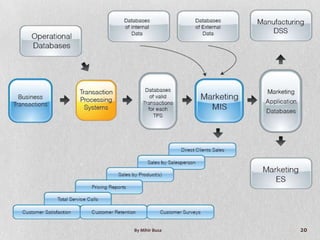
  Please see see following illustration for further explanation


                                     By Mihir Busa                19
By Mihir Busa   20
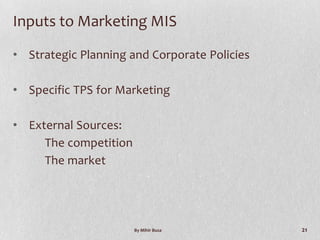
Inputs to Marketing MIS

• Strategic Planning and Corporate Policies

• Specific TPS for Marketing

• External Sources:
     The competition
     The market


                       By Mihir Busa          21
Marketing MIS Subsystems and Outputs

•   Marketing Research Support
•   Product Development Support
•   Product Planning & Life Cycle Support
•   Promotion and Advertising Support
•   Product Pricing Support


                     By Mihir Busa          22
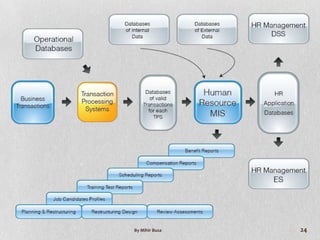
Human Resource MIS
• Integration to all of the activities related to
  employees and potential employees of the
  organization
• Enables employees monitoring with proper
  managerial reporting, track records assisting in
  further performance assessment


  Please see see following illustration for further explanation


                                     By Mihir Busa                23
By Mihir Busa   24
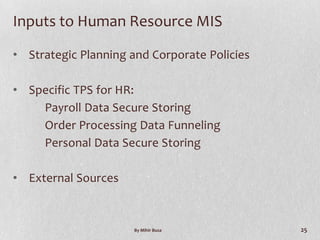
Inputs to Human Resource MIS

• Strategic Planning and Corporate Policies

• Specific TPS for HR:
    Payroll Data Secure Storing
    Order Processing Data Funneling
    Personal Data Secure Storing

• External Sources


                      By Mihir Busa           25
Human Resource MIS Subsystems and Outputs

• Human Resource Planning
• Personnel Selection and Recruiting support
• Training and Skills Management
• Scheduling and Job Placement support
• Comp, Wages, Commissions and Salary
  Management and Administration
• Streamlined Payroll system setup
• Organization Restructuring support

                   By Mihir Busa               26
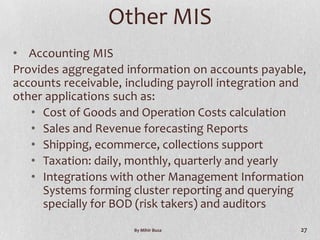
Other MIS
• Accounting MIS
Provides aggregated information on accounts payable,
accounts receivable, including payroll integration and
other applications such as:
   • Cost of Goods and Operation Costs calculation
   • Sales and Revenue forecasting Reports
   • Shipping, ecommerce, collections support
   • Taxation: daily, monthly, quarterly and yearly
   • Integrations with other Management Information
     Systems forming cluster reporting and querying
     specially for BOD (risk takers) and auditors
                      By Mihir Busa                  27
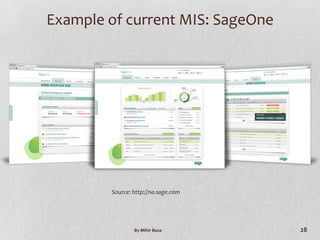
Example of current MIS: SageOne


        Source: http://na.sage.com


                By Mihir Busa        28
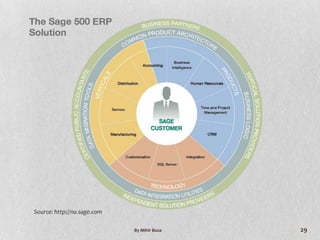
Source: http://na.sage.com

                             By Mihir Busa   29
Source: http://na.sage.com

                             By Mihir Busa   30
Conclusion
• To sum up, Senior Management / BOD would gain accurate control
  by improving overall business transactions while supporting
  Timeliness; Accuracy; Consistency; Completeness and Relevancy
  factors.

• Assists in Senior Management / BOD decisions to achieve defined
  goals within an established time period

• Improved basically MIS helps streamline and places organization to
  track of success and efficiency.


   This completes presentation convincing the BOD, many advantages of MIS by
               highlighting specific initiatives that MIS can address.
                                     Thank you.

                                By Mihir Busa                                  31

Advantages of MIS

  • 1.
    MANAGEMENT INFORMATION SYSTEMS (MIS): ADVANTAGES Presentation forhonorary: Board of Directors (BOD) Presentation by Mihir Busa
  • 2.
    Management Information Systems(MIS) • MIS stipulates managers with information and support for effective decision making along with delivering feedback on daily operations • Output or reports are usually generated through accumulation of transactions processing data • Each MIS is an integrated collection of subsystems, which are typically organized along functional lines with an organization By Mihir Busa 2
  • 3.
    Intended Benefits ofMIS MIS investments pays off in several different ways: • Core competency support • Enhanced distribution channel management • Increasing brand equity • Boosting production processes • Impact mass customization production processes • Leverage learning curve advantages • Leverage IT investment in computer aided design • Leverage stability with efficiency • Expand existing business and add ecommerce • Improve B2B commerce and relationship By Mihir Busa 3
  • 4.
    FIVE ELEMENTS OF MISUSABILITY • Timeliness • Accuracy • Consistency • Completeness • Relevance Please see see following illustrations for further explanation By Mihir Busa 4
  • 5.
  • 6.
    Outputs of aMIS Scheduled Reports Key Indicator Reports MIS Demand Reports Exception Reports By Mihir Busa 6
  • 7.
    Outputs of aMIS (continued) • Scheduled Reports a) Produced periodically or an a schedule (daily, weekly, monthly or quarterly) • Key Indicator Reports a) Summarized the previous day’s critical activities b) Typically available at the beginning of each day • Demand Reports a) Gives certain information at any Authority’s request • Exception Reports a) Automatically produced when unusual situation arises or requires action from Management By Mihir Busa 7
  • 8.
    Characteristics of awell planned MIS • Provides reports with fixed, standard and custom formats a) Hard-copy (official print outs) as well as soft-copy for electronic distribution (email, Desktop-Faxing or even publishing on/offline) • Utilization of crucial Internal Data stored on the network a) Standard Network Encryption option b) Provision for Local Hard Disk Access (functionality of Synchronization) • End Users can also develop custom reports • Requires formal requests from users a) Which can be logged for back tracking in future By Mihir Busa 8
  • 9.
    MIS for CompetitiveAdvantage • Provides supports to Managers as they work to achieve corporate goals per Manufacturing / Sales / Marketing / Strategic • Enables Managers to compare results to established company goals and identify problem areas as well as opportunities for improvements • Enables auto-alerts when problems areas arises and further flagging, prompting and demanding immediate action to resolve • Enables auto-alerts when opportunities areas are discovered By Mihir Busa 9
  • 10.
    MIS and Web(online) Technology • Data and reports may be set from Management Information System on company’s secure intranet (network) for access • Employees can utilize frontend program UI or built-in web browser on their Desktop / Laptops / Tablets / Smartphones to login and gain secure access to that same data • Increases: • Productivity, • Collaboration, • Team work synchronization and • Turn over time for business transactions By Mihir Busa 10
  • 11.
    Functional Aspects ofMIS • Management Information System is an integrated collection of functional information systems combined, along with each individual supporting functional areas • Including: • Business Transactions, • Transactions Processing Systems (TPS), • Primarily from 2 sources: Internet and Extranet • Databases Input for validity checks, • Funneled through following modules: • Financial MIS > Accounting MIS > Marketing MIS > Human Resources > etc. • And then finally Various Reporting for same By Mihir Busa 11
  • 12.
    Financial MIS • Providesfinancial information to all Financial Managers within an organization • Including Senior Management Complete with: Financial Data Security Standard (DSS) and Financial Enterprise Solutions (ES) Please see see following illustration for further explanation By Mihir Busa 12
  • 13.
  • 14.
    Inputs to theFinancial Information System • Execution of Strategic plan or Corporate Policies a) Preceding of major financial objectives and often projects financial needs • Transaction Processing System (TPS) Integration such as a) Critical financial information collected from almost all TPS, consisting of Payroll, Inventory Control, Order Processing, Accounts Payable, Accounts Receivable and General Ledger (book-keeping) b) External Sources c) Annual Reports and Financial Statements implementation By Mihir Busa 14
  • 15.
    Financial MIS Subsystemsand Outputs • Financial Subsystems consisting of: a) Profit & Loss b) Cost of Goods Systems c) Overhaul Auditing d) Internal Auditing e) External Auditing f) Funds Allocations g) Funds Management h) Spending Forecasting i) Future Projections and j) Detail Reporting: Monthly, Quarterly and Yearly By Mihir Busa 15
  • 16.
    Manufacturing MIS • Fundamentals: Strategic plan or Corporate Policies • The complete TPS again: Order Processing Inventory Data Data Reception and Inspection Personal Data Verification Check Production Processes • Consideration of External Sources Please see see following illustration for further explanation By Mihir Busa 16
  • 17.
  • 18.
    Manufacturing MIS Subsystemsand Outputs • Design and Engineering • Master Production Scheduling • Inventory Control • Manufacturing Resource Planning • Just-in-Time (JIT) Inventory and Manufacturing • Process Control • Computer-integrated Manufacturing (CIM) which allows • Computer-aided Design (CAD) • Quality Control and Testing By Mihir Busa 18
  • 19.
    Marketing MIS • Supportsmanagerial marketing activities including product development, distribution, pricing decisions, product planning, product life-cycling and promotional effectiveness Please see see following illustration for further explanation By Mihir Busa 19
  • 20.
  • 21.
    Inputs to MarketingMIS • Strategic Planning and Corporate Policies • Specific TPS for Marketing • External Sources: The competition The market By Mihir Busa 21
  • 22.
    Marketing MIS Subsystemsand Outputs • Marketing Research Support • Product Development Support • Product Planning & Life Cycle Support • Promotion and Advertising Support • Product Pricing Support By Mihir Busa 22
  • 23.
    Human Resource MIS •Integration to all of the activities related to employees and potential employees of the organization • Enables employees monitoring with proper managerial reporting, track records assisting in further performance assessment Please see see following illustration for further explanation By Mihir Busa 23
  • 24.
  • 25.
    Inputs to HumanResource MIS • Strategic Planning and Corporate Policies • Specific TPS for HR: Payroll Data Secure Storing Order Processing Data Funneling Personal Data Secure Storing • External Sources By Mihir Busa 25
  • 26.
    Human Resource MISSubsystems and Outputs • Human Resource Planning • Personnel Selection and Recruiting support • Training and Skills Management • Scheduling and Job Placement support • Comp, Wages, Commissions and Salary Management and Administration • Streamlined Payroll system setup • Organization Restructuring support By Mihir Busa 26
  • 27.
    Other MIS • AccountingMIS Provides aggregated information on accounts payable, accounts receivable, including payroll integration and other applications such as: • Cost of Goods and Operation Costs calculation • Sales and Revenue forecasting Reports • Shipping, ecommerce, collections support • Taxation: daily, monthly, quarterly and yearly • Integrations with other Management Information Systems forming cluster reporting and querying specially for BOD (risk takers) and auditors By Mihir Busa 27
  • 28.
    Example of currentMIS: SageOne Source: http://na.sage.com By Mihir Busa 28
  • 29.
  • 30.
  • 31.
    Conclusion • To sumup, Senior Management / BOD would gain accurate control by improving overall business transactions while supporting Timeliness; Accuracy; Consistency; Completeness and Relevancy factors. • Assists in Senior Management / BOD decisions to achieve defined goals within an established time period • Improved basically MIS helps streamline and places organization to track of success and efficiency. This completes presentation convincing the BOD, many advantages of MIS by highlighting specific initiatives that MIS can address. Thank you. By Mihir Busa 31