Basic Multithreading using POSIX
threads
Tushar B. Kute,
http://tusharkute.com
Threads
• A Thread is an independent stream of
instructions that can be schedule to run as such
by the OS.
• Think of a thread as a “procedure” that runs
independently from its main program.
• Multi-threaded programs are where several
procedures are able to be scheduled to run
simultaneously and/or independently by the OS.
• A Thread exists within a process and uses the
process resources.
Threads
• Threads only duplicate the essential
resources it needs to be independently
schedulable.
• A thread will die if the parent process dies.
• A thread is “lightweight” because most of
the overhead has already been
accomplished through the creation of the
process.
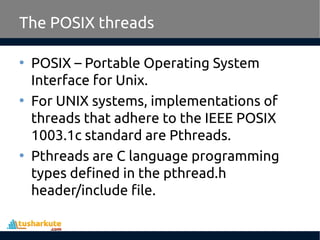
The POSIX threads
• POSIX – Portable Operating System
Interface for Unix.
• For UNIX systems, implementations of
threads that adhere to the IEEE POSIX
1003.1c standard are Pthreads.
• Pthreads are C language programming
types defined in the pthread.h
header/include file.
The Pthreads
• The primary motivation behind Pthreads is
improving program performance.
• Can be created with much less OS
overhead.
• Needs fewer system resources to run.
• View comparison of forking processes to
using a pthreads_create subroutine.
Timings reflect 50,000 processes/thread
creations.
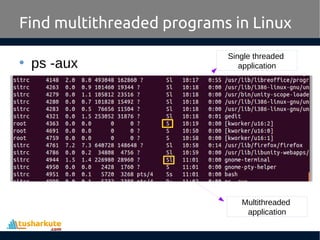
Find multithreaded programs in Linux
• ps -aux
Multithreaded
application
Single threaded
application
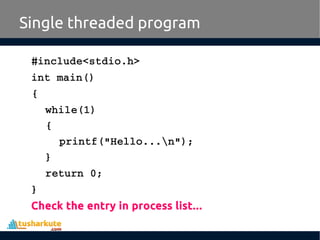
#include<stdio.h>
int main()
{
while(1)
{
printf("Hello...n");
}
return 0;
}
Check the entry in process list...
Single threaded program
Pthread library
• Pthread Library (60+ functions)
– Thread management: create, exit, detach, join, . .
.
– Thread cancellation
– Mutex locks: init, destroy, lock, unlock, . . .
– Condition variables: init, destroy, wait, timed
wait, . . . . . .
• Programs must include the file pthread.h
• Programs must be linked with the pthread
library (-lpthread)
Pthread: naming convensions
• Types: pthread[_object]_t
• Functions: pthread[_object]_action
• Constants/Macros: PTHREAD_PURPOSE
• Examples:
– pthread_t: the type of a thread
– pthread_create(): creates a thread
– pthread_mutex_t: the type of a mutex lock
– pthread_mutex_lock(): lock a mutex
– PTHREAD_CREATE_DETACHED
• Creates a new thread
• int pthread_create ( pthread_t *thread, 
pthread_attr_t *attr, void * (*start_routine) (void 
*), void *arg);
• Returns 0 to indicate success, otherwise returns error code...
–thread: output argument for the id of the new thread
–attr: input argument that specifies the attributes of the thread to be
created (NULL = default attributes)
–start_routine: function to use as the start of the new thread must
have prototype: void * foo(void*)
–arg: argument to pass to the new thread routine. If the thread
routine requires multiple arguments, they must be passed bundled
up in an array or a structure
pthread_create
• Terminates the calling thread
• void pthread_exit(void *retval);
• The return value is made available to
another thread calling a pthread_join()
• The return value of the function serves as
the argument to the (implicitly called)
pthread_exit().
•
pthread_exit
• Causes the calling thread to wait for another thread to
terminate
• int pthread_join( pthread_t thread, void **value_ptr);
– thread: input parameter, id of the thread to wait on
– value_ptr: output parameter, value given to
pthread_exit() by the terminating thread (which
happens to always be a void *)
• Returns 0 to indicate success, error code otherwise
• Multiple simultaneous calls for the same thread are not
allowed
pthread_join
int first()
{
int i;
for(i=0; ;i++)
{
printf("nFirst: %d",i);
sleep(1);
}
}
Single threaded program
int main()
{
int i;
first( );
for(i=0;;i++)
{
printf("nMain: %d",i);
sleep(1);
}
return 0;
}
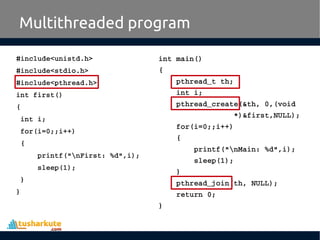
#include<unistd.h>
#include<stdio.h>
#include<pthread.h>
int first()
{
 int i;
 for(i=0;;i++)
 {
     printf("nFirst: %d",i);
     sleep(1);
 }
}
Multithreaded program
int main()
{
    pthread_t th;
    int i;
    pthread_create(&th, 0,(void 
                 *)&first,NULL);
    for(i=0;;i++)
    {
        printf("nMain: %d",i);
        sleep(1);
    }
    pthread_join(th, NULL);
    return 0;
}
Output
Process list
tushar@tusharkute.com
Thank you
This presentation is created using LibreOffice Impress 4.2.7.2, can be used freely as per GNU General Public License
Blogs
http://digitallocha.blogspot.in
http://kyamputar.blogspot.in
Web Resources
http://tusharkute.com

Basic Multithreading using Posix Threads

  • 1.
    Basic Multithreading usingPOSIX threads Tushar B. Kute, http://tusharkute.com
  • 2.
    Threads • A Threadis an independent stream of instructions that can be schedule to run as such by the OS. • Think of a thread as a “procedure” that runs independently from its main program. • Multi-threaded programs are where several procedures are able to be scheduled to run simultaneously and/or independently by the OS. • A Thread exists within a process and uses the process resources.
  • 3.
    Threads • Threads onlyduplicate the essential resources it needs to be independently schedulable. • A thread will die if the parent process dies. • A thread is “lightweight” because most of the overhead has already been accomplished through the creation of the process.
  • 4.
    The POSIX threads •POSIX – Portable Operating System Interface for Unix. • For UNIX systems, implementations of threads that adhere to the IEEE POSIX 1003.1c standard are Pthreads. • Pthreads are C language programming types defined in the pthread.h header/include file.
  • 5.
    The Pthreads • Theprimary motivation behind Pthreads is improving program performance. • Can be created with much less OS overhead. • Needs fewer system resources to run. • View comparison of forking processes to using a pthreads_create subroutine. Timings reflect 50,000 processes/thread creations.
  • 6.
    Find multithreaded programsin Linux • ps -aux Multithreaded application Single threaded application
  • 7.
  • 8.
    Pthread library • PthreadLibrary (60+ functions) – Thread management: create, exit, detach, join, . . . – Thread cancellation – Mutex locks: init, destroy, lock, unlock, . . . – Condition variables: init, destroy, wait, timed wait, . . . . . . • Programs must include the file pthread.h • Programs must be linked with the pthread library (-lpthread)
  • 9.
    Pthread: naming convensions •Types: pthread[_object]_t • Functions: pthread[_object]_action • Constants/Macros: PTHREAD_PURPOSE • Examples: – pthread_t: the type of a thread – pthread_create(): creates a thread – pthread_mutex_t: the type of a mutex lock – pthread_mutex_lock(): lock a mutex – PTHREAD_CREATE_DETACHED
  • 10.
    • Creates anew thread • int pthread_create ( pthread_t *thread,  pthread_attr_t *attr, void * (*start_routine) (void  *), void *arg); • Returns 0 to indicate success, otherwise returns error code... –thread: output argument for the id of the new thread –attr: input argument that specifies the attributes of the thread to be created (NULL = default attributes) –start_routine: function to use as the start of the new thread must have prototype: void * foo(void*) –arg: argument to pass to the new thread routine. If the thread routine requires multiple arguments, they must be passed bundled up in an array or a structure pthread_create
  • 11.
    • Terminates thecalling thread • void pthread_exit(void *retval); • The return value is made available to another thread calling a pthread_join() • The return value of the function serves as the argument to the (implicitly called) pthread_exit(). • pthread_exit
  • 12.
    • Causes thecalling thread to wait for another thread to terminate • int pthread_join( pthread_t thread, void **value_ptr); – thread: input parameter, id of the thread to wait on – value_ptr: output parameter, value given to pthread_exit() by the terminating thread (which happens to always be a void *) • Returns 0 to indicate success, error code otherwise • Multiple simultaneous calls for the same thread are not allowed pthread_join
  • 13.
    int first() { int i; for(i=0;;i++) { printf("nFirst: %d",i); sleep(1); } } Single threaded program int main() { int i; first( ); for(i=0;;i++) { printf("nMain: %d",i); sleep(1); } return 0; }
  • 14.
  • 15.
  • 16.
    tushar@tusharkute.com Thank you This presentationis created using LibreOffice Impress 4.2.7.2, can be used freely as per GNU General Public License Blogs http://digitallocha.blogspot.in http://kyamputar.blogspot.in Web Resources http://tusharkute.com