Expert systems M.S.Rama krishna (0458-703 )
Definition What  are Expert systems ? Knowledge based systems , & , Part of the Artificial Intelligence field. The idea is to inject expert knowledge in to a computer system. The  primary purpose  is  to automate  DECISION MAKING  Computer programs (if and then rules) that contain some subject-specific knowledge of one or more human experts  Made up of a set of rules that analyze user supplied information about a specific class of problems.  Systems that utilize reasoning capabilities and draw conclusions COMMON PROGRAMING LANGUAGE SUPPORT  The most commonly used are 1)  LISP.  2)  Prolog.
Components of an Expert System (1) Knowledge base : IT is the Nucleus of the expert system structure Stores all relevant information, data, rules, cases, and relationships used by the expert system Knowledge engineers :  who translate the knowledge of real human experts into rules and strategies, create it. These rules and strategies can change depending on the prevailing problem scenario
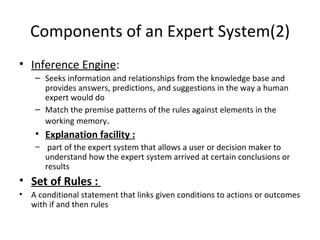
Components of an Expert System(2) Inference Engine :  Seeks information and relationships from the knowledge base and provides answers, predictions, and suggestions in the way a human expert would do  Match   the premise patterns of the rules against elements in the working memory . Explanation facility : part of the expert system that allows a user or decision maker to understand how the expert system arrived at certain conclusions or results Set of Rules :  A conditional statement that links given conditions to actions or outcomes with if and then rules
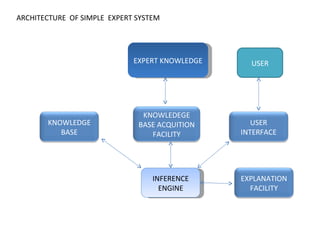
INFERENCE ENGINE EXPERT KNOWLEDGE ARCHITECTURE  OF SIMPLE  EXPERT SYSTEM EXPERT KNOWLEDGE USER KNOWLEDGE BASE KNOWLEDEGE BASE ACQUITION FACILITY EXPLANATION FACILITY USER INTERFACE
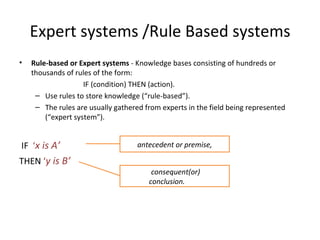
Expert systems /Rule Based systems Rule-based or Expert systems  - Knowledge bases consisting of hundreds or thousands of rules of the form:  IF (condition) THEN (action). Use rules to store knowledge (“rule-based”). The rules are usually gathered from experts in the field being represented (“expert system”). IF  ‘ x is A’ THEN  ‘ y is B’ antecedent or premise, consequent(or) conclusion. uent
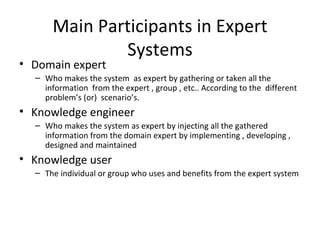
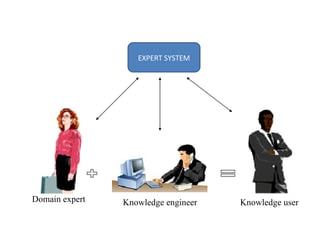
Main Participants in Expert Systems Domain expert Who makes the system  as expert by gathering or taken all the information  from the expert , group , etc.. According to the  different  problem’s (or)  scenario’s.  Knowledge engineer Who makes the system as expert by injecting all the gathered information from the domain expert by implementing , developing , designed and maintained  Knowledge user  The individual or group who uses and benefits from the expert system
Domain expert Knowledge engineer Knowledge user EXPERT SYSTEM
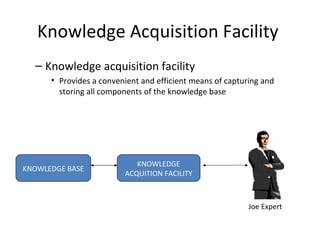
Knowledge Acquisition Facility  Knowledge acquisition facility Provides a convenient and efficient means of capturing and storing all components of the knowledge base Joe Expert KNOWLEDGE BASE KNOWLEDGE ACQUITION FACILITY
Methods  used in the Expert system The basic types are: 1)Decision trees  : A tree is formed with the series of questions , responses  where the answer is taken  from the responses generated  according to the scenario as end point. 2)Forward chaining  :  (data-driven) A method of reasoning that starts with the facts and works forward to the conclusions 3)Back ward chaining :  ( goal-driven ) A method of reasoning that starts with conclusions and works backward to the supporting facts 4)State machines  5)Bayesian networks 6)Black board systems 7)Case based reasoning
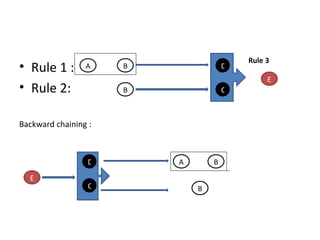
Example : Suppose we have three rules: R1: If A and B then D R2: If B then C R3: If C and D then E Forward chaining system :  1) facts are processed  first, 2) keep using the rules to draw new conclusions given those facts
Rule 1 :  Rule 2: Backward chaining :  A B B E D C Rule 3 E D C B B A
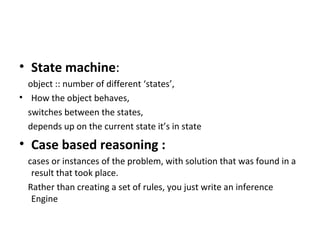
State machine :  object :: number of different ‘states’,  How the object behaves,  switches between the states,  depends up on the current state it’s in state Case based reasoning :  cases or instances of the problem, with solution that was found in a result that took place. Rather than creating a set of rules, you just write an inference Engine
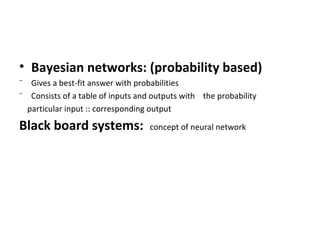
Bayesian networks: (probability based)  Gives a best-fit answer with probabilities Consists of a table of inputs and outputs with  the probability  particular input :: corresponding output  Black board systems:  concept of neural network
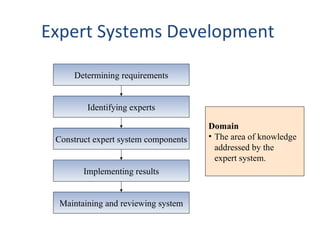
Expert Systems Development  Determining requirements Identifying experts Construct expert system components Implementing results Maintaining and reviewing system Domain The area of knowledge addressed by the expert system.
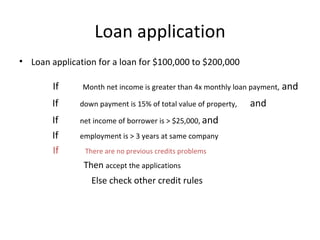
Loan application Loan application for a loan for $100,000 to $200,000 If  Month net income is greater than 4x monthly loan payment,  and If  down payment is 15% of total value of property,  and If  net income of borrower is > $25,000,  and If  employment is > 3 years at same company If  There are no previous credits problems   Then  accept the applications Else check other credit rules
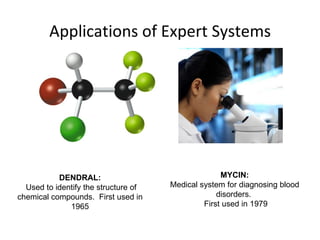
Applications of Expert Systems DENDRAL: Used to identify the structure of chemical compounds.  First used in 1965 MYCIN: Medical system for diagnosing blood disorders.  First used in 1979
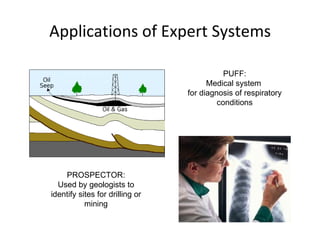
Applications of Expert Systems PROSPECTOR: Used by geologists to identify sites for drilling or mining PUFF: Medical system  for diagnosis of respiratory conditions
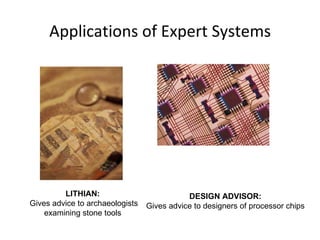
Applications of Expert Systems LITHIAN: Gives advice to archaeologists examining stone tools DESIGN ADVISOR: Gives advice to designers of processor chips
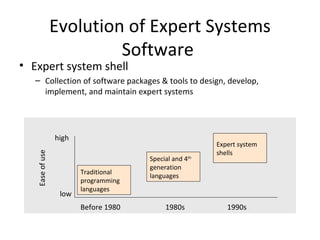
Evolution of Expert Systems Software  Expert system shell Collection of software packages & tools to design, develop, implement, and maintain expert systems Ease of use low high Before 1980 1980s 1990s Traditional programming languages Special and 4 th generation languages Expert system shells
Need for expert systems 1. Human expertise is very scarce. 2. Humans get tired from physical or mental workload. 3. Humans forget crucial details of a problem. 4. Humans are inconsistent in their day-to-day decisions. 5. Humans have limited working memory. 6. Humans are unable to comprehend large amounts of data quickly. 7. Humans are unable to retain large amounts of data in memory. 8. Humans are slow in recalling information stored in memory.
Expert System Limitations Limited focus Inability to learn Maintenance problems May have high development costs  Can only solve specific types of problems in a limited domain of knowledge
Advantages  Reduce employee training costs Centralize the decision making process. Create efficiencies and reduce the time needed to solve problems. Combine multiple human expert intelligences Reduce the amount of human errors. Expert-system approaches provide the added flexibility (Easy for modification) with the ability to model rules as data rather than as code
Problems with expert system Limited domain because , Domain experts cannot always clearly explain their logic and reasoning. Systems are not always up to date, and Don’t learn Experts needed to setup and maintain system No “common sense” , “ creative responses  ” ,  give in unusual circumstances by humans. Lack of flexibility and ability to adapt to changing environments
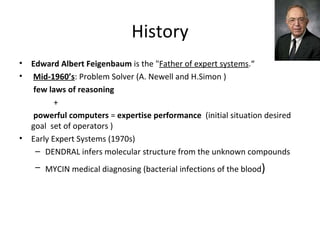
History Edward Albert Feigenbaum  is the " Father of expert systems .“ Mid-1960’s : Problem Solver (A. Newell and H.Simon )  few laws of reasoning + powerful computers  =  expertise performance  (initial situation desired goal  set of operators ) Early Expert Systems (1970s) DENDRAL infers molecular structure from the unknown compounds MYCIN medical diagnosing (bacterial infections of the blood )
“ A Hangover From AI Winter" AI winter  Is a period of reduced funding and interest in  ARTIFICIAL INTELLIGENCE research. The process of HYPE , disappointment and funding cuts are common in many emerging technologies  The worst times for AI were  1974−80  and  1987−93 1966: The failure of  Machine Translation 1970: The abandonment of connectionism 1971−75: DARPA's frustration with the SPEECH UNDERSTANDING RESEARCH program at CARNEGIE MELLON UNIVERSITY 1973: In the United Kingdom LIGHTHILL REPORT 1973−74: DARPA's cutbacks to academic AI research in general, 1987: The collapse of the LISP MACHINE market, 1988: The cancellation of new spending on AI by the STRATEGIC COMPUTING INITIATIVE. 1993:  EXPERT SYSTEMS slowly reaching the bottom, 1990s: The quiet disappearance of the FIFTH GENERATION COMPUTER project's original goals.
Conclusion They require a lot of collaboration between a knowledge engineer and a domain expert. When implemented correctly,  to over come the human error expert systems remove
References:   http://en.wikipedia.org/wiki/Expert_systems  http://www.exsys.com/demomain.html http://machineslikeus.com/news/end-ai-winter http://c2.com/cgi/wiki?AiWinter

Expert systems from rk

  • 1.
    Expert systems M.S.Ramakrishna (0458-703 )
  • 2.
    Definition What are Expert systems ? Knowledge based systems , & , Part of the Artificial Intelligence field. The idea is to inject expert knowledge in to a computer system. The primary purpose is to automate DECISION MAKING Computer programs (if and then rules) that contain some subject-specific knowledge of one or more human experts Made up of a set of rules that analyze user supplied information about a specific class of problems. Systems that utilize reasoning capabilities and draw conclusions COMMON PROGRAMING LANGUAGE SUPPORT The most commonly used are 1) LISP. 2) Prolog.
  • 3.
    Components of anExpert System (1) Knowledge base : IT is the Nucleus of the expert system structure Stores all relevant information, data, rules, cases, and relationships used by the expert system Knowledge engineers : who translate the knowledge of real human experts into rules and strategies, create it. These rules and strategies can change depending on the prevailing problem scenario
  • 4.
    Components of anExpert System(2) Inference Engine : Seeks information and relationships from the knowledge base and provides answers, predictions, and suggestions in the way a human expert would do Match the premise patterns of the rules against elements in the working memory . Explanation facility : part of the expert system that allows a user or decision maker to understand how the expert system arrived at certain conclusions or results Set of Rules : A conditional statement that links given conditions to actions or outcomes with if and then rules
  • 5.
    INFERENCE ENGINE EXPERTKNOWLEDGE ARCHITECTURE OF SIMPLE EXPERT SYSTEM EXPERT KNOWLEDGE USER KNOWLEDGE BASE KNOWLEDEGE BASE ACQUITION FACILITY EXPLANATION FACILITY USER INTERFACE
  • 6.
    Expert systems /RuleBased systems Rule-based or Expert systems - Knowledge bases consisting of hundreds or thousands of rules of the form: IF (condition) THEN (action). Use rules to store knowledge (“rule-based”). The rules are usually gathered from experts in the field being represented (“expert system”). IF ‘ x is A’ THEN ‘ y is B’ antecedent or premise, consequent(or) conclusion. uent
  • 7.
    Main Participants inExpert Systems Domain expert Who makes the system as expert by gathering or taken all the information from the expert , group , etc.. According to the different problem’s (or) scenario’s. Knowledge engineer Who makes the system as expert by injecting all the gathered information from the domain expert by implementing , developing , designed and maintained Knowledge user The individual or group who uses and benefits from the expert system
  • 8.
    Domain expert Knowledgeengineer Knowledge user EXPERT SYSTEM
  • 9.
    Knowledge Acquisition Facility Knowledge acquisition facility Provides a convenient and efficient means of capturing and storing all components of the knowledge base Joe Expert KNOWLEDGE BASE KNOWLEDGE ACQUITION FACILITY
  • 10.
    Methods usedin the Expert system The basic types are: 1)Decision trees : A tree is formed with the series of questions , responses where the answer is taken from the responses generated according to the scenario as end point. 2)Forward chaining : (data-driven) A method of reasoning that starts with the facts and works forward to the conclusions 3)Back ward chaining : ( goal-driven ) A method of reasoning that starts with conclusions and works backward to the supporting facts 4)State machines 5)Bayesian networks 6)Black board systems 7)Case based reasoning
  • 11.
    Example : Supposewe have three rules: R1: If A and B then D R2: If B then C R3: If C and D then E Forward chaining system : 1) facts are processed first, 2) keep using the rules to draw new conclusions given those facts
  • 12.
    Rule 1 : Rule 2: Backward chaining : A B B E D C Rule 3 E D C B B A
  • 13.
    State machine : object :: number of different ‘states’, How the object behaves, switches between the states, depends up on the current state it’s in state Case based reasoning : cases or instances of the problem, with solution that was found in a result that took place. Rather than creating a set of rules, you just write an inference Engine
  • 14.
    Bayesian networks: (probabilitybased) Gives a best-fit answer with probabilities Consists of a table of inputs and outputs with the probability particular input :: corresponding output Black board systems: concept of neural network
  • 15.
    Expert Systems Development Determining requirements Identifying experts Construct expert system components Implementing results Maintaining and reviewing system Domain The area of knowledge addressed by the expert system.
  • 16.
    Loan application Loanapplication for a loan for $100,000 to $200,000 If Month net income is greater than 4x monthly loan payment, and If down payment is 15% of total value of property, and If net income of borrower is > $25,000, and If employment is > 3 years at same company If There are no previous credits problems Then accept the applications Else check other credit rules
  • 17.
    Applications of ExpertSystems DENDRAL: Used to identify the structure of chemical compounds. First used in 1965 MYCIN: Medical system for diagnosing blood disorders. First used in 1979
  • 18.
    Applications of ExpertSystems PROSPECTOR: Used by geologists to identify sites for drilling or mining PUFF: Medical system for diagnosis of respiratory conditions
  • 19.
    Applications of ExpertSystems LITHIAN: Gives advice to archaeologists examining stone tools DESIGN ADVISOR: Gives advice to designers of processor chips
  • 20.
    Evolution of ExpertSystems Software Expert system shell Collection of software packages & tools to design, develop, implement, and maintain expert systems Ease of use low high Before 1980 1980s 1990s Traditional programming languages Special and 4 th generation languages Expert system shells
  • 21.
    Need for expertsystems 1. Human expertise is very scarce. 2. Humans get tired from physical or mental workload. 3. Humans forget crucial details of a problem. 4. Humans are inconsistent in their day-to-day decisions. 5. Humans have limited working memory. 6. Humans are unable to comprehend large amounts of data quickly. 7. Humans are unable to retain large amounts of data in memory. 8. Humans are slow in recalling information stored in memory.
  • 22.
    Expert System LimitationsLimited focus Inability to learn Maintenance problems May have high development costs Can only solve specific types of problems in a limited domain of knowledge
  • 23.
    Advantages Reduceemployee training costs Centralize the decision making process. Create efficiencies and reduce the time needed to solve problems. Combine multiple human expert intelligences Reduce the amount of human errors. Expert-system approaches provide the added flexibility (Easy for modification) with the ability to model rules as data rather than as code
  • 24.
    Problems with expertsystem Limited domain because , Domain experts cannot always clearly explain their logic and reasoning. Systems are not always up to date, and Don’t learn Experts needed to setup and maintain system No “common sense” , “ creative responses ” , give in unusual circumstances by humans. Lack of flexibility and ability to adapt to changing environments
  • 25.
    History Edward AlbertFeigenbaum  is the " Father of expert systems .“ Mid-1960’s : Problem Solver (A. Newell and H.Simon ) few laws of reasoning + powerful computers = expertise performance (initial situation desired goal set of operators ) Early Expert Systems (1970s) DENDRAL infers molecular structure from the unknown compounds MYCIN medical diagnosing (bacterial infections of the blood )
  • 26.
    “ A HangoverFrom AI Winter" AI winter  Is a period of reduced funding and interest in  ARTIFICIAL INTELLIGENCE research. The process of HYPE , disappointment and funding cuts are common in many emerging technologies  The worst times for AI were 1974−80 and 1987−93 1966: The failure of  Machine Translation 1970: The abandonment of connectionism 1971−75: DARPA's frustration with the SPEECH UNDERSTANDING RESEARCH program at CARNEGIE MELLON UNIVERSITY 1973: In the United Kingdom LIGHTHILL REPORT 1973−74: DARPA's cutbacks to academic AI research in general, 1987: The collapse of the LISP MACHINE market, 1988: The cancellation of new spending on AI by the STRATEGIC COMPUTING INITIATIVE. 1993:  EXPERT SYSTEMS slowly reaching the bottom, 1990s: The quiet disappearance of the FIFTH GENERATION COMPUTER project's original goals.
  • 27.
    Conclusion They requirea lot of collaboration between a knowledge engineer and a domain expert. When implemented correctly, to over come the human error expert systems remove
  • 28.
    References: http://en.wikipedia.org/wiki/Expert_systems http://www.exsys.com/demomain.html http://machineslikeus.com/news/end-ai-winter http://c2.com/cgi/wiki?AiWinter