AGENDA
INTRODUCTION
WHAT IS AN EXPERT SYSTEM
DEFINITION
NATURE OF ES
HISTORY OF ES
EXPERT SYSTEM & ARTIFICIAL INTELLIGENCE
COMPONENTS OF ES
ADVANTAGES & DISADVANTAGES OF ES
APPLICATIONS OF ES
SUMMARY
INTRODUCTION
 One of the branches of AI, which is the
expert system.
The ES is also known as knowledge-based
system.
The ES comprises many types of systems
based on rules, frames and fuzzy sets.
WHAT IS AN EXPERT SYSTEM
?
 Expert system is a term that describes a
computer program.
That simulates the judgement and behavior
of a human or an organization that has expert
knowledge and experience in a particular field.
DEFINITION
“Expert system is an information system that is
capable of mimicking human things and making
considerations during the process of decision
making”
COMPONENTS AN EXPERT
SYSTEM
KNOWLEDGE BASE
Stores all relevant information, data , rules, cases and relationships
used by expert system.
INFERENCE ENGINE
Seeks information and relationship from the knowledge base and
provides answers, predictions and suggestions in the way a human
expert would.
RULE
A conditional statement that links given conditions to actions or outcomes.
FUZZY LOGIC
A special research area in computer science that allows shades of gray and
does not require everything to be simply yes/no, or true/false.
NATURE OF EXPERT SYSTEM
In AI, an expert system is a computer system that emulates the decision-making
ability of a human expert.
ES are designed to solve complex problems by reasoning about knowledge ,
represented primarily as if-then rules rather than through conventional procedural code.
First ES was created in the 1970s
Proliferated 1980s
Expert systems were among the first truly successful forms of artificial
intelligence (AI) software.
An expert system is divided into two subsystems :The Inference
engine and the Knowledge base.
The knowledge base represents facts and rules.
The inference engine applies the rules to the known facts to deduce
new facts.
 Inference engines can also include explanation and debugging
abilities.
Expert systems have played a large role in Financial services, health
care, manufacturing and video games.
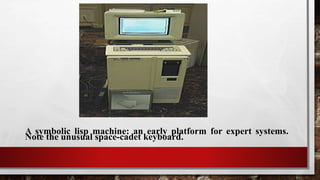
A symbolic lisp machine: an early platform for expert systems.
Note the unusual space-cadet keyboard.
HISTORY OF EXPERT SYSTEM
EARLY TO MID 1960S
General Purpose Problem Solver (GPS)
Although the GPS is not successful, it is still considered as time
predecessor of expert system since it aimed to create an intelligent
computer.
 MID 1960S
Researchers recognized that the problem-solving mechanism is only a
small part of a complete intelligent computer system.
EXAMPLES :- DENDRAL, MYCIN
•DENDRAL:- Its primary aim was to help organic chemists in identifying
unknown organic molecules, by analyzing their mass spectra and using
knowledge of chemistry.
•MYCIN:- Identify bacteria causing severe infections such as bacteremia
and meningitis.
Diagnosis of blood clotting diseases
 1970S
The concept of expert system was first developed in the 1970s by Edward
Feigenbaum [ professor and founder of the Knowledge Systems Laboratory at
Stanford university].
Father of expert systems.
Data processing to knowledge to “knowledge processing”.
By new processor technology and computer architectures .
Two early expert systems:-
Health care space for medical diagnoses
Helped chemists
 EARLY 1980S
 ES technology started to go commercial.
Programming tools and shells appeared.
About 1/3 of these systems are very successful and are still used.
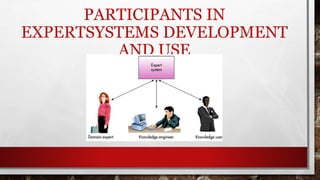
PARTICIPANTS IN
EXPERTSYSTEMS DEVELOPMENT
AND USE
DOMAIN EXPERT
The individual or group whose expertise and knowledge is captured for use in an
expert system.
KNOWLEDGE USER
The individual or group who uses and benefits from the expert system.
KNOWLEDGE ENGINEER
Some one trained or experienced in the design development, implementation, and
maintenance of an expert system.
ES AND AI
I. OVERVIEW OF ARTIFICIAL INTELLIGENCE
ARTIFICIAL INTELLIGENCE (AI)
Computers which the ability to mimic or duplicate the functions of the human
brain.
 ARTIFICIAL INTELLIGENCE SYSTEMS
The people, procedures, Hardware, software, data, and knowledge needed to
develop computer systems and machines that demonstrate the characteristics of
intelligence.
INTELLIGENT BEHAVIOUR
 Learn From Experience
 Apply Knowledge Acquired From Experience
 Solve Problems When Important information Missing
 Handle Complex Situation
 Determine What Is Important
 React Quickly And Correctly To A New Situation
 Understand Visual Images
II. OVERVIEW OF EXPERT SYSTEM (ES)
A computer application that performs a task that would otherwise be performed by
a human expert.
 Can…..
 Explain their reasoning or suggested decision.
Display intelligent behavior.
Draw conclusions from complex relationships.
Provide portable knowledge.
WHY USE EXPERT SYSTEMS?
Experts are not also available.
An expert system can be used any where any time.
Human experts are not 100% reliable or consistent.
Experts may not be good at explaining decisions.
Cost effective.
WHY AN EXPERT SYSTEM CAN BE USED
An expert system can be used if :-
The problem cannot be specified in terms of well defined algorithms.
When the task is hazardous.
There is scarcity of experts in the area.
The problem requires consistency and standardization.
Human experts have successfully solved similar problems.
ADVANTAGES OF EXPERT
SYSTEMConsistency
Speed / efficiency
Ability to solve complex and difficult problems
Reduce the cost of consulting experts for solving the problem
Hazardous working environment
Combination of knowledge and expertise from various sources
Training tool for trainees
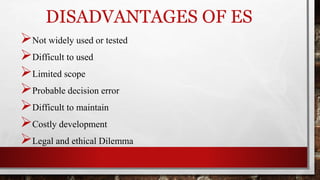
DISADVANTAGES OF ES
Not widely used or tested
Difficult to used
Limited scope
Probable decision error
Difficult to maintain
Costly development
Legal and ethical Dilemma
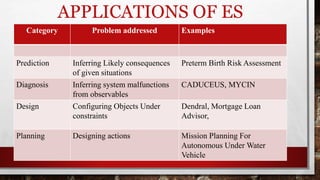
APPLICATIONS OF ES
Category Problem addressed Examples
Prediction Inferring Likely consequences
of given situations
Preterm Birth Risk Assessment
Diagnosis Inferring system malfunctions
from observables
CADUCEUS, MYCIN
Design Configuring Objects Under
constraints
Dendral, Mortgage Loan
Advisor,
Planning Designing actions Mission Planning For
Autonomous Under Water
Vehicle
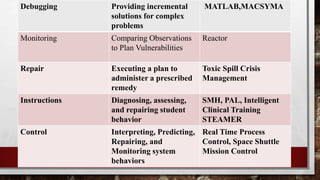
Debugging Providing incremental
solutions for complex
problems
MATLAB,MACSYMA
Monitoring Comparing Observations
to Plan Vulnerabilities
Reactor
Repair Executing a plan to
administer a prescribed
remedy
Toxic Spill Crisis
Management
Instructions Diagnosing, assessing,
and repairing student
behavior
SMH, PAL, Intelligent
Clinical Training
STEAMER
Control Interpreting, Predicting,
Repairing, and
Monitoring system
behaviors
Real Time Process
Control, Space Shuttle
Mission Control
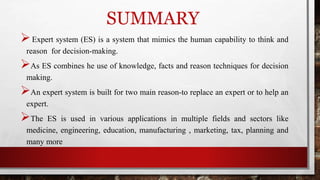
SUMMARY
Expert system (ES) is a system that mimics the human capability to think and
reason for decision-making.
As ES combines he use of knowledge, facts and reason techniques for decision
making.
An expert system is built for two main reason-to replace an expert or to help an
expert.
The ES is used in various applications in multiple fields and sectors like
medicine, engineering, education, manufacturing , marketing, tax, planning and
many more
THANK YOU

expertsystem.pptx email

  • 2.
    AGENDA INTRODUCTION WHAT IS ANEXPERT SYSTEM DEFINITION NATURE OF ES HISTORY OF ES EXPERT SYSTEM & ARTIFICIAL INTELLIGENCE COMPONENTS OF ES ADVANTAGES & DISADVANTAGES OF ES APPLICATIONS OF ES SUMMARY
  • 3.
    INTRODUCTION  One ofthe branches of AI, which is the expert system. The ES is also known as knowledge-based system. The ES comprises many types of systems based on rules, frames and fuzzy sets.
  • 4.
    WHAT IS ANEXPERT SYSTEM ?  Expert system is a term that describes a computer program. That simulates the judgement and behavior of a human or an organization that has expert knowledge and experience in a particular field.
  • 5.
    DEFINITION “Expert system isan information system that is capable of mimicking human things and making considerations during the process of decision making”
  • 6.
    COMPONENTS AN EXPERT SYSTEM KNOWLEDGEBASE Stores all relevant information, data , rules, cases and relationships used by expert system. INFERENCE ENGINE Seeks information and relationship from the knowledge base and provides answers, predictions and suggestions in the way a human expert would.
  • 7.
    RULE A conditional statementthat links given conditions to actions or outcomes. FUZZY LOGIC A special research area in computer science that allows shades of gray and does not require everything to be simply yes/no, or true/false.
  • 8.
    NATURE OF EXPERTSYSTEM In AI, an expert system is a computer system that emulates the decision-making ability of a human expert. ES are designed to solve complex problems by reasoning about knowledge , represented primarily as if-then rules rather than through conventional procedural code. First ES was created in the 1970s Proliferated 1980s Expert systems were among the first truly successful forms of artificial intelligence (AI) software.
  • 9.
    An expert systemis divided into two subsystems :The Inference engine and the Knowledge base. The knowledge base represents facts and rules. The inference engine applies the rules to the known facts to deduce new facts.  Inference engines can also include explanation and debugging abilities. Expert systems have played a large role in Financial services, health care, manufacturing and video games.
  • 10.
    A symbolic lispmachine: an early platform for expert systems. Note the unusual space-cadet keyboard.
  • 11.
    HISTORY OF EXPERTSYSTEM EARLY TO MID 1960S General Purpose Problem Solver (GPS) Although the GPS is not successful, it is still considered as time predecessor of expert system since it aimed to create an intelligent computer.
  • 12.
     MID 1960S Researchersrecognized that the problem-solving mechanism is only a small part of a complete intelligent computer system. EXAMPLES :- DENDRAL, MYCIN •DENDRAL:- Its primary aim was to help organic chemists in identifying unknown organic molecules, by analyzing their mass spectra and using knowledge of chemistry. •MYCIN:- Identify bacteria causing severe infections such as bacteremia and meningitis. Diagnosis of blood clotting diseases
  • 13.
     1970S The conceptof expert system was first developed in the 1970s by Edward Feigenbaum [ professor and founder of the Knowledge Systems Laboratory at Stanford university]. Father of expert systems. Data processing to knowledge to “knowledge processing”. By new processor technology and computer architectures . Two early expert systems:- Health care space for medical diagnoses Helped chemists
  • 14.
     EARLY 1980S ES technology started to go commercial. Programming tools and shells appeared. About 1/3 of these systems are very successful and are still used.
  • 15.
  • 16.
    DOMAIN EXPERT The individualor group whose expertise and knowledge is captured for use in an expert system. KNOWLEDGE USER The individual or group who uses and benefits from the expert system. KNOWLEDGE ENGINEER Some one trained or experienced in the design development, implementation, and maintenance of an expert system.
  • 17.
    ES AND AI I.OVERVIEW OF ARTIFICIAL INTELLIGENCE ARTIFICIAL INTELLIGENCE (AI) Computers which the ability to mimic or duplicate the functions of the human brain.  ARTIFICIAL INTELLIGENCE SYSTEMS The people, procedures, Hardware, software, data, and knowledge needed to develop computer systems and machines that demonstrate the characteristics of intelligence.
  • 18.
    INTELLIGENT BEHAVIOUR  LearnFrom Experience  Apply Knowledge Acquired From Experience  Solve Problems When Important information Missing  Handle Complex Situation  Determine What Is Important  React Quickly And Correctly To A New Situation  Understand Visual Images
  • 19.
    II. OVERVIEW OFEXPERT SYSTEM (ES) A computer application that performs a task that would otherwise be performed by a human expert.  Can…..  Explain their reasoning or suggested decision. Display intelligent behavior. Draw conclusions from complex relationships. Provide portable knowledge.
  • 20.
    WHY USE EXPERTSYSTEMS? Experts are not also available. An expert system can be used any where any time. Human experts are not 100% reliable or consistent. Experts may not be good at explaining decisions. Cost effective.
  • 21.
    WHY AN EXPERTSYSTEM CAN BE USED An expert system can be used if :- The problem cannot be specified in terms of well defined algorithms. When the task is hazardous. There is scarcity of experts in the area. The problem requires consistency and standardization. Human experts have successfully solved similar problems.
  • 22.
    ADVANTAGES OF EXPERT SYSTEMConsistency Speed/ efficiency Ability to solve complex and difficult problems Reduce the cost of consulting experts for solving the problem Hazardous working environment Combination of knowledge and expertise from various sources Training tool for trainees
  • 23.
    DISADVANTAGES OF ES Notwidely used or tested Difficult to used Limited scope Probable decision error Difficult to maintain Costly development Legal and ethical Dilemma
  • 24.
    APPLICATIONS OF ES CategoryProblem addressed Examples Prediction Inferring Likely consequences of given situations Preterm Birth Risk Assessment Diagnosis Inferring system malfunctions from observables CADUCEUS, MYCIN Design Configuring Objects Under constraints Dendral, Mortgage Loan Advisor, Planning Designing actions Mission Planning For Autonomous Under Water Vehicle
  • 25.
    Debugging Providing incremental solutionsfor complex problems MATLAB,MACSYMA Monitoring Comparing Observations to Plan Vulnerabilities Reactor Repair Executing a plan to administer a prescribed remedy Toxic Spill Crisis Management Instructions Diagnosing, assessing, and repairing student behavior SMH, PAL, Intelligent Clinical Training STEAMER Control Interpreting, Predicting, Repairing, and Monitoring system behaviors Real Time Process Control, Space Shuttle Mission Control
  • 26.
    SUMMARY Expert system (ES)is a system that mimics the human capability to think and reason for decision-making. As ES combines he use of knowledge, facts and reason techniques for decision making. An expert system is built for two main reason-to replace an expert or to help an expert. The ES is used in various applications in multiple fields and sectors like medicine, engineering, education, manufacturing , marketing, tax, planning and many more
  • 28.