Automotive RADAR Adoption
An Overview
Ram Mirwani
Director, Global Strategic Accounts
NI AWR Group
National Instruments
Topics
 Automotive RADAR
 Trends for Automotive RADAR
Overview of RADAR
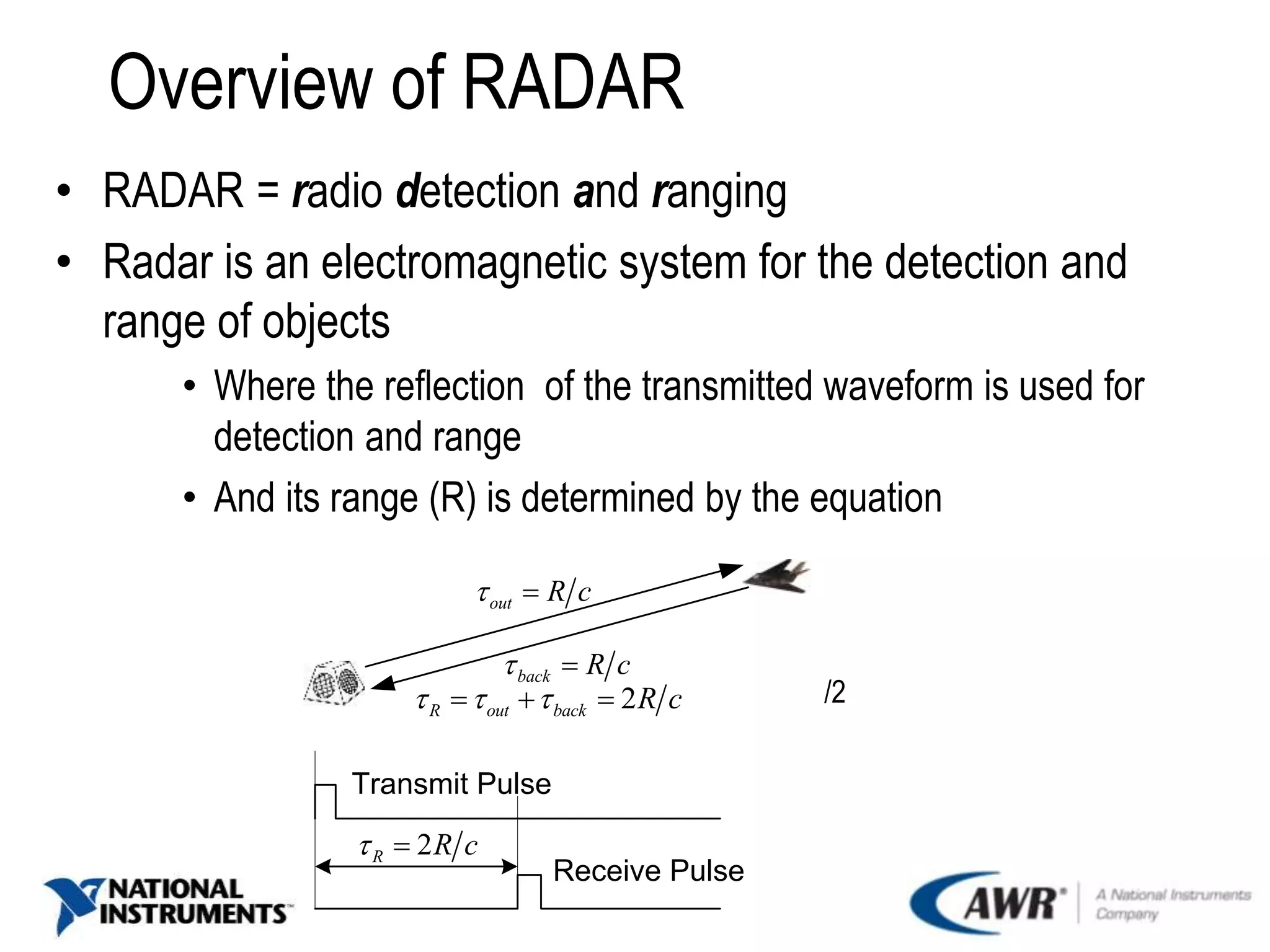
• RADAR = radio detection and ranging
• Radar is an electromagnetic system for the detection and
range of objects
• Where the reflection of the transmitted waveform is used for
detection and range
• And its range (R) is determined by the equation
/2
out R c 
back R c 
2R out back R c    
2R R c 
Transmit Pulse
Receive Pulse
Automotive RADAR
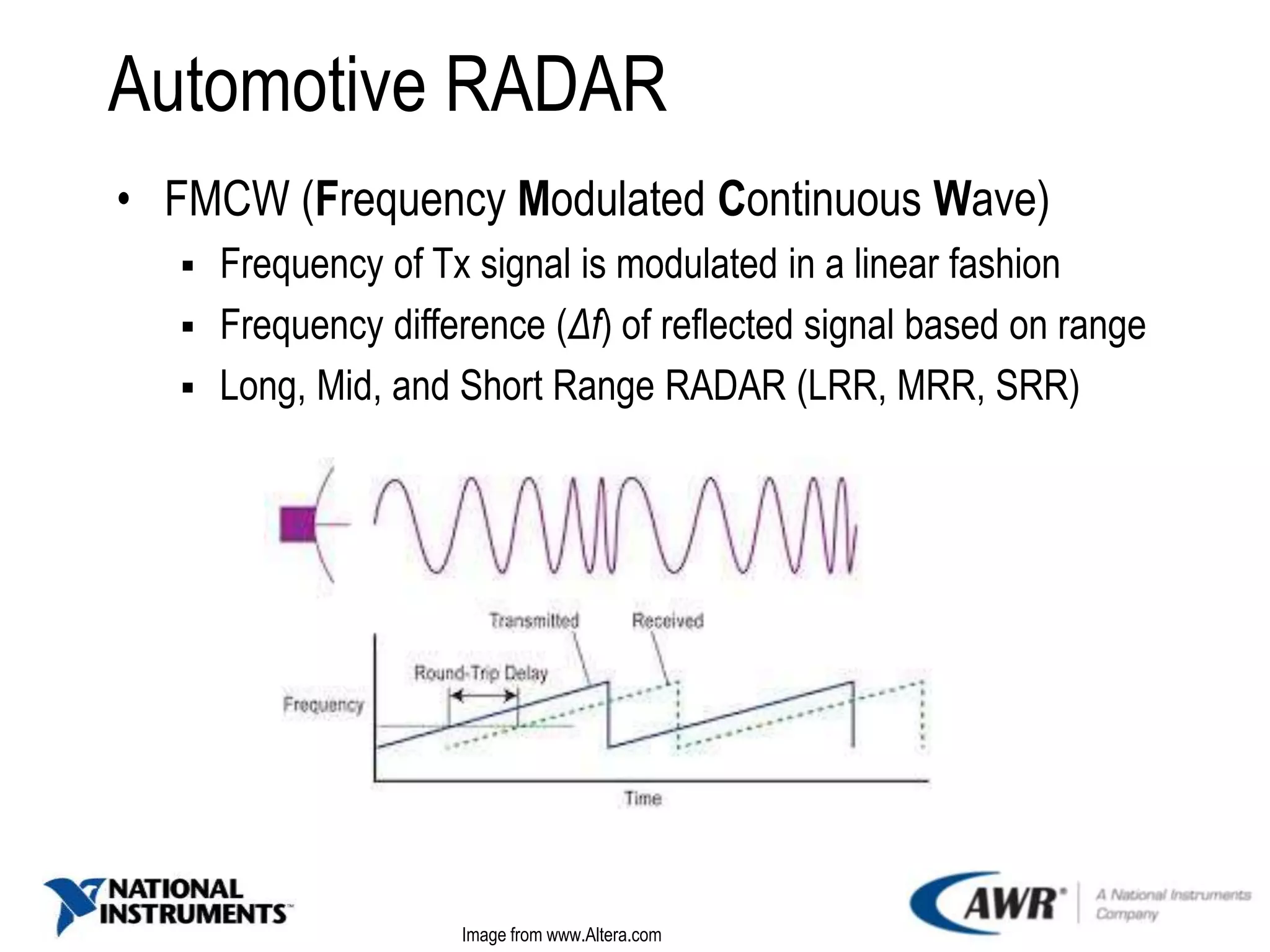
• FMCW (Frequency Modulated Continuous Wave)
 Frequency of Tx signal is modulated in a linear fashion
 Frequency difference (Δf) of reflected signal based on range
 Long, Mid, and Short Range RADAR (LRR, MRR, SRR)
Image from www.Altera.com
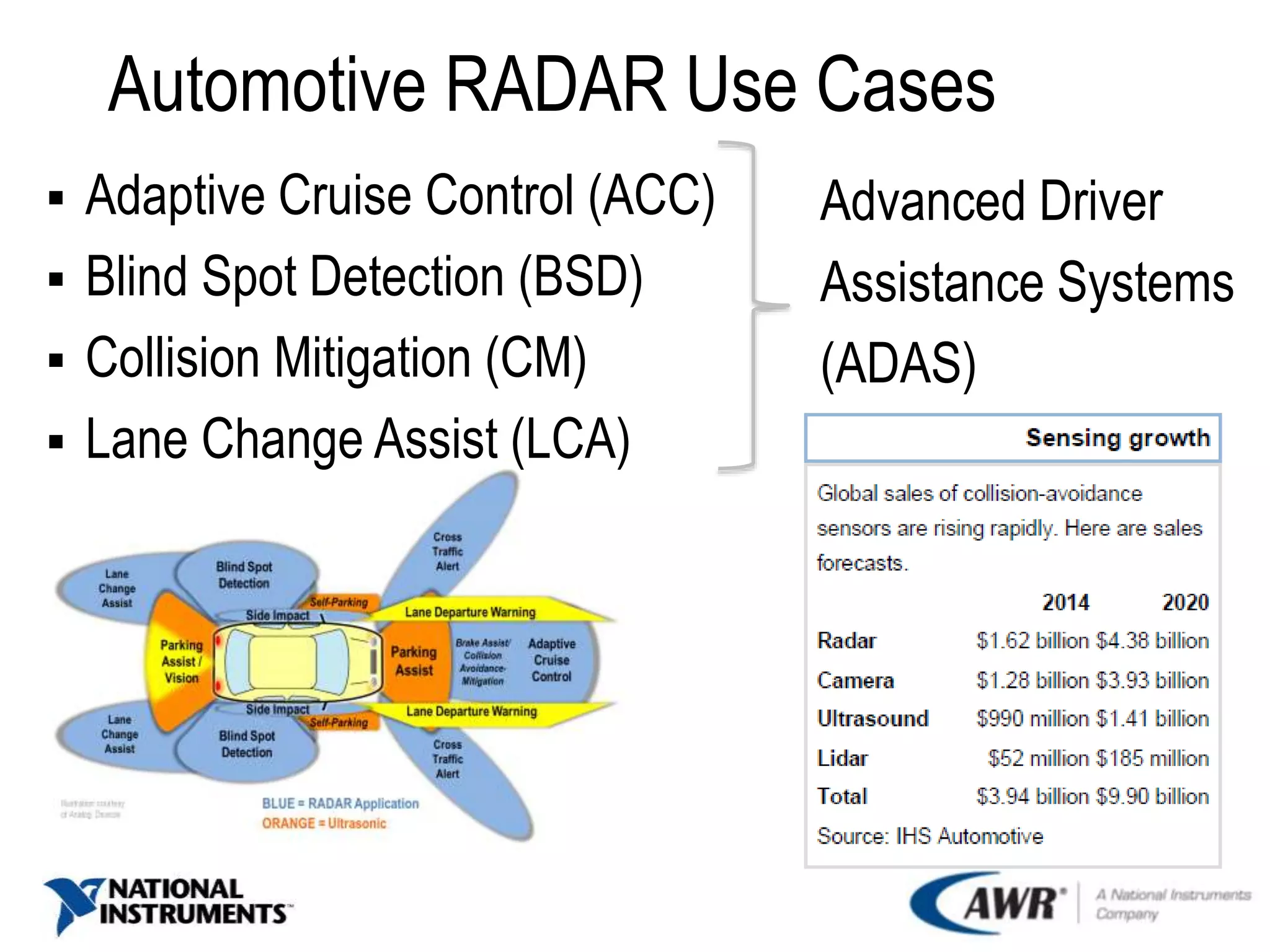
Automotive RADAR Use Cases
 Adaptive Cruise Control (ACC)
 Blind Spot Detection (BSD)
 Collision Mitigation (CM)
 Lane Change Assist (LCA)
Advanced Driver
Assistance Systems
(ADAS)
Trends in Automotive RADAR
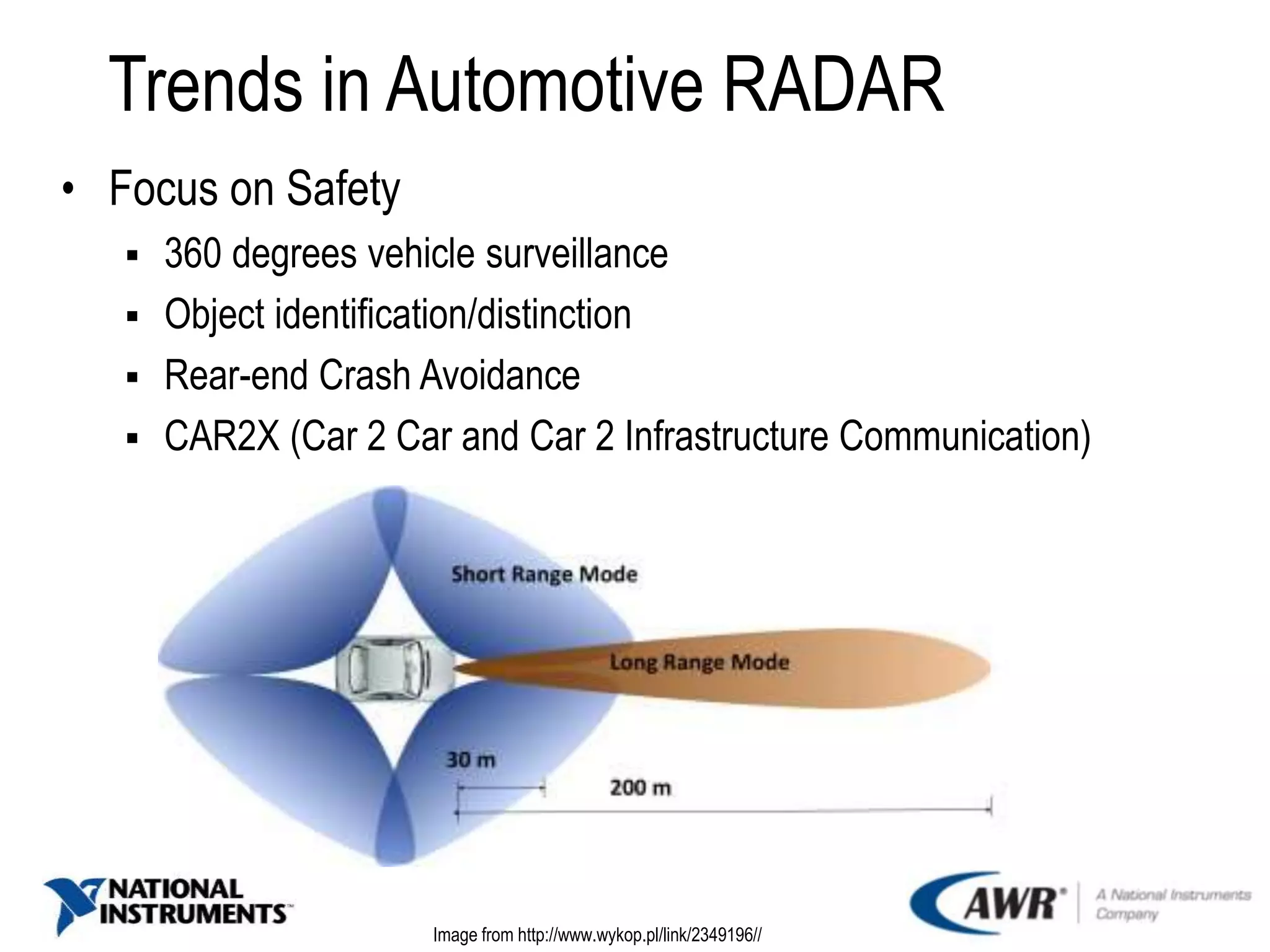
• Focus on Safety
 360 degrees vehicle surveillance
 Object identification/distinction
 Rear-end Crash Avoidance
 CAR2X (Car 2 Car and Car 2 Infrastructure Communication)
Image from http://www.wykop.pl/link/2349196//
Trends in Automotive RADAR
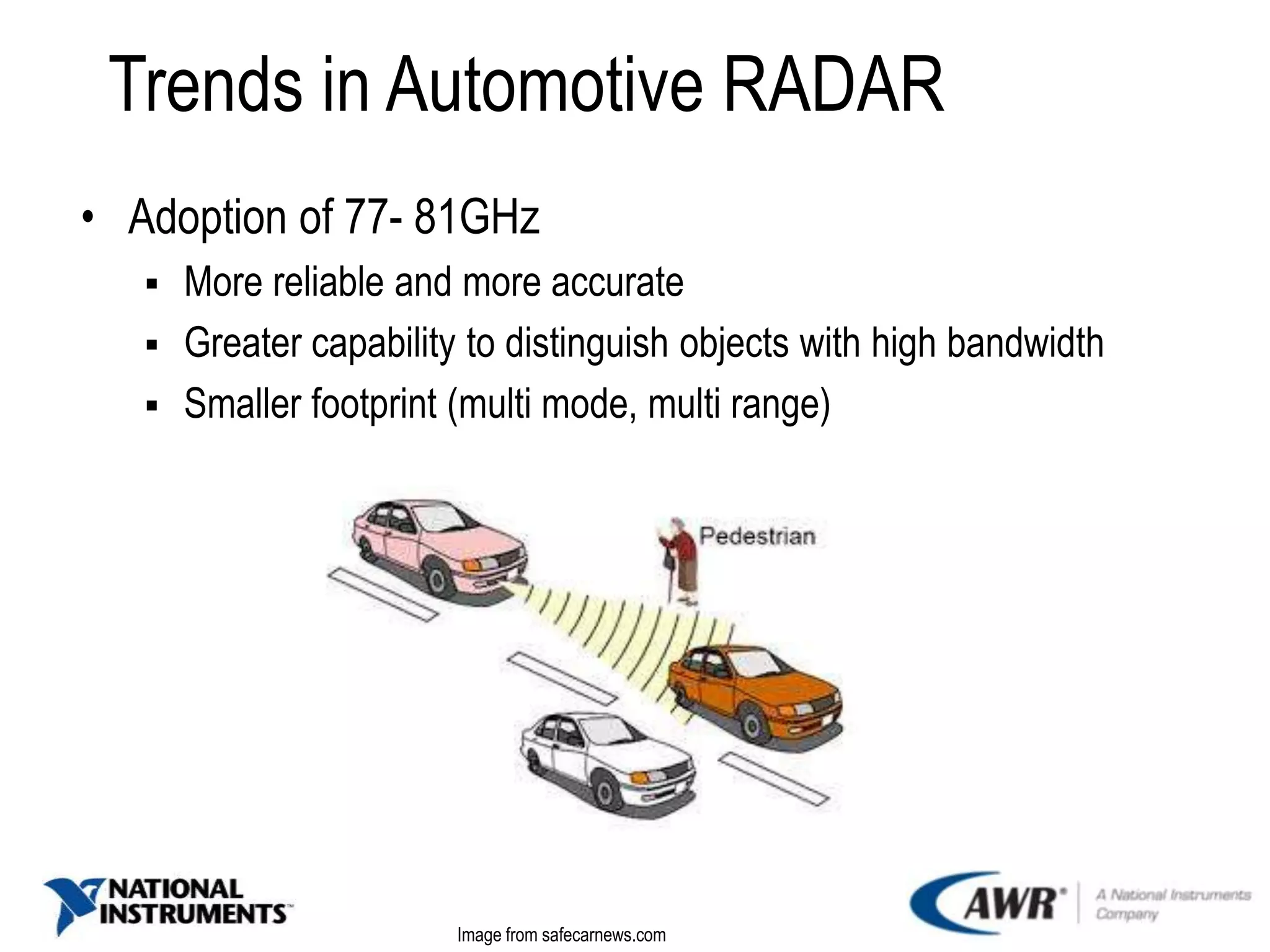
• Adoption of 77- 81GHz
 More reliable and more accurate
 Greater capability to distinguish objects with high bandwidth
 Smaller footprint (multi mode, multi range)
Image from safecarnews.com
Trends in Automotive RADAR
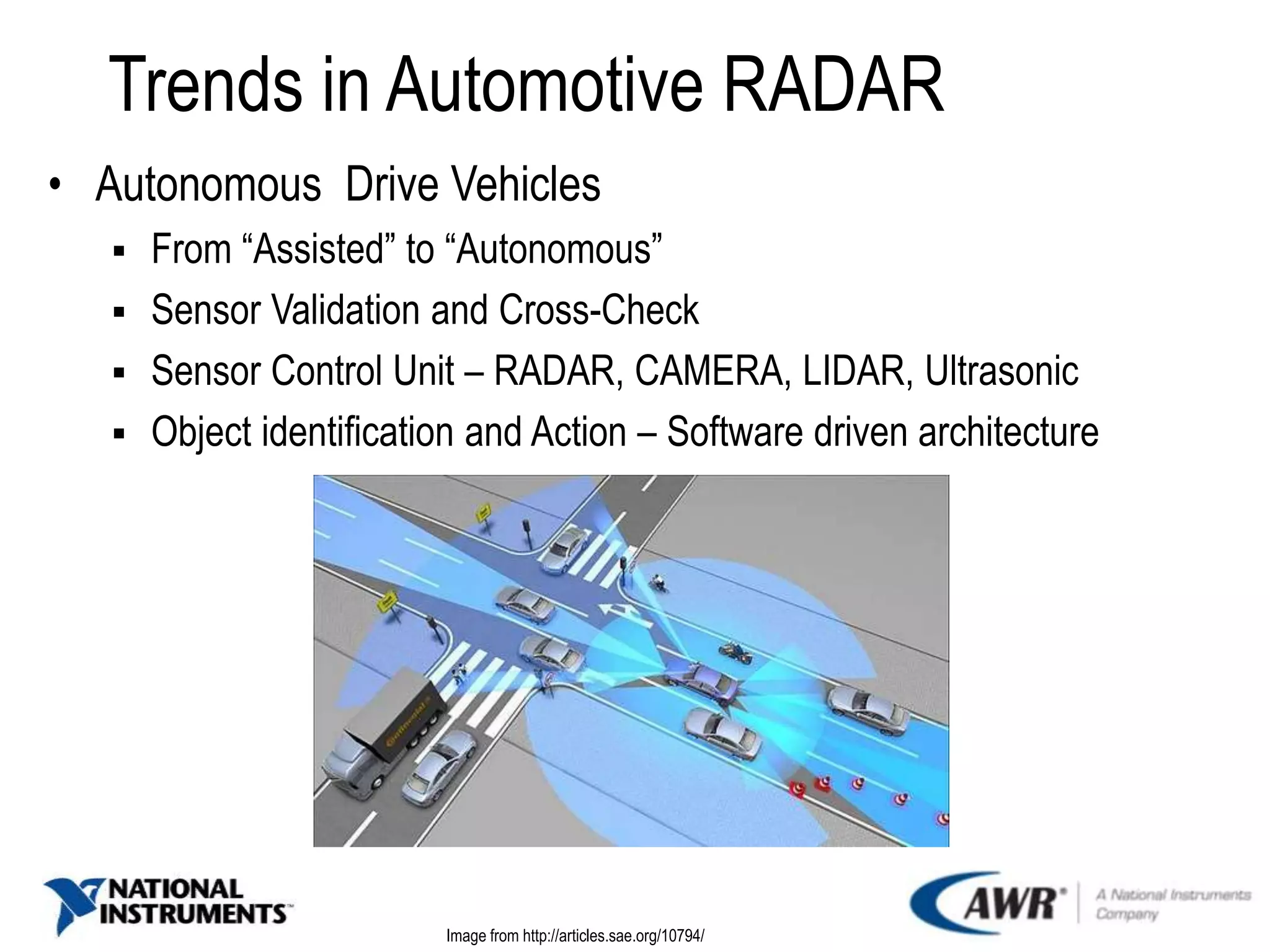
• Autonomous Drive Vehicles
 From “Assisted” to “Autonomous”
 Sensor Validation and Cross-Check
 Sensor Control Unit – RADAR, CAMERA, LIDAR, Ultrasonic
 Object identification and Action – Software driven architecture
Image from http://articles.sae.org/10794/
Trends in Automotive RADAR
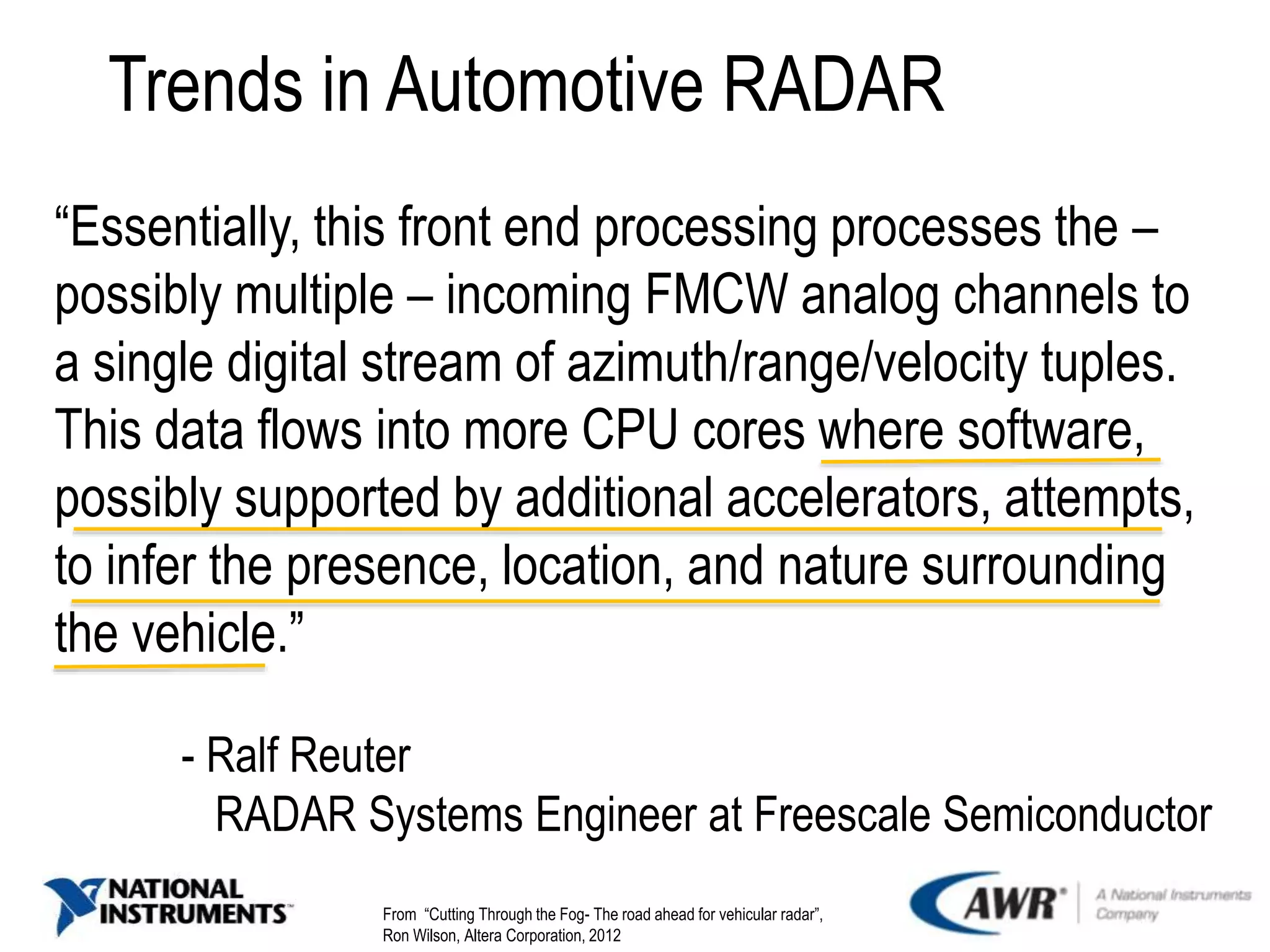
“Essentially, this front end processing processes the –
possibly multiple – incoming FMCW analog channels to
a single digital stream of azimuth/range/velocity tuples.
This data flows into more CPU cores where software,
possibly supported by additional accelerators, attempts,
to infer the presence, location, and nature surrounding
the vehicle.”
- Ralf Reuter
RADAR Systems Engineer at Freescale Semiconductor
From “Cutting Through the Fog- The road ahead for vehicular radar”,
Ron Wilson, Altera Corporation, 2012
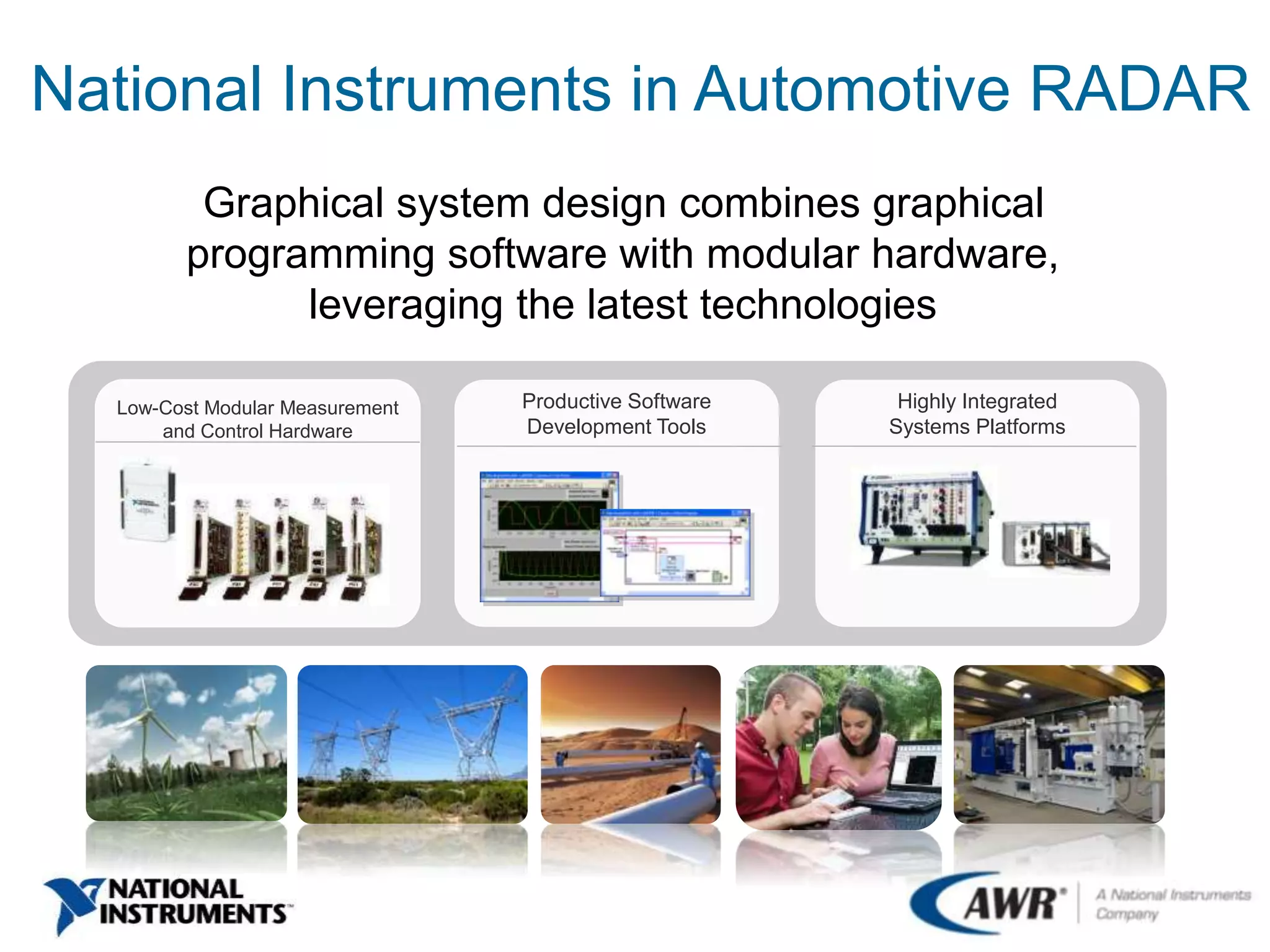
Low-Cost Modular Measurement
and Control Hardware
Productive Software
Development Tools
Highly Integrated
Systems Platforms
Graphical system design combines graphical
programming software with modular hardware,
leveraging the latest technologies
National Instruments in Automotive RADAR
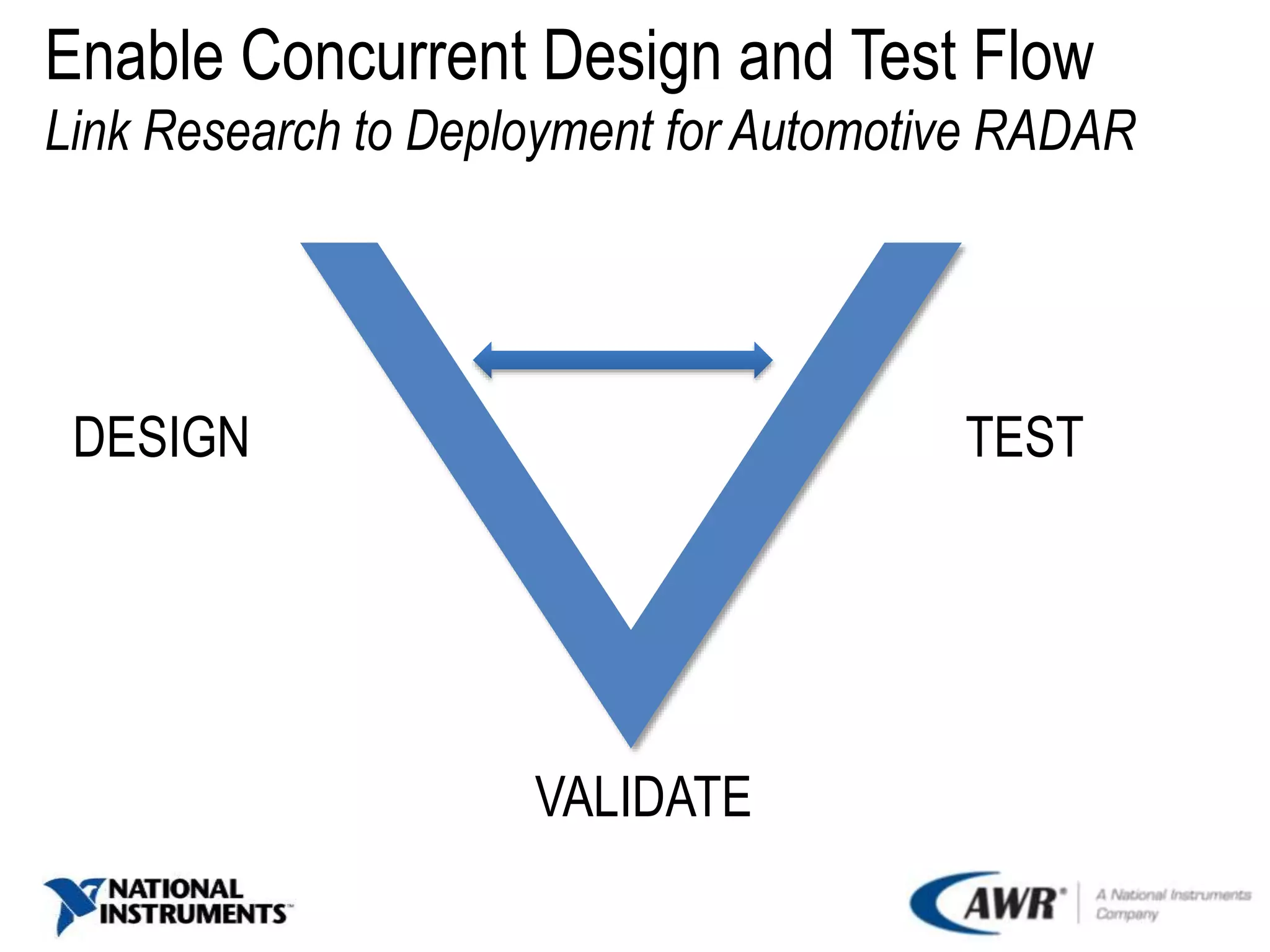
Enable Concurrent Design and Test Flow
Link Research to Deployment for Automotive RADAR
DESIGN
VALIDATE
TEST
Summary
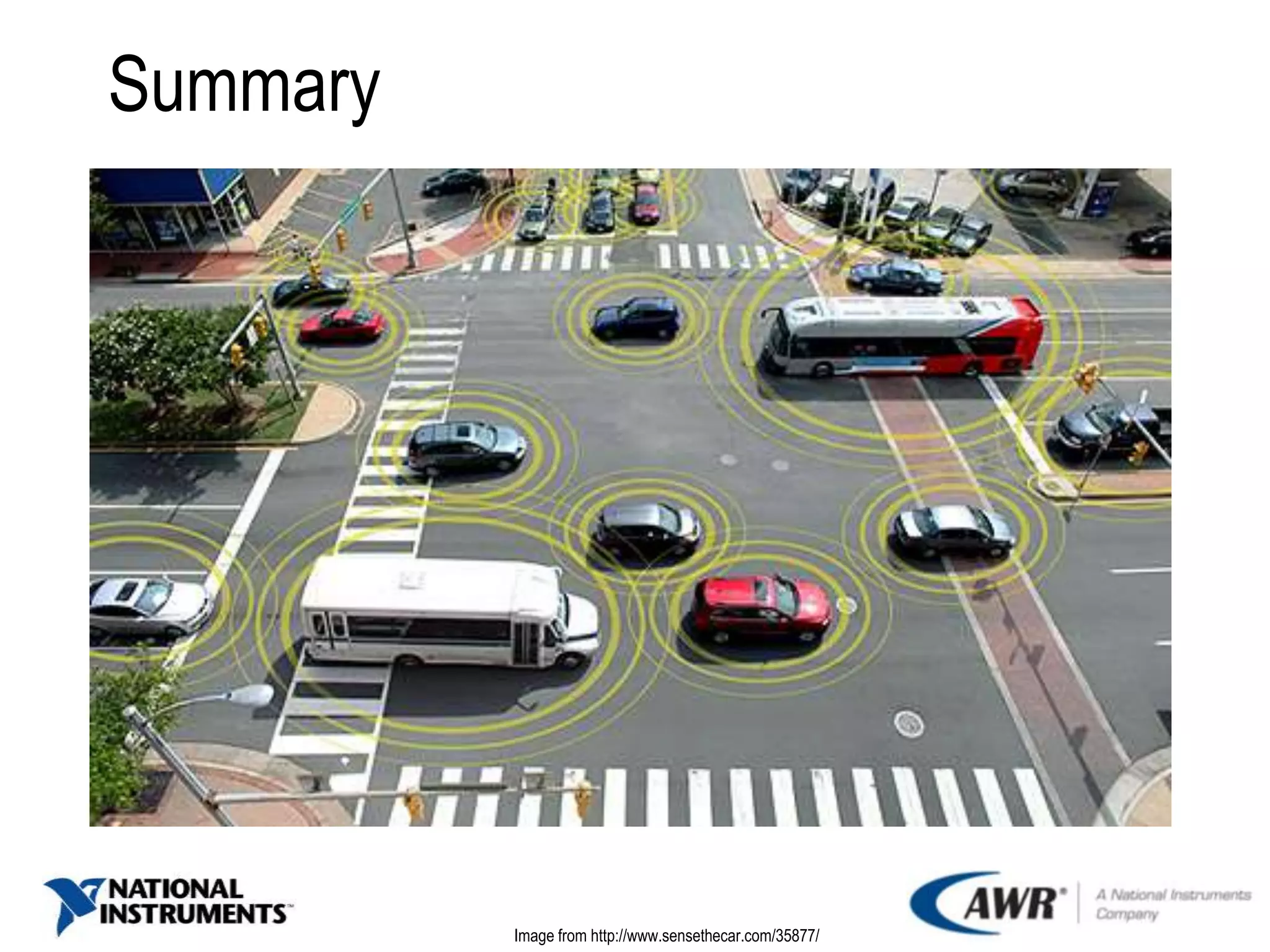
Image from http://www.sensethecar.com/35877/

Automotive RADAR Adoption—An Overview

  • 1.
    Automotive RADAR Adoption AnOverview Ram Mirwani Director, Global Strategic Accounts NI AWR Group National Instruments
  • 2.
    Topics  Automotive RADAR Trends for Automotive RADAR
  • 3.
    Overview of RADAR •RADAR = radio detection and ranging • Radar is an electromagnetic system for the detection and range of objects • Where the reflection of the transmitted waveform is used for detection and range • And its range (R) is determined by the equation /2 out R c  back R c  2R out back R c     2R R c  Transmit Pulse Receive Pulse
  • 4.
    Automotive RADAR • FMCW(Frequency Modulated Continuous Wave)  Frequency of Tx signal is modulated in a linear fashion  Frequency difference (Δf) of reflected signal based on range  Long, Mid, and Short Range RADAR (LRR, MRR, SRR) Image from www.Altera.com
  • 5.
    Automotive RADAR UseCases  Adaptive Cruise Control (ACC)  Blind Spot Detection (BSD)  Collision Mitigation (CM)  Lane Change Assist (LCA) Advanced Driver Assistance Systems (ADAS)
  • 6.
    Trends in AutomotiveRADAR • Focus on Safety  360 degrees vehicle surveillance  Object identification/distinction  Rear-end Crash Avoidance  CAR2X (Car 2 Car and Car 2 Infrastructure Communication) Image from http://www.wykop.pl/link/2349196//
  • 7.
    Trends in AutomotiveRADAR • Adoption of 77- 81GHz  More reliable and more accurate  Greater capability to distinguish objects with high bandwidth  Smaller footprint (multi mode, multi range) Image from safecarnews.com
  • 8.
    Trends in AutomotiveRADAR • Autonomous Drive Vehicles  From “Assisted” to “Autonomous”  Sensor Validation and Cross-Check  Sensor Control Unit – RADAR, CAMERA, LIDAR, Ultrasonic  Object identification and Action – Software driven architecture Image from http://articles.sae.org/10794/
  • 9.
    Trends in AutomotiveRADAR “Essentially, this front end processing processes the – possibly multiple – incoming FMCW analog channels to a single digital stream of azimuth/range/velocity tuples. This data flows into more CPU cores where software, possibly supported by additional accelerators, attempts, to infer the presence, location, and nature surrounding the vehicle.” - Ralf Reuter RADAR Systems Engineer at Freescale Semiconductor From “Cutting Through the Fog- The road ahead for vehicular radar”, Ron Wilson, Altera Corporation, 2012
  • 10.
    Low-Cost Modular Measurement andControl Hardware Productive Software Development Tools Highly Integrated Systems Platforms Graphical system design combines graphical programming software with modular hardware, leveraging the latest technologies National Instruments in Automotive RADAR
  • 11.
    Enable Concurrent Designand Test Flow Link Research to Deployment for Automotive RADAR DESIGN VALIDATE TEST
  • 12.

Editor's Notes

  • #2 For state-of-the-art in automotive radar, I can introduce the use of radar in vehicles today and some adoption trends including fitting in with connected vehicles.. I'll also briefly introduce the radar design process and tools to facilitate these adoption trends. Optimize RF Product Development with NI and AWR How can real world measurements validate a model behavior and reduce the overall product development cycle time? Is it possible to reduce cycle time for RF product development by your choice of tools and platforms used? This session will provide an update to NI and AWR product integration and introduce how you can use flexible and scalable integrated tools from NI and AWR throughout the product development cycle. It will also share how these combined platforms can use real world measurements in your product development flow to effectively bridge design and test development efforts and realize productivity gains including higher quality designs. This presentation will discuss several use cases including PA Design and Radar Systems Design.
  • #3 2 main topics I will share today are: An introduction to Automotive RADAR applications Some trends in this dynamic area of the automotive market
  • #4 Lets start with aligning what I mean by RADAR? Radar is actually an acronym and over time the acronym became a noun… RADAR stands for Radio Detection and Ranging, here detection implies the size and speed of the object and the object can be almost anything… TR is the time by the waveform to travel to the target (object) and return to the transmitter. C is the speed of light.. The division by 2 appears because the two way propagation of the of radar
  • #5 There are many kinds of RADAR systems. Automotive RADAR use FMCW signals ie Frequency modulated continous wave signals. As shown here, the transmitted signal is modulated in a linear fashion and the frequency difference of the reflected signal indicates the range. By varying the power of the TX signal, it is possible to create Long, mid, and short range RADAR systems reaching from 15 m to 300M and beyond.
  • #6 RADAR is used in several applications in automotives as listed here. Mostly compiling under the ADAS systems for driver assistance capability like ACC, BSD, CM and LCA. The use of RADAR in automotives is forecasted to increase as shown in the table here with annual revenues increasing to about $4B in 2020.
  • #7 Moving on to the trends in Automotive RADAR, one key trend is the use of RADAR to increase driver and pedestrian Safety. One use case in work is to use multiple RADAR sensors to offer a 360 degrees surveillance field around an automotive vehicle as shown here. And link to existing driver assistance capability like lane changing, ACC, that were discussed. Another key trend is to use high bandwidth RADAR systems for accurate object identification especially pedestrians for collision mitigation and rear-end crash avoidance. Car 2 Car and Car to Infrastructure communication is heavily in its research phase primarily to aid emergency services get on location faster if the need arrises.
  • #8 Another key trend is the adoption of the RADAR systems at the 77 to 81GHz frequency to create more reliable and accurate radar systems as several different research studies have shown. Again a primary drive being safety and the increased capability to distinguish various objects of different sizes. Which becomes increasingly critical in dense areas like cities. One additional trend is the development of smaller and multi-function radar sensors to offer the next generation driver assistance capability
  • #9 My final trend to share with you today is the advance Assisted Driver capability to Autonomous Drive Vehicles as shown on the image here. . The primary efforts lead to linking the existing sensor technology, with RADAR taking a primary role, and building the intelligence to cross-check the information between different sensors before pro-actively executing on a course of action. The variety of available sensors and benefits of simultaneous use will possibly lead to the creation of Sensor Control Units, much like the Engine Control Unit to ensure a high integrity of data collection from the sensors. And coupled with software driven architecture to process and analyze the data in real-time to determine subsequent actions.
  • #10 This point is highlighted in this quote from Ralf Reuter who is at Fresscale and showcases that the reliability and use of these next generation RADAR systems will depend more heavily on the software algorithms and processing capabilities.
  • #11 This software centric need is a tight fit with National Instruments central paradigm for instrumentation systems called Graphical Systems Design. For over 30 years, National Instruments Graphical Systems Design approach has combined graphical programming software with modular hardware to enable engineers and scientists to effectively build the instrumentation capabilities they need for their efforts. And our customers are now pulling National Instruments products into several research projects related to next generation Automotive RADAR systems as an enabler to efficiently bridge the data from hardware based sensors to detailed algorithm design efforts and software intelligence.
  • #12 And also to ultimately and effectively link their efforts with the NI platform as they go from research to validation and to deployment of their applications. The key trend here is to develop a design process that links the Design and Test efforts to reduce iterations and development time.
  • #13 As a summary, I will leave you with this image of where the Automotive RADAR trends are heading. Towards a vision where each vehicle is an interactive node in a transport system, with its own radar field and autonomous driving capability.