








Future Radar Technologies
and Applications
Dr. James Jeffs
Senior Technology Analyst
IDTechEx
© 2024 IDTechEx
IDTechEx Provides Clarity on Technology Innovation
Reports | Subscriptions | Consulting | Journals | Webinars
Since 1999 IDTechEx has provided
independent market research, consultancy
and subscriptions on emerging technology
to clients in over 80 countries.
• Technology assessment
• Technology scouting
• Company profiling
• Market sizing
• Market forecasts
• Strategic advice
© 2024 IDTechEx 2
Agenda for Today’s Presentation
1. Radar and its use within different industries
2. Performance requirements for radar in
automotive
3. Next generation radar performance and
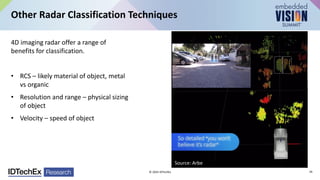
trends
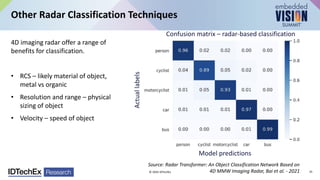
A. Increased resolution
B. 4-dimensional detection
C. High-dynamic range
D. Cost
E. Size
F. Power consumption
4. How radar data can be used for
classification Automotive Radar 2024-2044: Forecasts, Technologies, Applications
www.IDTechEx.com/Radar
Sample pages are available for all IDTechEx reports
© 2024 IDTechEx 3
4
© 2024 IDTechEx
Radar and its Use Within Different Industries
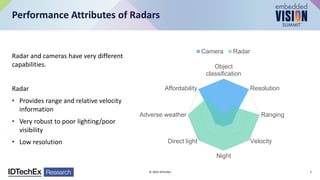
Radar and cameras have very different
capabilities.
Radar
• Provides range and relative velocity
information
• Very robust to poor lighting/poor
visibility
• Low resolution
Performance Attributes of Radars
Object
classification
Resolution
Ranging
Velocity
Night
Direct light
Adverse weather
Affordability
Camera Radar
© 2024 IDTechEx 5
Applications in Different Industries
6
© 2024 IDTechEx
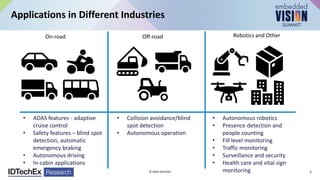
On-road Off-road Robotics and Other
• ADAS features - adaptive
cruise control
• Safety features – blind spot
detection, automatic
emergency braking
• Autonomous driving
• In-cabin applications
• Collision avoidance/blind
spot detection
• Autonomous operation
• Autonomous robotics
• Presence detection and
people counting
• Fill level monitoring
• Traffic monitoring
• Surveillance and security
• Health care and vital sign
monitoring
7
© 2024 IDTechEx
Performance Requirements for Radar in Automotive
Typical Applications for Automotive Radar
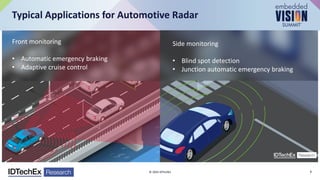
Front monitoring
• Automatic emergency braking
• Adaptive cruise control
Side monitoring
• Blind spot detection
• Junction automatic emergency braking
© 2024 IDTechEx 8
Typical Applications for Automotive Radar
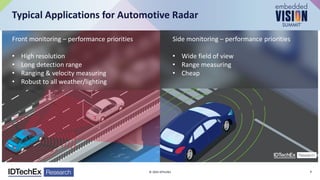
Front monitoring – performance priorities
• High resolution
• Long detection range
• Ranging & velocity measuring
• Robust to all weather/lighting
Side monitoring – performance priorities
• Wide field of view
• Range measuring
• Cheap
© 2024 IDTechEx 9
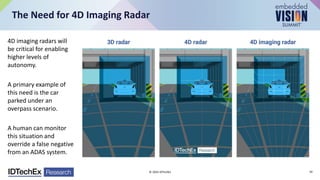
The Need for 4D Imaging Radar
4D imaging radars will
be critical for enabling
higher levels of
autonomy.
A primary example of
this need is the car
parked under an
overpass scenario.
A human can monitor
this situation and
override a false negative
from an ADAS system.
© 2024 IDTechEx 10
11
© 2024 IDTechEx
Next Generation Radar Performance and Trends
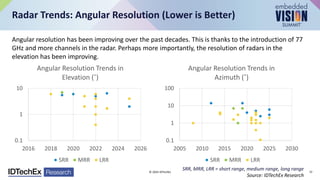
Angular resolution has been improving over the past decades. This is thanks to the introduction of 77
GHz and more channels in the radar. Perhaps more importantly, the resolution of radars in the
elevation has been improving.
Radar Trends: Angular Resolution (Lower is Better)
0.1
1
10
100
2005 2010 2015 2020 2025 2030
Angular Resolution Trends in
Azimuth (˚)
SRR MRR LRR
0.1
1
10
2016 2018 2020 2022 2024 2026
Angular Resolution Trends in
Elevation (˚)
SRR MRR LRR
SRR, MRR, LRR = short range, medium range, long range
Source: IDTechEx Research
© 2024 IDTechEx 12
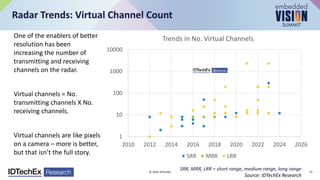
One of the enablers of better
resolution has been
increasing the number of
transmitting and receiving
channels on the radar.
Virtual channels = No.
transmitting channels X No.
receiving channels.
Virtual channels are like pixels
on a camera – more is better,
but that isn’t the full story.
Radar Trends: Virtual Channel Count
1
10
100
1000
10000
2010 2012 2014 2016 2018 2020 2022 2024 2026
Trends in No. Virtual Channels
SRR MRR LRR
SRR, MRR, LRR = short range, medium range, long range
Source: IDTechEx Research
© 2024 IDTechEx 13
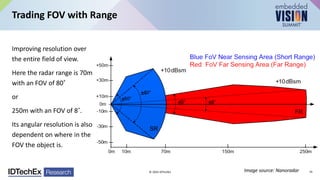
Improving resolution over
the entire field of view.
Here the radar range is 70m
with an FOV of 80˚
or
250m with an FOV of 8˚.
Its angular resolution is also
dependent on where in the
FOV the object is.
Trading FOV with Range
Image source: Nanoradar
Figure is blurry. Can you improve it?
© 2024 IDTechEx 14
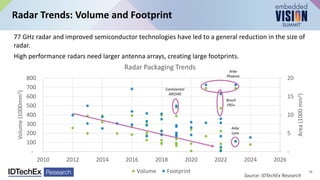
77 GHz radar and improved semiconductor technologies have led to a general reduction in the size of
radar.
High performance radars need larger antenna arrays, creating large footprints.
-
5
10
15
20
-
100
200
300
400
500
600
700
800
2010 2012 2014 2016 2018 2020 2022 2024 2026
Area
(1000
mm
2
)
Volume
(1000mm
3
)
Radar Packaging Trends
Volume Footprint
Radar Trends: Volume and Footprint
Source: IDTechEx Research
Continental
ARS540
Bosch
FR5+
Arbe
Lynx
Arbe
Phoenix
15
-
5
10
15
20
-
100
200
300
400
500
600
700
800
2010 2015 2020 2025
Area
(1000
mm
2
)
Volume
(1000mm
3
)
Radar Packaging Trends
Volume Footprint
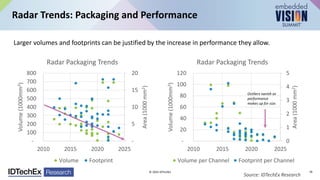
Larger volumes and footprints can be justified by the increase in performance they allow.
Radar Trends: Packaging and Performance
Source: IDTechEx Research
Outliers vanish as
performance
makes up for size.
0
1
2
3
4
5
-
20
40
60
80
100
120
2010 2015 2020 2025
Area
(1000
mm
2
)
Volume
(1000mm
3
)
Radar Packaging Trends
Volume per Channel Footprint per Channel
© 2024 IDTechEx 16
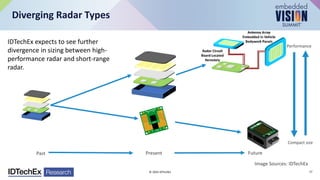
IDTechEx expects to see further
divergence in sizing between high-
performance radar and short-range
radar.
Diverging Radar Types
Past Future
Image Sources: IDTechEx
Performance
Compact size
Present
© 2024 IDTechEx 17
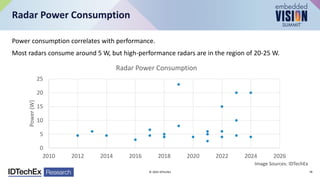
Power consumption correlates with performance.
Most radars consume around 5 W, but high-performance radars are in the region of 20-25 W.
Radar Power Consumption
0
5
10
15
20
25
2010 2012 2014 2016 2018 2020 2022 2024 2026
Power
(W)
Radar Power Consumption
Image Sources: IDTechEx
© 2024 IDTechEx 18
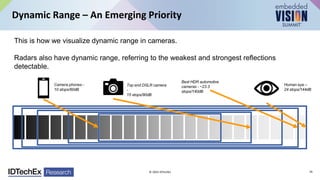
Dynamic Range – An Emerging Priority
This is how we visualize dynamic range in cameras.
Radars also have dynamic range, referring to the weakest and strongest reflections
detectable.
Camera phones -
10 stops/60dB
Top end DSLR camera
-
15 stops/90dB
Best HDR automotive
cameras - ~23.3
stops/140dB
Human eye –
24 stops/144dB
© 2024 IDTechEx 19
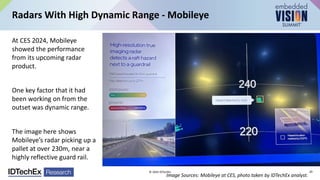
At CES 2024, Mobileye
showed the performance
from its upcoming radar
product.
One key factor that it had
been working on from the
outset was dynamic range.
The image here shows
Mobileye’s radar picking up a
pallet at over 230m, near a
highly reflective guard rail.
Radars With High Dynamic Range - Mobileye
Image Sources: Mobileye at CES, photo taken by IDTechEx analyst.
© 2024 IDTechEx 20
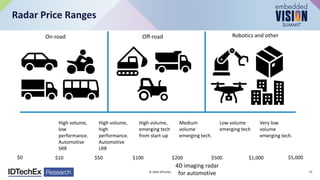
Radar Price Ranges
On-road Off-road Robotics and other
$0 $10 $50 $100 $200 $500 $1,000 $5,000
High volume,
low
performance.
Automotive
SRR
High volume,
high
performance.
Automotive
LRR
High volume,
emerging tech
from start-up
Medium
volume
emerging tech.
Low volume
emerging tech
Very low
volume
emerging tech.
4D imaging radar
for automotive
© 2024 IDTechEx 21
22
© 2024 IDTechEx
How Radar Data Can Be Used for Classification
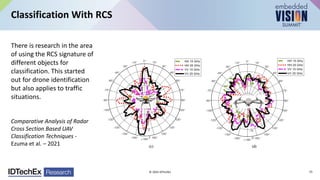
There is research in the area
of using the RCS signature of
different objects for
classification. This started
out for drone identification
but also applies to traffic
situations.
Comparative Analysis of Radar
Cross Section Based UAV
Classification Techniques -
Ezuma et al. – 2021
Classification With RCS
23
© 2024 IDTechEx
Other Radar Classification Techniques
24
© 2024 IDTechEx
Source: Steradian Semiconductor
Source: Arbe
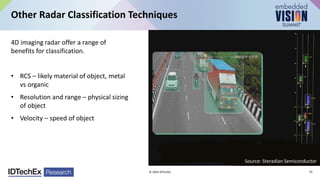
4D imaging radar offer a range of
benefits for classification.
• RCS – likely material of object, metal
vs organic
• Resolution and range – physical sizing
of object
• Velocity – speed of object
4D imaging radar offer a range of
benefits for classification.
• RCS – likely material of object,
metal vs organic
• Resolution and range – physical
sizing of object
• Velocity – speed of object
Other Radar Classification Techniques
25
© 2024 IDTechEx
Source: Steradian Semiconductor
Source: Radar Transformer: An Object Classification Network Based on
4D MMW Imaging Radar, Bai et al. - 2021
Actual
labels
Model predictions
Confusion matrix – radar-based classification
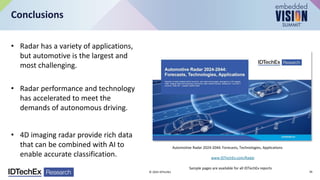
• Radar has a variety of applications,
but automotive is the largest and
most challenging.
• Radar performance and technology
has accelerated to meet the
demands of autonomous driving.
• 4D imaging radar provide rich data
that can be combined with AI to
enable accurate classification.
Conclusions
Automotive Radar 2024-2044: Forecasts, Technologies, Applications
www.IDTechEx.com/Radar
Sample pages are available for all IDTechEx reports
© 2024 IDTechEx 26
Resources
27
© 2024 IDTechEx
Key Radar Semiconductor Start-ups
Uhnder
https://www.uhnder.com/
Arbe
https://arberobotics.com/
IDTechEx Market Research
IDTechEx Automotive Radar 2024 – 2044:
Forecasts, Technologies, Applications
https://www.idtechex.com/radar
Academic Research on Radar Classification
Radar Object Classification Research, Bai et al.,
2021
https://www.mdpi.com/1424-
8220/21/11/3854
Comparative Analysis of Radar Cross Section
Based UAV Classification Techniques, Ezuma et
al., 2021
https://arxiv.org/abs/2112.09774
28
© 2024 IDTechEx
Appendix
0
100
200
300
400
2005 2010 2015 2020 2025 2030
FOV Trends in Azimuth (˚)
SRR MRR LRR
0
50
100
150
2005 2010 2015 2020 2025 2030
FOV Trends in Elevation (˚)
SRR MRR LRR
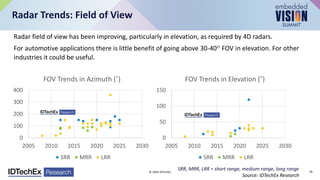
Radar field of view has been improving, particularly in elevation, as required by 4D radars.
For automotive applications there is little benefit of going above 30-40° FOV in elevation. For other
industries it could be useful.
Radar Trends: Field of View
SRR, MRR, LRR = short range, medium range, long range
Source: IDTechEx Research
© 2024 IDTechEx 29
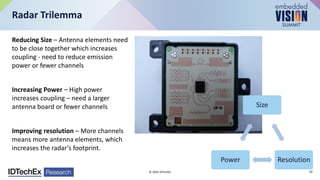
Reducing Size – Antenna elements need
to be close together which increases
coupling - need to reduce emission
power or fewer channels
Increasing Power – High power
increases coupling – need a larger
antenna board or fewer channels
Improving resolution – More channels
means more antenna elements, which
increases the radar’s footprint.
Radar Trilemma
Size
Resolution
Power
© 2024 IDTechEx 30
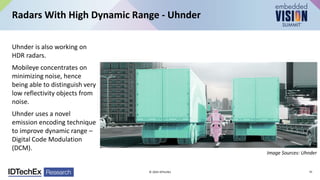
Uhnder is also working on
HDR radars.
Mobileye concentrates on
minimizing noise, hence
being able to distinguish very
low reflectivity objects from
noise.
Uhnder uses a novel
emission encoding technique
to improve dynamic range –
Digital Code Modulation
(DCM).
Radars With High Dynamic Range - Uhnder
© 2024 IDTechEx
Image Sources: Uhnder
31
The formula for this is
𝐷 =
𝜎𝑚𝑎𝑥
𝜎𝑚𝑖𝑛
𝑅𝑚𝑎𝑥
4
𝑅𝑚𝑖𝑛
4
Where 𝜎 is the radar cross section (RCS) and 𝑅 is the range.
Cars have an RCS of 100m2
Humans have an RCS of 0.1-1m2
If you have a car next to a human D = 1000 = 30dB.
If you have a car at 10m and a human at 100m, D = 107 = 70dB.
If you have a pickup (RCS=200) at 10m and a human at 200m, D = 3.2x108 = 85dB
How Much Dynamic Range is Needed?
© 2024 IDTechEx 32
Other Radar Classification Techniques
33
© 2024 IDTechEx
Source: Steradian Semiconductor
4D imaging radar offer a range of
benefits for classification.
• RCS – likely material of object, metal
vs organic
• Resolution and range – physical sizing
of object
• Velocity – speed of object

“Future Radar Technologies and Applications,” a Presentation from IDTechEx

  • 1.
    Future Radar Technologies andApplications Dr. James Jeffs Senior Technology Analyst IDTechEx © 2024 IDTechEx
  • 2.
    IDTechEx Provides Clarityon Technology Innovation Reports | Subscriptions | Consulting | Journals | Webinars Since 1999 IDTechEx has provided independent market research, consultancy and subscriptions on emerging technology to clients in over 80 countries. • Technology assessment • Technology scouting • Company profiling • Market sizing • Market forecasts • Strategic advice © 2024 IDTechEx 2
  • 3.
    Agenda for Today’sPresentation 1. Radar and its use within different industries 2. Performance requirements for radar in automotive 3. Next generation radar performance and trends A. Increased resolution B. 4-dimensional detection C. High-dynamic range D. Cost E. Size F. Power consumption 4. How radar data can be used for classification Automotive Radar 2024-2044: Forecasts, Technologies, Applications www.IDTechEx.com/Radar Sample pages are available for all IDTechEx reports © 2024 IDTechEx 3
  • 4.
    4 © 2024 IDTechEx Radarand its Use Within Different Industries
  • 5.
    Radar and camerashave very different capabilities. Radar • Provides range and relative velocity information • Very robust to poor lighting/poor visibility • Low resolution Performance Attributes of Radars Object classification Resolution Ranging Velocity Night Direct light Adverse weather Affordability Camera Radar © 2024 IDTechEx 5
  • 6.
    Applications in DifferentIndustries 6 © 2024 IDTechEx On-road Off-road Robotics and Other • ADAS features - adaptive cruise control • Safety features – blind spot detection, automatic emergency braking • Autonomous driving • In-cabin applications • Collision avoidance/blind spot detection • Autonomous operation • Autonomous robotics • Presence detection and people counting • Fill level monitoring • Traffic monitoring • Surveillance and security • Health care and vital sign monitoring
  • 7.
    7 © 2024 IDTechEx PerformanceRequirements for Radar in Automotive
  • 8.
    Typical Applications forAutomotive Radar Front monitoring • Automatic emergency braking • Adaptive cruise control Side monitoring • Blind spot detection • Junction automatic emergency braking © 2024 IDTechEx 8
  • 9.
    Typical Applications forAutomotive Radar Front monitoring – performance priorities • High resolution • Long detection range • Ranging & velocity measuring • Robust to all weather/lighting Side monitoring – performance priorities • Wide field of view • Range measuring • Cheap © 2024 IDTechEx 9
  • 10.
    The Need for4D Imaging Radar 4D imaging radars will be critical for enabling higher levels of autonomy. A primary example of this need is the car parked under an overpass scenario. A human can monitor this situation and override a false negative from an ADAS system. © 2024 IDTechEx 10
  • 11.
    11 © 2024 IDTechEx NextGeneration Radar Performance and Trends
  • 12.
    Angular resolution hasbeen improving over the past decades. This is thanks to the introduction of 77 GHz and more channels in the radar. Perhaps more importantly, the resolution of radars in the elevation has been improving. Radar Trends: Angular Resolution (Lower is Better) 0.1 1 10 100 2005 2010 2015 2020 2025 2030 Angular Resolution Trends in Azimuth (˚) SRR MRR LRR 0.1 1 10 2016 2018 2020 2022 2024 2026 Angular Resolution Trends in Elevation (˚) SRR MRR LRR SRR, MRR, LRR = short range, medium range, long range Source: IDTechEx Research © 2024 IDTechEx 12
  • 13.
    One of theenablers of better resolution has been increasing the number of transmitting and receiving channels on the radar. Virtual channels = No. transmitting channels X No. receiving channels. Virtual channels are like pixels on a camera – more is better, but that isn’t the full story. Radar Trends: Virtual Channel Count 1 10 100 1000 10000 2010 2012 2014 2016 2018 2020 2022 2024 2026 Trends in No. Virtual Channels SRR MRR LRR SRR, MRR, LRR = short range, medium range, long range Source: IDTechEx Research © 2024 IDTechEx 13
  • 14.
    Improving resolution over theentire field of view. Here the radar range is 70m with an FOV of 80˚ or 250m with an FOV of 8˚. Its angular resolution is also dependent on where in the FOV the object is. Trading FOV with Range Image source: Nanoradar Figure is blurry. Can you improve it? © 2024 IDTechEx 14
  • 15.
    77 GHz radarand improved semiconductor technologies have led to a general reduction in the size of radar. High performance radars need larger antenna arrays, creating large footprints. - 5 10 15 20 - 100 200 300 400 500 600 700 800 2010 2012 2014 2016 2018 2020 2022 2024 2026 Area (1000 mm 2 ) Volume (1000mm 3 ) Radar Packaging Trends Volume Footprint Radar Trends: Volume and Footprint Source: IDTechEx Research Continental ARS540 Bosch FR5+ Arbe Lynx Arbe Phoenix 15
  • 16.
    - 5 10 15 20 - 100 200 300 400 500 600 700 800 2010 2015 20202025 Area (1000 mm 2 ) Volume (1000mm 3 ) Radar Packaging Trends Volume Footprint Larger volumes and footprints can be justified by the increase in performance they allow. Radar Trends: Packaging and Performance Source: IDTechEx Research Outliers vanish as performance makes up for size. 0 1 2 3 4 5 - 20 40 60 80 100 120 2010 2015 2020 2025 Area (1000 mm 2 ) Volume (1000mm 3 ) Radar Packaging Trends Volume per Channel Footprint per Channel © 2024 IDTechEx 16
  • 17.
    IDTechEx expects tosee further divergence in sizing between high- performance radar and short-range radar. Diverging Radar Types Past Future Image Sources: IDTechEx Performance Compact size Present © 2024 IDTechEx 17
  • 18.
    Power consumption correlateswith performance. Most radars consume around 5 W, but high-performance radars are in the region of 20-25 W. Radar Power Consumption 0 5 10 15 20 25 2010 2012 2014 2016 2018 2020 2022 2024 2026 Power (W) Radar Power Consumption Image Sources: IDTechEx © 2024 IDTechEx 18
  • 19.
    Dynamic Range –An Emerging Priority This is how we visualize dynamic range in cameras. Radars also have dynamic range, referring to the weakest and strongest reflections detectable. Camera phones - 10 stops/60dB Top end DSLR camera - 15 stops/90dB Best HDR automotive cameras - ~23.3 stops/140dB Human eye – 24 stops/144dB © 2024 IDTechEx 19
  • 20.
    At CES 2024,Mobileye showed the performance from its upcoming radar product. One key factor that it had been working on from the outset was dynamic range. The image here shows Mobileye’s radar picking up a pallet at over 230m, near a highly reflective guard rail. Radars With High Dynamic Range - Mobileye Image Sources: Mobileye at CES, photo taken by IDTechEx analyst. © 2024 IDTechEx 20
  • 21.
    Radar Price Ranges On-roadOff-road Robotics and other $0 $10 $50 $100 $200 $500 $1,000 $5,000 High volume, low performance. Automotive SRR High volume, high performance. Automotive LRR High volume, emerging tech from start-up Medium volume emerging tech. Low volume emerging tech Very low volume emerging tech. 4D imaging radar for automotive © 2024 IDTechEx 21
  • 22.
    22 © 2024 IDTechEx HowRadar Data Can Be Used for Classification
  • 23.
    There is researchin the area of using the RCS signature of different objects for classification. This started out for drone identification but also applies to traffic situations. Comparative Analysis of Radar Cross Section Based UAV Classification Techniques - Ezuma et al. – 2021 Classification With RCS 23 © 2024 IDTechEx
  • 24.
    Other Radar ClassificationTechniques 24 © 2024 IDTechEx Source: Steradian Semiconductor Source: Arbe 4D imaging radar offer a range of benefits for classification. • RCS – likely material of object, metal vs organic • Resolution and range – physical sizing of object • Velocity – speed of object
  • 25.
    4D imaging radaroffer a range of benefits for classification. • RCS – likely material of object, metal vs organic • Resolution and range – physical sizing of object • Velocity – speed of object Other Radar Classification Techniques 25 © 2024 IDTechEx Source: Steradian Semiconductor Source: Radar Transformer: An Object Classification Network Based on 4D MMW Imaging Radar, Bai et al. - 2021 Actual labels Model predictions Confusion matrix – radar-based classification
  • 26.
    • Radar hasa variety of applications, but automotive is the largest and most challenging. • Radar performance and technology has accelerated to meet the demands of autonomous driving. • 4D imaging radar provide rich data that can be combined with AI to enable accurate classification. Conclusions Automotive Radar 2024-2044: Forecasts, Technologies, Applications www.IDTechEx.com/Radar Sample pages are available for all IDTechEx reports © 2024 IDTechEx 26
  • 27.
    Resources 27 © 2024 IDTechEx KeyRadar Semiconductor Start-ups Uhnder https://www.uhnder.com/ Arbe https://arberobotics.com/ IDTechEx Market Research IDTechEx Automotive Radar 2024 – 2044: Forecasts, Technologies, Applications https://www.idtechex.com/radar Academic Research on Radar Classification Radar Object Classification Research, Bai et al., 2021 https://www.mdpi.com/1424- 8220/21/11/3854 Comparative Analysis of Radar Cross Section Based UAV Classification Techniques, Ezuma et al., 2021 https://arxiv.org/abs/2112.09774
  • 28.
  • 29.
    0 100 200 300 400 2005 2010 20152020 2025 2030 FOV Trends in Azimuth (˚) SRR MRR LRR 0 50 100 150 2005 2010 2015 2020 2025 2030 FOV Trends in Elevation (˚) SRR MRR LRR Radar field of view has been improving, particularly in elevation, as required by 4D radars. For automotive applications there is little benefit of going above 30-40° FOV in elevation. For other industries it could be useful. Radar Trends: Field of View SRR, MRR, LRR = short range, medium range, long range Source: IDTechEx Research © 2024 IDTechEx 29
  • 30.
    Reducing Size –Antenna elements need to be close together which increases coupling - need to reduce emission power or fewer channels Increasing Power – High power increases coupling – need a larger antenna board or fewer channels Improving resolution – More channels means more antenna elements, which increases the radar’s footprint. Radar Trilemma Size Resolution Power © 2024 IDTechEx 30
  • 31.
    Uhnder is alsoworking on HDR radars. Mobileye concentrates on minimizing noise, hence being able to distinguish very low reflectivity objects from noise. Uhnder uses a novel emission encoding technique to improve dynamic range – Digital Code Modulation (DCM). Radars With High Dynamic Range - Uhnder © 2024 IDTechEx Image Sources: Uhnder 31
  • 32.
    The formula forthis is 𝐷 = 𝜎𝑚𝑎𝑥 𝜎𝑚𝑖𝑛 𝑅𝑚𝑎𝑥 4 𝑅𝑚𝑖𝑛 4 Where 𝜎 is the radar cross section (RCS) and 𝑅 is the range. Cars have an RCS of 100m2 Humans have an RCS of 0.1-1m2 If you have a car next to a human D = 1000 = 30dB. If you have a car at 10m and a human at 100m, D = 107 = 70dB. If you have a pickup (RCS=200) at 10m and a human at 200m, D = 3.2x108 = 85dB How Much Dynamic Range is Needed? © 2024 IDTechEx 32
  • 33.
    Other Radar ClassificationTechniques 33 © 2024 IDTechEx Source: Steradian Semiconductor 4D imaging radar offer a range of benefits for classification. • RCS – likely material of object, metal vs organic • Resolution and range – physical sizing of object • Velocity – speed of object