1
Minimally Invasive Total Hip
Replacement (MITHR)
Students:
For: Guntis Balodis,
Against: Andris Džeriņš
Mentor: Asoc. Prof. Pēteris Studers
2
 Total hip replacement has been termed as
«Operation of Century» as it has revolutionized the
treatment of patients with advanced hip disorders1
 In 1890, Gluck in Germany reported first total hip
replacement from ivory2
 In 1960s low friction arthroplasty procedures
developed by Sir John Charnley2
Introduction
1. Learmonth DI, Young C, Rorabeck C. The operation of the century: total hip replacement. The
Lancet 2007;370:1508-19.
2. Bhan S, Pankaj A. History and evolution of hip arthroplasty. Bhan S, Malhotra R (Ed). Key Issues
in Hip Arthropasty. New Delhi. Mediworld publications 2007.pp.4-10.
3
 In 2003 Berger popularized the idea of MITHR1
 Prof. Frederick Laude in Paris adapted the anterior
approach and modified the traction table and tissue
retractors to create a truly “minimally invasive
approach” 13 years ago1
History of MITHR
1. http://kog.net.au/hip/anterior-minimally-invasive-hip-replacement-surgery-amis-
thr
4
 Minimally invasive technique- total hip replacement
performed through an incision that is less than 10 cm
in length (6-10cm)
 Minimally invasive THA involves a modified surgical
dissection that uses internervous planes while
minimising any tendon or muscle trauma during the
exposure1
Introduction
1. Single-incision, minimally invasive total hip arthroplasty: length doesn't matter. de Beer J, Petruccelli D,
Zalzal P, Winemaker MJ J Arthroplasty. 2004 Dec; 19(8):945-50.
5
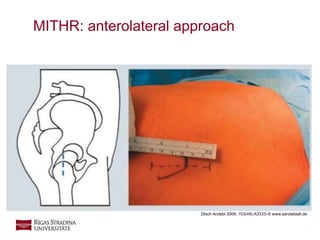
MITHR: anterolateral approach
Dtsch Arztebl 2006; 103(49):A3333–9 www.aerzteblatt.de
6
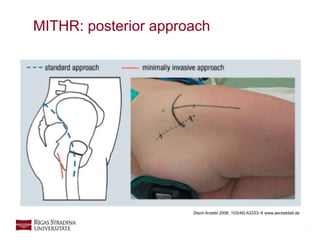
MITHR: posterior approach
Dtsch Arztebl 2006; 103(49):A3333–9 www.aerzteblatt.de
7
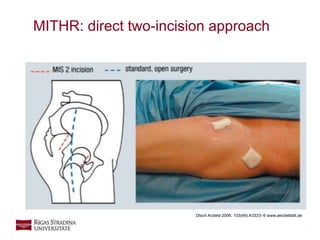
MITHR: direct two-incision approach
Dtsch Arztebl 2006; 103(49):A3333–9 www.aerzteblatt.de
8
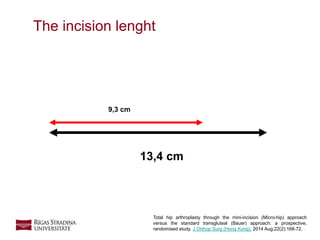
The incision lenght
Total hip arthroplasty through the mini-incision (Micro-hip) approach
versus the standard transgluteal (Bauer) approach: a prospective,
randomised study. J Orthop Surg (Hong Kong). 2014 Aug;22(2):168-72.
13,4 cm
9,3 cm
9
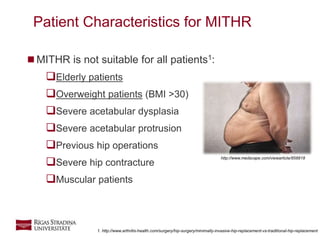
 MITHR is not suitable for all patients1:
Elderly patients
Overweight patients (BMI >30)
Severe acetabular dysplasia
Severe acetabular protrusion
Previous hip operations
Severe hip contracture
Muscular patients
Patient Characteristics for MITHR
1. http://www.arthritis-health.com/surgery/hip-surgery/minimally-invasive-hip-replacement-vs-traditional-hip-replacement
http://www.medscape.com/viewarticle/858818
10
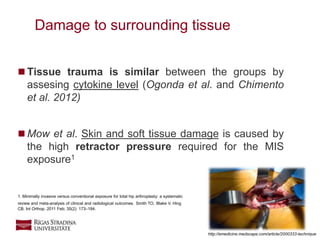
 Tissue trauma is similar between the groups by
assesing cytokine level (Ogonda et al. and Chimento
et al. 2012)
 Mow et al. Skin and soft tissue damage is caused by
the high retractor pressure required for the MIS
exposure1
Damage to surrounding tissue
http://emedicine.medscape.com/article/2000333-technique
1. Minimally invasive versus conventional exposure for total hip arthroplasty: a systematic
review and meta-analysis of clinical and radiological outcomes. Smith TO, Blake V, Hing
CB. Int Orthop. 2011 Feb; 35(2): 173–184.
11
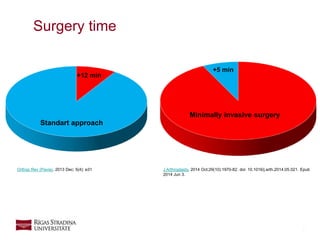
Surgery time
J Arthroplasty. 2014 Oct;29(10):1970-82. doi: 10.1016/j.arth.2014.05.021. Epub
2014 Jun 3.
Minimally invasive surgery
+5 min
Standart approach
+12 min
Orthop Rev (Pavia). 2013 Dec; 5(4): e31
12
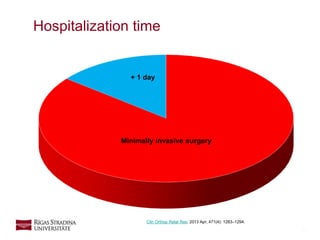
Hospitalization time
Minimally invasive surgery
+ 1 day
Clin Orthop Relat Res. 2013 Apr; 471(4): 1283–1294.
13
 There were no statistically significant differences between
the exposure methods during THA for complications such
as:
infection rates
intra- or postoperative fracture
dislocation rate
deep vein thrombosis
haematoma formation
wound complications
component loosening
Complication rates I
Minimally invasive versus conventional exposure for total hip arthroplasty: a systematic
review and meta-analysis of clinical and radiological outcomes. Smith TO, Blake V, Hing
CB. Int Orthop. 2011 Feb; 35(2): 173–184.
14
Complication rates II
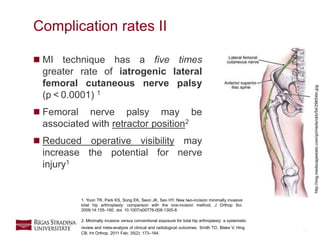
 MI technique has a five times
greater rate of iatrogenic lateral
femoral cutaneous nerve palsy
(p < 0.0001) 1
 Femoral nerve palsy may be
associated with retractor position2
 Reduced operative visibility may
increase the potential for nerve
injury1
1. Yoon TR, Park KS, Song EK, Seon JK, Seo HY. New two-incision minimally invasive
total hip arthroplasty: comparison with the one-incision method. J Orthop Sci.
2009;14:155–160. doi: 10.1007/s00776-008-1305-8.
2. Minimally invasive versus conventional exposure for total hip arthroplasty: a systematic
review and meta-analysis of clinical and radiological outcomes. Smith TO, Blake V, Hing
CB. Int Orthop. 2011 Feb; 35(2): 173–184.
http://img.medscapestatic.com/pi/meds/ckb/54/29654tn.jpg
15
 There was no statistically significant difference
between the exposure method in respect to:
WOMAC score (p = 0.13)
Harris hip score (p=0.06)
Oxford Hip score(p = 0.29)
SF-36 physical function (p=0.69)
Clinical outcomes
2. Minimally invasive versus conventional exposure for total hip arthroplasty: a systematic
review and meta-analysis of clinical and radiological outcomes. Smith TO, Blake V, Hing
CB. Int Orthop. 2011 Feb; 35(2): 173–184.
16
6 weeks – 2 years after surgery
0
1
2
3
4
5
6
7
8
9
10
6 weeks 12 weeks 1 year 2 years
VAS pain at motion 1.5 1 0 0
Harris 7.7 9.1 9.6 9.9
VAS satisfaction 9.6 9.6 10 10
Standart lateral
VAS pain at motion Harris VAS satisfaction
Orthop Rev (Pavia). 2013 Dec; 5(4): e31.
[0-10] [0-10] [0-10]
17
0
1
2
3
4
5
6
7
8
9
10
6 weeks 12 weeks 1 year 2 years
VAS pain at motion 1 0 0 0
Harris 8.3 9.5 9.9 9.9
VAS satisfaction 10 10 10 10
Minimally invasive
VAS pain at motion Harris VAS satisfaction
6 weeks – 2 years after surgery
Orthop Rev (Pavia). 2013 Dec; 5(4): e31.
[0-10] [0-10] [0-10]
18
 Repantis et al. 2014. On discharge, postoperative
hematocrit lower in conventional THA patients, but
the difference was not statistically significant (p =
0.08)
 There was no statistical significant difference in the
amount of blood units transfused in the two groups
(p = 0.67).
Blood-loss
Repantis T, Korovessis PG. Comparison of minimally invasive approach versus
conventional anterolateral approach for total hip arthroplasty. E J of Orth Surg.
Feb 2014.
19
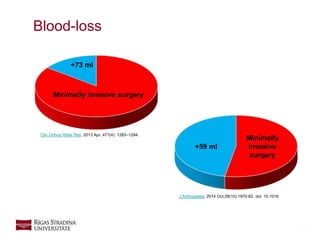
Blood-loss
Clin Orthop Relat Res. 2013 Apr; 471(4): 1283–1294.
Minimally invasive surgery
+73 ml
Minimally
invasive
surgery
+59 ml
J Arthroplasty. 2014 Oct;29(10):1970-82. doi: 10.1016
20
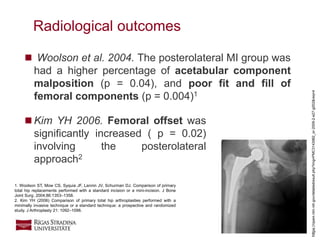
 Woolson et al. 2004. The posterolateral MI group was
had a higher percentage of acetabular component
malposition (p = 0.04), and poor fit and fill of
femoral components (p = 0.004)1
Radiological outcomes
1. Woolson ST, Mow CS, Syquia JF, Lannin JV, Schurman DJ. Comparison of primary
total hip replacements performed with a standard incision or a mini-incision. J Bone
Joint Surg. 2004;86:1353–1358.
2. Kim YH (2006) Comparison of primary total hip arthroplasties performed with a
minimally invasive technique or a standard technique: a prospective and randomized
study. J Arthroplasty 21: 1092–1098.
 Kim YH 2006. Femoral offset was
significantly increased ( p = 0.02)
involving the posterolateral
approach2
https://openi.nlm.nih.gov/detailedresult.php?img=PMC3143982_or-2009-2-e27-g002&req=4
21
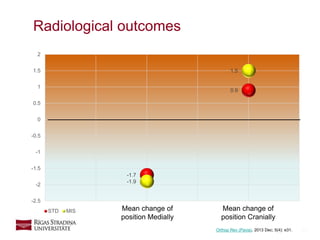
-1.7
0.9
-1.9
1.5
-2.5
-2
-1.5
-1
-0.5
0
0.5
1
1.5
2
STD MIS
Radiological outcomes
Mean change of
position Medially
Mean change of
position Cranially
Orthop Rev (Pavia). 2013 Dec; 5(4): e31.
22
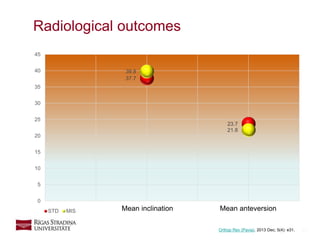
37.7
23.7
39.8
21.8
0
5
10
15
20
25
30
35
40
45
STD MIS
Radiological outcomes
Mean inclination Mean anteversion
Orthop Rev (Pavia). 2013 Dec; 5(4): e31.
23
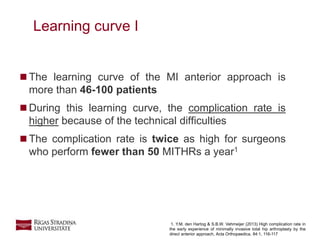
 The learning curve of the MI anterior approach is
more than 46-100 patients
 During this learning curve, the complication rate is
higher because of the technical difficulties
 The complication rate is twice as high for surgeons
who perform fewer than 50 MITHRs a year1
Learning curve I
1. Y.M. den Hartog & S.B.W. Vehmeijer (2013) High complication rate in
the early experience of minimally invasive total hip arthroplasty by the
direct anterior approach, Acta Orthopaedica, 84:1, 116-117
24
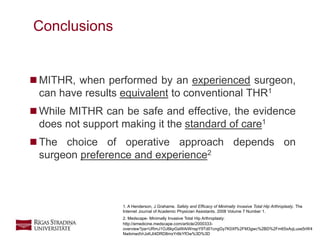
 MITHR, when performed by an experienced surgeon,
can have results equivalent to conventional THR1
 While MITHR can be safe and effective, the evidence
does not support making it the standard of care1
 The choice of operative approach depends on
surgeon preference and experience2
Conclusions
1. A Henderson, J Grahame. Safety and Efficacy of Minimally Invasive Total Hip Arthroplasty. The
Internet Journal of Academic Physician Assistants. 2008 Volume 7 Number 1.
2. Medscape- Minimally Invasive Total Hip Arthroplasty:
http://emedicine.medscape.com/article/2000333-
overview?pa=URmJ1OJ6kpGaWAiWnspY9Td01cngGy7K0Xf%2FM3gwc%2BD%2Fm65xAqLuxe5rW4
NwbmwdVrJxKJt4DRD8mxYr6kYfOw%3D%3D
25
Thank You for Your Attention!

Minimally invasive total hip replacement

  • 1.
    1 Minimally Invasive TotalHip Replacement (MITHR) Students: For: Guntis Balodis, Against: Andris Džeriņš Mentor: Asoc. Prof. Pēteris Studers
  • 2.
    2  Total hipreplacement has been termed as «Operation of Century» as it has revolutionized the treatment of patients with advanced hip disorders1  In 1890, Gluck in Germany reported first total hip replacement from ivory2  In 1960s low friction arthroplasty procedures developed by Sir John Charnley2 Introduction 1. Learmonth DI, Young C, Rorabeck C. The operation of the century: total hip replacement. The Lancet 2007;370:1508-19. 2. Bhan S, Pankaj A. History and evolution of hip arthroplasty. Bhan S, Malhotra R (Ed). Key Issues in Hip Arthropasty. New Delhi. Mediworld publications 2007.pp.4-10.
  • 3.
    3  In 2003Berger popularized the idea of MITHR1  Prof. Frederick Laude in Paris adapted the anterior approach and modified the traction table and tissue retractors to create a truly “minimally invasive approach” 13 years ago1 History of MITHR 1. http://kog.net.au/hip/anterior-minimally-invasive-hip-replacement-surgery-amis- thr
  • 4.
    4  Minimally invasivetechnique- total hip replacement performed through an incision that is less than 10 cm in length (6-10cm)  Minimally invasive THA involves a modified surgical dissection that uses internervous planes while minimising any tendon or muscle trauma during the exposure1 Introduction 1. Single-incision, minimally invasive total hip arthroplasty: length doesn't matter. de Beer J, Petruccelli D, Zalzal P, Winemaker MJ J Arthroplasty. 2004 Dec; 19(8):945-50.
  • 5.
    5 MITHR: anterolateral approach DtschArztebl 2006; 103(49):A3333–9 www.aerzteblatt.de
  • 6.
    6 MITHR: posterior approach DtschArztebl 2006; 103(49):A3333–9 www.aerzteblatt.de
  • 7.
    7 MITHR: direct two-incisionapproach Dtsch Arztebl 2006; 103(49):A3333–9 www.aerzteblatt.de
  • 8.
    8 The incision lenght Totalhip arthroplasty through the mini-incision (Micro-hip) approach versus the standard transgluteal (Bauer) approach: a prospective, randomised study. J Orthop Surg (Hong Kong). 2014 Aug;22(2):168-72. 13,4 cm 9,3 cm
  • 9.
    9  MITHR isnot suitable for all patients1: Elderly patients Overweight patients (BMI >30) Severe acetabular dysplasia Severe acetabular protrusion Previous hip operations Severe hip contracture Muscular patients Patient Characteristics for MITHR 1. http://www.arthritis-health.com/surgery/hip-surgery/minimally-invasive-hip-replacement-vs-traditional-hip-replacement http://www.medscape.com/viewarticle/858818
  • 10.
    10  Tissue traumais similar between the groups by assesing cytokine level (Ogonda et al. and Chimento et al. 2012)  Mow et al. Skin and soft tissue damage is caused by the high retractor pressure required for the MIS exposure1 Damage to surrounding tissue http://emedicine.medscape.com/article/2000333-technique 1. Minimally invasive versus conventional exposure for total hip arthroplasty: a systematic review and meta-analysis of clinical and radiological outcomes. Smith TO, Blake V, Hing CB. Int Orthop. 2011 Feb; 35(2): 173–184.
  • 11.
    11 Surgery time J Arthroplasty.2014 Oct;29(10):1970-82. doi: 10.1016/j.arth.2014.05.021. Epub 2014 Jun 3. Minimally invasive surgery +5 min Standart approach +12 min Orthop Rev (Pavia). 2013 Dec; 5(4): e31
  • 12.
    12 Hospitalization time Minimally invasivesurgery + 1 day Clin Orthop Relat Res. 2013 Apr; 471(4): 1283–1294.
  • 13.
    13  There wereno statistically significant differences between the exposure methods during THA for complications such as: infection rates intra- or postoperative fracture dislocation rate deep vein thrombosis haematoma formation wound complications component loosening Complication rates I Minimally invasive versus conventional exposure for total hip arthroplasty: a systematic review and meta-analysis of clinical and radiological outcomes. Smith TO, Blake V, Hing CB. Int Orthop. 2011 Feb; 35(2): 173–184.
  • 14.
    14 Complication rates II MI technique has a five times greater rate of iatrogenic lateral femoral cutaneous nerve palsy (p < 0.0001) 1  Femoral nerve palsy may be associated with retractor position2  Reduced operative visibility may increase the potential for nerve injury1 1. Yoon TR, Park KS, Song EK, Seon JK, Seo HY. New two-incision minimally invasive total hip arthroplasty: comparison with the one-incision method. J Orthop Sci. 2009;14:155–160. doi: 10.1007/s00776-008-1305-8. 2. Minimally invasive versus conventional exposure for total hip arthroplasty: a systematic review and meta-analysis of clinical and radiological outcomes. Smith TO, Blake V, Hing CB. Int Orthop. 2011 Feb; 35(2): 173–184. http://img.medscapestatic.com/pi/meds/ckb/54/29654tn.jpg
  • 15.
    15  There wasno statistically significant difference between the exposure method in respect to: WOMAC score (p = 0.13) Harris hip score (p=0.06) Oxford Hip score(p = 0.29) SF-36 physical function (p=0.69) Clinical outcomes 2. Minimally invasive versus conventional exposure for total hip arthroplasty: a systematic review and meta-analysis of clinical and radiological outcomes. Smith TO, Blake V, Hing CB. Int Orthop. 2011 Feb; 35(2): 173–184.
  • 16.
    16 6 weeks –2 years after surgery 0 1 2 3 4 5 6 7 8 9 10 6 weeks 12 weeks 1 year 2 years VAS pain at motion 1.5 1 0 0 Harris 7.7 9.1 9.6 9.9 VAS satisfaction 9.6 9.6 10 10 Standart lateral VAS pain at motion Harris VAS satisfaction Orthop Rev (Pavia). 2013 Dec; 5(4): e31. [0-10] [0-10] [0-10]
  • 17.
    17 0 1 2 3 4 5 6 7 8 9 10 6 weeks 12weeks 1 year 2 years VAS pain at motion 1 0 0 0 Harris 8.3 9.5 9.9 9.9 VAS satisfaction 10 10 10 10 Minimally invasive VAS pain at motion Harris VAS satisfaction 6 weeks – 2 years after surgery Orthop Rev (Pavia). 2013 Dec; 5(4): e31. [0-10] [0-10] [0-10]
  • 18.
    18  Repantis etal. 2014. On discharge, postoperative hematocrit lower in conventional THA patients, but the difference was not statistically significant (p = 0.08)  There was no statistical significant difference in the amount of blood units transfused in the two groups (p = 0.67). Blood-loss Repantis T, Korovessis PG. Comparison of minimally invasive approach versus conventional anterolateral approach for total hip arthroplasty. E J of Orth Surg. Feb 2014.
  • 19.
    19 Blood-loss Clin Orthop RelatRes. 2013 Apr; 471(4): 1283–1294. Minimally invasive surgery +73 ml Minimally invasive surgery +59 ml J Arthroplasty. 2014 Oct;29(10):1970-82. doi: 10.1016
  • 20.
    20  Woolson etal. 2004. The posterolateral MI group was had a higher percentage of acetabular component malposition (p = 0.04), and poor fit and fill of femoral components (p = 0.004)1 Radiological outcomes 1. Woolson ST, Mow CS, Syquia JF, Lannin JV, Schurman DJ. Comparison of primary total hip replacements performed with a standard incision or a mini-incision. J Bone Joint Surg. 2004;86:1353–1358. 2. Kim YH (2006) Comparison of primary total hip arthroplasties performed with a minimally invasive technique or a standard technique: a prospective and randomized study. J Arthroplasty 21: 1092–1098.  Kim YH 2006. Femoral offset was significantly increased ( p = 0.02) involving the posterolateral approach2 https://openi.nlm.nih.gov/detailedresult.php?img=PMC3143982_or-2009-2-e27-g002&req=4
  • 21.
    21 -1.7 0.9 -1.9 1.5 -2.5 -2 -1.5 -1 -0.5 0 0.5 1 1.5 2 STD MIS Radiological outcomes Meanchange of position Medially Mean change of position Cranially Orthop Rev (Pavia). 2013 Dec; 5(4): e31.
  • 22.
    22 37.7 23.7 39.8 21.8 0 5 10 15 20 25 30 35 40 45 STD MIS Radiological outcomes Meaninclination Mean anteversion Orthop Rev (Pavia). 2013 Dec; 5(4): e31.
  • 23.
    23  The learningcurve of the MI anterior approach is more than 46-100 patients  During this learning curve, the complication rate is higher because of the technical difficulties  The complication rate is twice as high for surgeons who perform fewer than 50 MITHRs a year1 Learning curve I 1. Y.M. den Hartog & S.B.W. Vehmeijer (2013) High complication rate in the early experience of minimally invasive total hip arthroplasty by the direct anterior approach, Acta Orthopaedica, 84:1, 116-117
  • 24.
    24  MITHR, whenperformed by an experienced surgeon, can have results equivalent to conventional THR1  While MITHR can be safe and effective, the evidence does not support making it the standard of care1  The choice of operative approach depends on surgeon preference and experience2 Conclusions 1. A Henderson, J Grahame. Safety and Efficacy of Minimally Invasive Total Hip Arthroplasty. The Internet Journal of Academic Physician Assistants. 2008 Volume 7 Number 1. 2. Medscape- Minimally Invasive Total Hip Arthroplasty: http://emedicine.medscape.com/article/2000333- overview?pa=URmJ1OJ6kpGaWAiWnspY9Td01cngGy7K0Xf%2FM3gwc%2BD%2Fm65xAqLuxe5rW4 NwbmwdVrJxKJt4DRD8mxYr6kYfOw%3D%3D
  • 25.
    25 Thank You forYour Attention!

Editor's Notes

  • #3 He set out to create a hip replacement that created lower frictional forces after examining one hip replacement patient whose prosthesis created an annoying squeak while walking. Charnley developed a hip replacement consisting of a metal femoral stem and a polyethylene component for seating the joint in the acetabulum of the pelvis. the orthopedic surgeon largely considered to be the father of modern total hip replacements.
  • #6 Multiple mini-incision approaches have been described to include anterior, anterolateral, direct lateral, posterior, posterolateral, and a direct two-incision approach.
  • #9 The Micro-hip group achieved a significantly lower mean incision length (9.3 vs. 13.4 cm, p<0.001) 80 women and 63 men aged 33 to 89 (mean, 62) years with primary osteoarthritis of the hip were randomised to undergo unilateral THA through a mini-incision approach (Micro-hip, n=55) or standard, lateral, transgluteal approach (Bauer, n=88)
  • #11 Whilst the skin incision may be reduced, tissue trauma is similar between the groups for this procedure by assesing cytokine level (Ogonda et al. and Chimento et al. 2012). Increase in perioperative cytokine level has been demonstrated to correlate with surgical trauma [34]. No significant difference between the MI and conventional THA exposure for cytokine level suggesting that whilst the skin incision may be reduced, tissue trauma is similar between the groups for this procedure (Ogonda et al. and Chimento et al.). The cosmetics of the scar of mini-posterior approach was more frequently reported as poorer than the standard posterior approach, when reviewed by plastic surgeons
  • #12 The median duration of surgery was longer for MIS patients (119 vs 107 minutes, P<0.001) Twelve randomised controlled trials and four non-randomised trials comprising of 1498 total hip arthroplasties were included. The mini-incision posterior approach was associated with an early improvement in Harris hip score of 1.8 points (P<0.001), reduced operating time (5minutes, P<0.001)
  • #13 Totally 357 primary THA
  • #15 The lateral femoral cutaneous nerve (LFCN) supplies sensation to skin over the anterior, lateral and posterolateral thigh from the inguinal ligament to the knee. There have been reports of pain and sensory disturbance in the distribution of the LFCN following other procedures. condition characterized by tingling, numbness and burning pain in the outer part of your thigh Reduced operative visibility may increase the potential for nerve injury due to the added difficulty in identifying nerves during dissection.1
  • #16 visual analogue scale (VAS) At 2 weeks postoperatively, patients with MIS (group A) reported significantly (p = 0.013) lower postoperative pain score (VAS = 0.97 ± 1.4), in comparison with patients of group B (conventional) (VAS = 2 ± 2.17), whereas there was no statistical significant difference at the final follow-up evaluation
  • #17 Totally 357 primary THA
  • #18 Totally 357 primary THA
  • #20 We identified 418 articles. Of these 11 provided background information and 30 provided data (3548 THAs) for the systematic review. Limited incision THA was better than standard incision THA in four measures: length of hospitalization (6 versus 7 days), VAS pain at discharge (2 versus 4), blood loss (421 mL versus 494 mL), and the Harris hip score at 3 months postoperation (90 versus 84). There were no outcomes for which standard incision was better. There was no major difference in the rate of complications.
  • #21 They related this to the reduced visualisation of the acetabulum and proximal femur from the small incision. femoral offset is measured from the distance between the center of the femoral head and a line drawn down center of femoral shaft; It is caused by increased varus (>135*) or lateralisation.
  • #24 The message of our study was that surgeons, even with a lot of experience and good results with one approach for total hip arthroplasty, should really consider the value of changing their standard approach to a new and technically difficult operation, especially when the potential advantage of the new technique has not yet been proven which is the case with the direct anterior approach. It may be unethical to subject patients to a long learning curve when there is a good alternative operation available. How many patients a surgeon would like to expose to this learning curve, especially when he masters another surgical approach, with good results and a low complication rate? 1