Key Concepts In Pain
Management Following Hip
& Knee Arthroplasty
Dr Pranav Bansal
Associate Professor
Dept of Anaesthesiology &
Critical Care
BPS Govt. Medical College for Women, Khanpur Kalan,
Sonepat
An unpleasant sensory and emotional experience
associated with actual or potential tissue damage or
described in terms of such damage.
IASP Pain Definition (1994, 2008)
According to Katz and Melzack, pain is a personal
and subjective experience that can only be felt by
the sufferer.
It is easier to find men who will volunteer to die, than
to find those who are willing to endure pain with
patience. Julius Caesar
What is Pain?
Patients' overall ranking (median scores) of the importance of
addressing questions regarding joint replacement surgery:
Macario et al 2008
n= 29 19
Hip Knee
Will the surgery affect my abilities to care for myself? 5 5
Am I going to need physical therapy? 5 5
How mobile will I be after my surgery? 5 5
When will I be able to walk normally again? 5 5
What are my options if I decide not to receive surgery? 5 4
Will the surgery cause pain afterwards? 5 4
How long will I be in the hospital? 5 4
Is there anything I can do to eliminate
pain after surgery? 4 5
Will I receive medication to manage the pain? 4 4
What do Arthroplasty patients want?
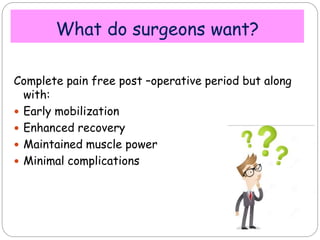
What do surgeons want?
Complete pain free post –operative period but along
with:
 Early mobilization
 Enhanced recovery
 Maintained muscle power
 Minimal complications
What do Anaesthetists want?
 Good quality analgesia for patients
 Incorporate newer Regional Anaesthesia
techniques: e.g. Neuraxial blocks with newer
additivies and USG guided Nerve blocks to improve
outcomes
 Maintain clinical skills
 Optimise patient outcome
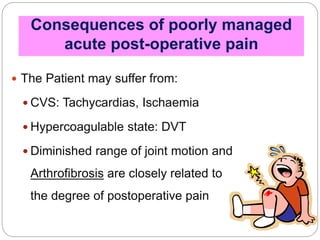
Consequences of poorly managed
acute post-operative pain
 The Patient may suffer from:
 CVS: Tachycardias, Ischaemia
 Hypercoagulable state: DVT
 Diminished range of joint motion and
Arthrofibrosis are closely related to
the degree of postoperative pain
 Psychological: Anxiety, Depression, Sleep
Deprivation
 Prolonged hospital stays, increased hospital
readmissions and increased opioid use
 ForThe Healthcare professional:
 Low Morale
 Complaints to/towards/against Institute
 Litigation
Consequences of poorly managed
acute post-operative pain
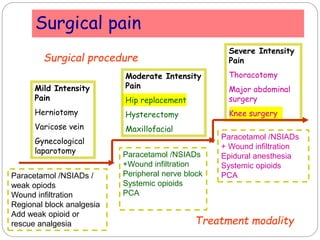
Surgical pain
Mild Intensity
Pain
Herniotomy
Varicose vein
Gynecological
laparotomy
Moderate Intensity
Pain
Hip replacement
Hysterectomy
Maxillofacial
Severe Intensity
Pain
Thoracotomy
Major abdominal
surgery
Knee surgery
Paracetamol /NSIADs /
weak opiods
Wound infiltration
Regional block analgesia
Add weak opioid or
rescue analgesia
Paracetamol /NSIADs
+Wound infiltration
Peripheral nerve block
Systemic opioids
PCA
Paracetamol /NSIADs
+ Wound infiltration
Epidural anesthesia
Systemic opioids
PCA
Treatment modality
Surgical procedure
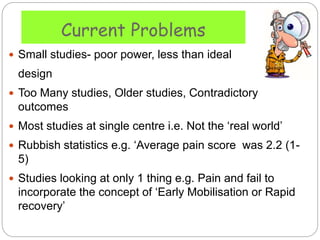
Current Problems
 Small studies- poor power, less than ideal
design
 Too Many studies, Older studies, Contradictory
outcomes
 Most studies at single centre i.e. Not the ‘real world’
 Rubbish statistics e.g. ‘Average pain score was 2.2 (1-
5)
 Studies looking at only 1 thing e.g. Pain and fail to
incorporate the concept of ‘Early Mobilisation or Rapid
recovery’
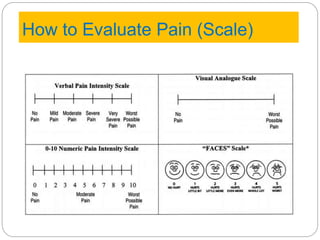
How to Evaluate Pain (Scale)
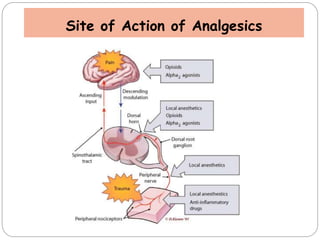
Site of Action of Analgesics
The preparation for
Post-Operative
Analgesia should start in
the Pre-Operative
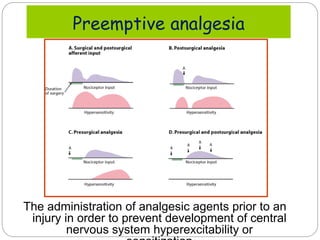
The administration of analgesic agents prior to an
injury in order to prevent development of central
nervous system hyperexcitability or
Preemptive analgesia
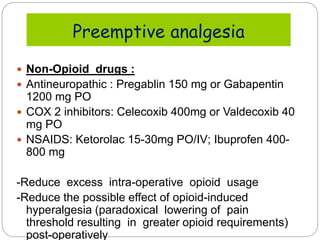
 Non-Opioid drugs :
 Antineuropathic : Pregablin 150 mg or Gabapentin
1200 mg PO
 COX 2 inhibitors: Celecoxib 400mg or Valdecoxib 40
mg PO
 NSAIDS: Ketorolac 15-30mg PO/IV; Ibuprofen 400-
800 mg
-Reduce excess intra-operative opioid usage
-Reduce the possible effect of opioid-induced
hyperalgesia (paradoxical lowering of pain
threshold resulting in greater opioid requirements)
post-operatively
Preemptive analgesia
 Using rofecoxib 24 hours and 1 hour before
surgery with continued postoperative drug
administration for 14 days had better
outcomes in total knee arthroplasty. These
patients showed reduced opioid
requirements, faster time to physical
rehabilitation, reduced nausea and
vomiting, better sleep patterns and
greater patient satisfaction after surgery.
Buvanendran A, Kroin JS, Tuman KJ, Lubenow TR,
Elmofty D, Moric M, Rosenberg AG. Effects of
Perioperative Administration of a Selective
Preemptive analgesia
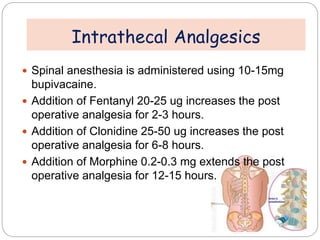
 Spinal anesthesia is administered using 10-15mg
bupivacaine.
 Addition of Fentanyl 20-25 ug increases the post
operative analgesia for 2-3 hours.
 Addition of Clonidine 25-50 ug increases the post
operative analgesia for 6-8 hours.
 Addition of Morphine 0.2-0.3 mg extends the post
operative analgesia for 12-15 hours.
Intrathecal Analgesics
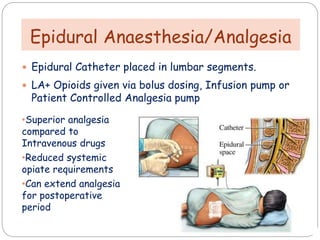
Epidural Anaesthesia/Analgesia
 Epidural Catheter placed in lumbar segments.
 LA+ Opioids given via bolus dosing, Infusion pump or
Patient Controlled Analgesia pump
•Superior analgesia
compared to
Intravenous drugs
•Reduced systemic
opiate requirements
•Can extend analgesia
for postoperative
period
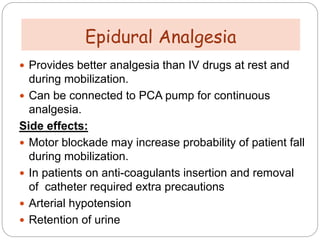
 Provides better analgesia than IV drugs at rest and
during mobilization.
 Can be connected to PCA pump for continuous
analgesia.
Side effects:
 Motor blockade may increase probability of patient fall
during mobilization.
 In patients on anti-coagulants insertion and removal
of catheter required extra precautions
 Arterial hypotension
 Retention of urine
Epidural Analgesia
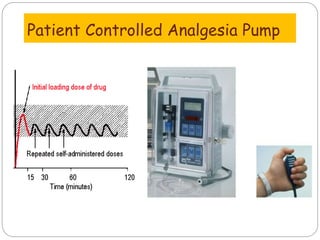
Patient Controlled Analgesia Pump
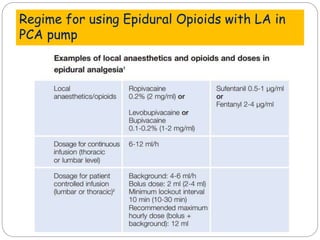
Regime for using Epidural Opioids with LA in
PCA pump
Advantages of PCA:
 Allows patient participation and gives them
autonomy in their treatment
 Rapid titration
 Precise Analgesic calculations for scientific
studies
 Reduced analgesic requirements
 Reduced incidence of breakthrough pain
 Less staffing and monitoring concerns
Drugs for Post-operative analgesia
Acetaminophen (Paracetamol)
 Excellent drug for Mild to Moderate pain
 Typical dose: 1gm IV every 6-8Hrs (upto 4 g / 24 hrs)
NSAIDs (Diclofenac Sodium, Ketorolac)
 No physical dependence
 Ceiling effect
 Warnings: ↓dose / avoid if: GI ulceration, Renal dysfunction,
Bleeding disorders / Coagulopathy
Tramadol (50-100 mg IV every 6-8 hr)
 Mild to Moderate Post-op pain
 Side effect: Nausea and Vomiting
Opioids
 Codiene, Morphine, pethidine, fentanyl,
methadone, sufentanyl, oxycodone
Side Effects include: Nausea / Vomiting,
Pruritus, Sedation, Constipation, Urinary
Retention, Ileus, Respiratory Depression
 Lidocaine (Lox) – fast onset, short duration of
action
 Bupivacaine (Sensorcaine) – slow onset, longer
duration
 Ropivacaine: longer duration, less cardiotoxic
Local Anaesthetics
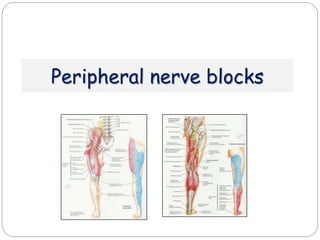
Peripheral nerve blocks
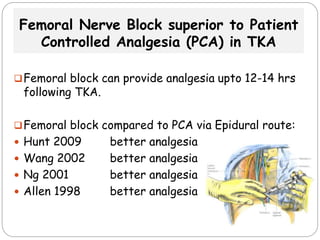
Femoral Nerve Block superior to Patient
Controlled Analgesia (PCA) in TKA
Femoral block can provide analgesia upto 12-14 hrs
following TKA.
Femoral block compared to PCA via Epidural route:
 Hunt 2009 better analgesia
 Wang 2002 better analgesia
 Ng 2001 better analgesia
 Allen 1998 better analgesia
Role of Sciatic Nerve Block in Total knee
Replacement
Sciatic nerve provides innervation to posterior part
of knee joint
 Fowler et al. BJA 2008; Systematic review
 8 studies included; n=464 knee replacement
Most common PNB :femoral sheath catheter (5),
single shot femoral (2), continuous lumbar plexus
block (1).
Femoral nerve block
 Comparable analgesia to epidural but less
hypotension
Psoas compartment block: Hip/Knee
Psoas compartment: Femoral/Obturator/lateral
cutaneous nerve thigh
 Touray et al. BJA 2008: Syst review 30 studies- 20 RCTs
 Mildly superior to IV opiates and ‘3-in-1’ block <8 hours
 Technically Difficult
 As good as epidural if catheter used
 Single injection reduces pain for 4-8hrs
 Other analgesics required in 18% TKA
 Catheter can extend analgesia beyond 8hrs
 Complications: Epidural extension
Epidural Vs Continuous femoral nerve block Vs PCA
and effect on rehabilitation after Hip arthroplasy
 Singelyn et al. 2005
 45 patients; Hip arthroplasy under GA
 3 groups: Epidural / continuous femoral nerve block
(FNB)/ PCA
 All patients had:
similar pain relief,
comparable rehabilitation
duration of hospital stay
 Patients with Continuous FNB had less side effects
(nausea/vomiting, urinary retention, hypotension,
catheter problems)
 Limitation: Small group size
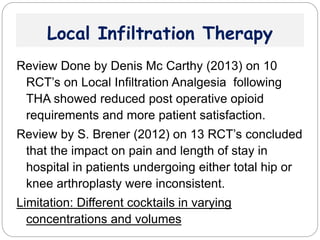
Local Infiltration Therapy
Review Done by Denis Mc Carthy (2013) on 10
RCT’s on Local Infiltration Analgesia following
THA showed reduced post operative opioid
requirements and more patient satisfaction.
Review by S. Brener (2012) on 13 RCT’s concluded
that the impact on pain and length of stay in
hospital in patients undergoing either total hip or
knee arthroplasty were inconsistent.
Limitation: Different cocktails in varying
concentrations and volumes
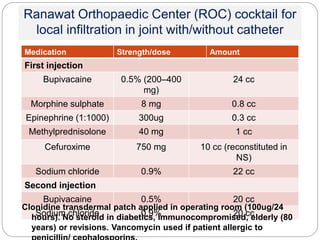
Ranawat Orthopaedic Center (ROC) cocktail for
local infiltration in joint with/without catheter
Medication Strength/dose Amount
First injection
Bupivacaine 0.5% (200–400
mg)
24 cc
Morphine sulphate 8 mg 0.8 cc
Epinephrine (1:1000) 300ug 0.3 cc
Methylprednisolone 40 mg 1 cc
Cefuroxime 750 mg 10 cc (reconstituted in
NS)
Sodium chloride 0.9% 22 cc
Second injection
Bupivacaine 0.5% 20 cc
Sodium chloride 0.9% 20 cc
Clonidine transdermal patch applied in operating room (100ug/24
hours). No steroid in diabetics, immunocompromised, elderly (80
years) or revisions. Vancomycin used if patient allergic to
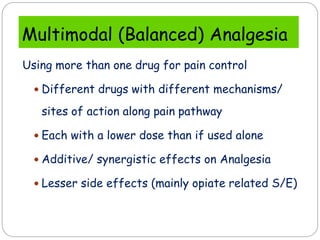
Multimodal (Balanced) Analgesia
Using more than one drug for pain control
 Different drugs with different mechanisms/
sites of action along pain pathway
 Each with a lower dose than if used alone
 Additive/ synergistic effects on Analgesia
 Lesser side effects (mainly opiate related S/E)
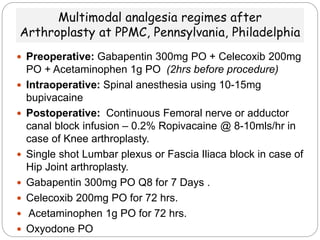
Multimodal analgesia regimes after
Arthroplasty at PPMC, Pennsylvania, Philadelphia
 Preoperative: Gabapentin 300mg PO + Celecoxib 200mg
PO + Acetaminophen 1g PO (2hrs before procedure)
 Intraoperative: Spinal anesthesia using 10-15mg
bupivacaine
 Postoperative: Continuous Femoral nerve or adductor
canal block infusion – 0.2% Ropivacaine @ 8-10mls/hr in
case of Knee arthroplasty.
 Single shot Lumbar plexus or Fascia Iliaca block in case of
Hip Joint arthroplasty.
 Gabapentin 300mg PO Q8 for 7 Days .
 Celecoxib 200mg PO for 72 hrs.
 Acetaminophen 1g PO for 72 hrs.
 Oxyodone PO
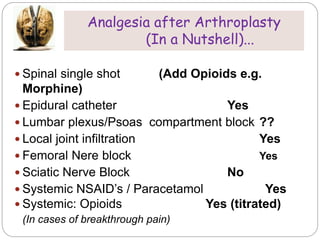
 Spinal single shot (Add Opioids e.g.
Morphine)
 Epidural catheter Yes
 Lumbar plexus/Psoas compartment block ??
 Local joint infiltration Yes
 Femoral Nere block Yes
 Sciatic Nerve Block No
 Systemic NSAID’s / Paracetamol Yes
 Systemic: Opioids Yes (titrated)
(In cases of breakthrough pain)
Analgesia after Arthroplasty
(In a Nutshell)...
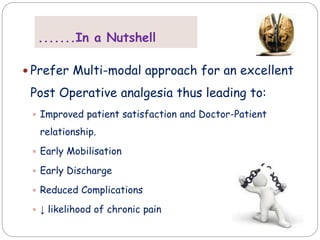
.......In a Nutshell
 Prefer Multi-modal approach for an excellent
Post Operative analgesia thus leading to:
 Improved patient satisfaction and Doctor-Patient
relationship.
 Early Mobilisation
 Early Discharge
 Reduced Complications
 ↓ likelihood of chronic pain
Pain management after joint replacement surgery

Pain management after joint replacement surgery

  • 1.
    Key Concepts InPain Management Following Hip & Knee Arthroplasty Dr Pranav Bansal Associate Professor Dept of Anaesthesiology & Critical Care BPS Govt. Medical College for Women, Khanpur Kalan, Sonepat
  • 2.
    An unpleasant sensoryand emotional experience associated with actual or potential tissue damage or described in terms of such damage. IASP Pain Definition (1994, 2008) According to Katz and Melzack, pain is a personal and subjective experience that can only be felt by the sufferer. It is easier to find men who will volunteer to die, than to find those who are willing to endure pain with patience. Julius Caesar What is Pain?
  • 3.
    Patients' overall ranking(median scores) of the importance of addressing questions regarding joint replacement surgery: Macario et al 2008 n= 29 19 Hip Knee Will the surgery affect my abilities to care for myself? 5 5 Am I going to need physical therapy? 5 5 How mobile will I be after my surgery? 5 5 When will I be able to walk normally again? 5 5 What are my options if I decide not to receive surgery? 5 4 Will the surgery cause pain afterwards? 5 4 How long will I be in the hospital? 5 4 Is there anything I can do to eliminate pain after surgery? 4 5 Will I receive medication to manage the pain? 4 4 What do Arthroplasty patients want?
  • 4.
    What do surgeonswant? Complete pain free post –operative period but along with:  Early mobilization  Enhanced recovery  Maintained muscle power  Minimal complications
  • 5.
    What do Anaesthetistswant?  Good quality analgesia for patients  Incorporate newer Regional Anaesthesia techniques: e.g. Neuraxial blocks with newer additivies and USG guided Nerve blocks to improve outcomes  Maintain clinical skills  Optimise patient outcome
  • 6.
    Consequences of poorlymanaged acute post-operative pain  The Patient may suffer from:  CVS: Tachycardias, Ischaemia  Hypercoagulable state: DVT  Diminished range of joint motion and Arthrofibrosis are closely related to the degree of postoperative pain
  • 7.
     Psychological: Anxiety,Depression, Sleep Deprivation  Prolonged hospital stays, increased hospital readmissions and increased opioid use  ForThe Healthcare professional:  Low Morale  Complaints to/towards/against Institute  Litigation Consequences of poorly managed acute post-operative pain
  • 8.
    Surgical pain Mild Intensity Pain Herniotomy Varicosevein Gynecological laparotomy Moderate Intensity Pain Hip replacement Hysterectomy Maxillofacial Severe Intensity Pain Thoracotomy Major abdominal surgery Knee surgery Paracetamol /NSIADs / weak opiods Wound infiltration Regional block analgesia Add weak opioid or rescue analgesia Paracetamol /NSIADs +Wound infiltration Peripheral nerve block Systemic opioids PCA Paracetamol /NSIADs + Wound infiltration Epidural anesthesia Systemic opioids PCA Treatment modality Surgical procedure
  • 9.
    Current Problems  Smallstudies- poor power, less than ideal design  Too Many studies, Older studies, Contradictory outcomes  Most studies at single centre i.e. Not the ‘real world’  Rubbish statistics e.g. ‘Average pain score was 2.2 (1- 5)  Studies looking at only 1 thing e.g. Pain and fail to incorporate the concept of ‘Early Mobilisation or Rapid recovery’
  • 10.
    How to EvaluatePain (Scale)
  • 11.
    Site of Actionof Analgesics
  • 12.
    The preparation for Post-Operative Analgesiashould start in the Pre-Operative
  • 13.
    The administration ofanalgesic agents prior to an injury in order to prevent development of central nervous system hyperexcitability or Preemptive analgesia
  • 14.
     Non-Opioid drugs:  Antineuropathic : Pregablin 150 mg or Gabapentin 1200 mg PO  COX 2 inhibitors: Celecoxib 400mg or Valdecoxib 40 mg PO  NSAIDS: Ketorolac 15-30mg PO/IV; Ibuprofen 400- 800 mg -Reduce excess intra-operative opioid usage -Reduce the possible effect of opioid-induced hyperalgesia (paradoxical lowering of pain threshold resulting in greater opioid requirements) post-operatively Preemptive analgesia
  • 15.
     Using rofecoxib24 hours and 1 hour before surgery with continued postoperative drug administration for 14 days had better outcomes in total knee arthroplasty. These patients showed reduced opioid requirements, faster time to physical rehabilitation, reduced nausea and vomiting, better sleep patterns and greater patient satisfaction after surgery. Buvanendran A, Kroin JS, Tuman KJ, Lubenow TR, Elmofty D, Moric M, Rosenberg AG. Effects of Perioperative Administration of a Selective Preemptive analgesia
  • 16.
     Spinal anesthesiais administered using 10-15mg bupivacaine.  Addition of Fentanyl 20-25 ug increases the post operative analgesia for 2-3 hours.  Addition of Clonidine 25-50 ug increases the post operative analgesia for 6-8 hours.  Addition of Morphine 0.2-0.3 mg extends the post operative analgesia for 12-15 hours. Intrathecal Analgesics
  • 17.
    Epidural Anaesthesia/Analgesia  EpiduralCatheter placed in lumbar segments.  LA+ Opioids given via bolus dosing, Infusion pump or Patient Controlled Analgesia pump •Superior analgesia compared to Intravenous drugs •Reduced systemic opiate requirements •Can extend analgesia for postoperative period
  • 18.
     Provides betteranalgesia than IV drugs at rest and during mobilization.  Can be connected to PCA pump for continuous analgesia. Side effects:  Motor blockade may increase probability of patient fall during mobilization.  In patients on anti-coagulants insertion and removal of catheter required extra precautions  Arterial hypotension  Retention of urine Epidural Analgesia
  • 19.
  • 20.
    Regime for usingEpidural Opioids with LA in PCA pump
  • 21.
    Advantages of PCA: Allows patient participation and gives them autonomy in their treatment  Rapid titration  Precise Analgesic calculations for scientific studies  Reduced analgesic requirements  Reduced incidence of breakthrough pain  Less staffing and monitoring concerns
  • 22.
    Drugs for Post-operativeanalgesia Acetaminophen (Paracetamol)  Excellent drug for Mild to Moderate pain  Typical dose: 1gm IV every 6-8Hrs (upto 4 g / 24 hrs) NSAIDs (Diclofenac Sodium, Ketorolac)  No physical dependence  Ceiling effect  Warnings: ↓dose / avoid if: GI ulceration, Renal dysfunction, Bleeding disorders / Coagulopathy Tramadol (50-100 mg IV every 6-8 hr)  Mild to Moderate Post-op pain  Side effect: Nausea and Vomiting
  • 23.
    Opioids  Codiene, Morphine,pethidine, fentanyl, methadone, sufentanyl, oxycodone Side Effects include: Nausea / Vomiting, Pruritus, Sedation, Constipation, Urinary Retention, Ileus, Respiratory Depression  Lidocaine (Lox) – fast onset, short duration of action  Bupivacaine (Sensorcaine) – slow onset, longer duration  Ropivacaine: longer duration, less cardiotoxic Local Anaesthetics
  • 24.
  • 25.
    Femoral Nerve Blocksuperior to Patient Controlled Analgesia (PCA) in TKA Femoral block can provide analgesia upto 12-14 hrs following TKA. Femoral block compared to PCA via Epidural route:  Hunt 2009 better analgesia  Wang 2002 better analgesia  Ng 2001 better analgesia  Allen 1998 better analgesia
  • 26.
    Role of SciaticNerve Block in Total knee Replacement Sciatic nerve provides innervation to posterior part of knee joint  Fowler et al. BJA 2008; Systematic review  8 studies included; n=464 knee replacement Most common PNB :femoral sheath catheter (5), single shot femoral (2), continuous lumbar plexus block (1). Femoral nerve block  Comparable analgesia to epidural but less hypotension
  • 27.
    Psoas compartment block:Hip/Knee Psoas compartment: Femoral/Obturator/lateral cutaneous nerve thigh  Touray et al. BJA 2008: Syst review 30 studies- 20 RCTs  Mildly superior to IV opiates and ‘3-in-1’ block <8 hours  Technically Difficult  As good as epidural if catheter used  Single injection reduces pain for 4-8hrs  Other analgesics required in 18% TKA  Catheter can extend analgesia beyond 8hrs  Complications: Epidural extension
  • 28.
    Epidural Vs Continuousfemoral nerve block Vs PCA and effect on rehabilitation after Hip arthroplasy  Singelyn et al. 2005  45 patients; Hip arthroplasy under GA  3 groups: Epidural / continuous femoral nerve block (FNB)/ PCA  All patients had: similar pain relief, comparable rehabilitation duration of hospital stay  Patients with Continuous FNB had less side effects (nausea/vomiting, urinary retention, hypotension, catheter problems)  Limitation: Small group size
  • 29.
    Local Infiltration Therapy ReviewDone by Denis Mc Carthy (2013) on 10 RCT’s on Local Infiltration Analgesia following THA showed reduced post operative opioid requirements and more patient satisfaction. Review by S. Brener (2012) on 13 RCT’s concluded that the impact on pain and length of stay in hospital in patients undergoing either total hip or knee arthroplasty were inconsistent. Limitation: Different cocktails in varying concentrations and volumes
  • 30.
    Ranawat Orthopaedic Center(ROC) cocktail for local infiltration in joint with/without catheter Medication Strength/dose Amount First injection Bupivacaine 0.5% (200–400 mg) 24 cc Morphine sulphate 8 mg 0.8 cc Epinephrine (1:1000) 300ug 0.3 cc Methylprednisolone 40 mg 1 cc Cefuroxime 750 mg 10 cc (reconstituted in NS) Sodium chloride 0.9% 22 cc Second injection Bupivacaine 0.5% 20 cc Sodium chloride 0.9% 20 cc Clonidine transdermal patch applied in operating room (100ug/24 hours). No steroid in diabetics, immunocompromised, elderly (80 years) or revisions. Vancomycin used if patient allergic to
  • 31.
    Multimodal (Balanced) Analgesia Usingmore than one drug for pain control  Different drugs with different mechanisms/ sites of action along pain pathway  Each with a lower dose than if used alone  Additive/ synergistic effects on Analgesia  Lesser side effects (mainly opiate related S/E)
  • 32.
    Multimodal analgesia regimesafter Arthroplasty at PPMC, Pennsylvania, Philadelphia  Preoperative: Gabapentin 300mg PO + Celecoxib 200mg PO + Acetaminophen 1g PO (2hrs before procedure)  Intraoperative: Spinal anesthesia using 10-15mg bupivacaine  Postoperative: Continuous Femoral nerve or adductor canal block infusion – 0.2% Ropivacaine @ 8-10mls/hr in case of Knee arthroplasty.  Single shot Lumbar plexus or Fascia Iliaca block in case of Hip Joint arthroplasty.  Gabapentin 300mg PO Q8 for 7 Days .  Celecoxib 200mg PO for 72 hrs.  Acetaminophen 1g PO for 72 hrs.  Oxyodone PO
  • 33.
     Spinal singleshot (Add Opioids e.g. Morphine)  Epidural catheter Yes  Lumbar plexus/Psoas compartment block ??  Local joint infiltration Yes  Femoral Nere block Yes  Sciatic Nerve Block No  Systemic NSAID’s / Paracetamol Yes  Systemic: Opioids Yes (titrated) (In cases of breakthrough pain) Analgesia after Arthroplasty (In a Nutshell)...
  • 34.
    .......In a Nutshell Prefer Multi-modal approach for an excellent Post Operative analgesia thus leading to:  Improved patient satisfaction and Doctor-Patient relationship.  Early Mobilisation  Early Discharge  Reduced Complications  ↓ likelihood of chronic pain