THE DIRECT ANTERIOR HIP
REPLACEMENT
ANTHONY S UNGER, MD
ANTHONY S UNGER, MD
 DISCLOSURES
 INNOMED—ROYALTIES
 BIOMET– ROYALTIES,CONSULTANT
 STRYKER—CONSULTANT, SPEAKER
 MEDTRONIC—SPEAKER
 CORMET—RESEARCH GRANT
DIRECT ANTERIOR APPROACH THR
HISTORY
First described by Carl Hueter in
Germany in ~ 1881
Hueter,C. Fünfte abtheilung: die verletzung und krankheiten des hüftgelenkes , neunundzwanzigstes capitel.
In: HueterC, editor. Grundriss der chirurgie. 2nd edition. Leipzig; FCWVogel; 1882. P 129-200.
DIRECT ANTERIOR APPROACH THR
HISTORY
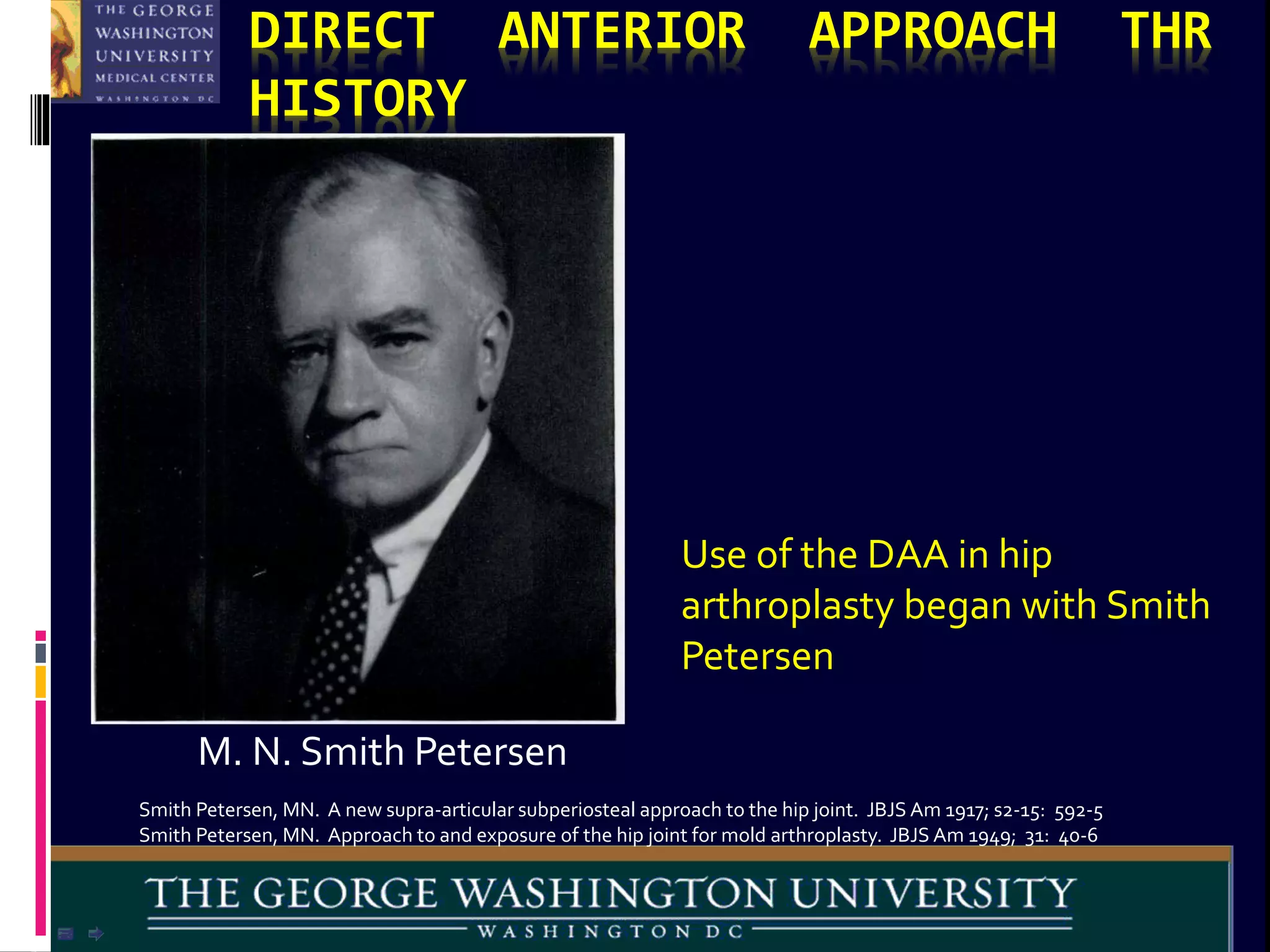
Use of the DAA in hip
arthroplasty began with Smith
Petersen
Smith Petersen, MN. A new supra-articular subperiosteal approach to the hip joint. JBJS Am 1917; s2-15: 592-5
Smith Petersen, MN. Approach to and exposure of the hip joint for mold arthroplasty. JBJS Am 1949; 31: 40-6
M. N. Smith Petersen
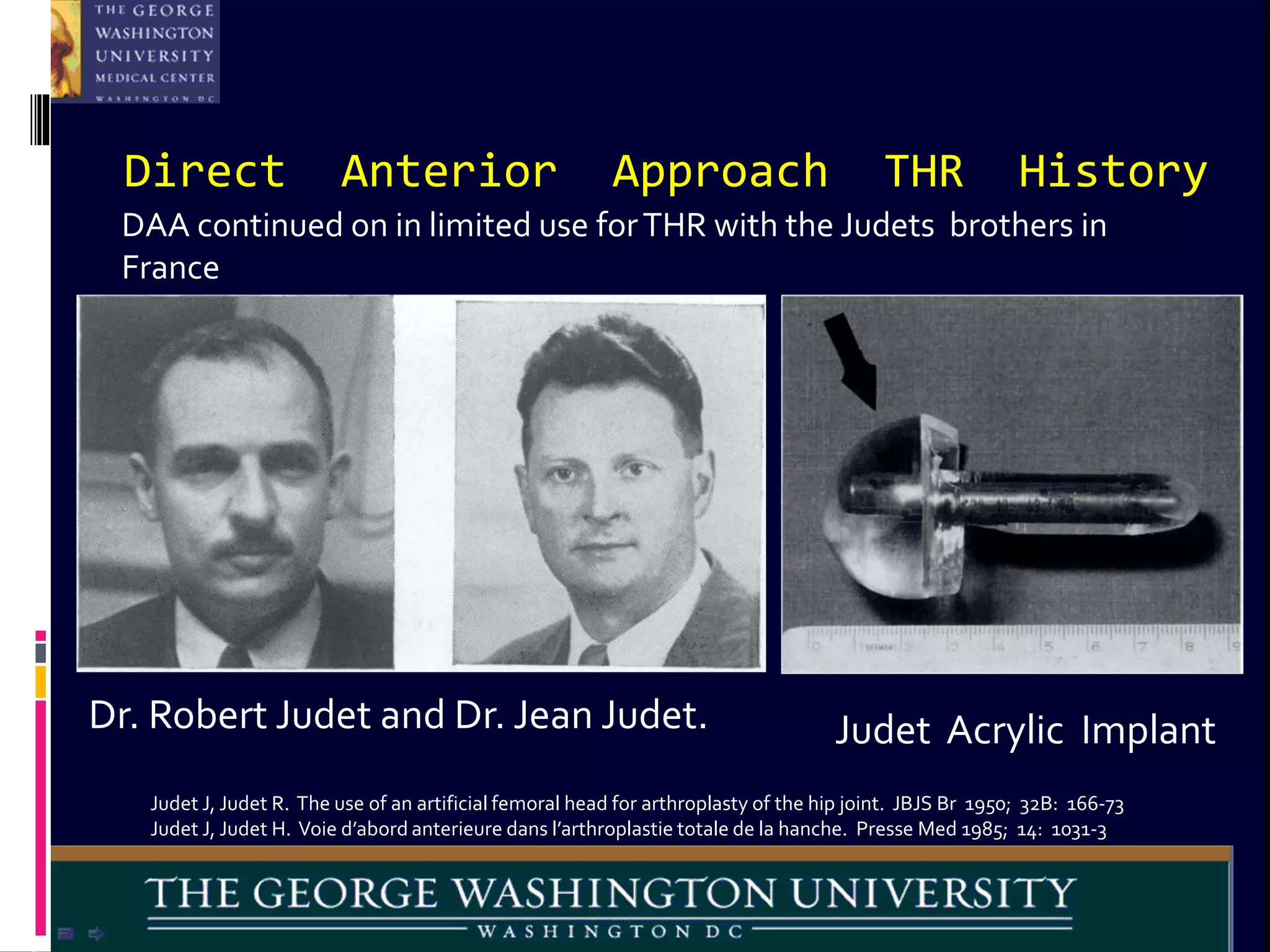
DAA continued on in limited use forTHR with the Judets brothers in
France
Judet J, Judet R. The use of an artificial femoral head for arthroplasty of the hip joint. JBJS Br 1950; 32B: 166-73
Judet J, Judet H. Voie d’abord anterieure dans l’arthroplastie totale de la hanche. Presse Med 1985; 14: 1031-3
Dr. Robert Judet and Dr. Jean Judet. Judet Acrylic Implant
Direct Anterior Approach THR History
DIRECT ANTERIOR APPROACH THR
HISTORY
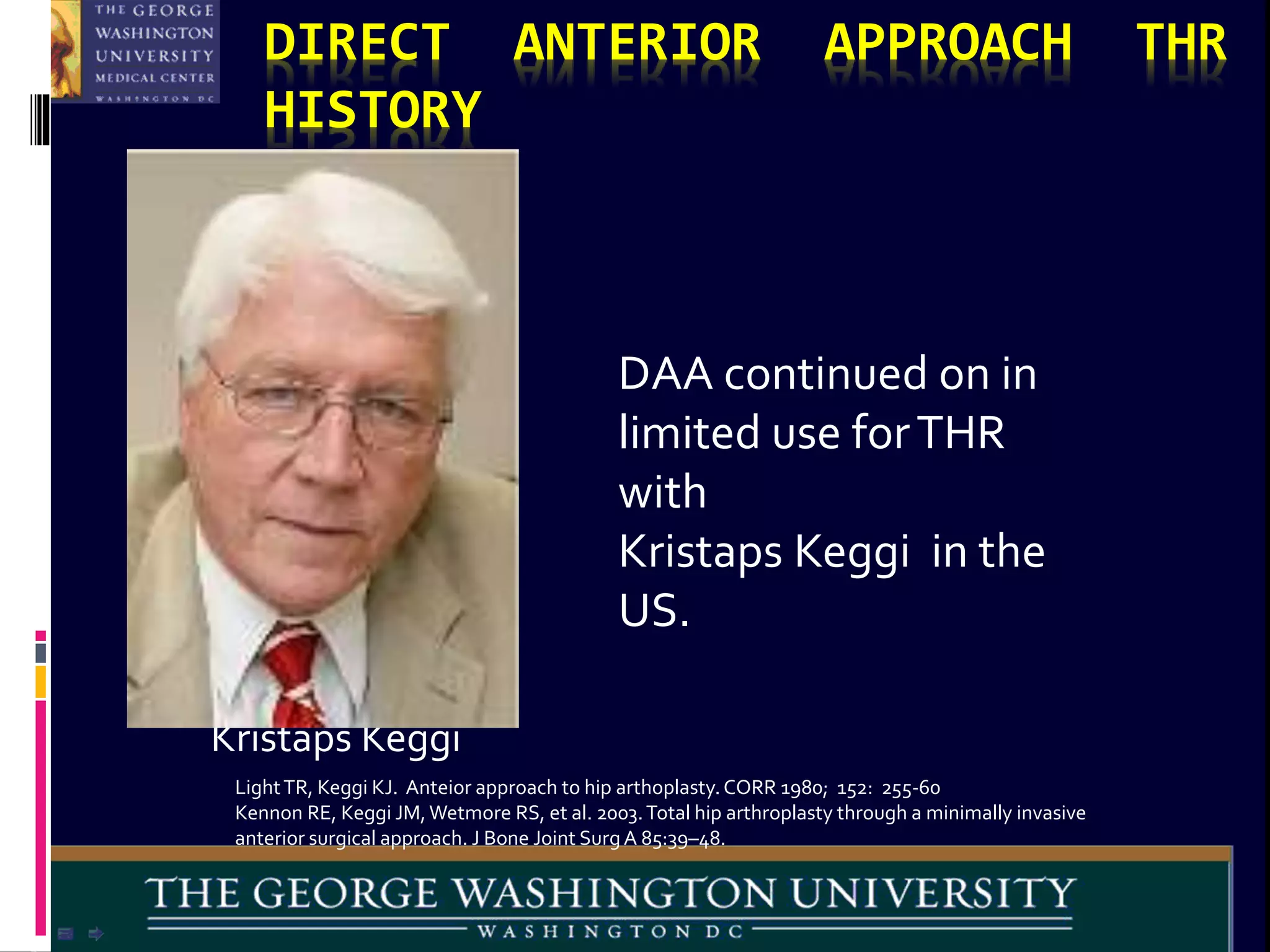
DAA continued on in
limited use forTHR
with
Kristaps Keggi in the
US.
LightTR, Keggi KJ. Anteior approach to hip arthoplasty.CORR 1980; 152: 255-60
Kennon RE, Keggi JM,Wetmore RS, et al. 2003.Total hip arthroplasty through a minimally invasive
anterior surgical approach. J Bone Joint SurgA 85:39–48.
Kristaps Keggi
DIRECT ANTERIOR APPROACH THR
HISTORY
specialized orthopedic
table, popularized by
Joel Matta.
Matta JM, ShahrdarC, FergusonT. Single-incision anterior approach for total hip arthoplasty on an orthopaedic table.
CORR 2005; 441: 115-24
Stefan Kreuzer MD, Kevin Leffers BS, Suneel Kumar MD. DirectAnteriorApproach for Hip Resurfacing:
SurgicalTechnique and Complications. CORR (2011) 469:1574–1581
Rachbauer F, NoglerM, Mayr E, et al. Minimally invasive single incision anterior approach for total hiparthoplasty-early results.
In: HozackWJ, Krismer M, Nogler M, et al editiors. Minimally invasive total joint arthroplasty. Berlin: Springer; 2004. P. 54-9
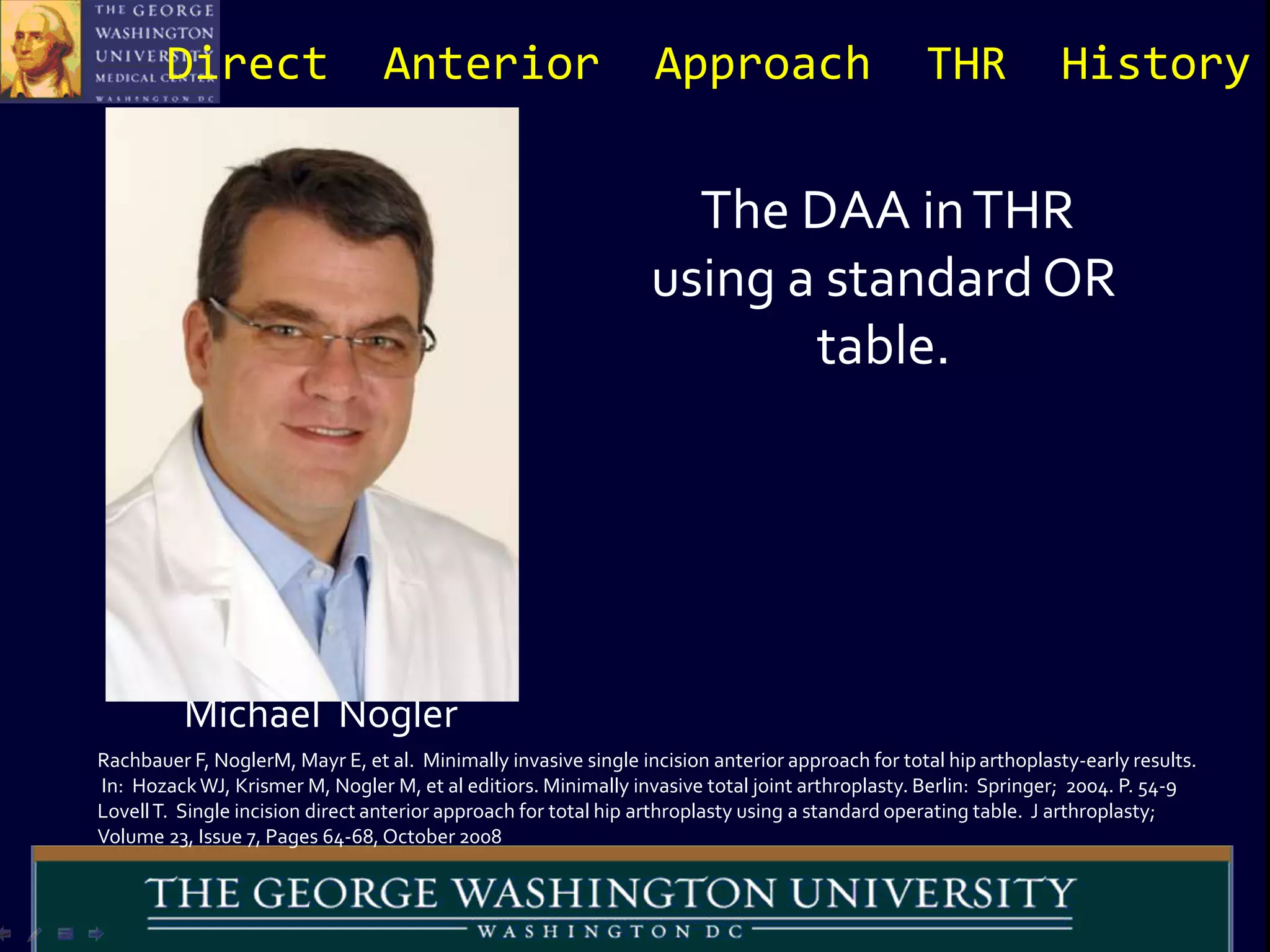
LovellT. Single incision direct anterior approach for total hip arthroplasty using a standard operating table. J arthroplasty;
Volume 23, Issue 7, Pages 64-68, October 2008
The DAA inTHR
using a standard OR
table.
Direct Anterior Approach THR History
Michael Nogler
DIRECT ANTERIOR APPROACH THR
HISTORY
The principles and basic
technique of the approach
are the same with or without
the use of a specialized
orthopedic table.
The History of the anterior approach to the hip.
Rachbauer F, Kain MS, Leung M.
Orthop Clin North Am. 2009 Jul; 40(3): 311-20
DIRECT ANTERIOR APPROACH
SCIENTIFIC BASIS
Multiple Authors Have Proposed DAA
THR Has:
Less Soft Tissue Damage
Faster & Easier Recovery
Lower Dislocation Risk
Is There Data For These Claims?
Anterior Approach inTHA Improves Outcomes: Affirms. JOSEPH T. MOSKAL, Orthopedics,
SEPTEMBER 2011 |Volume 34 • Number 9
DAA HAS LESS SOFT TISSUE
DAMAGE
More Abductor DamageWith
Posterior Approach
ThanWith DirectAnterior
Approach
The posterior approach had
measurable damage to the
abductor muscles and gluteus
minimus tendon in each specimen
Meneghini RM, Pagnano MW,Trousdale RT, Hozack WJ. Muscle damage during MIS total hip
arthroplasty: Smith-Petersen versus posterior approach. Clin Orthop Relat Res. 2006;453:293–8
Creatine Kinase Differences between
Anterior and Posterior MISTHA
Creatine Kinase Differences between
Anterior and Posterior MISTHA
5.5X 1.4X 1.8X
-200
-100
0
100
200
300
400
CRP IL-6 IL-1B TNF-a
DAA
MPA
Creatine Kinase Differences between
Anterior and Posterior MISTHA
-200
-100
0
100
200
300
400
CRP IL-6 IL-1B TNF-a
DAA
MPA
Creatine Kinase Differences between
Anterior and Posterior MISTHA
DAA RECOVERY MAY BE FASTER &
EASIER
A prospective, randomized study compared DL
THA and DAA approachTHA. Using numerous
validated outcome measures the DAATHA had
significantly better improvements at 6 weeks,
6 months, and 1 year than did the direct lateral
approachTHA.
Restrepo C, Parvizi J, Pour AE, Hozack WJ. Prospective randomized study of two surgical
approaches for total hip arthroplasty J Arthroplasty. 2010; 25(5):671-679.e1.
DAA RECOVERY MAY BE FASTER &
EASIER
A prospective, randomized IRB-approved clinical
study comparing DAA to PosteriorTHA
CONCLUSION
The DAA cohort required less post-op pain medication, half-
day shorter hospitalization and patients had higher
functional scores at one and three months.
Prospective Randomized Study of Anterior vs. Postero-lateral Approach forTotal Hip Arthroplasty.
William P. Barrett, Shelly Turner. Session 44-Adult Reconstruction HipVI, paper 655. AAOS 2012.
DAA HAS A LOWER DISLOCATION
RATE
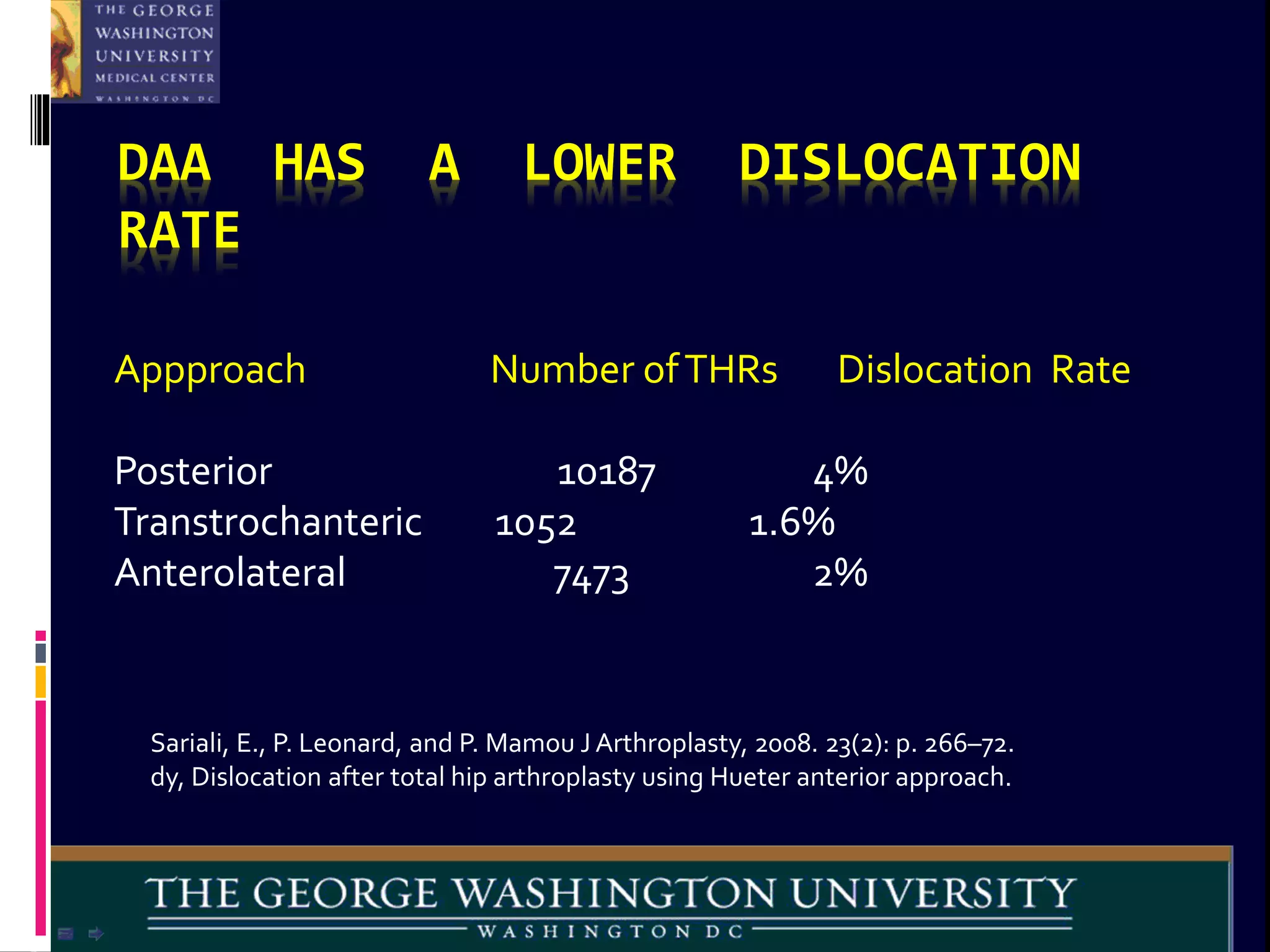
Sariali, E., P. Leonard, and P. Mamou J Arthroplasty, 2008. 23(2): p. 266–72.
dy, Dislocation after total hip arthroplasty using Hueter anterior approach.
Appproach Number ofTHRs Dislocation Rate
Posterior 10187 4%
Transtrochanteric 1052 1.6%
Anterolateral 7473 2%
DAA HAS A LOWER DISLOCATION
RATE
Direct anterior approach for total hip arthroplasty using the fracture table. Phillip H.
Horne & Steven A. Olson. Curr Rev Musculoskelet Med (2011) 4:139–145
1% Dislocation Rate For DAA THR Using A Fracture Table
DAA ADVANTAGES
 PATIENT SUPINE—LL EQUALIZATION
 LOWER DISLOCATION RATE
 LESS INVASIVE ?
 OBESE PATIENTS EASIER
 LESS DVT??—LESS KINKING OF FEMORAL
VEIN
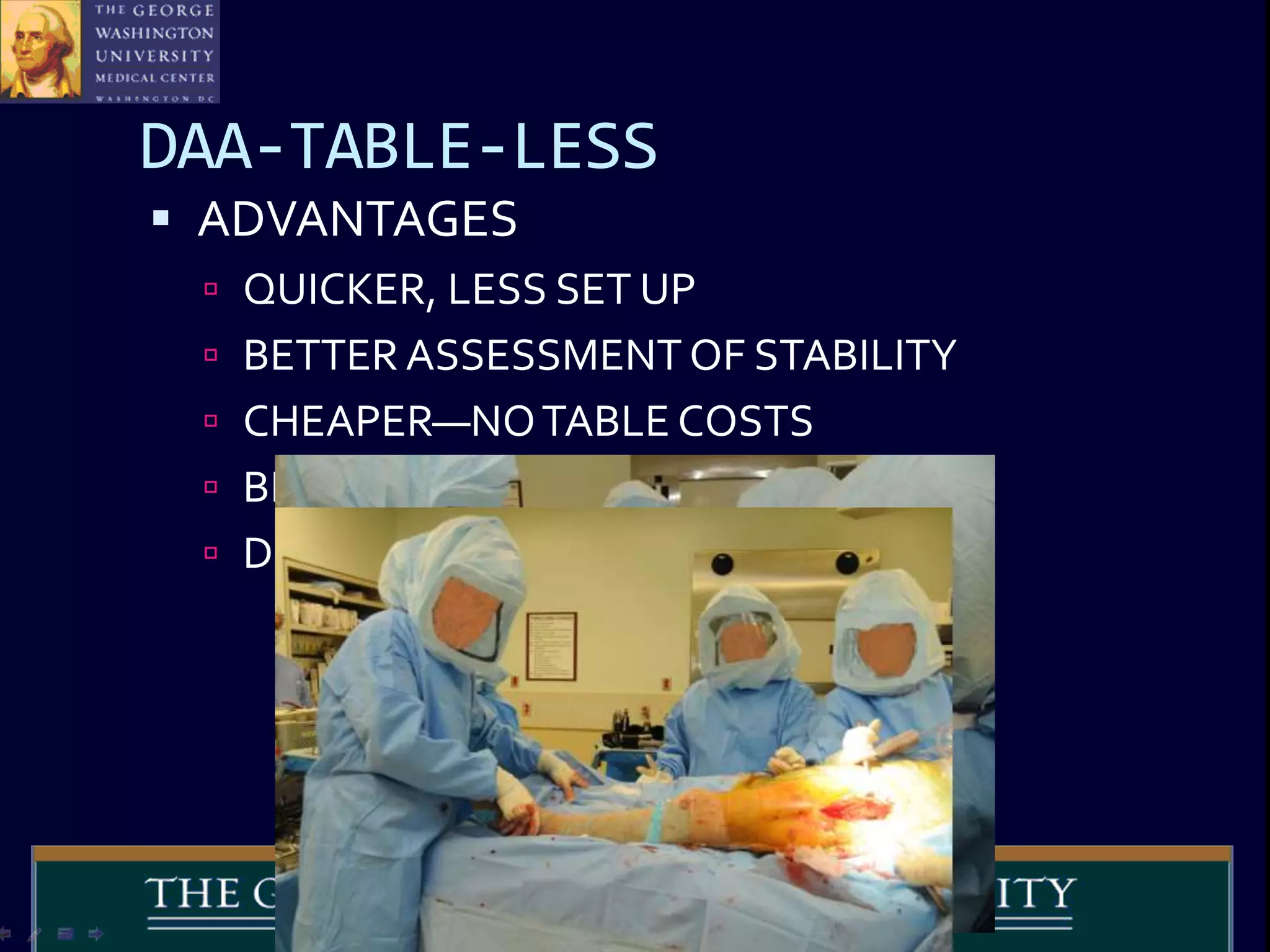
DAA-TABLE-LESS
 ADVANTAGES
 QUICKER, LESS SET UP
 BETTER ASSESSMENT OF STABILITY
 CHEAPER—NOTABLE COSTS
 BETTER ABILITYTO EQUAL LL
 DON’T NEED XRAY
DAA-TABLE-LESS
 DISADVANTAGES
 NEED 2ND ASSISTANT
 NO MARKETING OFTABLE
 NEED GOOD SURGICAL EXPOSURE
 NO XRAYTO ASSESS FEMORAL COMPONENT
THE DAA VIDEO
MY SERIES
 2005-2013
 750 HIPS
 DISLOCATIONS=4
 LOOSE STEM=1
 FRACTURE=1
 INFECTION=1
 AVG LOS =2 DAYS
MY EXPERIENCE
 2 DAA SURGEONS and 2
POSTERIOR SURGEONS
 ALL USED SAME
PATHWAY/PROTOCOL
 COMMUNITY HOSPITAL WITH
SNF UNIT
 DATA FROM 2013-2014
Demographics
AA 1 AA 2 PA 1 PA 2
MEAN AGE 70.8 66.6 72.4 69.1
FEMALE 79 16 23 13
MALE 49 7 12 16
MEAN BMI 26.4 27.9 26.9 28.1
%
MEDICARE 71.1 60.9 71.4 62.1
% NON-
MEDICARE 28.9 39.1 28.6 37.9
Length of Stay (LOS)
Procedure LOS (Days)
AA 2.58 ± 0.73
PA 3.43 ± 1.39
AA 1 AA 2 PA 1 PA 2
TOTAL
SURGERIES 128 23 35 29
COMPLICATION
RATE (%) 7.03 8.70 20.00 13.79
% Discharged Home
0
10
20
30
40
50
60
70
80
% discharged home
DAA p<.05
Series1
Series2
Series3
Series4
%Home in 24 HR
0
1
2
3
4
5
6
7
8
9
1 2 3 4
DAA p <.05
% home in 24 hrs
% home in 24 hrs
56 yo male, Hx of Femur FX, R
Hip pain
RTHA DAA Intra op xray
RTHA DAA Post op
55 yo MD Bilat DJD HIP
undergoes L-THA DAA
POST-OP R-THA after XRT
CONCLUSION
 DAA
 LESS DISLOCATION
 MORE PRECISE LL EQUALIZATION
 FASTER RECOVERY
 “I ADVOCATE FORTHE DAA HIP
REPLACEMENT”
THANKYOU

The Direct Anterior Hip Replacement

  • 1.
    THE DIRECT ANTERIORHIP REPLACEMENT ANTHONY S UNGER, MD
  • 2.
    ANTHONY S UNGER,MD  DISCLOSURES  INNOMED—ROYALTIES  BIOMET– ROYALTIES,CONSULTANT  STRYKER—CONSULTANT, SPEAKER  MEDTRONIC—SPEAKER  CORMET—RESEARCH GRANT
  • 3.
    DIRECT ANTERIOR APPROACHTHR HISTORY First described by Carl Hueter in Germany in ~ 1881 Hueter,C. Fünfte abtheilung: die verletzung und krankheiten des hüftgelenkes , neunundzwanzigstes capitel. In: HueterC, editor. Grundriss der chirurgie. 2nd edition. Leipzig; FCWVogel; 1882. P 129-200.
  • 4.
    DIRECT ANTERIOR APPROACHTHR HISTORY Use of the DAA in hip arthroplasty began with Smith Petersen Smith Petersen, MN. A new supra-articular subperiosteal approach to the hip joint. JBJS Am 1917; s2-15: 592-5 Smith Petersen, MN. Approach to and exposure of the hip joint for mold arthroplasty. JBJS Am 1949; 31: 40-6 M. N. Smith Petersen
  • 5.
    DAA continued onin limited use forTHR with the Judets brothers in France Judet J, Judet R. The use of an artificial femoral head for arthroplasty of the hip joint. JBJS Br 1950; 32B: 166-73 Judet J, Judet H. Voie d’abord anterieure dans l’arthroplastie totale de la hanche. Presse Med 1985; 14: 1031-3 Dr. Robert Judet and Dr. Jean Judet. Judet Acrylic Implant Direct Anterior Approach THR History
  • 6.
    DIRECT ANTERIOR APPROACHTHR HISTORY DAA continued on in limited use forTHR with Kristaps Keggi in the US. LightTR, Keggi KJ. Anteior approach to hip arthoplasty.CORR 1980; 152: 255-60 Kennon RE, Keggi JM,Wetmore RS, et al. 2003.Total hip arthroplasty through a minimally invasive anterior surgical approach. J Bone Joint SurgA 85:39–48. Kristaps Keggi
  • 7.
    DIRECT ANTERIOR APPROACHTHR HISTORY specialized orthopedic table, popularized by Joel Matta. Matta JM, ShahrdarC, FergusonT. Single-incision anterior approach for total hip arthoplasty on an orthopaedic table. CORR 2005; 441: 115-24 Stefan Kreuzer MD, Kevin Leffers BS, Suneel Kumar MD. DirectAnteriorApproach for Hip Resurfacing: SurgicalTechnique and Complications. CORR (2011) 469:1574–1581
  • 8.
    Rachbauer F, NoglerM,Mayr E, et al. Minimally invasive single incision anterior approach for total hiparthoplasty-early results. In: HozackWJ, Krismer M, Nogler M, et al editiors. Minimally invasive total joint arthroplasty. Berlin: Springer; 2004. P. 54-9 LovellT. Single incision direct anterior approach for total hip arthroplasty using a standard operating table. J arthroplasty; Volume 23, Issue 7, Pages 64-68, October 2008 The DAA inTHR using a standard OR table. Direct Anterior Approach THR History Michael Nogler
  • 9.
    DIRECT ANTERIOR APPROACHTHR HISTORY The principles and basic technique of the approach are the same with or without the use of a specialized orthopedic table. The History of the anterior approach to the hip. Rachbauer F, Kain MS, Leung M. Orthop Clin North Am. 2009 Jul; 40(3): 311-20
  • 10.
    DIRECT ANTERIOR APPROACH SCIENTIFICBASIS Multiple Authors Have Proposed DAA THR Has: Less Soft Tissue Damage Faster & Easier Recovery Lower Dislocation Risk Is There Data For These Claims? Anterior Approach inTHA Improves Outcomes: Affirms. JOSEPH T. MOSKAL, Orthopedics, SEPTEMBER 2011 |Volume 34 • Number 9
  • 11.
    DAA HAS LESSSOFT TISSUE DAMAGE More Abductor DamageWith Posterior Approach ThanWith DirectAnterior Approach The posterior approach had measurable damage to the abductor muscles and gluteus minimus tendon in each specimen Meneghini RM, Pagnano MW,Trousdale RT, Hozack WJ. Muscle damage during MIS total hip arthroplasty: Smith-Petersen versus posterior approach. Clin Orthop Relat Res. 2006;453:293–8
  • 13.
    Creatine Kinase Differencesbetween Anterior and Posterior MISTHA
  • 14.
    Creatine Kinase Differencesbetween Anterior and Posterior MISTHA 5.5X 1.4X 1.8X
  • 15.
    -200 -100 0 100 200 300 400 CRP IL-6 IL-1BTNF-a DAA MPA Creatine Kinase Differences between Anterior and Posterior MISTHA
  • 16.
    -200 -100 0 100 200 300 400 CRP IL-6 IL-1BTNF-a DAA MPA Creatine Kinase Differences between Anterior and Posterior MISTHA
  • 17.
    DAA RECOVERY MAYBE FASTER & EASIER A prospective, randomized study compared DL THA and DAA approachTHA. Using numerous validated outcome measures the DAATHA had significantly better improvements at 6 weeks, 6 months, and 1 year than did the direct lateral approachTHA. Restrepo C, Parvizi J, Pour AE, Hozack WJ. Prospective randomized study of two surgical approaches for total hip arthroplasty J Arthroplasty. 2010; 25(5):671-679.e1.
  • 18.
    DAA RECOVERY MAYBE FASTER & EASIER A prospective, randomized IRB-approved clinical study comparing DAA to PosteriorTHA CONCLUSION The DAA cohort required less post-op pain medication, half- day shorter hospitalization and patients had higher functional scores at one and three months. Prospective Randomized Study of Anterior vs. Postero-lateral Approach forTotal Hip Arthroplasty. William P. Barrett, Shelly Turner. Session 44-Adult Reconstruction HipVI, paper 655. AAOS 2012.
  • 19.
    DAA HAS ALOWER DISLOCATION RATE Sariali, E., P. Leonard, and P. Mamou J Arthroplasty, 2008. 23(2): p. 266–72. dy, Dislocation after total hip arthroplasty using Hueter anterior approach. Appproach Number ofTHRs Dislocation Rate Posterior 10187 4% Transtrochanteric 1052 1.6% Anterolateral 7473 2%
  • 20.
    DAA HAS ALOWER DISLOCATION RATE Direct anterior approach for total hip arthroplasty using the fracture table. Phillip H. Horne & Steven A. Olson. Curr Rev Musculoskelet Med (2011) 4:139–145 1% Dislocation Rate For DAA THR Using A Fracture Table
  • 21.
    DAA ADVANTAGES  PATIENTSUPINE—LL EQUALIZATION  LOWER DISLOCATION RATE  LESS INVASIVE ?  OBESE PATIENTS EASIER  LESS DVT??—LESS KINKING OF FEMORAL VEIN
  • 22.
    DAA-TABLE-LESS  ADVANTAGES  QUICKER,LESS SET UP  BETTER ASSESSMENT OF STABILITY  CHEAPER—NOTABLE COSTS  BETTER ABILITYTO EQUAL LL  DON’T NEED XRAY
  • 23.
    DAA-TABLE-LESS  DISADVANTAGES  NEED2ND ASSISTANT  NO MARKETING OFTABLE  NEED GOOD SURGICAL EXPOSURE  NO XRAYTO ASSESS FEMORAL COMPONENT
  • 24.
  • 25.
    MY SERIES  2005-2013 750 HIPS  DISLOCATIONS=4  LOOSE STEM=1  FRACTURE=1  INFECTION=1  AVG LOS =2 DAYS
  • 26.
    MY EXPERIENCE  2DAA SURGEONS and 2 POSTERIOR SURGEONS  ALL USED SAME PATHWAY/PROTOCOL  COMMUNITY HOSPITAL WITH SNF UNIT  DATA FROM 2013-2014
  • 27.
    Demographics AA 1 AA2 PA 1 PA 2 MEAN AGE 70.8 66.6 72.4 69.1 FEMALE 79 16 23 13 MALE 49 7 12 16 MEAN BMI 26.4 27.9 26.9 28.1 % MEDICARE 71.1 60.9 71.4 62.1 % NON- MEDICARE 28.9 39.1 28.6 37.9
  • 28.
    Length of Stay(LOS) Procedure LOS (Days) AA 2.58 ± 0.73 PA 3.43 ± 1.39
  • 29.
    AA 1 AA2 PA 1 PA 2 TOTAL SURGERIES 128 23 35 29 COMPLICATION RATE (%) 7.03 8.70 20.00 13.79
  • 30.
    % Discharged Home 0 10 20 30 40 50 60 70 80 %discharged home DAA p<.05 Series1 Series2 Series3 Series4
  • 31.
    %Home in 24HR 0 1 2 3 4 5 6 7 8 9 1 2 3 4 DAA p <.05 % home in 24 hrs % home in 24 hrs
  • 32.
    56 yo male,Hx of Femur FX, R Hip pain
  • 33.
  • 34.
  • 35.
    55 yo MDBilat DJD HIP undergoes L-THA DAA
  • 36.
  • 37.
    CONCLUSION  DAA  LESSDISLOCATION  MORE PRECISE LL EQUALIZATION  FASTER RECOVERY  “I ADVOCATE FORTHE DAA HIP REPLACEMENT”
  • 38.

Editor's Notes

  • #28 Age/sex/medicare vs commerical
  • #30 POSTERIOR VS ANTERIOR—REMOVE NAMES ADD %