Minimally Invasive Total Hip
Replacement
Alexander Gordon, MD
Osteoarthritis
• Symptoms
– Pain
– Stiffness
• In the morning or after
periods of rest
– Swelling
– Crunching or giving way
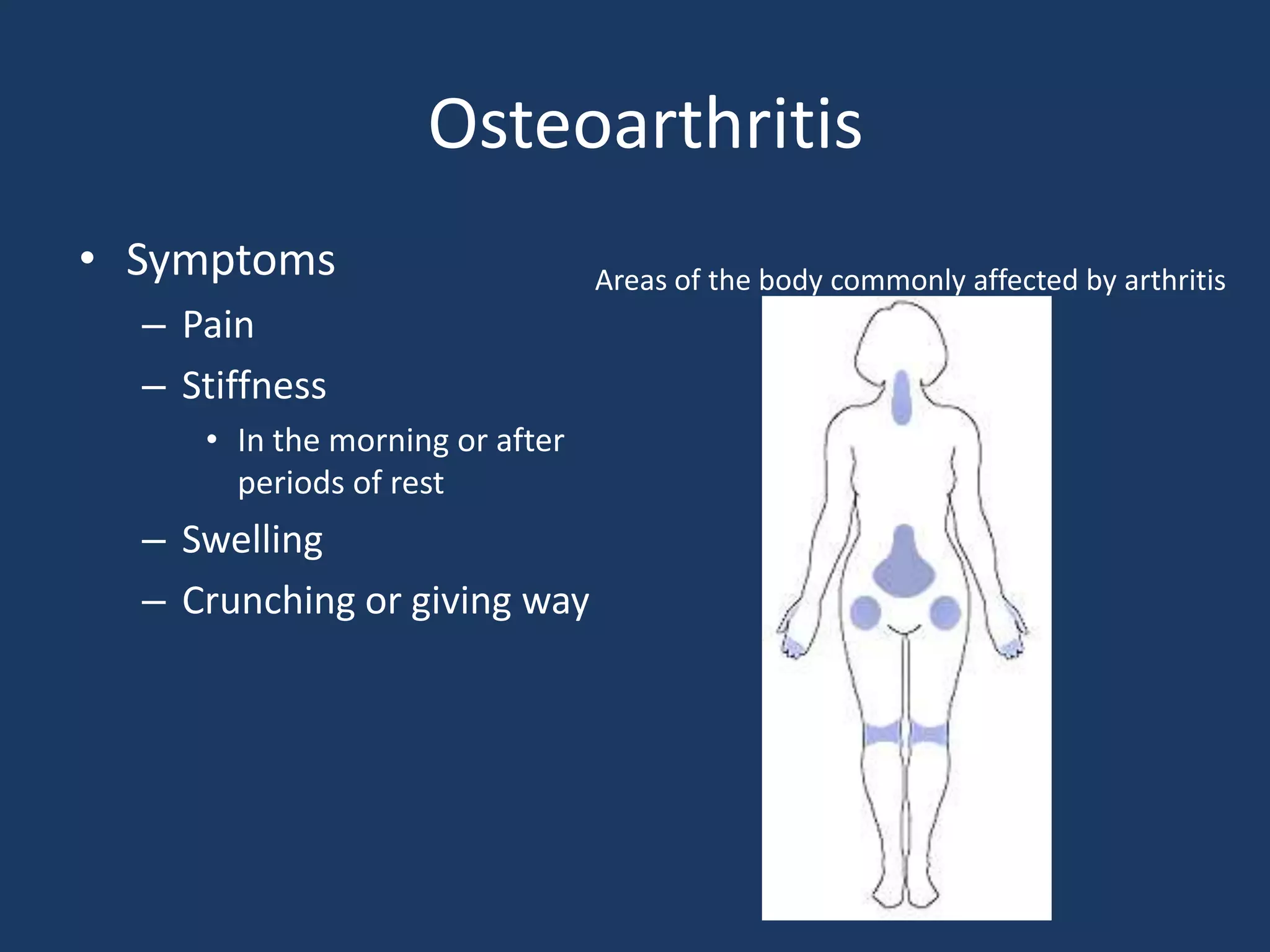
Areas of the body commonly affected by arthritis
Osteoarthritis
• How Can I Tell?
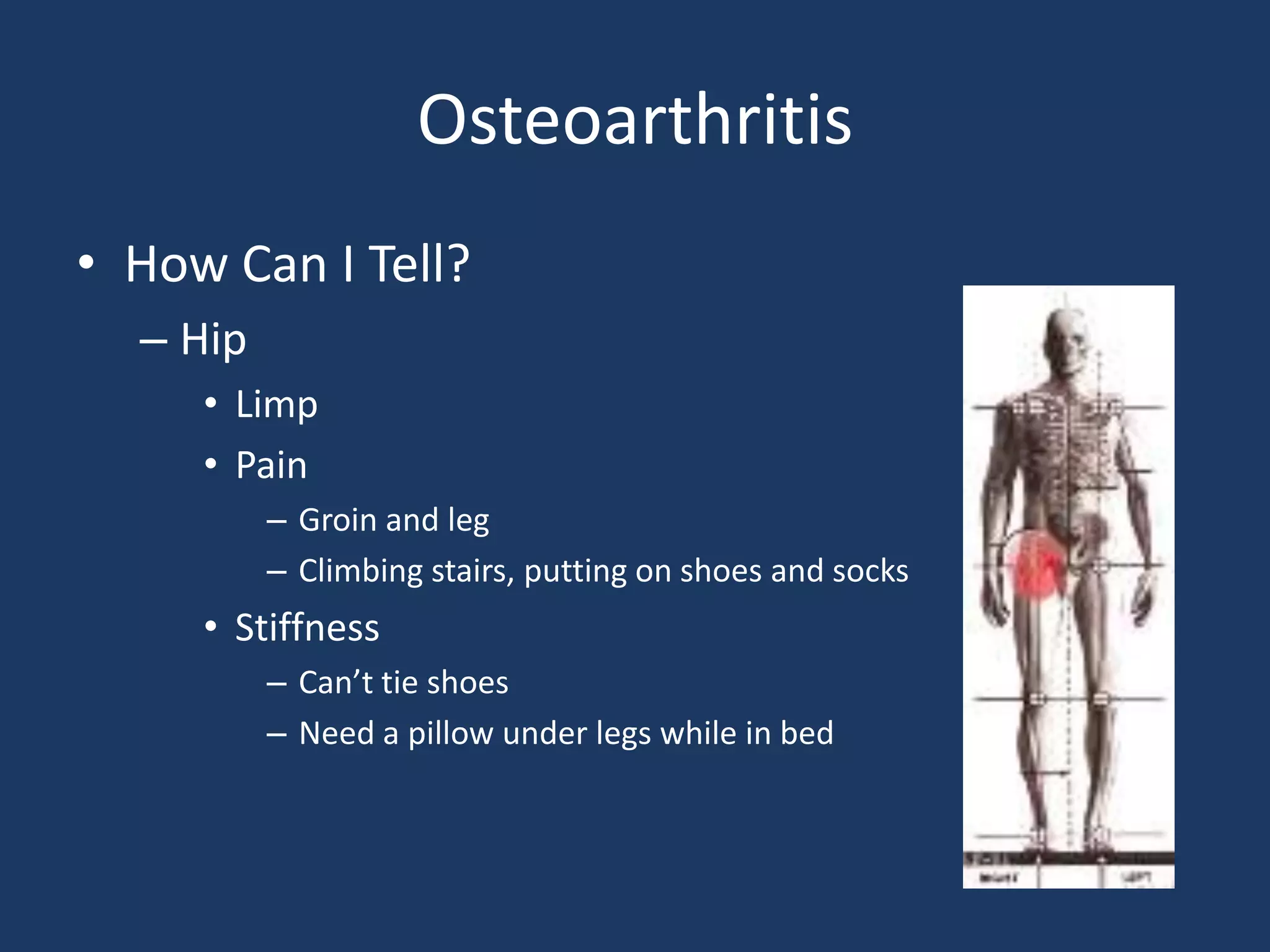
– Hip
• Limp
• Pain
– Groin and leg
– Climbing stairs, putting on shoes and socks
• Stiffness
– Can’t tie shoes
– Need a pillow under legs while in bed
Non-surgical Treatment
• Diet
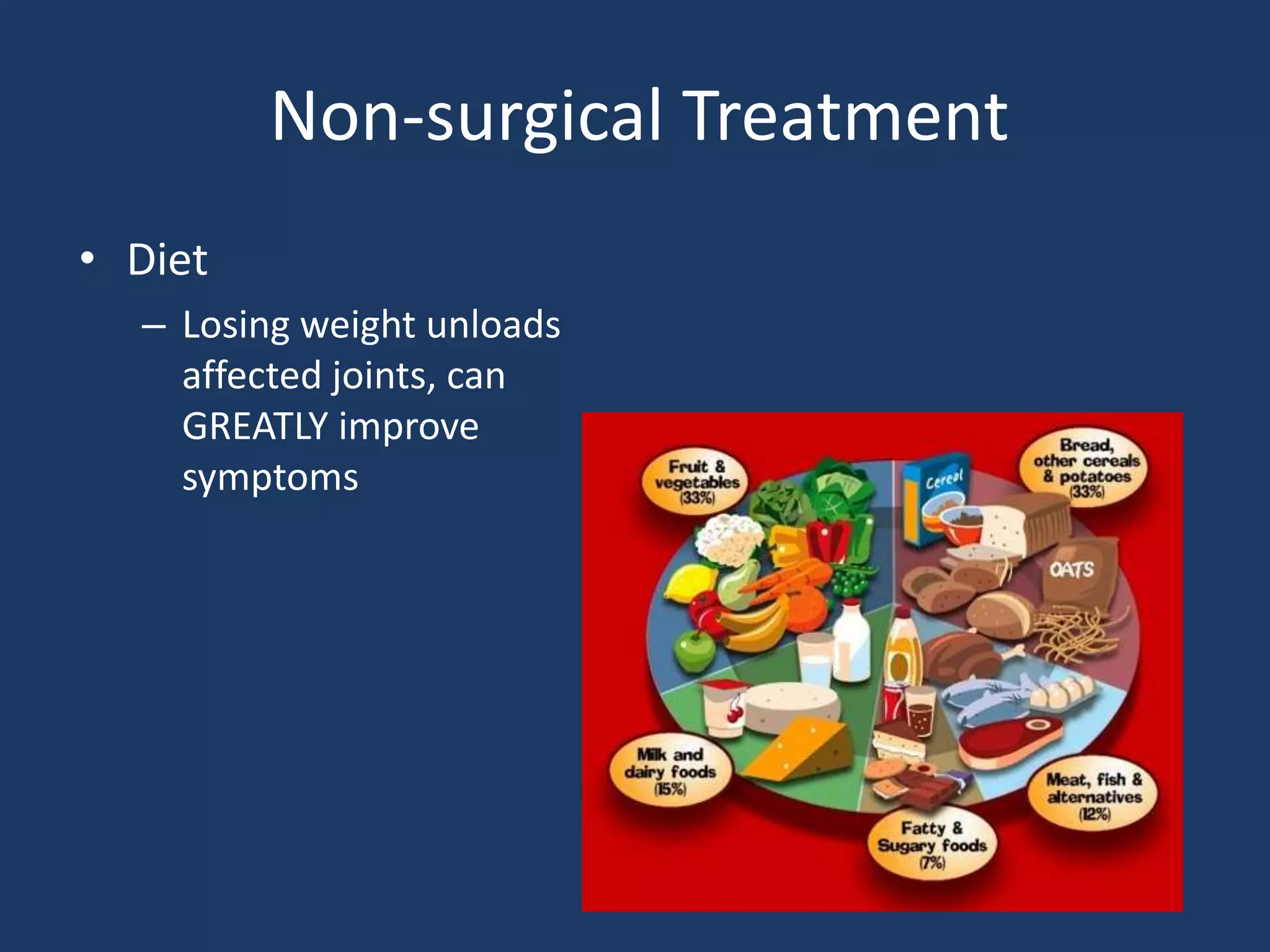
– Losing weight unloads
affected joints, can
GREATLY improve
symptoms
Treatment Options
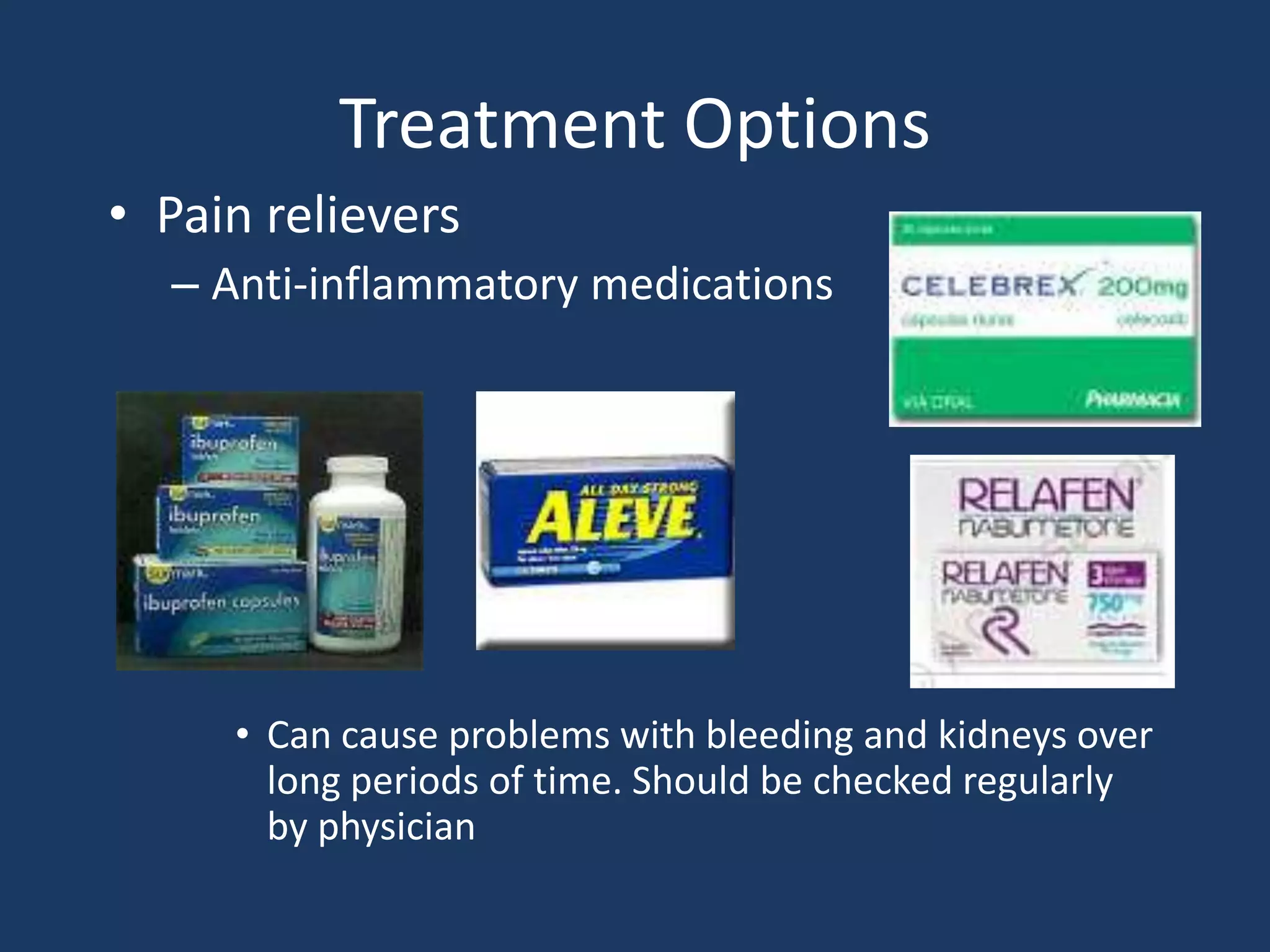
• Pain relievers
– Anti-inflammatory medications
• Can cause problems with bleeding and kidneys over
long periods of time. Should be checked regularly
by physician
Treatment Options
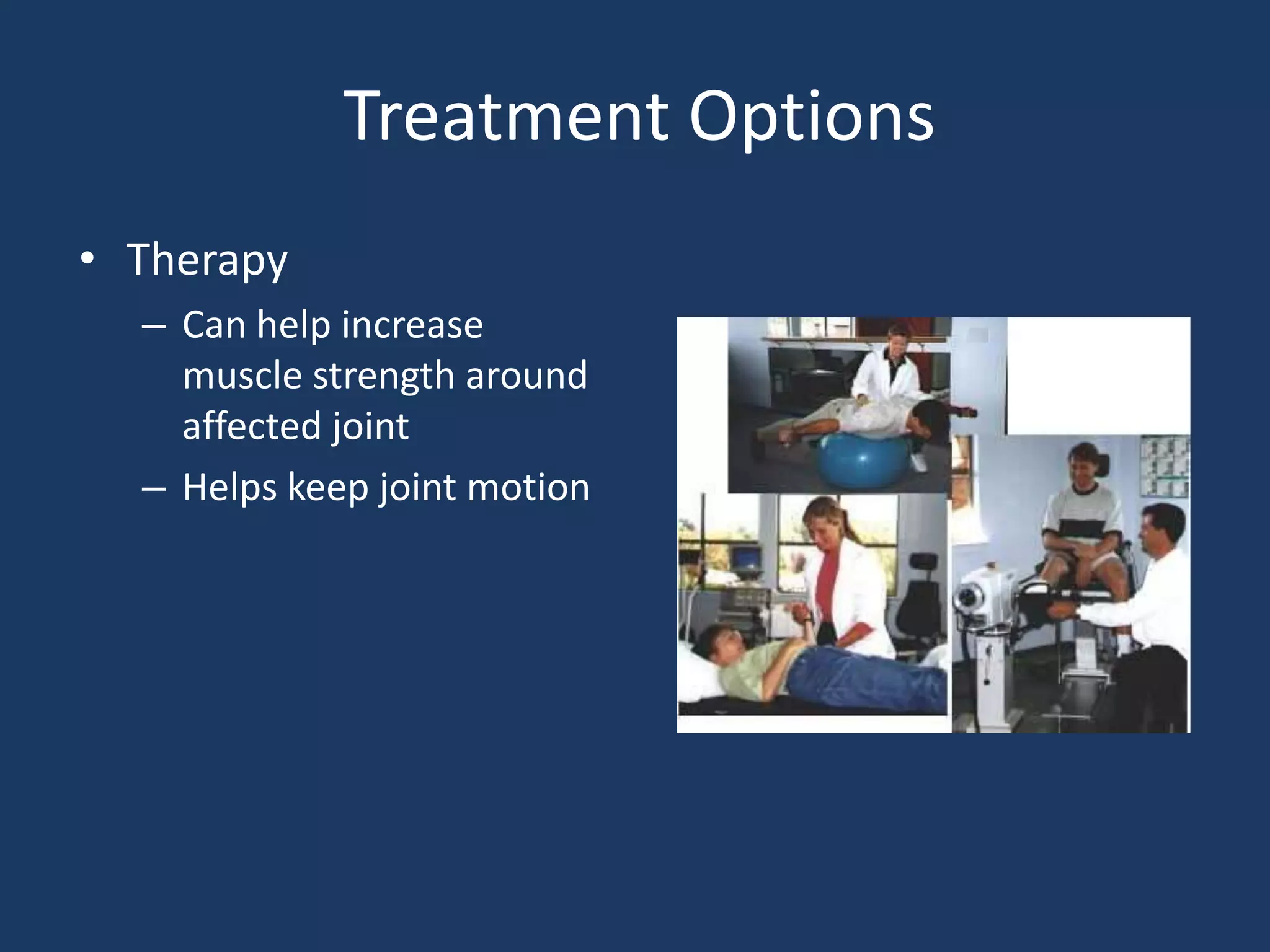
• Therapy
– Can help increase
muscle strength around
affected joint
– Helps keep joint motion
Treatment Options
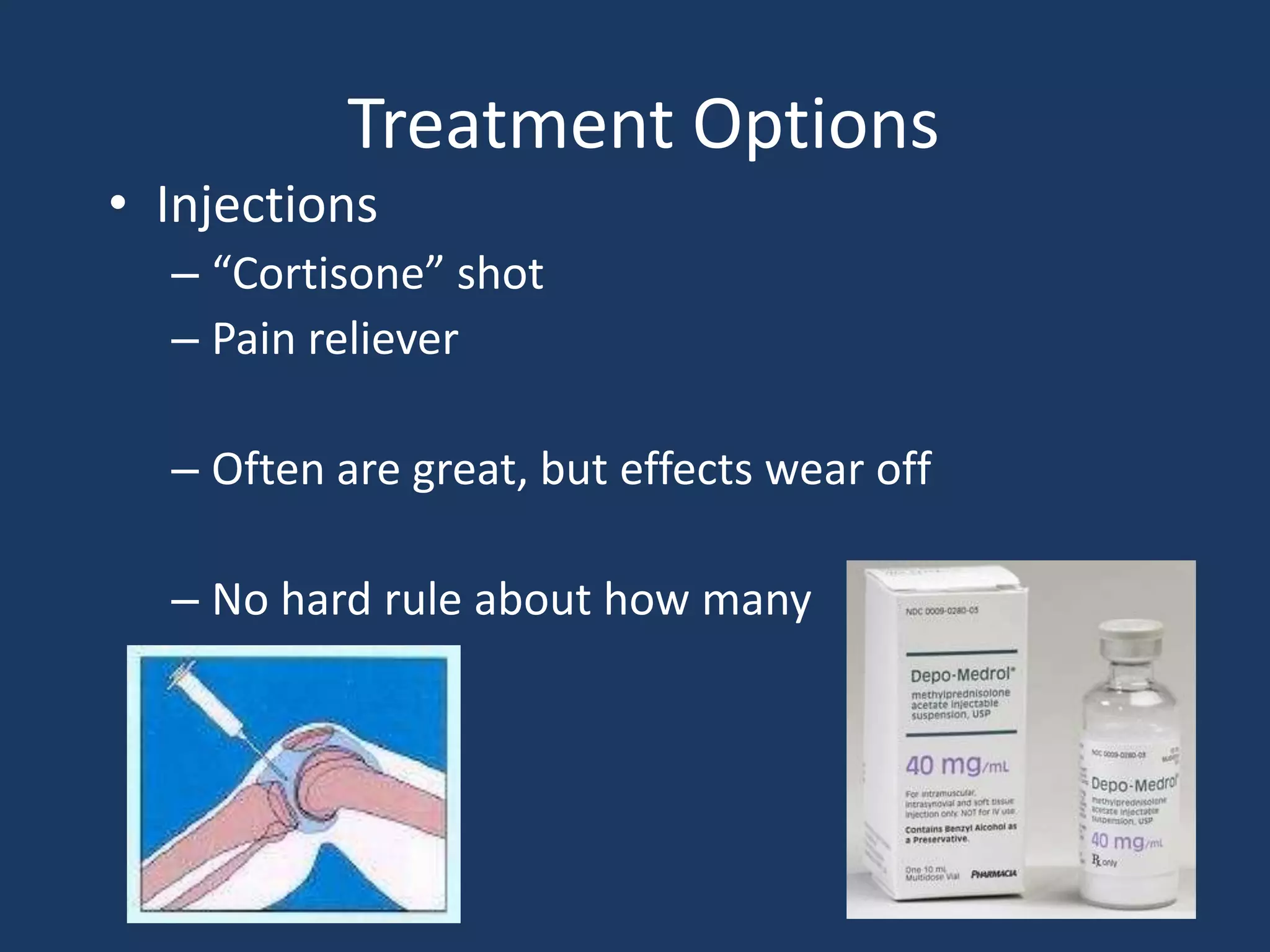
• Injections
– “Cortisone” shot
– Pain reliever
– Often are great, but effects wear off
– No hard rule about how many
Lubricant injection
• Given in series
• Only FDA approved for
knee
• Replaces worn fluid
• Sometimes great,
sometimes not
• Can be repeated every
6 months
• If you’ve tried these, and still have
pain that causes you to have:
• Difficulty walking
• Difficulty cutting toe nails, tying shoes,
putting on socks
• Difficulty sitting in a low chair or driving
• Walk shorter distances
• If you don’t find a close parking space, you
skip it
• You start to walk slower
• You limp
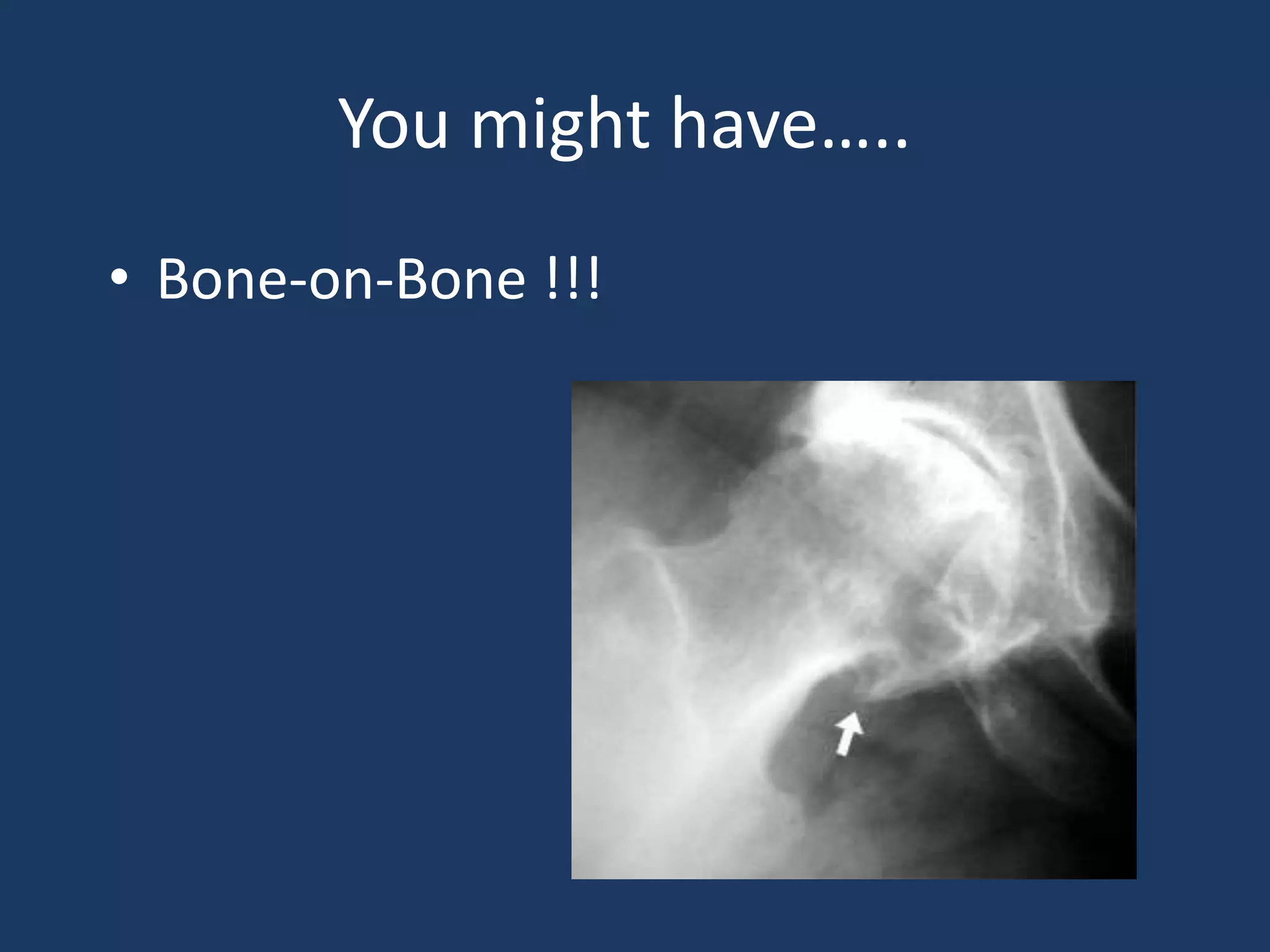
You might have…..
• Bone-on-Bone !!!
Indications
• When the history, physical examination, and
imaging studies conclude a diagnosis of
advanced degenerative disease of the hip….
• And, the patient is having significant pain and
disability that has not responded to a medical
management program….
• The patient is a candidate for a TOTAL HIP
ARTHROPLASTY
Fundamental Differences
• The outcome of total hip arthroplasty is
directly related to the quality of the technique
used to introduce the devices into the human
body.
• Much different principles involved when
comparing to excision or removal of diseased
organs.
• The surgeon must introduce object of
substantial size into the body
Which one is different?
• 1) Cholecystectomy
• 2)Lumbar Discectomy
• 3)Hysterectomy
• 4)Total Hip Arthroplasty
• 5)Radical Prostatectomy
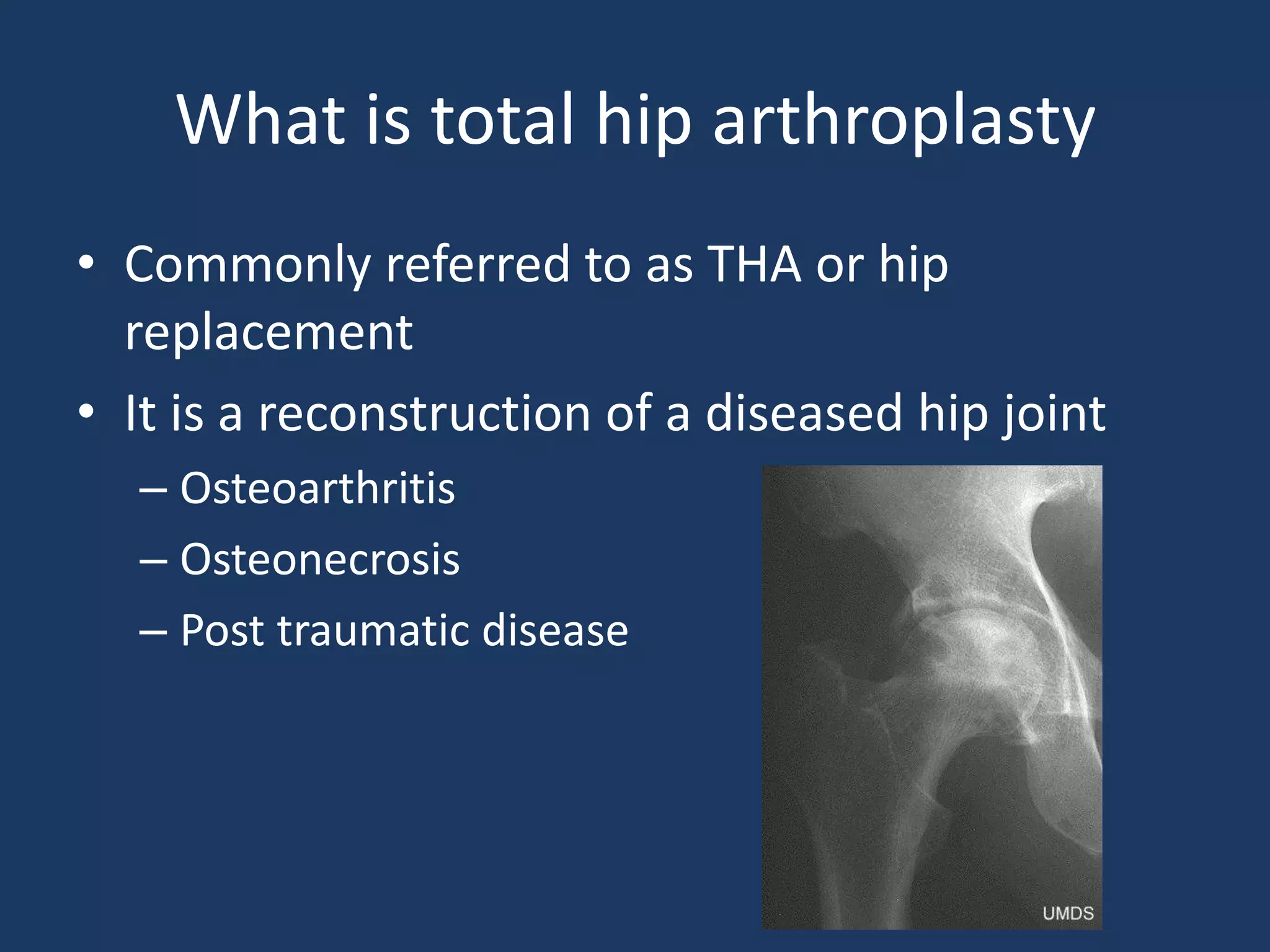
What is total hip arthroplasty
• Commonly referred to as THA or hip
replacement
• It is a reconstruction of a diseased hip joint
– Osteoarthritis
– Osteonecrosis
– Post traumatic disease
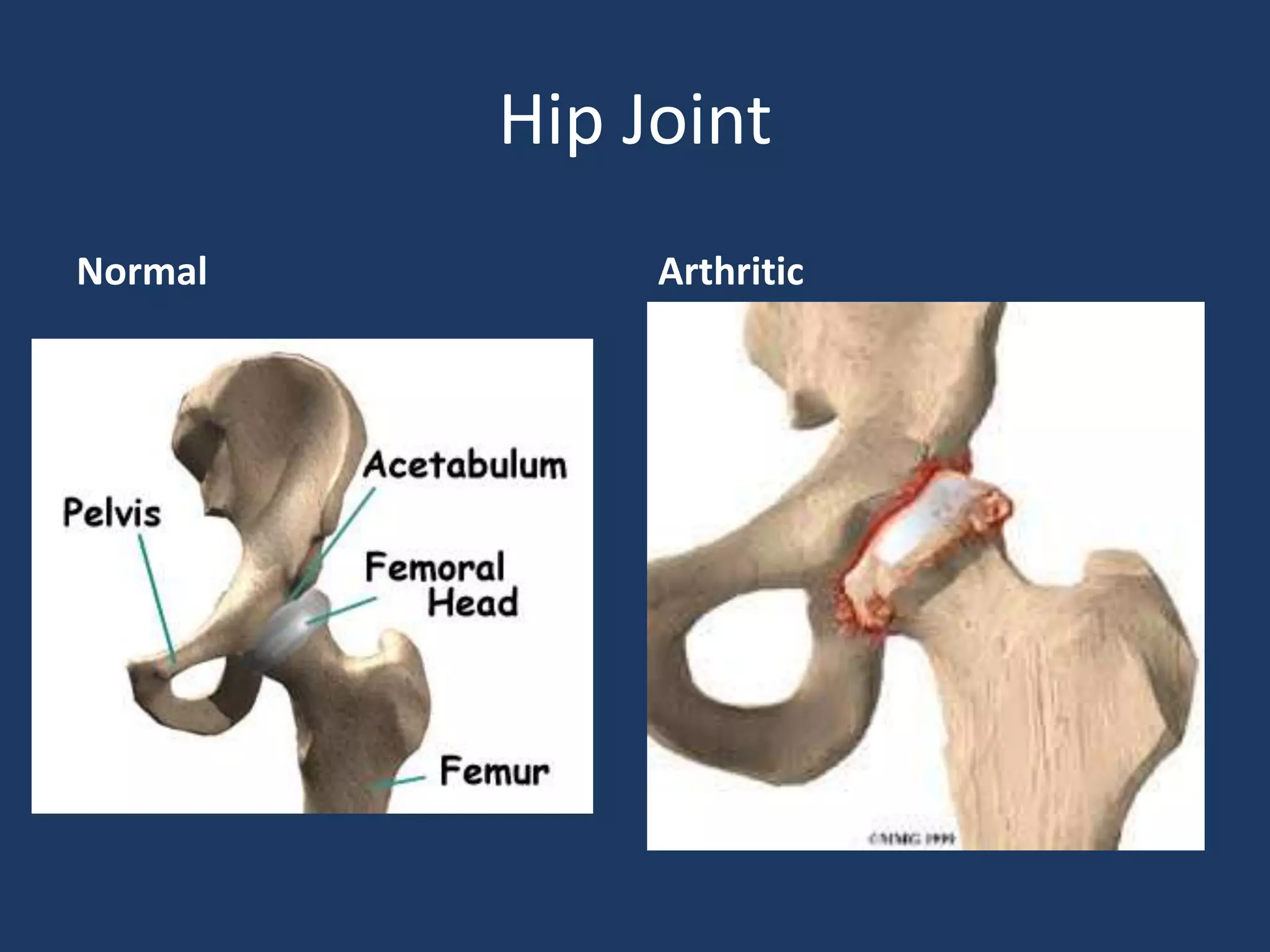
Hip Joint
Normal Arthritic
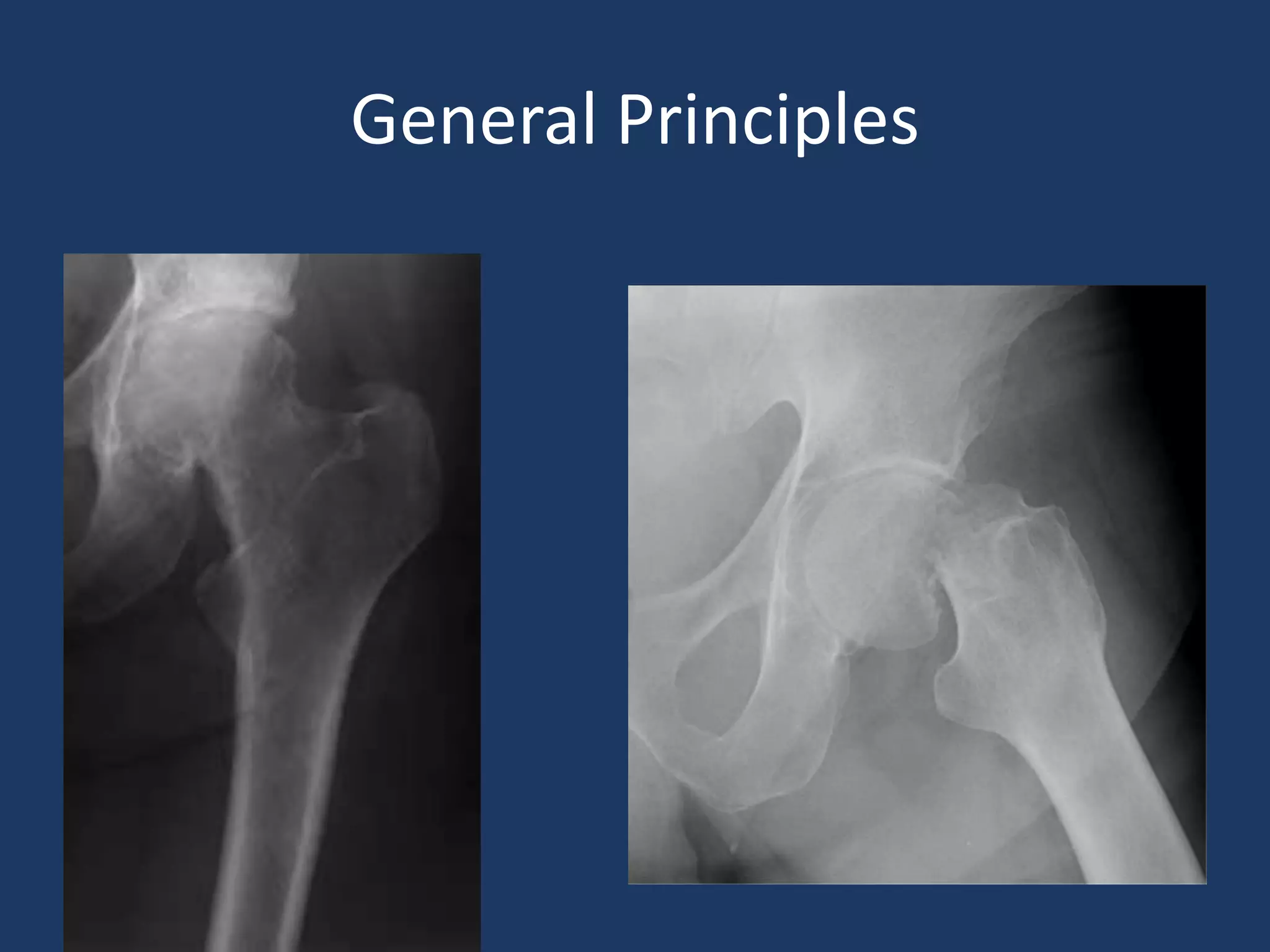
General Principles
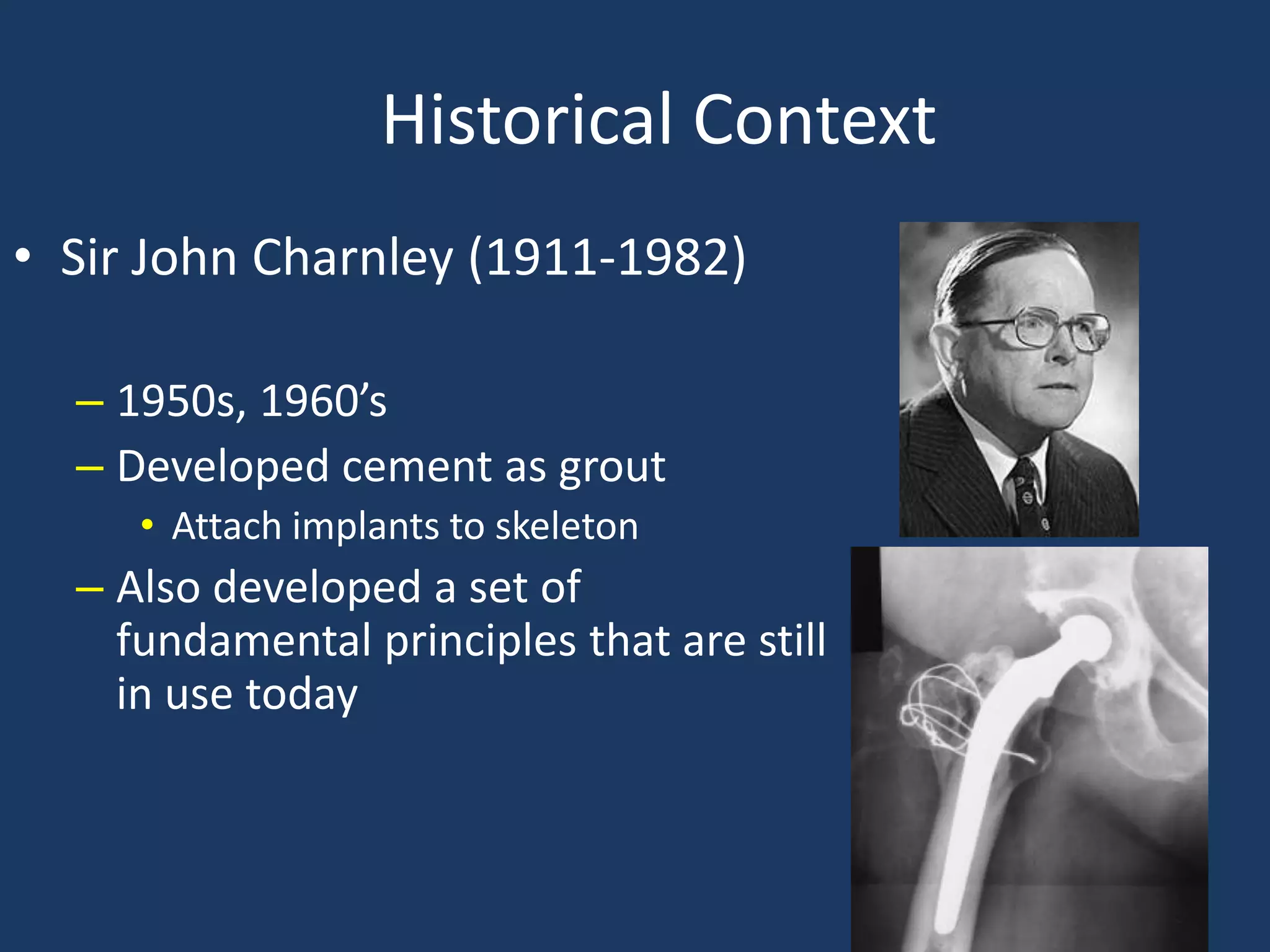
Historical Context
• Sir John Charnley (1911-1982)
– 1950s, 1960’s
– Developed cement as grout
• Attach implants to skeleton
– Also developed a set of
fundamental principles that are still
in use today
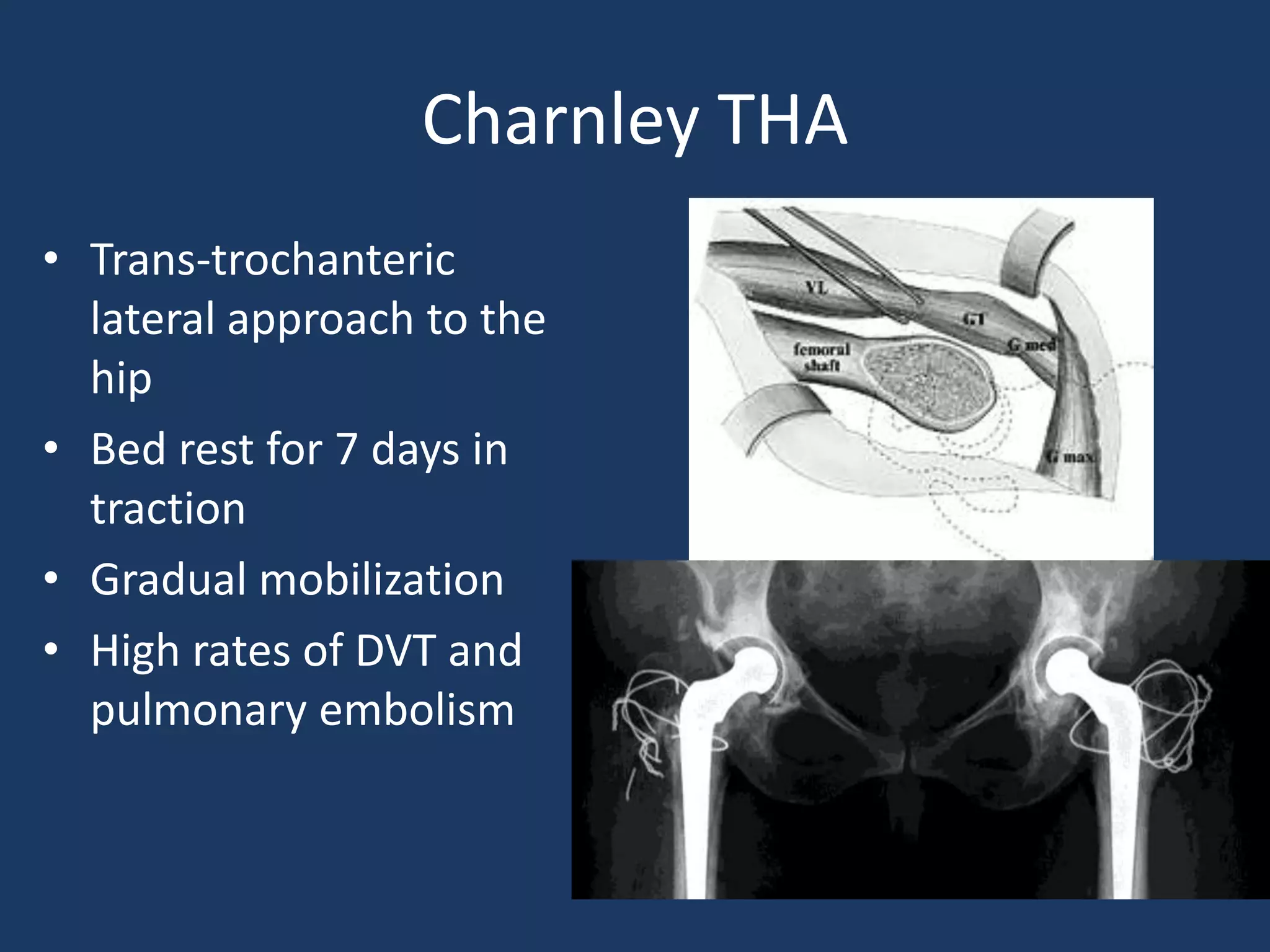
Charnley THA
• Trans-trochanteric
lateral approach to the
hip
• Bed rest for 7 days in
traction
• Gradual mobilization
• High rates of DVT and
pulmonary embolism
Charnley THA
• Could be considered
– MAXIMALLY INVASIVE
• However,
– Also, MAXIMALLY EFFECTIVE!
• Without Charnley, we would not be where we
are today!
Evolution of total hip replacement
• The Charnley technique was brought to the US
and the world in the 1970’s and proved to be
an effective and reproducible way of relieving
pain and restoring function in patients with
degenerative disease of the hip
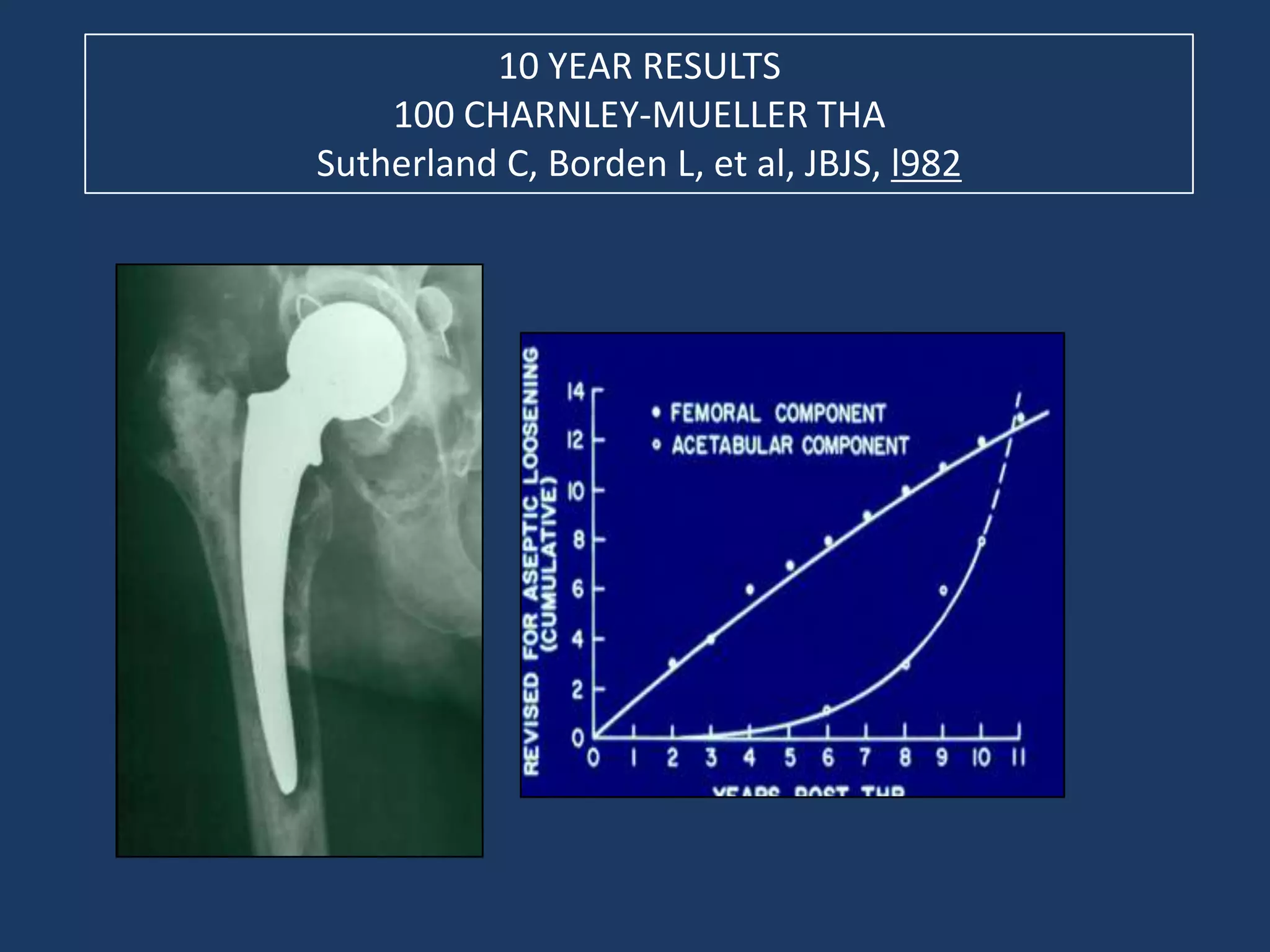
10 YEAR RESULTS
100 CHARNLEY-MUELLER THA
Sutherland C, Borden L, et al, JBJS, l982
THA evolution
• 1980’s and 1990’s
– Realization of Charnley technique limitations
• Polyethylene wear
• Component loosening
• Trochanteric Non-union
• Persistent limp
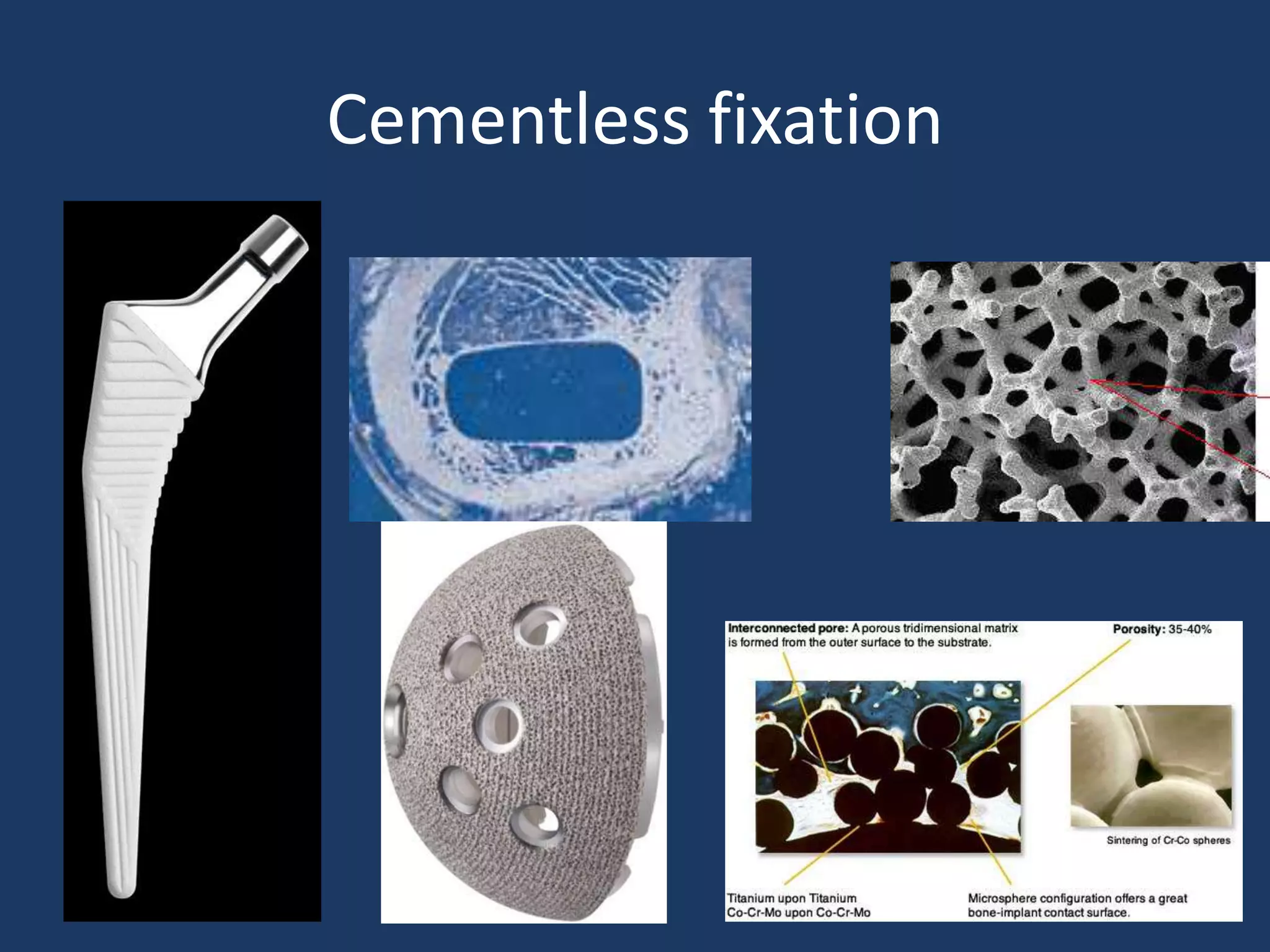
– Introduction of cementless implants and
alternative surgical approaches
– Understanding the role of implant positioning
Cementless fixation
Surgical Approaches
• Direct Lateral
– 33%
• Posterior
– 67%
• Both offer excellent exposure, have unique
limitations and complications
Direct Lateral Approach
• Pros
– Good exposure
– Low dislocation rate
– Can position lateral or
supine
• Cons
– Abductor weakness and
limp
– H.O.
– Superior Gluteal n. at
risk (cannot split medius
more than 3-5 cm
proximal to Troch)
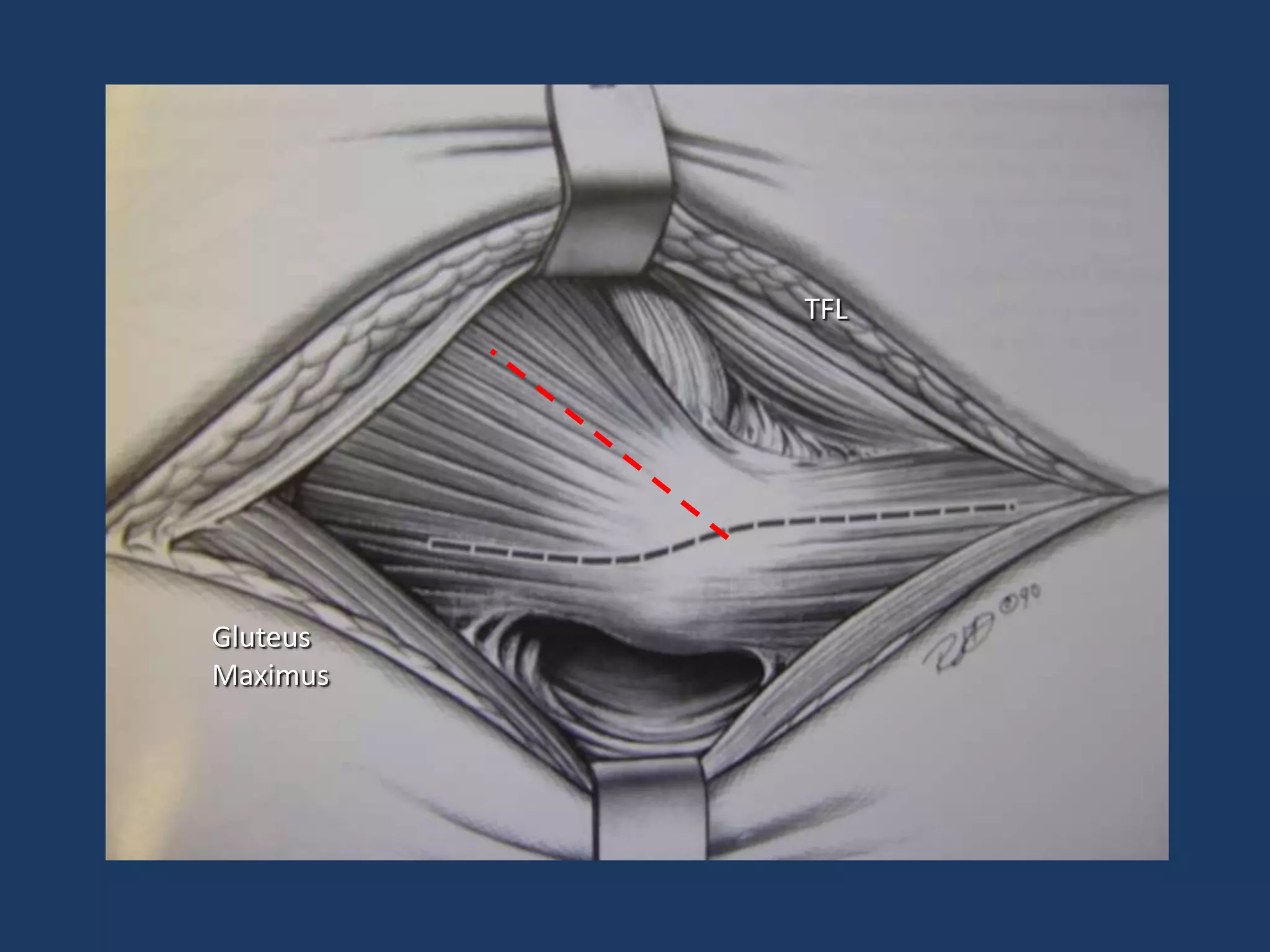
TFL
Gluteus
Maximus
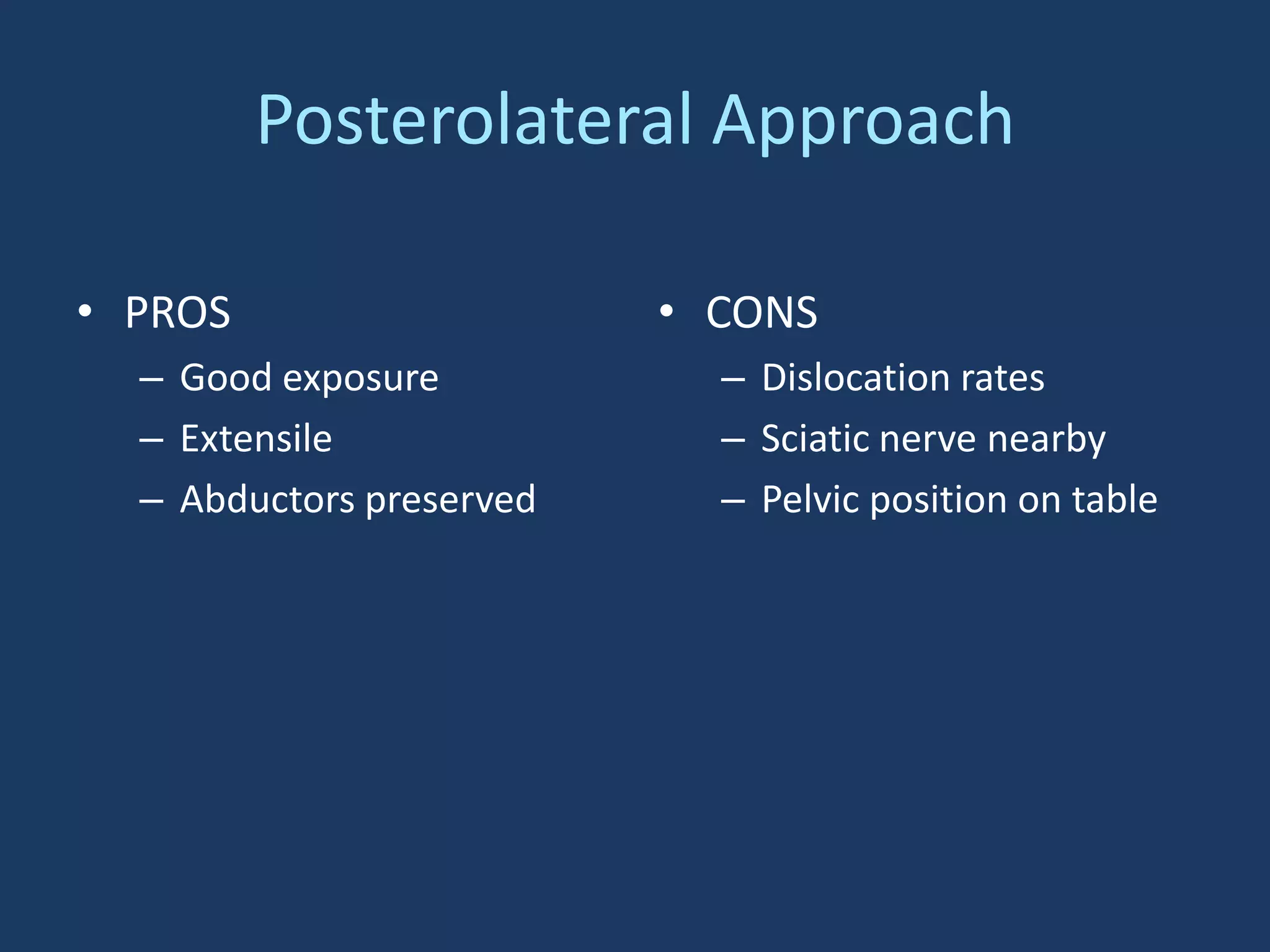
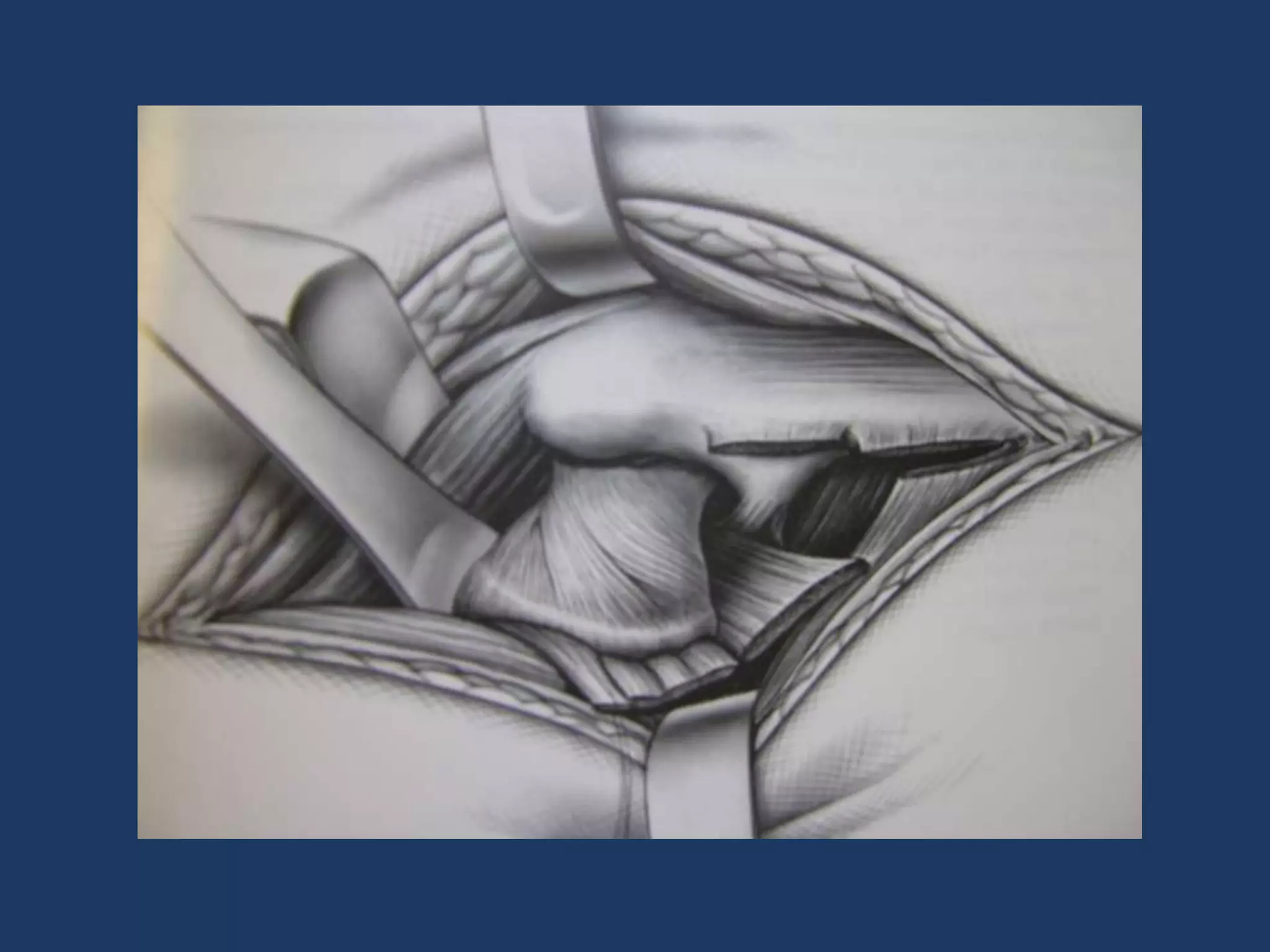
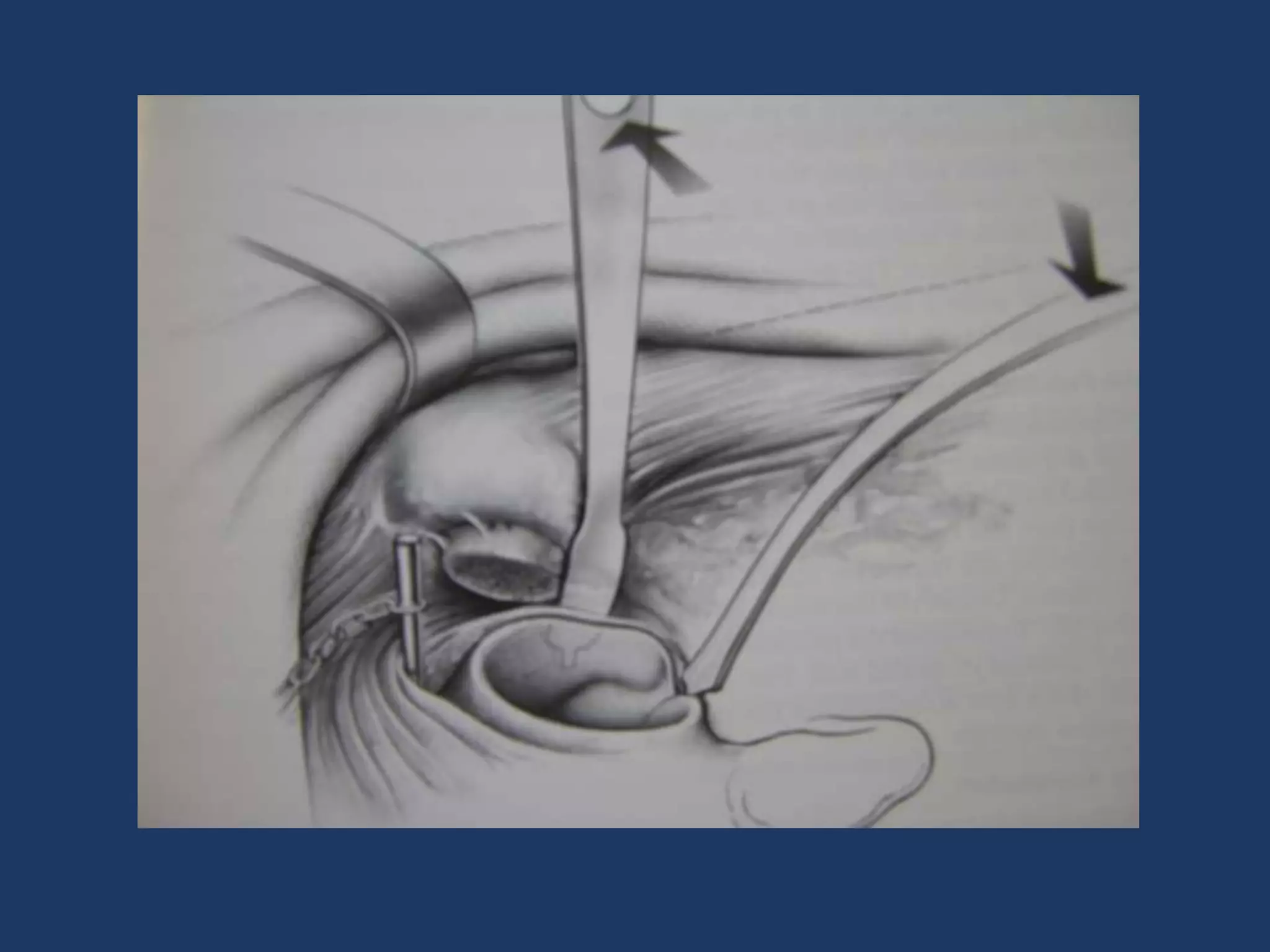
Posterolateral Approach
• PROS
– Good exposure
– Extensile
– Abductors preserved
• CONS
– Dislocation rates
– Sciatic nerve nearby
– Pelvic position on table
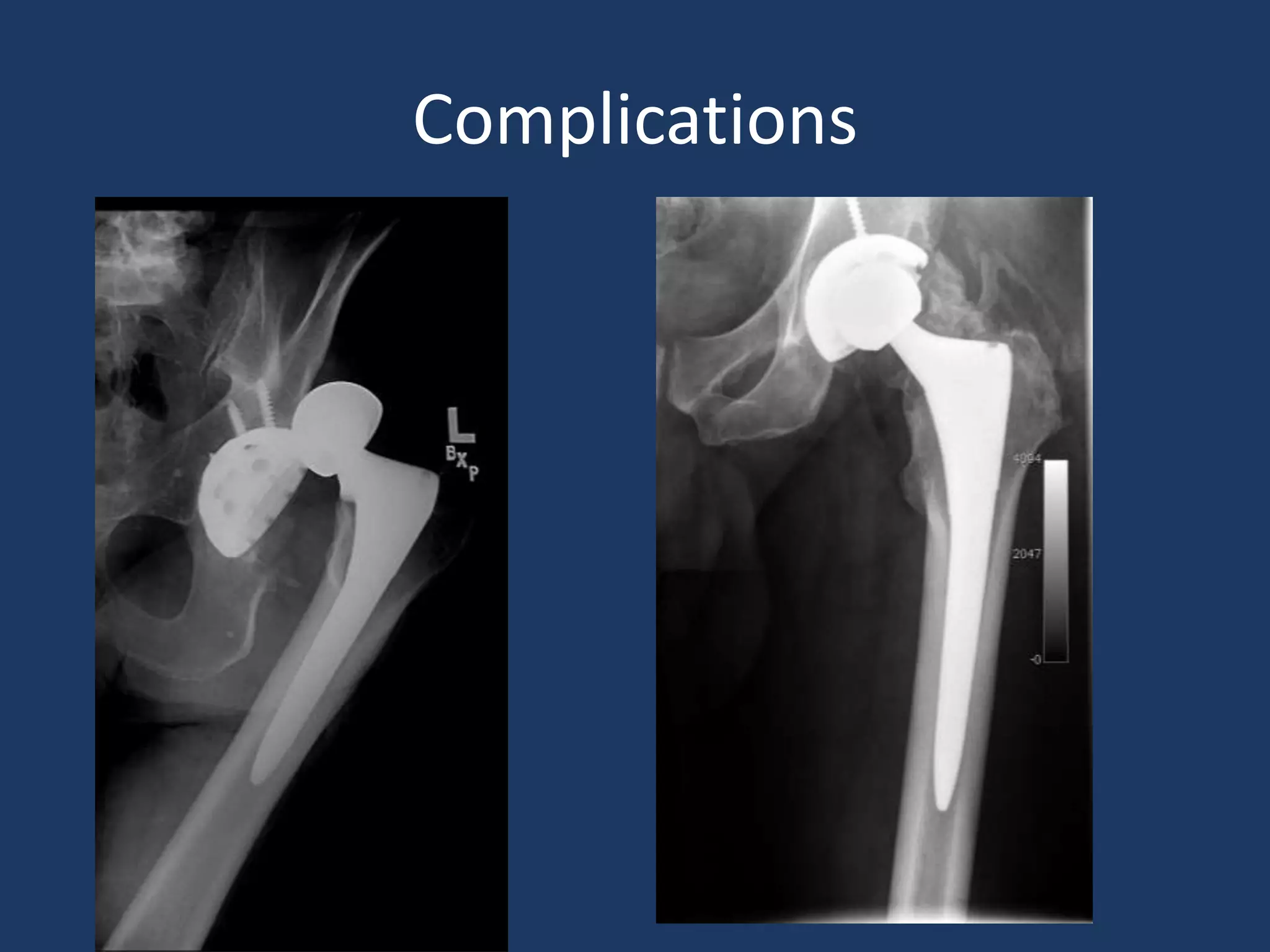
Complications
Outcomes
• In general, patients stayed 4-5 days in hospital
• 8-12 weeks recovery
• Overall excellent outcomes in terms of pain
relief and return of function
• Complication rates reasonable
• Patients still with concerns about painful and
lengthy recovery
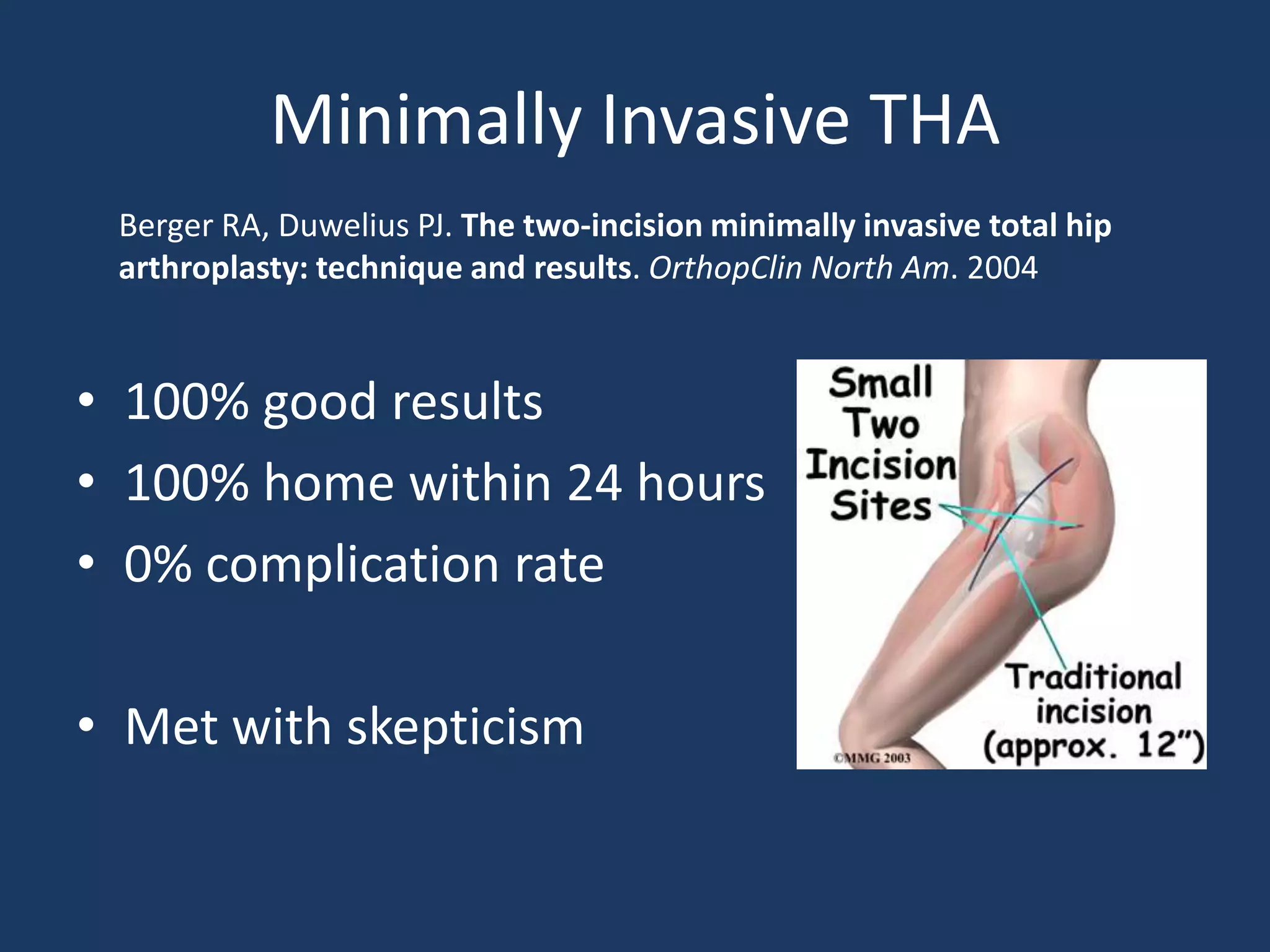
Minimally Invasive THA
• 100% good results
• 100% home within 24 hours
• 0% complication rate
• Met with skepticism
Berger RA, Duwelius PJ. The two-incision minimally invasive total hip
arthroplasty: technique and results. OrthopClin North Am. 2004
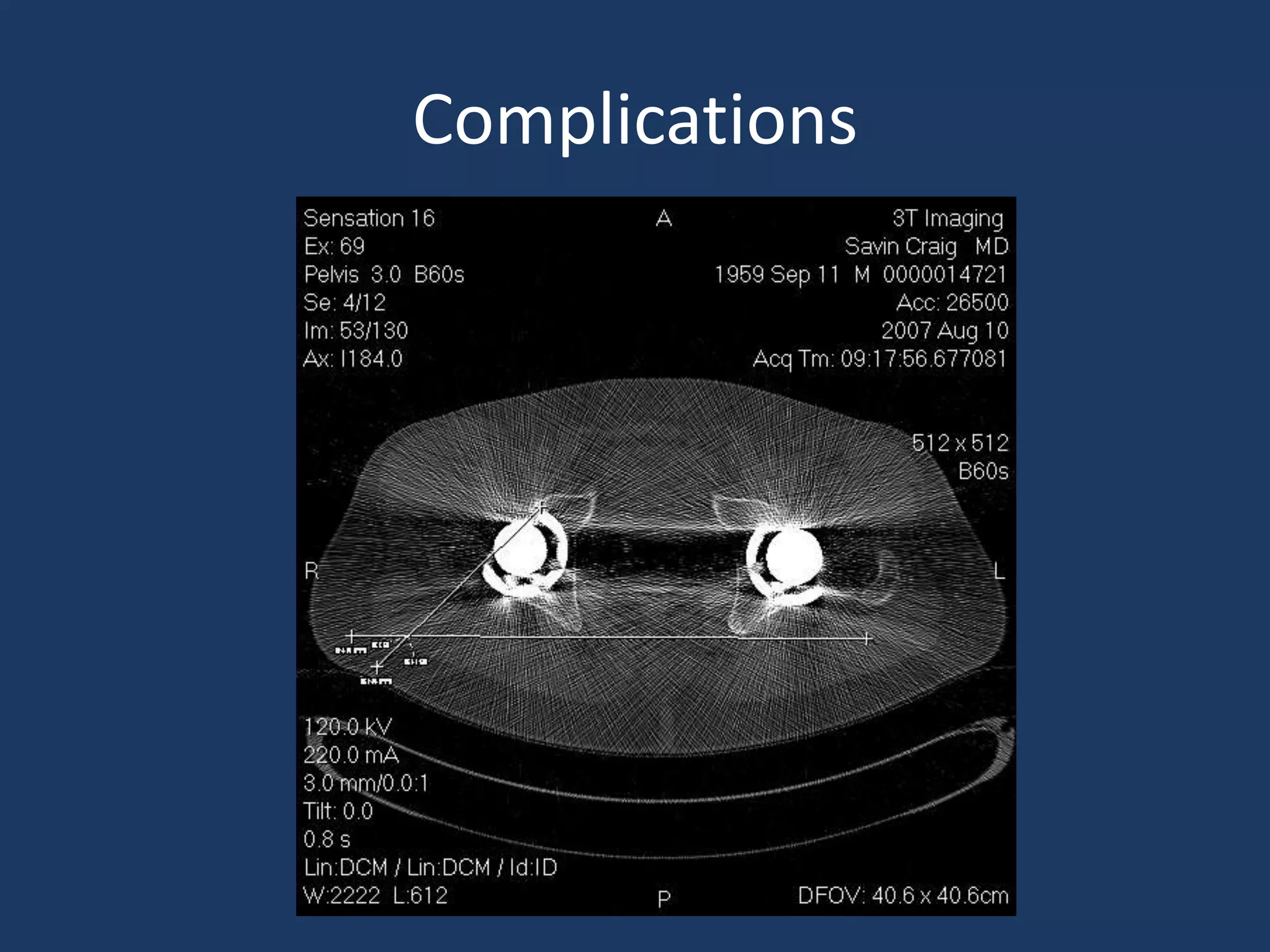
Complications
Complications
Bal BS, Haltom D, Aleto T, Barrett M. Early complications of primary total
hip replacement performed with a two incision minimally invasive
technique. J Bone Joint Surg Am. 2005
Pagnano MW, Leone J, Lewallen DG, Hanssen AD. Two-incision THA
had modest outcomes and some substantial complications.
ClinOrthopRelat Res. 2005
Pagnano MW, Trousdale RT, Meneghini RM, Hanssen AD. Slower
recovery after two-incision than mini-posterior-incision total hip
arthroplasty: surgical technique. J Bone Joint Surg Am. 2009
Alternative MIS THA approaches
O’Brien DA, Rorabeck CH. The mini-incision direct lateral approach in primary
total hip arthroplasty.ClinOrthopRelat Res. 2005
Duwelius PJ, Burkhart RL, Hayhurst JO, Moller H, Butler JB.
Comparison of the 2-incision and mini-incision posterior total hip
arthroplasty technique: a retrospective match-pair controlled study.
J Arthroplasty. 2007
Woolson ST, Mow CS, Syquia JF, Lannin JV, Schurman DJ. Comparison of
primary total hip replacements with a standard incision or a mini-incision. J
Bone Joint Surg Am. 2004
Minimal-incision total hip arthroplasty.
Goldstein WM, Branson JJ, Berland KA, Gordon AC. J Bone Joint Surg
Am. 2003;85-A Suppl 4:33-8
Summary
• Most of these studies demonstrated minor
short term recovery improvements, with no
difference to standard approach at 3 months.
• Complications rates were generally higher
– Blood loss
– Component malposition
– Soft tissue injury
• First performed in 1947 by Robert Judet in
France
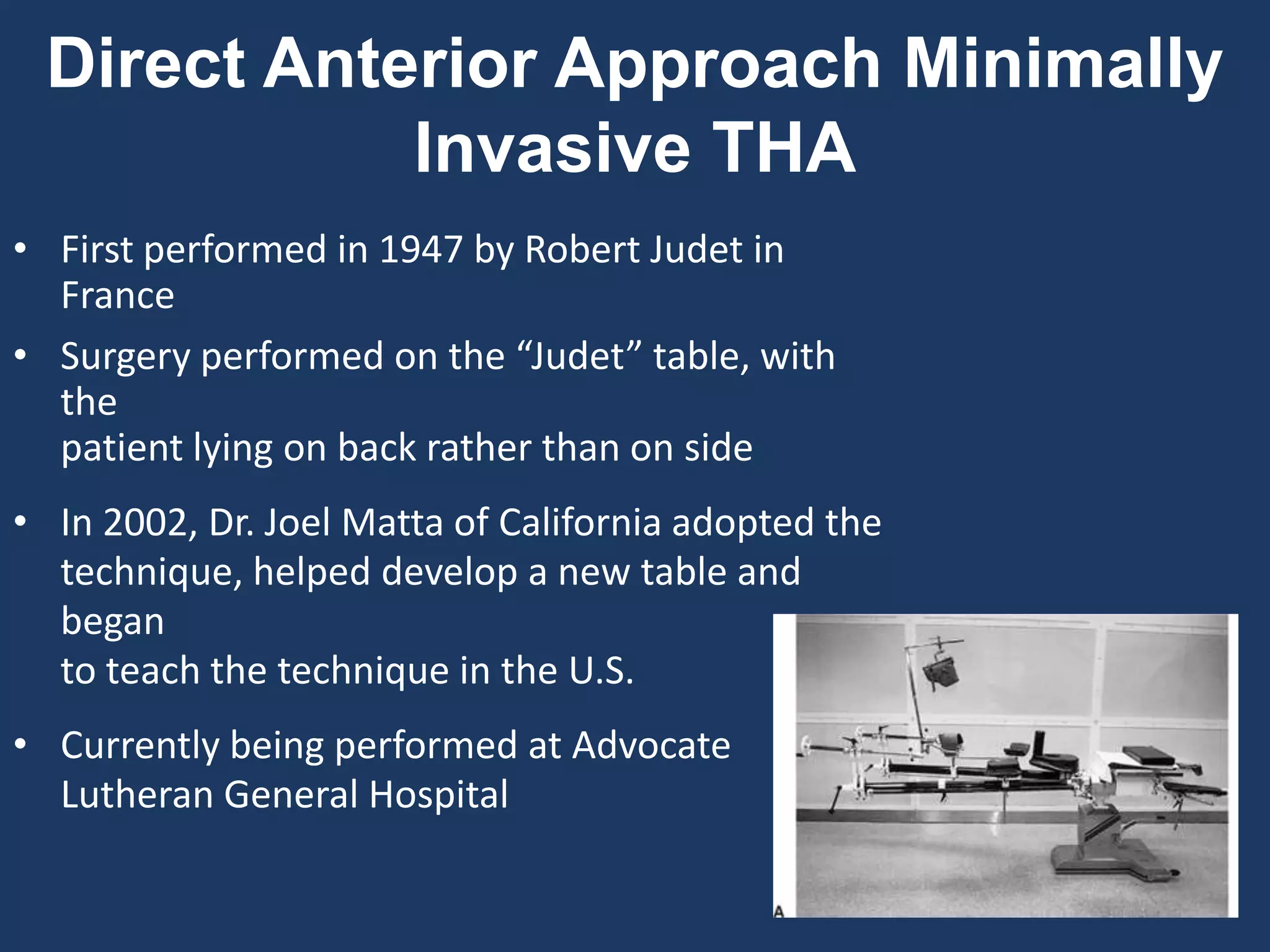
• Surgery performed on the “Judet” table, with
the
patient lying on back rather than on side
• In 2002, Dr. Joel Matta of California adopted the
technique, helped develop a new table and
began
to teach the technique in the U.S.
• Currently being performed at Advocate
Lutheran General Hospital
Direct Anterior Approach Minimally
Invasive THA
Anterior Approach
What is it?
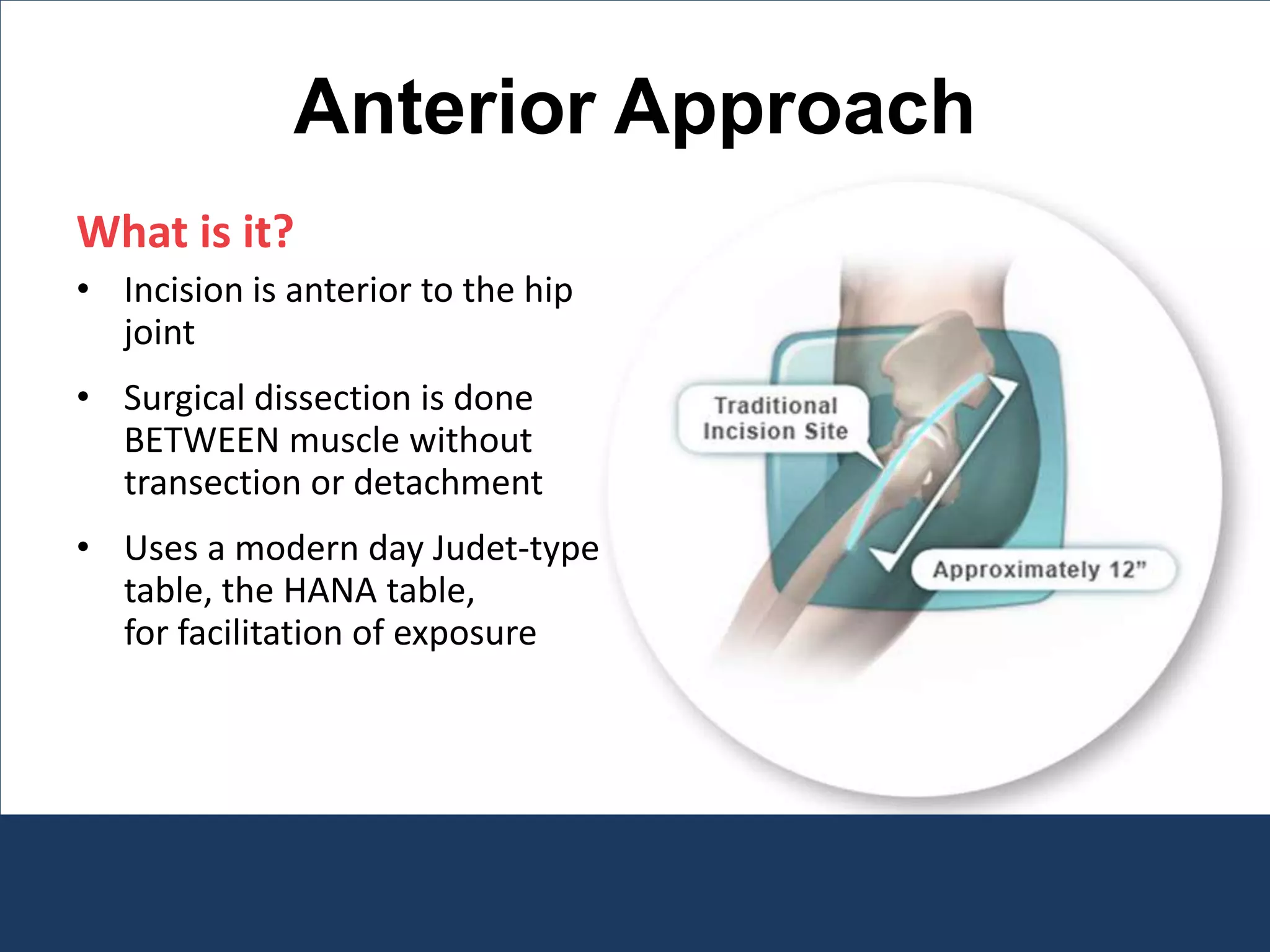
• Incision is anterior to the hip
joint
• Surgical dissection is done
BETWEEN muscle without
transection or detachment
• Uses a modern day Judet-type
table, the HANA table,
for facilitation of exposure
Anterior Approach
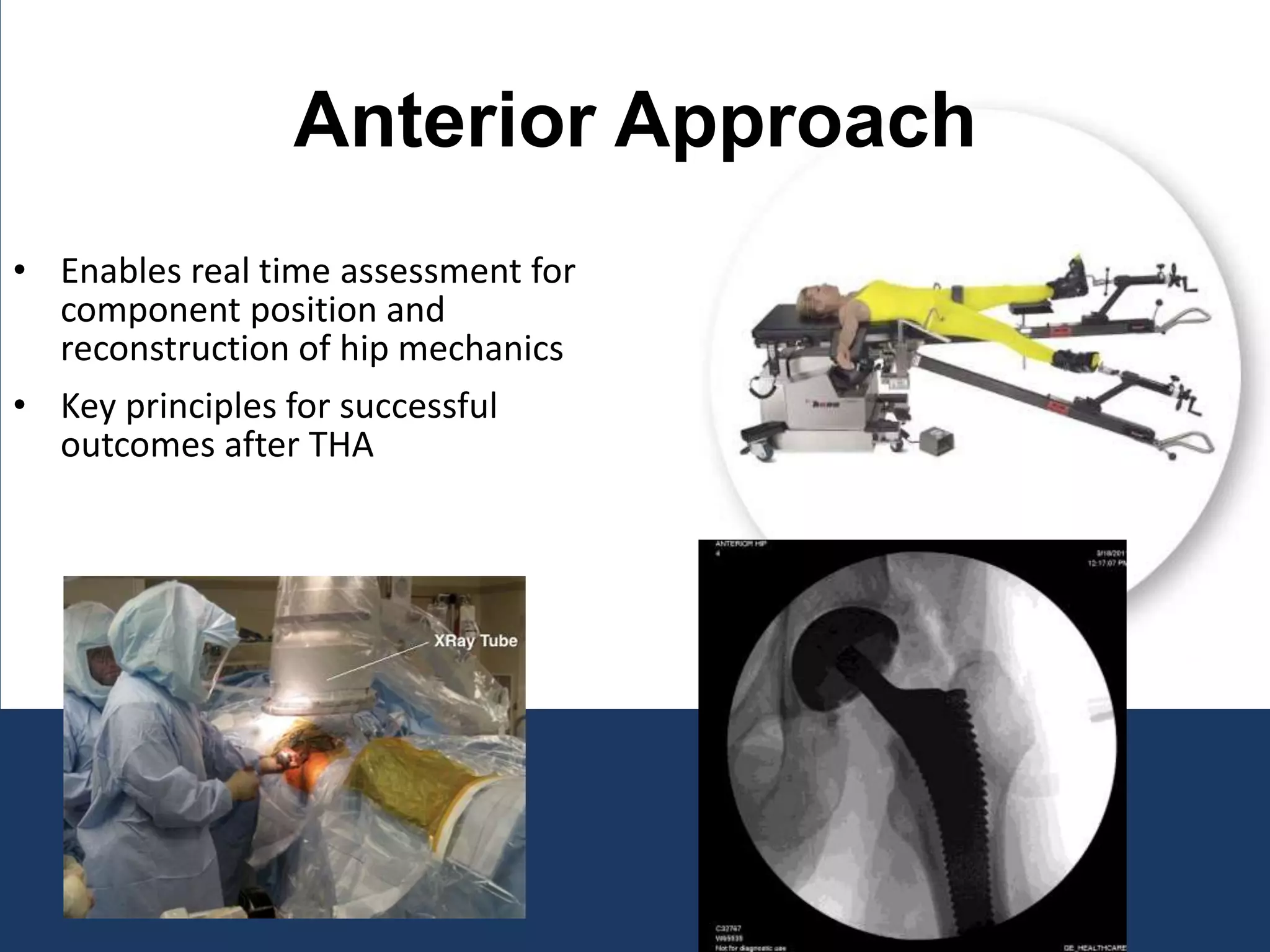
• Patients lie on back
• Enables real time assessment for
component position and
reconstruction of hip mechanics
• Key principles for successful
outcomes after THA
• Less trauma to the body
• Smaller incision
• Potentially less pain (especially when sitting)
• Less need for medication
• Faster recovery (muscles are spared lengthy healing)
• Minimal physical rehabilitation
• Fewer restrictions on activity after surgery
Potential benefits
of the Anterior Approach
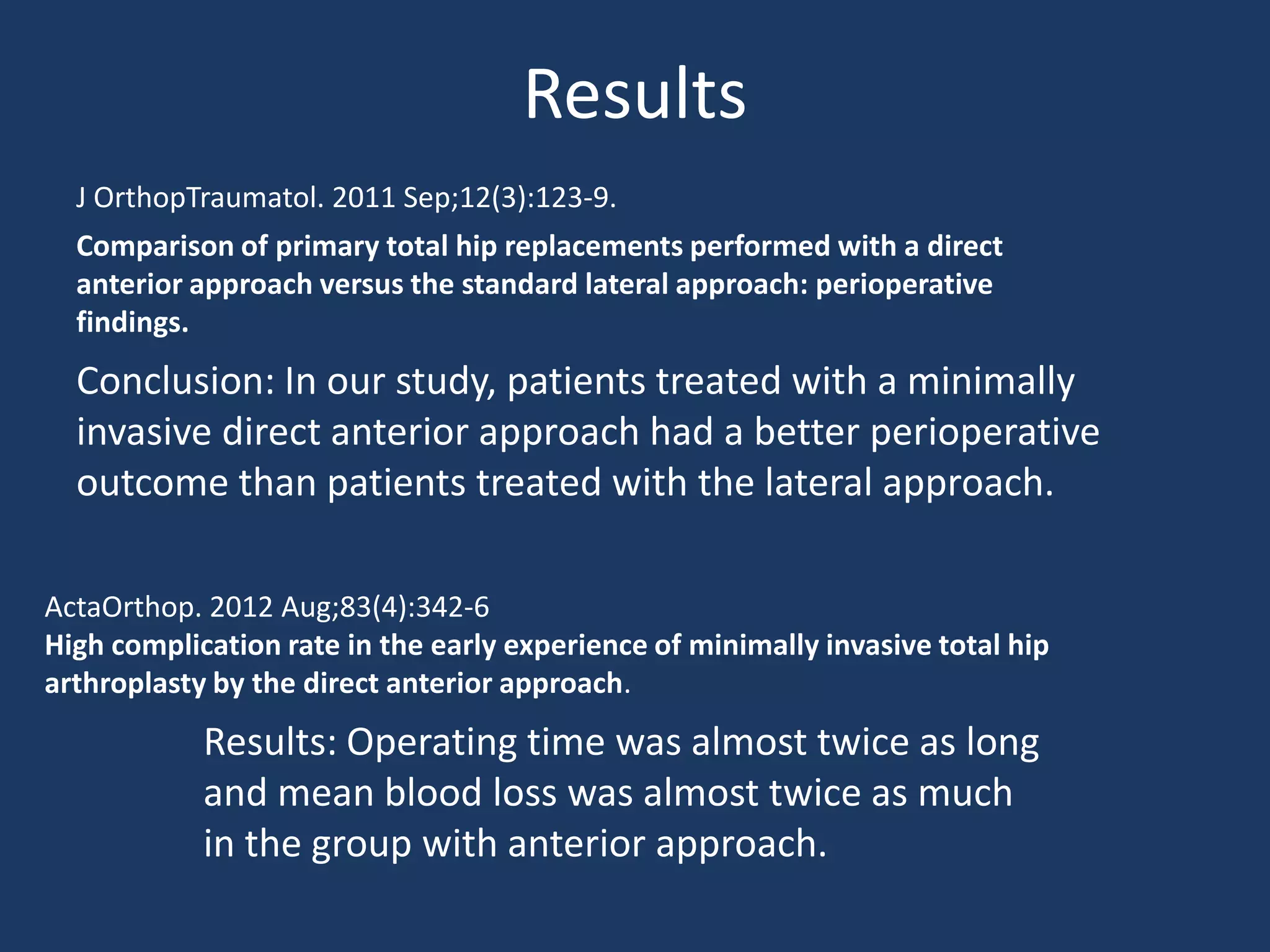
Results
Comparison of primary total hip replacements performed with a direct
anterior approach versus the standard lateral approach: perioperative
findings.
Conclusion: In our study, patients treated with a minimally
invasive direct anterior approach had a better perioperative
outcome than patients treated with the lateral approach.
ActaOrthop. 2012 Aug;83(4):342-6
High complication rate in the early experience of minimally invasive total hip
arthroplasty by the direct anterior approach.
Results: Operating time was almost twice as long
and mean blood loss was almost twice as much
in the group with anterior approach.
J OrthopTraumatol. 2011 Sep;12(3):123-9.
Personal Experience
• Started the technique in 2011, after attending
cadaver courses and surgeon visitation.
• Have been performing at Skokie hospital
• Very selective for my early patients
– Non-obese
– No deformity
Personal Experience
• Now performing almost all cases through this
approach
• Did note higher blood loss initially
• No complications such as dislocation or
fracture
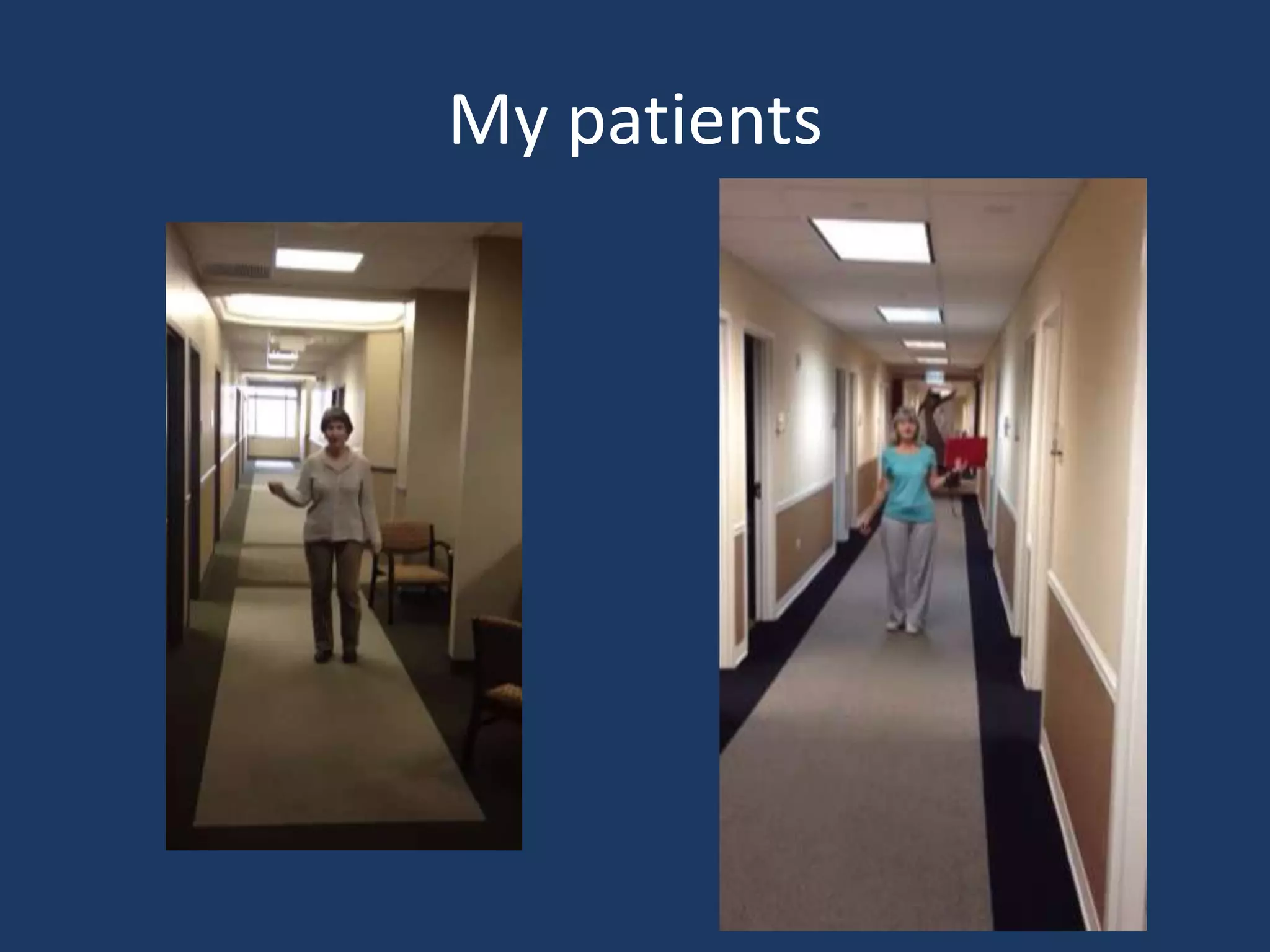
• Very satisfied patients
Personal Experience
• Must have team approach to aid in rapid
recovery
• Regional Anesthesia
• Multi-modal pain management
• Nursing care
• Early Physical Therapy
My patients
Summary
• Total hip arthroplasty has been proven to be a
safe and effective operation for patients with
degenerative conditions of the hip
• Previous iterations of minimally invasive
surgery have not proven to allow faster
recovery, but were associated with increased
risk.
Summary
• Direct Anterior Minimally Invasive is a
promising method to allow faster recovery of
function and possibly IMPROVE the outcomes
of the procedure
• Like any new technique, education and
experience are critical to success.
• My patients have been very happy and I plan
to continue to develop this procedure.
Thank you
Alexander Gordon, MD

Community Minimally Invasive Total Hip Replacement Slideshow

  • 1.
    Minimally Invasive TotalHip Replacement Alexander Gordon, MD
  • 2.
    Osteoarthritis • Symptoms – Pain –Stiffness • In the morning or after periods of rest – Swelling – Crunching or giving way Areas of the body commonly affected by arthritis
  • 3.
    Osteoarthritis • How CanI Tell? – Hip • Limp • Pain – Groin and leg – Climbing stairs, putting on shoes and socks • Stiffness – Can’t tie shoes – Need a pillow under legs while in bed
  • 4.
    Non-surgical Treatment • Diet –Losing weight unloads affected joints, can GREATLY improve symptoms
  • 5.
    Treatment Options • Painrelievers – Anti-inflammatory medications • Can cause problems with bleeding and kidneys over long periods of time. Should be checked regularly by physician
  • 6.
    Treatment Options • Therapy –Can help increase muscle strength around affected joint – Helps keep joint motion
  • 7.
    Treatment Options • Injections –“Cortisone” shot – Pain reliever – Often are great, but effects wear off – No hard rule about how many
  • 8.
    Lubricant injection • Givenin series • Only FDA approved for knee • Replaces worn fluid • Sometimes great, sometimes not • Can be repeated every 6 months
  • 9.
    • If you’vetried these, and still have pain that causes you to have: • Difficulty walking • Difficulty cutting toe nails, tying shoes, putting on socks • Difficulty sitting in a low chair or driving • Walk shorter distances
  • 10.
    • If youdon’t find a close parking space, you skip it • You start to walk slower • You limp
  • 11.
    You might have….. •Bone-on-Bone !!!
  • 12.
    Indications • When thehistory, physical examination, and imaging studies conclude a diagnosis of advanced degenerative disease of the hip…. • And, the patient is having significant pain and disability that has not responded to a medical management program…. • The patient is a candidate for a TOTAL HIP ARTHROPLASTY
  • 13.
    Fundamental Differences • Theoutcome of total hip arthroplasty is directly related to the quality of the technique used to introduce the devices into the human body. • Much different principles involved when comparing to excision or removal of diseased organs. • The surgeon must introduce object of substantial size into the body
  • 14.
    Which one isdifferent? • 1) Cholecystectomy • 2)Lumbar Discectomy • 3)Hysterectomy • 4)Total Hip Arthroplasty • 5)Radical Prostatectomy
  • 15.
    What is totalhip arthroplasty • Commonly referred to as THA or hip replacement • It is a reconstruction of a diseased hip joint – Osteoarthritis – Osteonecrosis – Post traumatic disease
  • 16.
  • 17.
  • 18.
    Historical Context • SirJohn Charnley (1911-1982) – 1950s, 1960’s – Developed cement as grout • Attach implants to skeleton – Also developed a set of fundamental principles that are still in use today
  • 19.
    Charnley THA • Trans-trochanteric lateralapproach to the hip • Bed rest for 7 days in traction • Gradual mobilization • High rates of DVT and pulmonary embolism
  • 20.
    Charnley THA • Couldbe considered – MAXIMALLY INVASIVE • However, – Also, MAXIMALLY EFFECTIVE! • Without Charnley, we would not be where we are today!
  • 21.
    Evolution of totalhip replacement • The Charnley technique was brought to the US and the world in the 1970’s and proved to be an effective and reproducible way of relieving pain and restoring function in patients with degenerative disease of the hip
  • 22.
    10 YEAR RESULTS 100CHARNLEY-MUELLER THA Sutherland C, Borden L, et al, JBJS, l982
  • 23.
    THA evolution • 1980’sand 1990’s – Realization of Charnley technique limitations • Polyethylene wear • Component loosening • Trochanteric Non-union • Persistent limp – Introduction of cementless implants and alternative surgical approaches – Understanding the role of implant positioning
  • 24.
  • 25.
    Surgical Approaches • DirectLateral – 33% • Posterior – 67% • Both offer excellent exposure, have unique limitations and complications
  • 26.
    Direct Lateral Approach •Pros – Good exposure – Low dislocation rate – Can position lateral or supine • Cons – Abductor weakness and limp – H.O. – Superior Gluteal n. at risk (cannot split medius more than 3-5 cm proximal to Troch)
  • 27.
  • 29.
    Posterolateral Approach • PROS –Good exposure – Extensile – Abductors preserved • CONS – Dislocation rates – Sciatic nerve nearby – Pelvic position on table
  • 33.
  • 34.
    Outcomes • In general,patients stayed 4-5 days in hospital • 8-12 weeks recovery • Overall excellent outcomes in terms of pain relief and return of function • Complication rates reasonable • Patients still with concerns about painful and lengthy recovery
  • 35.
    Minimally Invasive THA •100% good results • 100% home within 24 hours • 0% complication rate • Met with skepticism Berger RA, Duwelius PJ. The two-incision minimally invasive total hip arthroplasty: technique and results. OrthopClin North Am. 2004
  • 36.
  • 37.
    Complications Bal BS, HaltomD, Aleto T, Barrett M. Early complications of primary total hip replacement performed with a two incision minimally invasive technique. J Bone Joint Surg Am. 2005 Pagnano MW, Leone J, Lewallen DG, Hanssen AD. Two-incision THA had modest outcomes and some substantial complications. ClinOrthopRelat Res. 2005 Pagnano MW, Trousdale RT, Meneghini RM, Hanssen AD. Slower recovery after two-incision than mini-posterior-incision total hip arthroplasty: surgical technique. J Bone Joint Surg Am. 2009
  • 38.
    Alternative MIS THAapproaches O’Brien DA, Rorabeck CH. The mini-incision direct lateral approach in primary total hip arthroplasty.ClinOrthopRelat Res. 2005 Duwelius PJ, Burkhart RL, Hayhurst JO, Moller H, Butler JB. Comparison of the 2-incision and mini-incision posterior total hip arthroplasty technique: a retrospective match-pair controlled study. J Arthroplasty. 2007 Woolson ST, Mow CS, Syquia JF, Lannin JV, Schurman DJ. Comparison of primary total hip replacements with a standard incision or a mini-incision. J Bone Joint Surg Am. 2004 Minimal-incision total hip arthroplasty. Goldstein WM, Branson JJ, Berland KA, Gordon AC. J Bone Joint Surg Am. 2003;85-A Suppl 4:33-8
  • 39.
    Summary • Most ofthese studies demonstrated minor short term recovery improvements, with no difference to standard approach at 3 months. • Complications rates were generally higher – Blood loss – Component malposition – Soft tissue injury
  • 40.
    • First performedin 1947 by Robert Judet in France • Surgery performed on the “Judet” table, with the patient lying on back rather than on side • In 2002, Dr. Joel Matta of California adopted the technique, helped develop a new table and began to teach the technique in the U.S. • Currently being performed at Advocate Lutheran General Hospital Direct Anterior Approach Minimally Invasive THA
  • 41.
    Anterior Approach What isit? • Incision is anterior to the hip joint • Surgical dissection is done BETWEEN muscle without transection or detachment • Uses a modern day Judet-type table, the HANA table, for facilitation of exposure
  • 42.
    Anterior Approach • Patientslie on back • Enables real time assessment for component position and reconstruction of hip mechanics • Key principles for successful outcomes after THA
  • 43.
    • Less traumato the body • Smaller incision • Potentially less pain (especially when sitting) • Less need for medication • Faster recovery (muscles are spared lengthy healing) • Minimal physical rehabilitation • Fewer restrictions on activity after surgery Potential benefits of the Anterior Approach
  • 44.
    Results Comparison of primarytotal hip replacements performed with a direct anterior approach versus the standard lateral approach: perioperative findings. Conclusion: In our study, patients treated with a minimally invasive direct anterior approach had a better perioperative outcome than patients treated with the lateral approach. ActaOrthop. 2012 Aug;83(4):342-6 High complication rate in the early experience of minimally invasive total hip arthroplasty by the direct anterior approach. Results: Operating time was almost twice as long and mean blood loss was almost twice as much in the group with anterior approach. J OrthopTraumatol. 2011 Sep;12(3):123-9.
  • 45.
    Personal Experience • Startedthe technique in 2011, after attending cadaver courses and surgeon visitation. • Have been performing at Skokie hospital • Very selective for my early patients – Non-obese – No deformity
  • 46.
    Personal Experience • Nowperforming almost all cases through this approach • Did note higher blood loss initially • No complications such as dislocation or fracture • Very satisfied patients
  • 47.
    Personal Experience • Musthave team approach to aid in rapid recovery • Regional Anesthesia • Multi-modal pain management • Nursing care • Early Physical Therapy
  • 48.
  • 49.
    Summary • Total hiparthroplasty has been proven to be a safe and effective operation for patients with degenerative conditions of the hip • Previous iterations of minimally invasive surgery have not proven to allow faster recovery, but were associated with increased risk.
  • 50.
    Summary • Direct AnteriorMinimally Invasive is a promising method to allow faster recovery of function and possibly IMPROVE the outcomes of the procedure • Like any new technique, education and experience are critical to success. • My patients have been very happy and I plan to continue to develop this procedure.
  • 51.