Evolution of
Total Hip
Arthroplasty, and its
design.
Moderator: Dr (Prof) Anil Juyal
Presenter: Dr Tejasvi Agarwal
 The Original Intent of Arthroplasty
was to restore motion to an
ankylosed joint.
 Now this concept has been
expanded to include the retoration
as far as possible, of the integrity
and functional power of the
disease joint.
Goal of THR
Biomechanically
sound, stable hip joint
by restoration of
normal center of
rotation of femoral
head
HISTORY OF HIP
REPLACEMENT SURGERY
 Total hip arthroplasty (THA) has
completely revolutionized the nature
in which the arthritic hip is treated,
and is considered to be one of the
most successful orthopaedic
interventions of its generation.
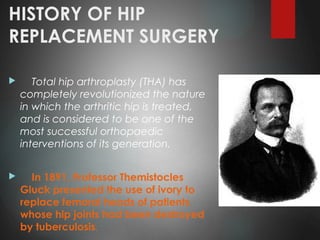
 In 1891, Professor Themistocles
Glück presented the use of ivory to
replace femoral heads of patients
whose hip joints had been destroyed
by tuberculosis.
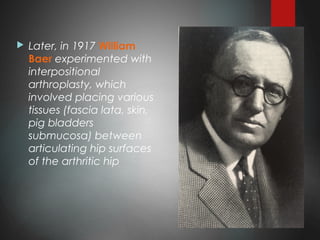
 Later, in 1917 William
Baer experimented with
interpositional
arthroplasty, which
involved placing various
tissues (fascia lata, skin,
pig bladders
submucosa) between
articulating hip surfaces
of the arthritic hip
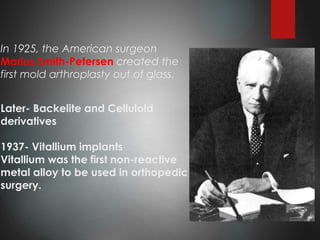
In 1925, the American surgeon
Marius Smith-Petersen created the
first mold arthroplasty out of glass.
Later- Backelite and Celluloid
derivatives
1937- Vitallium implants
Vitallium was the first non-reactive
metal alloy to be used in orthopedic
surgery.
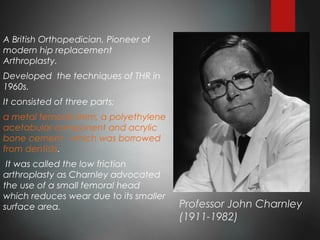
Professor John Charnley
(1911-1982)
A British Orthopedician, Pioneer of
modern hip replacement
Arthroplasty.
Developed the techniques of THR in
1960s.
It consisted of three parts;
a metal femoral stem, a polyethylene
acetabular component and acrylic
bone cement - which was borrowed
from dentists.
It was called the low friction
arthroplasty as Charnley advocated
the use of a small femoral head
which reduces wear due to its smaller
surface area.
TOTAL HIP
COMPONENTS AND
DESIGNS
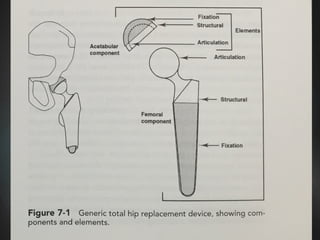
 The Primary design goal of restoration of
the geometry and bearing quality of the
hip joint leads to recognition that all THR
devices involves 2 primary components.
 Femoral and Acetabular.
 Each components has 3 elements.
Fixation System Design:
 Press Fitting: Direct hard tissue apposition.
Goal is to achieve and maintain local tissue stresses
within a range that causes neither atrophy or
necrosis.
 Cement: PMMA and its variant is used.
 Ingrowth
 Adhesion
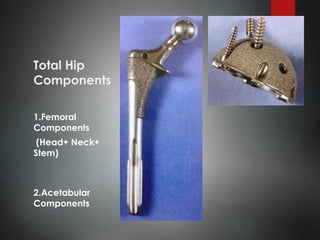
Total Hip
Components
1.Femoral
Components
(Head+ Neck+
Stem)
2.Acetabular
Components
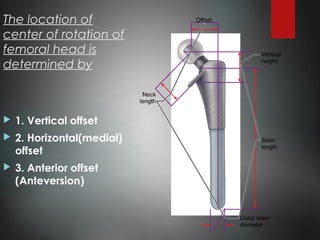
The location of
center of rotation of
femoral head is
determined by
 1. Vertical offset
 2. Horizontal(medial)
offset
 3. Anterior offset
(Anteversion)
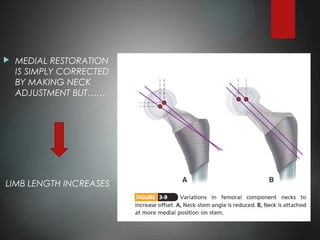
 MEDIAL RESTORATION
IS SIMPLY CORRECTED
BY MAKING NECK
ADJUSTMENT BUT……
LIMB LENGTH INCREASES
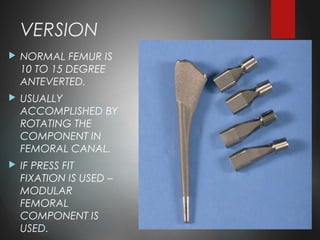
VERSION
 NORMAL FEMUR IS
10 TO 15 DEGREE
ANTEVERTED.
 USUALLY
ACCOMPLISHED BY
ROTATING THE
COMPONENT IN
FEMORAL CANAL.
 IF PRESS FIT
FIXATION IS USED –
MODULAR
FEMORAL
COMPONENT IS
USED.
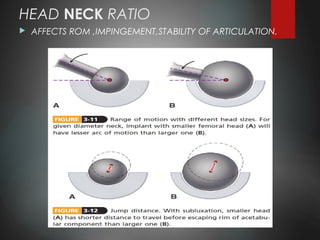
HEAD NECK RATIO
 AFFECTS ROM ,IMPINGEMENT,STABILITY OF ARTICULATION.
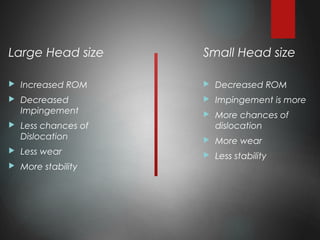
Large Head size
 Increased ROM
 Decreased
Impingement
 Less chances of
Dislocation
 Less wear
 More stability
Small Head size
 Decreased ROM
 Impingement is more
 More chances of
dislocation
 More wear
 Less stability
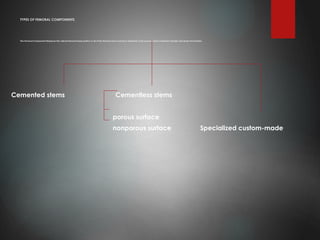
TYPES OF FEMORAL COMPONENTS
The Femoral Component Replaces the natural femoral head portion or all of the femoral neck and bony elements in the proximal femur between Greater and lesser trochanters.
Cemented stems Cementless stems
porous surface
nonporous surface Specialized custom-made
CEMENTED STEMS
 Most designers favour- cobalt chrome alloy
PMMA cement is the standard for
femoral component fixation
Disadvantages- Debonding,
Mechanical loosening, Extensive bone loss with
fragmented cement
 Earlier the original Charnley’s component was
about 13 cm long. But current stem design ranges
from 120-150mm.
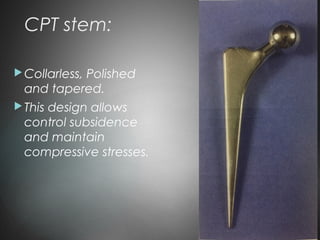
CPT stem:
Collarless, Polished
and tapered.
This design allows
control subsidence
and maintain
compressive stresses.
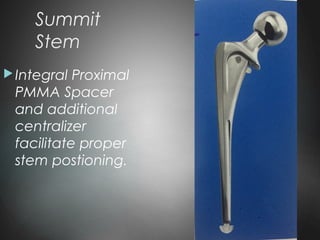
Summit
Stem
Integral Proximal
PMMA Spacer
and additional
centralizer
facilitate proper
stem postioning.
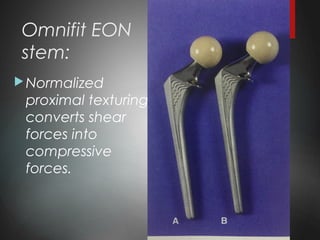
Omnifit EON
stem:
Normalized
proximal texturing
converts shear
forces into
compressive
forces.
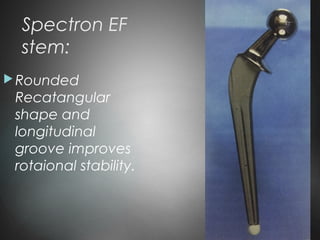
Spectron EF
stem:
Rounded
Recatangular
shape and
longitudinal
groove improves
rotaional stability.
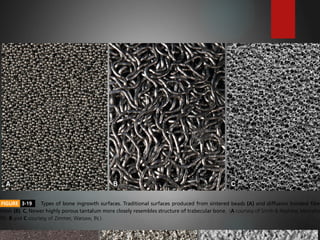
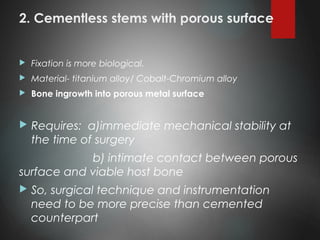
2. Cementless stems with porous surface
 Fixation is more biological.
 Material- titanium alloy/ Cobalt-Chromium alloy
 Bone ingrowth into porous metal surface
 Requires: a)immediate mechanical stability at
the time of surgery
b) intimate contact between porous
surface and viable host bone
 So, surgical technique and instrumentation
need to be more precise than cemented
counterpart
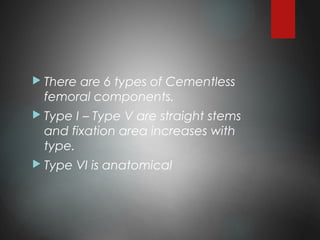
 There are 6 types of Cementless
femoral components.
 Type I – Type V are straight stems
and fixation area increases with
type.
 Type VI is anatomical
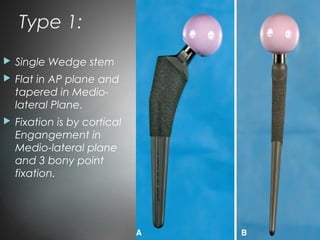
Type 1:
 Single Wedge stem
 Flat in AP plane and
tapered in Medio-
lateral Plane.
 Fixation is by cortical
Engangement in
Medio-lateral plane
and 3 bony point
fixation.
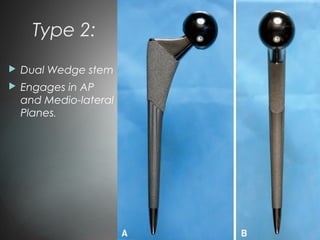
Type 2:
 Dual Wedge stem
 Engages in AP
and Medio-lateral
Planes.
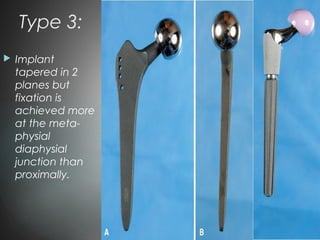
Type 3:
 Implant
tapered in 2
planes but
fixation is
achieved more
at the meta-
physial
diaphysial
junction than
proximally.
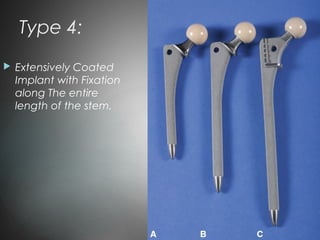
Type 4:
 Extensively Coated
Implant with Fixation
along The entire
length of the stem.
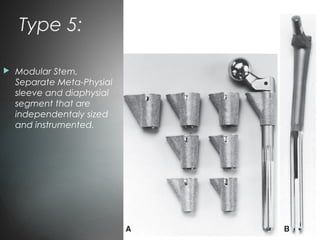
Type 5:
 Modular Stem,
Separate Meta-Physial
sleeve and diaphysial
segment that are
independentaly sized
and instrumented.
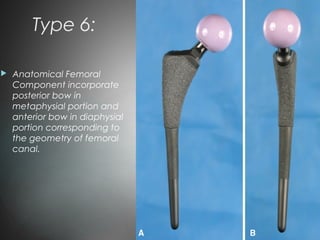
Type 6:
 Anatomical Femoral
Component incorporate
posterior bow in
metaphysial portion and
anterior bow in diaphysial
portion corresponding to
the geometry of femoral
canal.
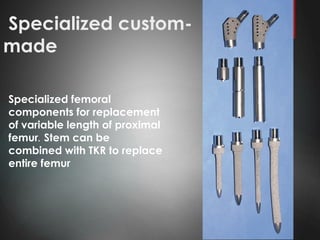
Specialized custom-
made
Specialized femoral
components for replacement
of variable length of proximal
femur. Stem can be
combined with TKR to replace
entire femur
ACETABULAR
COMPONENTS
Cemented
Cementless
Constrained type
Specialized custom made
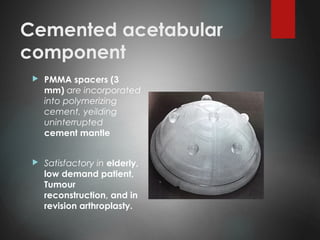
Cemented acetabular
component
 PMMA spacers (3
mm) are incorporated
into polymerizing
cement, yeilding
uninterrupted
cement mantle
 Satisfactory in elderly,
low demand patient,
Tumour
reconstruction, and in
revision arthroplasty.
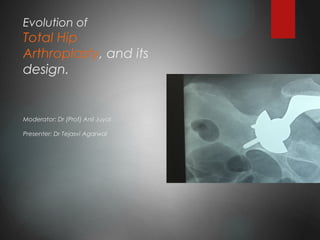
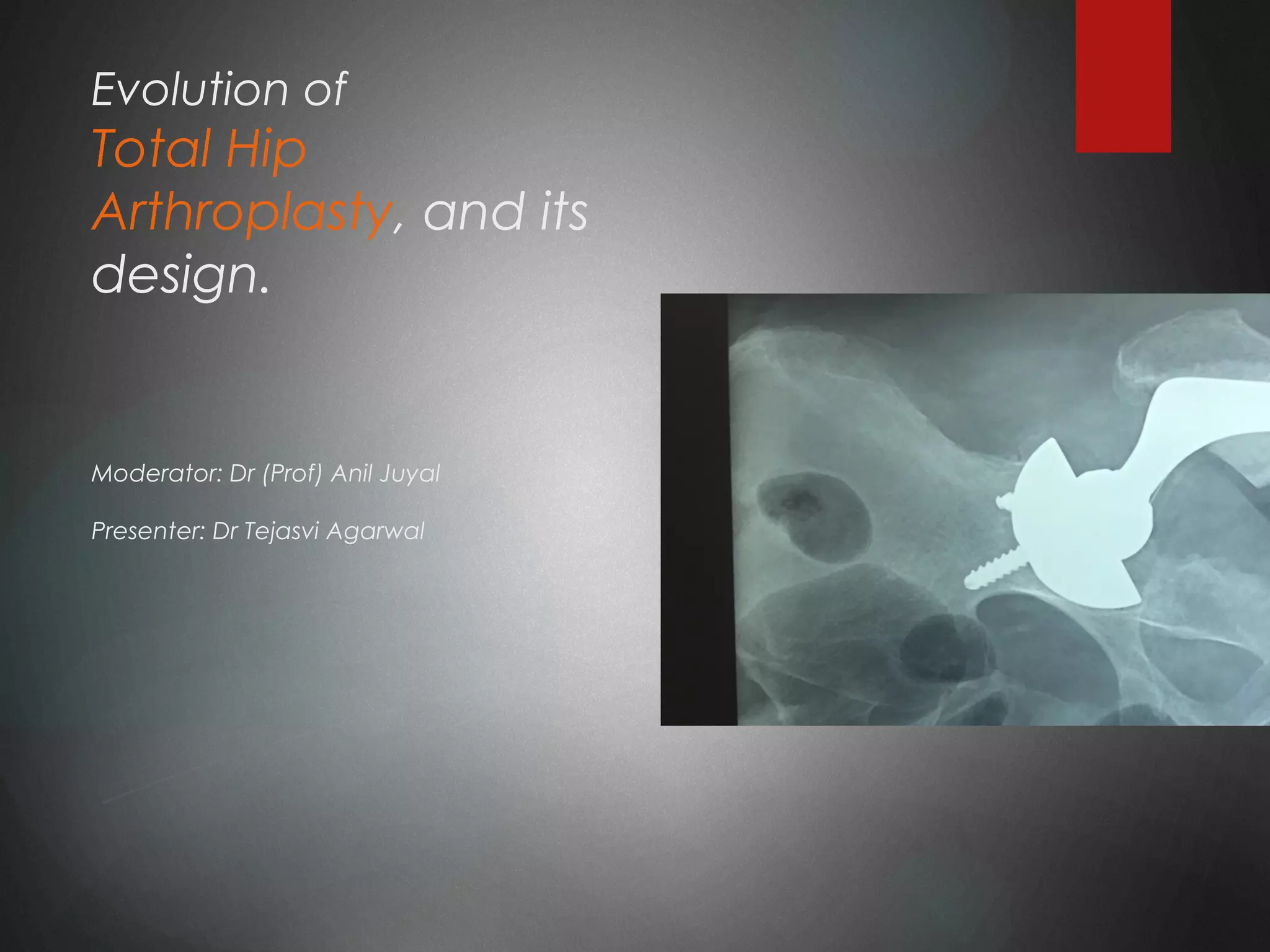
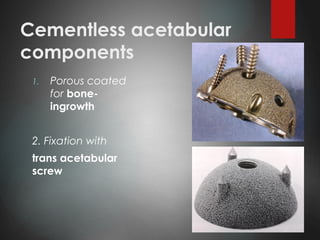
Cementless acetabular
components
1. Porous coated
for bone-
ingrowth
2. Fixation with
trans acetabular
screw
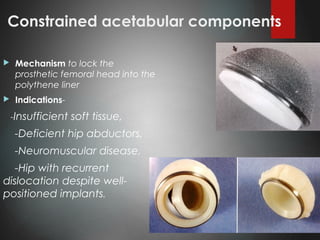
Constrained acetabular components
 Mechanism to lock the
prosthetic femoral head into the
polythene liner
 Indications-
-Insufficient soft tissue,
-Deficient hip abductors,
-Neuromuscular disease,
-Hip with recurrent
dislocation despite well-
positioned implants.
Alternative bearings(evolution)
Ivory Femoral Head
Baer’s Membrane
Mould Arthroplasty- Glass, Bakelite,
vitallium.
Metal on metal bearings
Highly cross linked polyethylene
Ceramic on ceramic bearings
Ideal bearing surface
1. Low coefficient of friction
2. Small volume of wear particle generation
3. Low tissue reaction to wear particles
4. High resistance to third body wear
5. Enough deformation of articular surfaces
to permit adequate fluid film lubrication
during the stance phase without
increasing wear
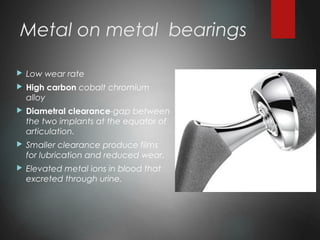
Metal on metal bearings
 Low wear rate
 High carbon cobalt chromium
alloy
 Diametral clearance-gap between
the two implants at the equator of
articulation.
 Smaller clearance produce films
for lubrication and reduced wear.
 Elevated metal ions in blood that
excreted through urine.
 So contraindicated in impending renal failure.
 Placental transfer occur of these metal ions.
 Delayed type hypersensitivity (aseptic
lymphocytic vasculitis associated lesions)
 Pseudotumour
 Recommendation for symptomatic patients is
measurement of blood cobalt and chromium ion
level and/MRI or USG.
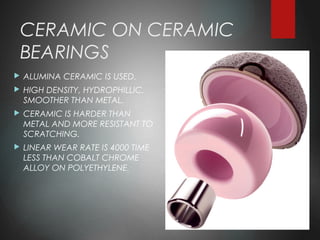
CERAMIC ON CERAMIC
BEARINGS
 ALUMINA CERAMIC IS USED.
 HIGH DENSITY, HYDROPHILLIC,
SMOOTHER THAN METAL.
 CERAMIC IS HARDER THAN
METAL AND MORE RESISTANT TO
SCRATCHING.
 LINEAR WEAR RATE IS 4000 TIME
LESS THAN COBALT CHROME
ALLOY ON POLYETHYLENE.
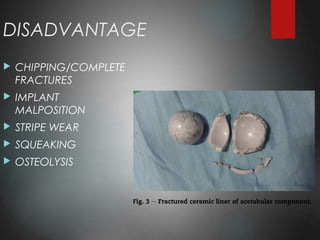
DISADVANTAGE
 CHIPPING/COMPLETE
FRACTURES
 IMPLANT
MALPOSITION
 STRIPE WEAR
 SQUEAKING
 OSTEOLYSIS
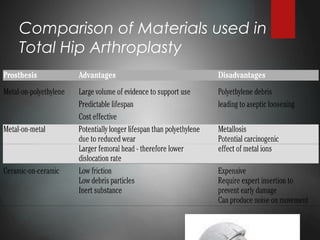
Comparison of Materials used in
Total Hip Arthroplasty
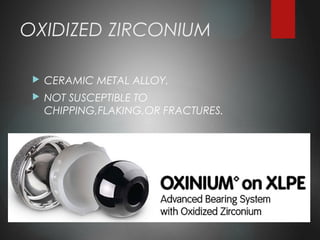
OXIDIZED ZIRCONIUM
 CERAMIC METAL ALLOY.
 NOT SUSCEPTIBLE TO
CHIPPING,FLAKING,OR FRACTURES.
Compliant bearings
 Cartilage is an example of a compliant bearing
that has a low modulus but is capable of large
deformation without failure.
 Polyurethanes are synthetic polymers having
properties comparable to those of articular
cartilage.
 Extensive laboratory and mechanical studies have
been underway over the last decade to
determine suitability of polyurethanes as a bearing
surface aimed at obtaining a bearing surface
couple in which the surfaces are separated by
pressure developed in joint fluid as well as by
deformation of articular surfaces.
Future Advances in THR
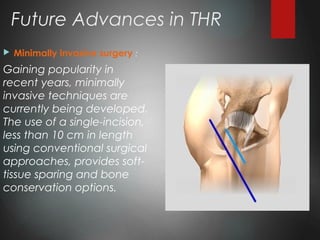
 Minimally invasive surgery :
Gaining popularity in
recent years, minimally
invasive techniques are
currently being developed.
The use of a single-incision,
less than 10 cm in length
using conventional surgical
approaches, provides soft-
tissue sparing and bone
conservation options.
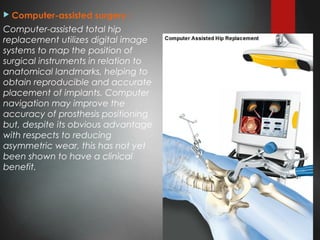
 Computer-assisted surgery :
Computer-assisted total hip
replacement utilizes digital image
systems to map the position of
surgical instruments in relation to
anatomical landmarks, helping to
obtain reproducible and accurate
placement of implants. Computer
navigation may improve the
accuracy of prosthesis positioning
but, despite its obvious advantage
with respects to reducing
asymmetric wear, this has not yet
been shown to have a clinical
benefit.
 Since the first total hip arthroplasty in 1891,
research has developed from perfecting
surgical technique to advances in technology
(with respects to both prosthesis design and
materials) in order to provide a reproducible
technique that provides a good range of
motion, stability and most importantly
adequate life span.
 As the average age of those receiving hip
Arthroplasty decreases, such considerations will
continue to be of great value to increase
implant longevity in highly active patients.
Thank You

Evolution of Total Hip Replacement

  • 1.
    Evolution of Total Hip Arthroplasty,and its design. Moderator: Dr (Prof) Anil Juyal Presenter: Dr Tejasvi Agarwal
  • 2.
     The OriginalIntent of Arthroplasty was to restore motion to an ankylosed joint.  Now this concept has been expanded to include the retoration as far as possible, of the integrity and functional power of the disease joint.
  • 3.
    Goal of THR Biomechanically sound,stable hip joint by restoration of normal center of rotation of femoral head
  • 4.
    HISTORY OF HIP REPLACEMENTSURGERY  Total hip arthroplasty (THA) has completely revolutionized the nature in which the arthritic hip is treated, and is considered to be one of the most successful orthopaedic interventions of its generation.  In 1891, Professor Themistocles Glück presented the use of ivory to replace femoral heads of patients whose hip joints had been destroyed by tuberculosis.
  • 5.
     Later, in1917 William Baer experimented with interpositional arthroplasty, which involved placing various tissues (fascia lata, skin, pig bladders submucosa) between articulating hip surfaces of the arthritic hip
  • 6.
    In 1925, theAmerican surgeon Marius Smith-Petersen created the first mold arthroplasty out of glass. Later- Backelite and Celluloid derivatives 1937- Vitallium implants Vitallium was the first non-reactive metal alloy to be used in orthopedic surgery.
  • 7.
    Professor John Charnley (1911-1982) ABritish Orthopedician, Pioneer of modern hip replacement Arthroplasty. Developed the techniques of THR in 1960s. It consisted of three parts; a metal femoral stem, a polyethylene acetabular component and acrylic bone cement - which was borrowed from dentists. It was called the low friction arthroplasty as Charnley advocated the use of a small femoral head which reduces wear due to its smaller surface area.
  • 8.
  • 9.
     The Primarydesign goal of restoration of the geometry and bearing quality of the hip joint leads to recognition that all THR devices involves 2 primary components.  Femoral and Acetabular.  Each components has 3 elements.
  • 11.
    Fixation System Design: Press Fitting: Direct hard tissue apposition. Goal is to achieve and maintain local tissue stresses within a range that causes neither atrophy or necrosis.  Cement: PMMA and its variant is used.  Ingrowth  Adhesion
  • 13.
  • 14.
    The location of centerof rotation of femoral head is determined by  1. Vertical offset  2. Horizontal(medial) offset  3. Anterior offset (Anteversion)
  • 15.
     MEDIAL RESTORATION ISSIMPLY CORRECTED BY MAKING NECK ADJUSTMENT BUT…… LIMB LENGTH INCREASES
  • 16.
    VERSION  NORMAL FEMURIS 10 TO 15 DEGREE ANTEVERTED.  USUALLY ACCOMPLISHED BY ROTATING THE COMPONENT IN FEMORAL CANAL.  IF PRESS FIT FIXATION IS USED – MODULAR FEMORAL COMPONENT IS USED.
  • 17.
    HEAD NECK RATIO AFFECTS ROM ,IMPINGEMENT,STABILITY OF ARTICULATION.
  • 18.
    Large Head size Increased ROM  Decreased Impingement  Less chances of Dislocation  Less wear  More stability Small Head size  Decreased ROM  Impingement is more  More chances of dislocation  More wear  Less stability
  • 19.
    TYPES OF FEMORALCOMPONENTS The Femoral Component Replaces the natural femoral head portion or all of the femoral neck and bony elements in the proximal femur between Greater and lesser trochanters. Cemented stems Cementless stems porous surface nonporous surface Specialized custom-made
  • 20.
    CEMENTED STEMS  Mostdesigners favour- cobalt chrome alloy PMMA cement is the standard for femoral component fixation Disadvantages- Debonding, Mechanical loosening, Extensive bone loss with fragmented cement  Earlier the original Charnley’s component was about 13 cm long. But current stem design ranges from 120-150mm.
  • 21.
    CPT stem: Collarless, Polished andtapered. This design allows control subsidence and maintain compressive stresses.
  • 22.
    Summit Stem Integral Proximal PMMA Spacer andadditional centralizer facilitate proper stem postioning.
  • 23.
  • 24.
  • 25.
    2. Cementless stemswith porous surface  Fixation is more biological.  Material- titanium alloy/ Cobalt-Chromium alloy  Bone ingrowth into porous metal surface  Requires: a)immediate mechanical stability at the time of surgery b) intimate contact between porous surface and viable host bone  So, surgical technique and instrumentation need to be more precise than cemented counterpart
  • 26.
     There are6 types of Cementless femoral components.  Type I – Type V are straight stems and fixation area increases with type.  Type VI is anatomical
  • 27.
    Type 1:  SingleWedge stem  Flat in AP plane and tapered in Medio- lateral Plane.  Fixation is by cortical Engangement in Medio-lateral plane and 3 bony point fixation.
  • 28.
    Type 2:  DualWedge stem  Engages in AP and Medio-lateral Planes.
  • 29.
    Type 3:  Implant taperedin 2 planes but fixation is achieved more at the meta- physial diaphysial junction than proximally.
  • 30.
    Type 4:  ExtensivelyCoated Implant with Fixation along The entire length of the stem.
  • 31.
    Type 5:  ModularStem, Separate Meta-Physial sleeve and diaphysial segment that are independentaly sized and instrumented.
  • 32.
    Type 6:  AnatomicalFemoral Component incorporate posterior bow in metaphysial portion and anterior bow in diaphysial portion corresponding to the geometry of femoral canal.
  • 33.
    Specialized custom- made Specialized femoral componentsfor replacement of variable length of proximal femur. Stem can be combined with TKR to replace entire femur
  • 34.
  • 35.
    Cemented acetabular component  PMMAspacers (3 mm) are incorporated into polymerizing cement, yeilding uninterrupted cement mantle  Satisfactory in elderly, low demand patient, Tumour reconstruction, and in revision arthroplasty.
  • 36.
    Cementless acetabular components 1. Porouscoated for bone- ingrowth 2. Fixation with trans acetabular screw
  • 37.
    Constrained acetabular components Mechanism to lock the prosthetic femoral head into the polythene liner  Indications- -Insufficient soft tissue, -Deficient hip abductors, -Neuromuscular disease, -Hip with recurrent dislocation despite well- positioned implants.
  • 38.
    Alternative bearings(evolution) Ivory FemoralHead Baer’s Membrane Mould Arthroplasty- Glass, Bakelite, vitallium. Metal on metal bearings Highly cross linked polyethylene Ceramic on ceramic bearings
  • 39.
    Ideal bearing surface 1.Low coefficient of friction 2. Small volume of wear particle generation 3. Low tissue reaction to wear particles 4. High resistance to third body wear 5. Enough deformation of articular surfaces to permit adequate fluid film lubrication during the stance phase without increasing wear
  • 40.
    Metal on metalbearings  Low wear rate  High carbon cobalt chromium alloy  Diametral clearance-gap between the two implants at the equator of articulation.  Smaller clearance produce films for lubrication and reduced wear.  Elevated metal ions in blood that excreted through urine.
  • 41.
     So contraindicatedin impending renal failure.  Placental transfer occur of these metal ions.  Delayed type hypersensitivity (aseptic lymphocytic vasculitis associated lesions)  Pseudotumour  Recommendation for symptomatic patients is measurement of blood cobalt and chromium ion level and/MRI or USG.
  • 42.
    CERAMIC ON CERAMIC BEARINGS ALUMINA CERAMIC IS USED.  HIGH DENSITY, HYDROPHILLIC, SMOOTHER THAN METAL.  CERAMIC IS HARDER THAN METAL AND MORE RESISTANT TO SCRATCHING.  LINEAR WEAR RATE IS 4000 TIME LESS THAN COBALT CHROME ALLOY ON POLYETHYLENE.
  • 43.
  • 44.
    Comparison of Materialsused in Total Hip Arthroplasty
  • 45.
    OXIDIZED ZIRCONIUM  CERAMICMETAL ALLOY.  NOT SUSCEPTIBLE TO CHIPPING,FLAKING,OR FRACTURES.
  • 46.
    Compliant bearings  Cartilageis an example of a compliant bearing that has a low modulus but is capable of large deformation without failure.  Polyurethanes are synthetic polymers having properties comparable to those of articular cartilage.  Extensive laboratory and mechanical studies have been underway over the last decade to determine suitability of polyurethanes as a bearing surface aimed at obtaining a bearing surface couple in which the surfaces are separated by pressure developed in joint fluid as well as by deformation of articular surfaces.
  • 47.
    Future Advances inTHR  Minimally invasive surgery : Gaining popularity in recent years, minimally invasive techniques are currently being developed. The use of a single-incision, less than 10 cm in length using conventional surgical approaches, provides soft- tissue sparing and bone conservation options.
  • 48.
     Computer-assisted surgery: Computer-assisted total hip replacement utilizes digital image systems to map the position of surgical instruments in relation to anatomical landmarks, helping to obtain reproducible and accurate placement of implants. Computer navigation may improve the accuracy of prosthesis positioning but, despite its obvious advantage with respects to reducing asymmetric wear, this has not yet been shown to have a clinical benefit.
  • 49.
     Since thefirst total hip arthroplasty in 1891, research has developed from perfecting surgical technique to advances in technology (with respects to both prosthesis design and materials) in order to provide a reproducible technique that provides a good range of motion, stability and most importantly adequate life span.  As the average age of those receiving hip Arthroplasty decreases, such considerations will continue to be of great value to increase implant longevity in highly active patients.
  • 50.

Editor's Notes

  • #11 Femoral: An element to restore articulating surface property and the geometry of femoral head (Articulation element). An Element to anchor the restored surface of proximal femur (Fixation element). An Element to couple the articulation element and the fixation element and to maintain an appropriate structural relationship between them (Structural element). Acetabular: An element to restore the articulating surface property and geometry of acetabular socket( Articulation element). An element to anchor the restore surface to the peri-acetabular pelvis (Fixation element) An Element to couple the articulation element and the fixation element and to maintain an appropriate structural relationship between them (Structural element). <number>
  • #19 <number>
  • #42 A pseudotumor is a non-cancerous soft tissue growth that occurs when metal particles from a metal-on-metal hip implant irritate tissue in the hip. Pseudotumors do not always cause problems, but when they do, severe pain and inflammation in the hip often requires a revision surgery to correct. Metal-on-metal pseudotumours are large focal solid or semiliquid masses around the hip (or knee) prostheses. The pseudotumours mimic local effects of neoplasia or infection in the absence of either of these. The principal symptom is pain. There may be restricted range of movement with large pseudotumours. <number>