OUTCOME OF DISTAL END
TIBIA FRACTURES MANAGED
BY MINIMALLY INVASIVE
PLATE OSTEOSYNTHESIS
TECHNIQUE
Dr sagar tomar
Llrm medical college ,meerut ,up
INTRODUCTION
 Earlier, the treatment of distal tibia was done using
intramedullary osteosynthesis but it does not
provide a stable rigid fixation.
 open reduction and internal fixation was attempted
with classical plates, but it requires a quite larger
incision causing larger periosteal damage.
 This Traditional ORIF results in extensive
soft tissue dissection and periosteal injury and are
associated with high rates of infection, delayed
union, and non‐union.
 Because of these drawbacks, research and
development leads to the invention of new plates
called “BIOLOGICAL PLATE” and new surgical
procedures ,one of which is “MINIMALLY
INVASIVE PLATE OSTEOSYNTHESIS”
MIPO technique
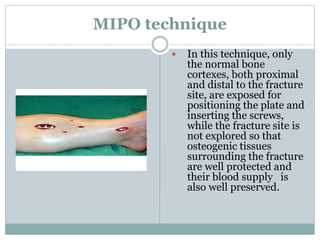
 In this technique, only
the normal bone
cortexes, both proximal
and distal to the fracture
site, are exposed for
positioning the plate and
inserting the screws,
while the fracture site is
not explored so that
osteogenic tissues
surrounding the fracture
are well protected and
their blood supply is
also well preserved.
biomechanics
 Mipo relies on relative stability rather than absolute
rigid fixation because of which micromotion is
produced at the fracture site and a larger and rapid
callus formation occurs leading to rapid bone
healing.
 Relative stability does not require accurate
apposition of fragments as the # gap are filled up by
bridging callus .
Indication of mipo in distal tibial #
intraarticular or periarticular fractures which
are considered unsuitable for intramedullary nailing.
They include
 Communited fractures
 low-grade open fractures of the distal tibia
 displaced pilon fractures with sufficient medial soft-
tissue coverage to allow articular reconstruction and
percutaneous plating
 unstable distal metaphyseal and diaphyseal fractures.
Contra-indication
 MIPO is contraindicated in situations where the
medial soft tissue is compromised, such as in severe
open fractures or badly contused skin.
 If the bone is osteoporotic or comminution is so
excessive that surgery cannot restore or stabilize the
joint, then other methods of treatment must be
sought such as external fixator.
 In severely shattered pilon fractures when only
choice is external fixator.
Advantage of mipo
 minimizes risk of soft tissue damage
 preserve vascular supply to bone and soft tissue
 decrease periosteum damage
 have better and faster callus formation
 have better healing and union rate
 decrease complication of infection and re-fracture
 decrease the use of supplementary bone grafting
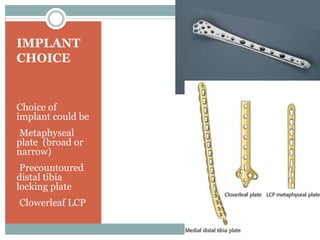
IMPLANT
CHOICE
Choice of
implant could be
•Metaphyseal
plate (broad or
narrow)
•Precountoured
distal tibia
locking plate
•Clowerleaf LCP
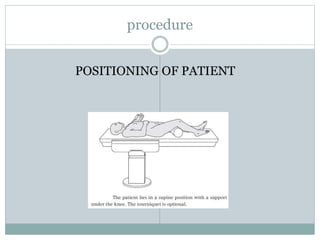
procedure
POSITIONING OF PATIENT
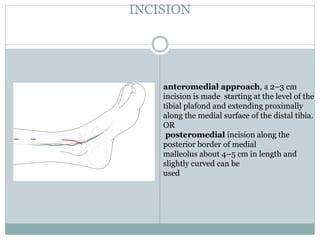
INCISION
anteromedial approach, a 2–3 cm
incision is made starting at the level of the
tibial plafond and extending proximally
along the medial surface of the distal tibia.
OR
posteromedial incision along the
posterior border of medial
malleolus about 4–5 cm in length and
slightly curved can be
used
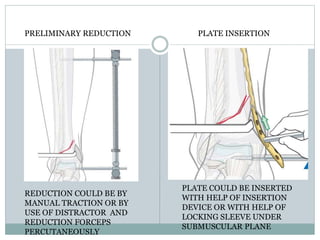
PRELIMINARY REDUCTION
REDUCTION COULD BE BY
MANUAL TRACTION OR BY
USE OF DISTRACTOR AND
REDUCTION FORCEPS
PERCUTANEOUSLY
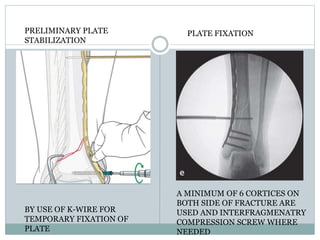
PLATE INSERTION
PLATE COULD BE INSERTED
WITH HELP OF INSERTION
DEVICE OR WITH HELP OF
LOCKING SLEEVE UNDER
SUBMUSCULAR PLANE
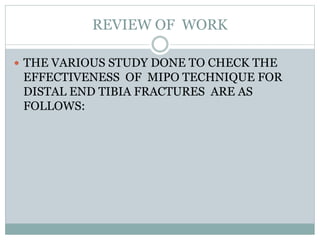
PRELIMINARY PLATE
STABILIZATION
BY USE OF K-WIRE FOR
TEMPORARY FIXATION OF
PLATE
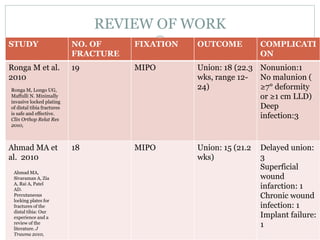
PLATE FIXATION
A MINIMUM OF 6 CORTICES ON
BOTH SIDE OF FRACTURE ARE
USED AND INTERFRAGMENATRY
COMPRESSION SCREW WHERE
NEEDED
REVIEW OF WORK
 THE VARIOUS STUDY DONE TO CHECK THE
EFFECTIVENESS OF MIPO TECHNIQUE FOR
DISTAL END TIBIA FRACTURES ARE AS
FOLLOWS:
REVIEW OF WORK
STUDY NO. OF
FRACTURE
FIXATION OUTCOME COMPLICATI
ON
Ronga M et al.
2010
19 MIPO Union: 18 (22.3
wks, range 12-
24)
Nonunion:1
No malunion (
≥7° deformity
or ≥1 cm LLD)
Deep
infection:3
Ahmad MA et
al. 2010
18 MIPO Union: 15 (21.2
wks)
Delayed union:
3
Superficial
wound
infarction: 1
Chronic wound
infection: 1
Implant failure:
1
Ronga M, Longo UG,
Maffulli N. Minimally
invasive locked plating
of distal tibia fractures
is safe and effective.
Clin Orthop Relat Res
2010,
Ahmad MA,
Sivaraman A, Zia
A, Rai A, Patel
AD.
Percutaneous
locking plates for
fractures of the
distal tibia: Our
experience and a
review of the
literature. J
Trauma 2010,
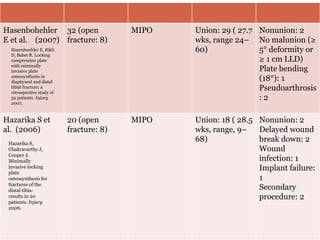
Hasenbohehler
E et al. (2007)
32 (open
fracture: 8)
MIPO Union: 29 ( 27.7
wks, range 24–
60)
Nonunion: 2
No malunion (≥
5° deformity or
≥ 1 cm LLD)
Plate bending
(18°): 1
Pseudoarthrosis
: 2
Hazarika S et
al. (2006)
20 (open
fracture: 8)
MIPO Union: 18 ( 28.5
wks, range, 9–
68)
Nonunion: 2
Delayed wound
break down: 2
Wound
infection: 1
Implant failure:
1
Secondary
procedure: 2
Hasenboehler E, Rikli
D, Babst R. Locking
compression plate
with minimally
invasive plate
osteosynthesis in
diaphyseal and distal
tibial fracture: a
retrospective study of
32 patients. Injury
2007,
Hazarika S,
Chakravarthy J,
Cooper J.
Minimally
invasive locking
plate
osteosynthesis for
fractures of the
distal tibia-
results in 20
patients. Injury
2006,
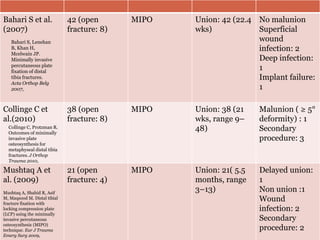
Bahari S et al.
(2007)
42 (open
fracture: 8)
MIPO Union: 42 (22.4
wks)
No malunion
Superficial
wound
infection: 2
Deep infection:
1
Implant failure:
1
Collinge C et
al.(2010)
38 (open
fracture: 8)
MIPO Union: 38 (21
wks, range 9–
48)
Malunion ( ≥ 5°
deformity) : 1
Secondary
procedure: 3
Mushtaq A et
al. (2009)
21 (open
fracture: 4)
MIPO Union: 21( 5.5
months, range
3–13)
Delayed union:
1
Non union :1
Wound
infection: 2
Secondary
procedure: 2
Bahari S, Lenehan
B, Khan H,
Mcelwain JP.
Minimally invasive
percutaneous plate
fixation of distal
tibia fractures.
Acta Orthop Belg
2007,
Collinge C, Protzman R.
Outcomes of minimally
invasive plate
osteosynthesis for
metaphyseal distal tibia
fractures. J Orthop
Trauma 2010,
Mushtaq A, Shahid R, Asif
M, Maqsood M. Distal tibial
fracture fixation with
locking compression plate
(LCP) using the minimally
invasive percutaneous
osteosynthesis (MIPO)
technique. Eur J Trauma
Emerg Surg 2009,
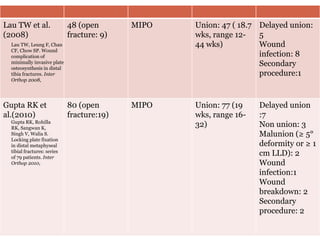
Lau TW et al.
(2008)
48 (open
fracture: 9)
MIPO Union: 47 ( 18.7
wks, range 12-
44 wks)
Delayed union:
5
Wound
infection: 8
Secondary
procedure:1
Gupta RK et
al.(2010)
80 (open
fracture:19)
MIPO Union: 77 (19
wks, range 16-
32)
Delayed union
:7
Non union: 3
Malunion (≥ 5°
deformity or ≥ 1
cm LLD): 2
Wound
infection:1
Wound
breakdown: 2
Secondary
procedure: 2
Lau TW, Leung F, Chan
CF, Chow SP. Wound
complication of
minimally invasive plate
osteosynthesis in distal
tibia fractures. Inter
Orthop 2008,
Gupta RK, Rohilla
RK, Sangwan K,
Singh V, Walia S.
Locking plate fixation
in distal metaphyseal
tibial fractures: series
of 79 patients. Inter
Orthop 2010,
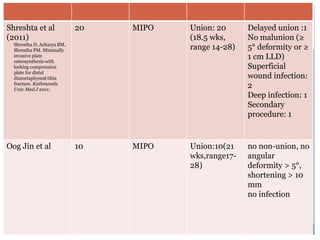
Shreshta et al
(2011)
20 MIPO Union: 20
(18.5 wks,
range 14-28)
Delayed union :1
No malunion (≥
5° deformity or ≥
1 cm LLD)
Superficial
wound infection:
2
Deep infection: 1
Secondary
procedure: 1
Oog Jin et al 10 MIPO Union:10(21
wks,range17-
28)
no non-union, no
angular
deformity > 5°,
shortening > 10
mm
no infection
Shrestha D, Acharya BM,
Shrestha PM. Minimally
invasive plate
osteosynthesis with
locking compression
plate for distal
diametaphyseal tibia
fracture. Kathmandu
Univ Med J 2011;
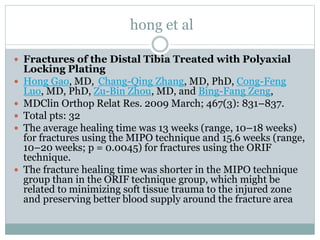
hong et al
 Fractures of the Distal Tibia Treated with Polyaxial
Locking Plating
 Hong Gao, MD, Chang-Qing Zhang, MD, PhD, Cong-Feng
Luo, MD, PhD, Zu-Bin Zhou, MD, and Bing-Fang Zeng,
 MDClin Orthop Relat Res. 2009 March; 467(3): 831–837.
 Total pts: 32
 The average healing time was 13 weeks (range, 10–18 weeks)
for fractures using the MIPO technique and 15.6 weeks (range,
10–20 weeks; p = 0.0045) for fractures using the ORIF
technique.
 The fracture healing time was shorter in the MIPO technique
group than in the ORIF technique group, which might be
related to minimizing soft tissue trauma to the injured zone
and preserving better blood supply around the fracture area
ADVANTAGE OF
MIPPO OVER
ORIF
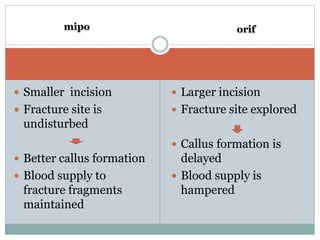
mipo orif
 Smaller incision
 Fracture site is
undisturbed
 Better callus formation
 Blood supply to
fracture fragments
maintained
 Larger incision
 Fracture site explored
 Callus formation is
delayed
 Blood supply is
hampered
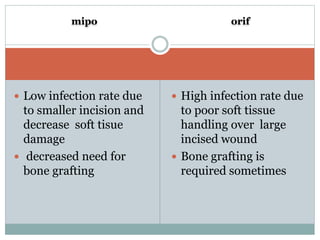
mipo orif
 Low infection rate due
to smaller incision and
decrease soft tisue
damage
 decreased need for
bone grafting
 High infection rate due
to poor soft tissue
handling over large
incised wound
 Bone grafting is
required sometimes
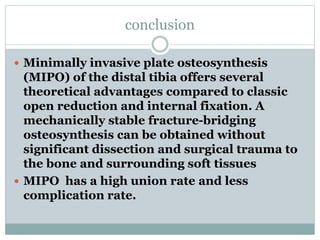
conclusion
 Minimally invasive plate osteosynthesis
(MIPO) of the distal tibia offers several
theoretical advantages compared to classic
open reduction and internal fixation. A
mechanically stable fracture-bridging
osteosynthesis can be obtained without
significant dissection and surgical trauma to
the bone and surrounding soft tissues
 MIPO has a high union rate and less
complication rate.
Thank you

minimally invasive percutaneous plate osteosynthesis

  • 1.
    OUTCOME OF DISTALEND TIBIA FRACTURES MANAGED BY MINIMALLY INVASIVE PLATE OSTEOSYNTHESIS TECHNIQUE Dr sagar tomar Llrm medical college ,meerut ,up
  • 2.
    INTRODUCTION  Earlier, thetreatment of distal tibia was done using intramedullary osteosynthesis but it does not provide a stable rigid fixation.  open reduction and internal fixation was attempted with classical plates, but it requires a quite larger incision causing larger periosteal damage.  This Traditional ORIF results in extensive soft tissue dissection and periosteal injury and are associated with high rates of infection, delayed union, and non‐union.
  • 3.
     Because ofthese drawbacks, research and development leads to the invention of new plates called “BIOLOGICAL PLATE” and new surgical procedures ,one of which is “MINIMALLY INVASIVE PLATE OSTEOSYNTHESIS”
  • 4.
    MIPO technique  Inthis technique, only the normal bone cortexes, both proximal and distal to the fracture site, are exposed for positioning the plate and inserting the screws, while the fracture site is not explored so that osteogenic tissues surrounding the fracture are well protected and their blood supply is also well preserved.
  • 5.
    biomechanics  Mipo relieson relative stability rather than absolute rigid fixation because of which micromotion is produced at the fracture site and a larger and rapid callus formation occurs leading to rapid bone healing.  Relative stability does not require accurate apposition of fragments as the # gap are filled up by bridging callus .
  • 6.
    Indication of mipoin distal tibial # intraarticular or periarticular fractures which are considered unsuitable for intramedullary nailing. They include  Communited fractures  low-grade open fractures of the distal tibia  displaced pilon fractures with sufficient medial soft- tissue coverage to allow articular reconstruction and percutaneous plating  unstable distal metaphyseal and diaphyseal fractures.
  • 7.
    Contra-indication  MIPO iscontraindicated in situations where the medial soft tissue is compromised, such as in severe open fractures or badly contused skin.  If the bone is osteoporotic or comminution is so excessive that surgery cannot restore or stabilize the joint, then other methods of treatment must be sought such as external fixator.  In severely shattered pilon fractures when only choice is external fixator.
  • 8.
    Advantage of mipo minimizes risk of soft tissue damage  preserve vascular supply to bone and soft tissue  decrease periosteum damage  have better and faster callus formation  have better healing and union rate  decrease complication of infection and re-fracture  decrease the use of supplementary bone grafting
  • 9.
    IMPLANT CHOICE Choice of implant couldbe •Metaphyseal plate (broad or narrow) •Precountoured distal tibia locking plate •Clowerleaf LCP
  • 10.
  • 11.
    INCISION anteromedial approach, a2–3 cm incision is made starting at the level of the tibial plafond and extending proximally along the medial surface of the distal tibia. OR posteromedial incision along the posterior border of medial malleolus about 4–5 cm in length and slightly curved can be used
  • 12.
    PRELIMINARY REDUCTION REDUCTION COULDBE BY MANUAL TRACTION OR BY USE OF DISTRACTOR AND REDUCTION FORCEPS PERCUTANEOUSLY PLATE INSERTION PLATE COULD BE INSERTED WITH HELP OF INSERTION DEVICE OR WITH HELP OF LOCKING SLEEVE UNDER SUBMUSCULAR PLANE
  • 13.
    PRELIMINARY PLATE STABILIZATION BY USEOF K-WIRE FOR TEMPORARY FIXATION OF PLATE PLATE FIXATION A MINIMUM OF 6 CORTICES ON BOTH SIDE OF FRACTURE ARE USED AND INTERFRAGMENATRY COMPRESSION SCREW WHERE NEEDED
  • 14.
    REVIEW OF WORK THE VARIOUS STUDY DONE TO CHECK THE EFFECTIVENESS OF MIPO TECHNIQUE FOR DISTAL END TIBIA FRACTURES ARE AS FOLLOWS:
  • 15.
    REVIEW OF WORK STUDYNO. OF FRACTURE FIXATION OUTCOME COMPLICATI ON Ronga M et al. 2010 19 MIPO Union: 18 (22.3 wks, range 12- 24) Nonunion:1 No malunion ( ≥7° deformity or ≥1 cm LLD) Deep infection:3 Ahmad MA et al. 2010 18 MIPO Union: 15 (21.2 wks) Delayed union: 3 Superficial wound infarction: 1 Chronic wound infection: 1 Implant failure: 1 Ronga M, Longo UG, Maffulli N. Minimally invasive locked plating of distal tibia fractures is safe and effective. Clin Orthop Relat Res 2010, Ahmad MA, Sivaraman A, Zia A, Rai A, Patel AD. Percutaneous locking plates for fractures of the distal tibia: Our experience and a review of the literature. J Trauma 2010,
  • 16.
    Hasenbohehler E et al.(2007) 32 (open fracture: 8) MIPO Union: 29 ( 27.7 wks, range 24– 60) Nonunion: 2 No malunion (≥ 5° deformity or ≥ 1 cm LLD) Plate bending (18°): 1 Pseudoarthrosis : 2 Hazarika S et al. (2006) 20 (open fracture: 8) MIPO Union: 18 ( 28.5 wks, range, 9– 68) Nonunion: 2 Delayed wound break down: 2 Wound infection: 1 Implant failure: 1 Secondary procedure: 2 Hasenboehler E, Rikli D, Babst R. Locking compression plate with minimally invasive plate osteosynthesis in diaphyseal and distal tibial fracture: a retrospective study of 32 patients. Injury 2007, Hazarika S, Chakravarthy J, Cooper J. Minimally invasive locking plate osteosynthesis for fractures of the distal tibia- results in 20 patients. Injury 2006,
  • 17.
    Bahari S etal. (2007) 42 (open fracture: 8) MIPO Union: 42 (22.4 wks) No malunion Superficial wound infection: 2 Deep infection: 1 Implant failure: 1 Collinge C et al.(2010) 38 (open fracture: 8) MIPO Union: 38 (21 wks, range 9– 48) Malunion ( ≥ 5° deformity) : 1 Secondary procedure: 3 Mushtaq A et al. (2009) 21 (open fracture: 4) MIPO Union: 21( 5.5 months, range 3–13) Delayed union: 1 Non union :1 Wound infection: 2 Secondary procedure: 2 Bahari S, Lenehan B, Khan H, Mcelwain JP. Minimally invasive percutaneous plate fixation of distal tibia fractures. Acta Orthop Belg 2007, Collinge C, Protzman R. Outcomes of minimally invasive plate osteosynthesis for metaphyseal distal tibia fractures. J Orthop Trauma 2010, Mushtaq A, Shahid R, Asif M, Maqsood M. Distal tibial fracture fixation with locking compression plate (LCP) using the minimally invasive percutaneous osteosynthesis (MIPO) technique. Eur J Trauma Emerg Surg 2009,
  • 18.
    Lau TW etal. (2008) 48 (open fracture: 9) MIPO Union: 47 ( 18.7 wks, range 12- 44 wks) Delayed union: 5 Wound infection: 8 Secondary procedure:1 Gupta RK et al.(2010) 80 (open fracture:19) MIPO Union: 77 (19 wks, range 16- 32) Delayed union :7 Non union: 3 Malunion (≥ 5° deformity or ≥ 1 cm LLD): 2 Wound infection:1 Wound breakdown: 2 Secondary procedure: 2 Lau TW, Leung F, Chan CF, Chow SP. Wound complication of minimally invasive plate osteosynthesis in distal tibia fractures. Inter Orthop 2008, Gupta RK, Rohilla RK, Sangwan K, Singh V, Walia S. Locking plate fixation in distal metaphyseal tibial fractures: series of 79 patients. Inter Orthop 2010,
  • 19.
    Shreshta et al (2011) 20MIPO Union: 20 (18.5 wks, range 14-28) Delayed union :1 No malunion (≥ 5° deformity or ≥ 1 cm LLD) Superficial wound infection: 2 Deep infection: 1 Secondary procedure: 1 Oog Jin et al 10 MIPO Union:10(21 wks,range17- 28) no non-union, no angular deformity > 5°, shortening > 10 mm no infection Shrestha D, Acharya BM, Shrestha PM. Minimally invasive plate osteosynthesis with locking compression plate for distal diametaphyseal tibia fracture. Kathmandu Univ Med J 2011;
  • 20.
    hong et al Fractures of the Distal Tibia Treated with Polyaxial Locking Plating  Hong Gao, MD, Chang-Qing Zhang, MD, PhD, Cong-Feng Luo, MD, PhD, Zu-Bin Zhou, MD, and Bing-Fang Zeng,  MDClin Orthop Relat Res. 2009 March; 467(3): 831–837.  Total pts: 32  The average healing time was 13 weeks (range, 10–18 weeks) for fractures using the MIPO technique and 15.6 weeks (range, 10–20 weeks; p = 0.0045) for fractures using the ORIF technique.  The fracture healing time was shorter in the MIPO technique group than in the ORIF technique group, which might be related to minimizing soft tissue trauma to the injured zone and preserving better blood supply around the fracture area
  • 21.
  • 22.
    mipo orif  Smallerincision  Fracture site is undisturbed  Better callus formation  Blood supply to fracture fragments maintained  Larger incision  Fracture site explored  Callus formation is delayed  Blood supply is hampered
  • 23.
    mipo orif  Lowinfection rate due to smaller incision and decrease soft tisue damage  decreased need for bone grafting  High infection rate due to poor soft tissue handling over large incised wound  Bone grafting is required sometimes
  • 24.
    conclusion  Minimally invasiveplate osteosynthesis (MIPO) of the distal tibia offers several theoretical advantages compared to classic open reduction and internal fixation. A mechanically stable fracture-bridging osteosynthesis can be obtained without significant dissection and surgical trauma to the bone and surrounding soft tissues  MIPO has a high union rate and less complication rate.
  • 25.