AOTrauma Principles Course
Closed tibial shaft fractures
Piet de Boer, UK
John Wilber, US
Closed tibial shaft fractures
• Assessment of the injury
• Nonoperative/operative options
• Choice of implants (their advantages and disadvantages)
• Importance of the closed soft-tissue injury
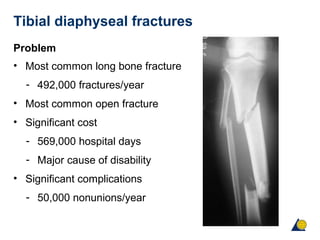
Tibial diaphyseal fractures
Problem
• Most common long bone fracture
- 492,000 fractures/year
• Most common open fracture
• Significant cost
- 569,000 hospital days
- Major cause of disability
• Significant complications
- 50,000 nonunions/year
Assessment of tibial diaphyseal fractures
Classification
• Fracture
• Soft Tissue
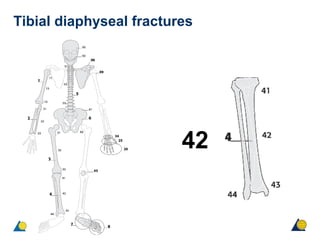
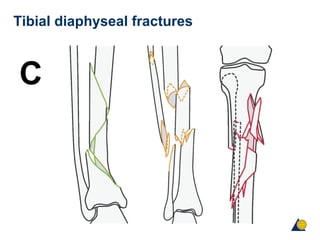
Tibial diaphyseal fractures
42
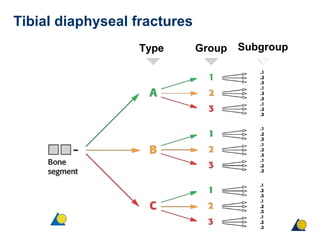
Tibial diaphyseal fractures
Type Group Subgroup
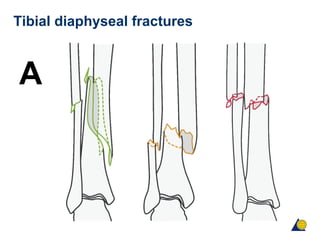
Tibial diaphyseal fractures
A
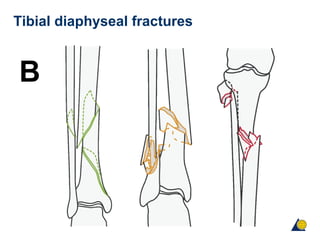
Tibial diaphyseal fractures
B
Tibial diaphyseal fractures
C
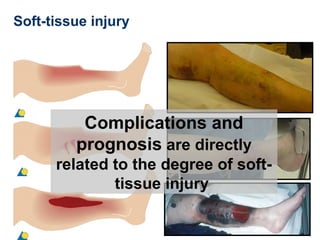
Soft-tissue injury
Complications and
prognosis are directly
related to the degree of soft-
tissue injury
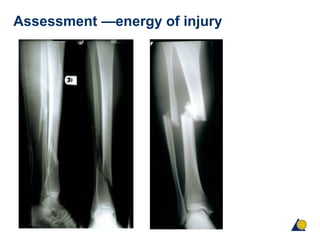
Assessment—energy of injury
• Accumulative biologic injury
• Pre-existing condition
• Injury
• Treatment
Threshold for Complication
Assessment —energy of injury
Assessment
• History: velocity of injury
• Clinical examination
• General ATLS (advanced trauma life support)
• Local soft tissues
• Neurovascular
Assessment
• X-rays: A/P and lateral
• Special investigations:
- Pressure monitoring
- Angiography
- CT (computed tomography, never immediate)
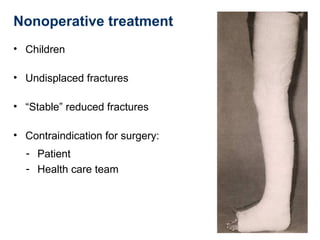
Nonoperative treatment
• Nonoperative treatment does NOT mean no treatment
• Closed reduction and plaster of Paris application achieve
good results
• Nonoperative treatment is difficult and demanding
Nonoperative treatment
• Plaster can prevent lateral shift
• Plaster can prevent angulation
• Plaster can control rotation
• Plaster can NOT prevent shortening
“A fracture in plaster of Paris will not displace
more than its previous maximal
displacement”
Sarmiento,York 1998
Nonoperative treatment
• Children
• Undisplaced fractures
• “Stable” reduced fractures
• Contraindication for surgery:
- Patient
- Health care team
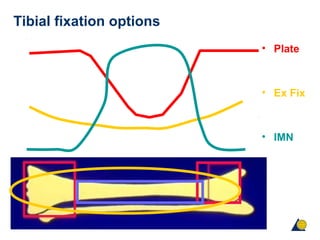
Tibial fixation options
• Plate
• Ex Fix
• IMN
Operative treatment—nailing
• Destroys endosteal circulation
• Indirect reduction which preserves soft-tissue
attachments
• Allows movement at fracture site which results in early
union with callus formation
• Anatomical reduction rare but restoration of length, axis,
and rotation is usual
Nailing—mechanics
• Nails function as internal splints
• Nails can withstand heavy loads
• Nails can be mobilized with early weight bearing
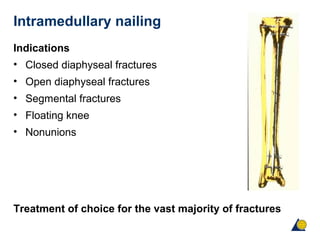
Intramedullary nailing
Indications
• Closed diaphyseal fractures
• Open diaphyseal fractures
• Segmental fractures
• Floating knee
• Nonunions
Treatment of choice for the vast majority of fractures
Insertion principles
Starting point
• Proximal
• Central
• Anterior
Locking Principles
In the vast majority of cases static locking is carried out
Locking
• None
• Static
• Dynamic
Indications
• Length
• Rotation
• Alignment
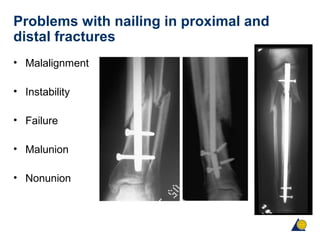
Problems with nailing in proximal and
distal fractures
• Malalignment
• Instability
• Failure
• Malunion
• Nonunion
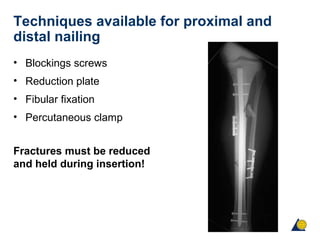
Techniques available for proximal and
distal nailing
• Blockings screws
• Reduction plate
• Fibular fixation
• Percutaneous clamp
Fractures must be reduced
and held during insertion!
Reamed or unreamed nails?
Closed tibial fractures [CM Court-Brown et al 1996]
Reamed nails
• Union (weeks) 15.4
• Nonunion 0%
• Malunion 0%
• Screw breakage 4%
• Nail breakage 0%
Unreamed nails
• Union (wks) 22.8
• Nonunion 20%
• Malunion 16%
• Screw breakage 52%
• Nail breakage 4%
Reamed mechanically and biologically superior.
Operative treatment—compression
plating
• Destroys periosteal circulation
• Direct reduction will destroy soft-tissue attachments
• Rigid fixation will result in slow union without callus
formation
• Anatomical reduction
• Implant failure possible if technique is not perfect
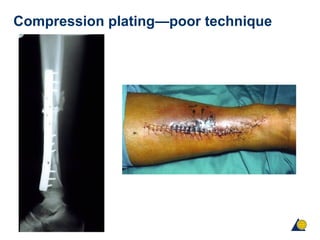
Compression plating—poor technique
Compression plating—indications
• Simple metaphyseal fractures
• Corrective osteotomy for malunion
• Plating for hypertrophic nonunion
Operative treatment—MIPO
(minimally invasive plate osteosynthesis)
• Indirect reduction preserves soft tissues but imperfect
reduction leading to malunion is a problem
• Bridge plating produces stable fixation resulting in early
healing with callus formation
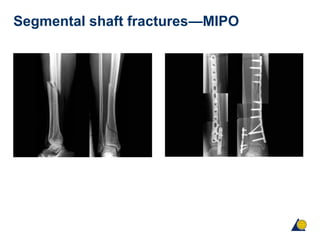
Segmental shaft fractures—MIPO
Plating—mechanics
• Plates cannot withstand weight-bearing forces
• Plates will not permit early full weight bearing
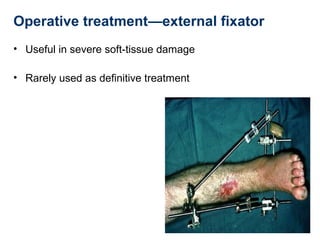
Operative treatment—external fixator
• Useful in severe soft-tissue damage
• Rarely used as definitive treatment
Complications of tibial nailing—specific
to nailing
• Anterior knee pain
• Thermal necrosis
• Latrogenic fracture
Anterior knee pain
• May be related to leaving end of nail proud
• Will not be cured by nail removal unless proximal end of
the nail is very prominent
Anterior knee pain
• Incidence varies from series to series
• 0–40%
• Related to surgical approach—may be more common in
patella tendon splitting approaches
• NB: Centre of tibial head is just medial to patellar tendon
Tibial nailing
• High incidence of compartment syndromes
• High index of suspicion
• Avoid local anesthetic techniques
Compartment syndrome
• Variable reported incidence in published series: 1–7%
• Occurs in both reamed and unreamed nailing
• A high index of suspicion will lead to a high level of
diagnosis
• Diagnosis is clinical and not dependant on measuring
pressures
Closed tibial shaft fractures
• Decision-making
• Fracture
• Limb
• Patient:
- other injuries
- other pathologies
• Health care environment
Closed tibial shaft fractures
• Assessment of the injury
• Nonoperative/operative options
• Choice of implants—their advantages and
disadvantages
• Surgical technique
• Importance of the closed soft-tissue injury

Closed tibial shaft