TITANIUM ELASTIC NAILING SYSTEM
Dr.PONNILAVAN
• In early 1980 , flexible stable intramedullary nailing using
titanium was developed in an University in Nancy, France
( hence called Nancy Nail) ( Depuy)
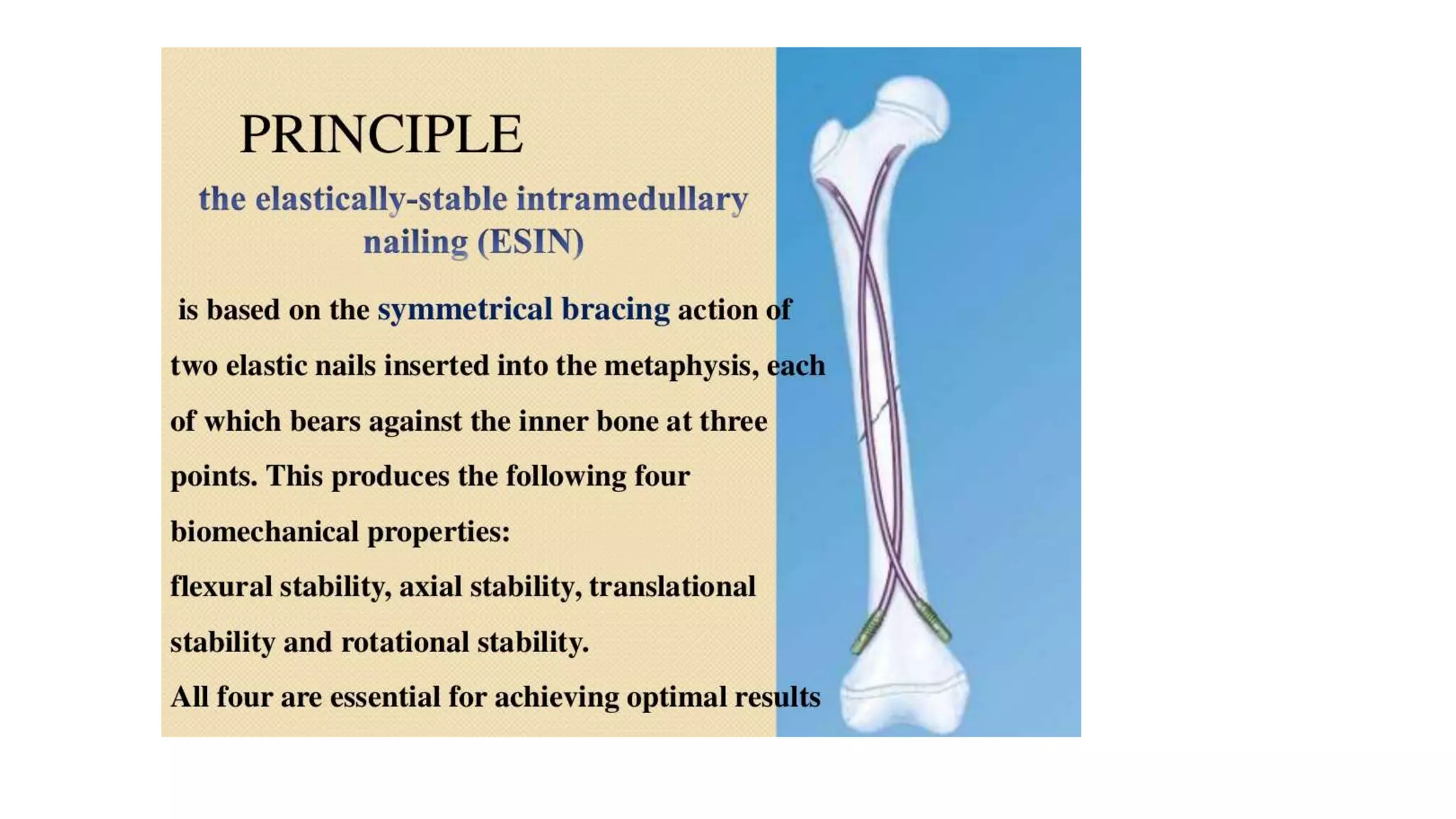
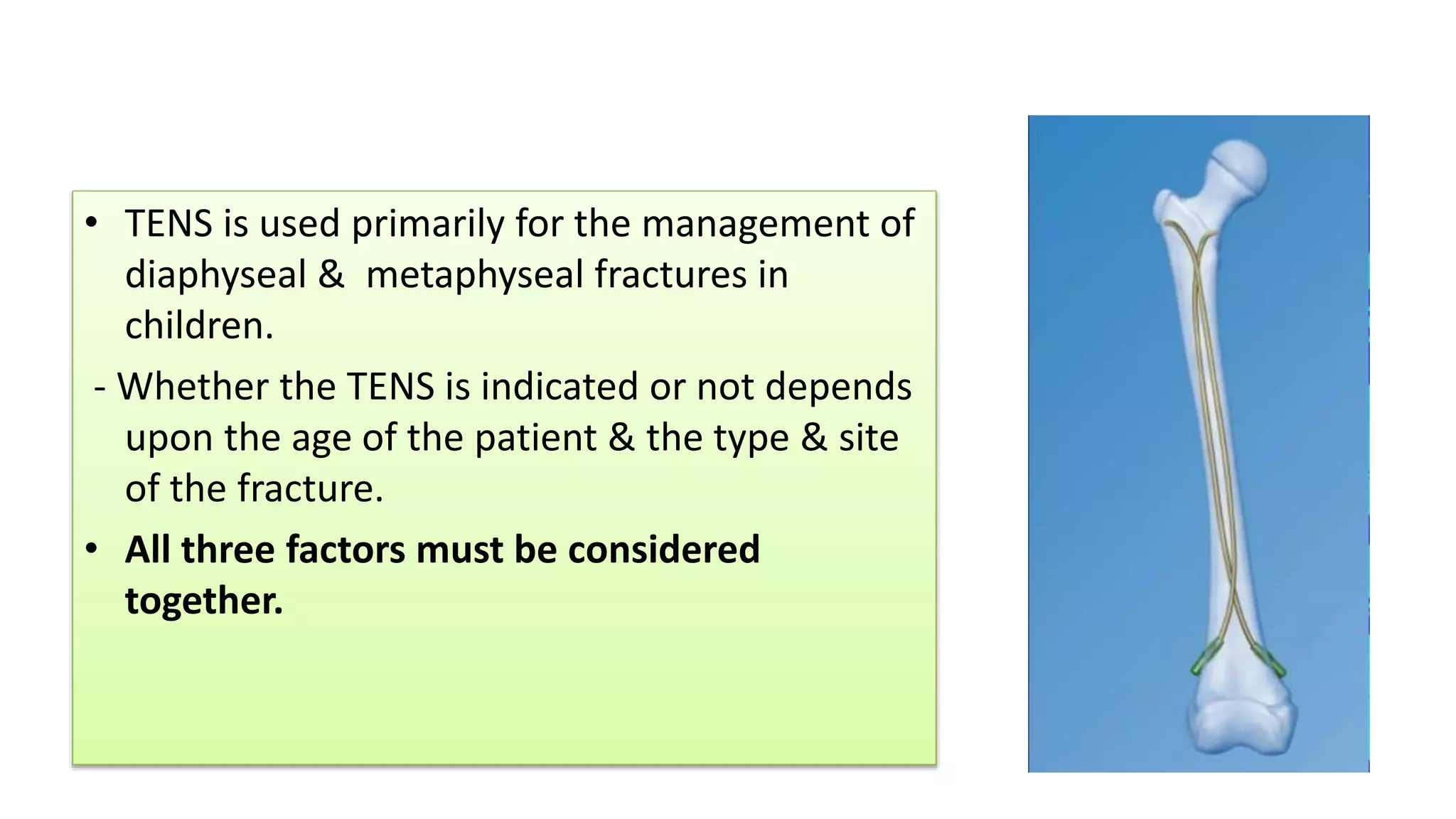
• TENS is used primarily for the management of
diaphyseal & metaphyseal fractures in
children.
- Whether the TENS is indicated or not depends
upon the age of the patient & the type & site
of the fracture.
• All three factors must be considered
together.
• Age
• Age limit depends on the biological development of the child.
• Experience has shown that the lower limit is 3–4 years and the
upper limit 13–15 years.
• Type of fracture
– Transverse fractures
– Short oblique or transverse fractures with broken-off wedges
– Long oblique fractures with the possibility of cortical support
– Spiral fractures
– Multi-fragment and bifocal fractures
– Pathological fractures with juvenile bone cysts
• Fracture site
– femur: diaphyseal
– distal femur: metaphyseal
– femur: subtrochanteric
– lower leg: diaphyseal
– lower leg: distal metaphyseal
– humerus: diaphyseal and subcapital
– humerus: supracondylar
– radius and ulna: shaft
– radius: neck
• Other possible special indications:
– humerus and forearm in adults
– polytrauma in combination with craniocerebral trauma, even
outside the age range specified above
– prophylactic stabilization with juvenile bone cysts
– osteogenesis imperfecta
• Contraindications
– intraarticular fractures
– complex femoral fractures, particularly in connection with
overweight (50–60 kg) and/or age (15–16 years)
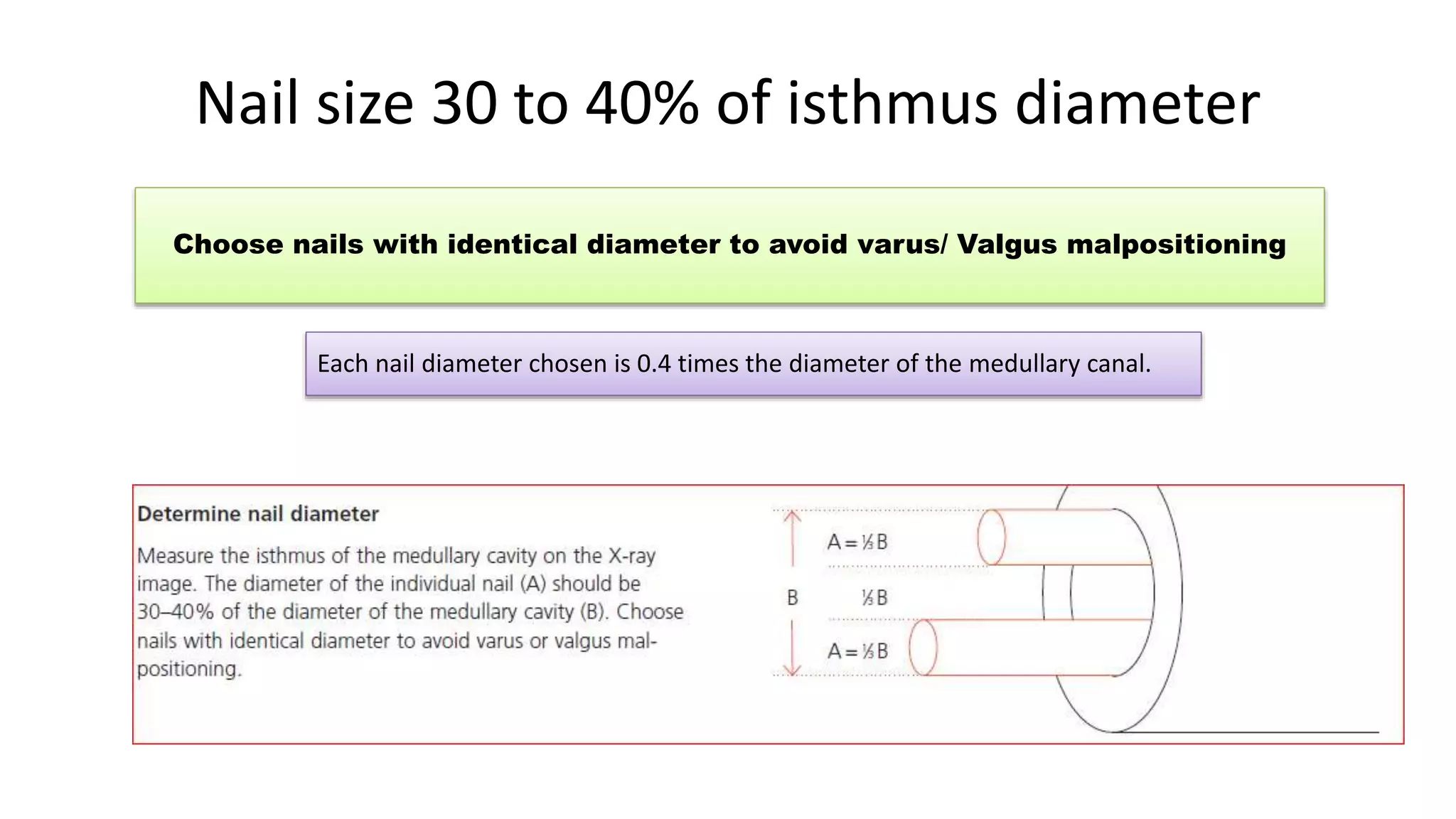
Nail size 30 to 40% of isthmus diameter
Choose nails with identical diameter to avoid varus/ Valgus malpositioning
Each nail diameter chosen is 0.4 times the diameter of the medullary canal.
FART stability
Pre-bend nails
• Vertex of arch should be located at the level of # zone.
• Pre-bend both nails in exactly the same way.
• Pressure applied internally can be increased by prebending the nails to a
smaller diameter, thus shifting the nail crossover points more towards the
metaphyses.
• This can increase the stability in complex fractures.
• TENS serve as load sharing devices
• Flexible enough to allow bending and avoid the need to cross the physis
during their insertion.
• Relatively small incisions confer a cosmetic advantage to the traditional
plating techniques.
• These nails are easy to remove, and allow for early ambulation (48–72
hours).
Ascending technique
• FEMUR - standard
• Radius
• Proximal humerus#
• Do not prebend for radial head/neck #
Descending technique
• Tibia
• Ulna
• Femur
• Distal humerus #
• ( TUFdh)
• THANK YOU

Tens

  • 1.
    TITANIUM ELASTIC NAILINGSYSTEM Dr.PONNILAVAN
  • 2.
    • In early1980 , flexible stable intramedullary nailing using titanium was developed in an University in Nancy, France ( hence called Nancy Nail) ( Depuy)
  • 5.
    • TENS isused primarily for the management of diaphyseal & metaphyseal fractures in children. - Whether the TENS is indicated or not depends upon the age of the patient & the type & site of the fracture. • All three factors must be considered together.
  • 6.
    • Age • Agelimit depends on the biological development of the child. • Experience has shown that the lower limit is 3–4 years and the upper limit 13–15 years.
  • 7.
    • Type offracture – Transverse fractures – Short oblique or transverse fractures with broken-off wedges – Long oblique fractures with the possibility of cortical support – Spiral fractures – Multi-fragment and bifocal fractures – Pathological fractures with juvenile bone cysts
  • 8.
    • Fracture site –femur: diaphyseal – distal femur: metaphyseal – femur: subtrochanteric – lower leg: diaphyseal – lower leg: distal metaphyseal – humerus: diaphyseal and subcapital – humerus: supracondylar – radius and ulna: shaft – radius: neck
  • 9.
    • Other possiblespecial indications: – humerus and forearm in adults – polytrauma in combination with craniocerebral trauma, even outside the age range specified above – prophylactic stabilization with juvenile bone cysts – osteogenesis imperfecta
  • 10.
    • Contraindications – intraarticularfractures – complex femoral fractures, particularly in connection with overweight (50–60 kg) and/or age (15–16 years)
  • 11.
    Nail size 30to 40% of isthmus diameter Choose nails with identical diameter to avoid varus/ Valgus malpositioning Each nail diameter chosen is 0.4 times the diameter of the medullary canal.
  • 13.
  • 14.
  • 15.
    • Vertex ofarch should be located at the level of # zone. • Pre-bend both nails in exactly the same way. • Pressure applied internally can be increased by prebending the nails to a smaller diameter, thus shifting the nail crossover points more towards the metaphyses. • This can increase the stability in complex fractures.
  • 16.
    • TENS serveas load sharing devices • Flexible enough to allow bending and avoid the need to cross the physis during their insertion. • Relatively small incisions confer a cosmetic advantage to the traditional plating techniques. • These nails are easy to remove, and allow for early ambulation (48–72 hours).
  • 17.
    Ascending technique • FEMUR- standard • Radius • Proximal humerus# • Do not prebend for radial head/neck #
  • 18.
    Descending technique • Tibia •Ulna • Femur • Distal humerus # • ( TUFdh)
  • 21.