Mechantronics and
Application
Milling Machines
Presented by
Aroosa
Sidra ALi
Outline
• History
• Introduction
• Sensors
• Actuators
• Mechanical Elements
• Mechanism
• Basic Components
• Types
History
• Milling machines were first invented and
developed by Eli Whitney(1798) to mass
produce interchangeable musket parts.
Although crude, these machines assisted
man in maintaining accuracy and
uniformity while duplicating parts that
could not be manufactured with the use of
a file.
Introduction Of Milling
• A milling machine is a tool found primarily in the
metalworking industry. In general, these machines are
used to shape solid products by eliminating excess
material in order to form a finished product
• A milling machine is usually capable of cutting a wide
variety of metals, ranging from aluminum to stainless
steel. Depending on the material being cut, the machine
can be set to move at a faster or slower pace. Softer
materials are generally milled at higher speeds while
harder materials usually require slower speeds. In
addition, harder materials often require smaller amounts
of material to be milled off at one time.
Sensors
• Sensor Tool for Automated Material
Inspection in Milling Machines
• Automatic tool changer
• Coolant system
• Encloser.
Actuators
•12 volt linear actuator for milling machine
12 volt linear actuator
• A linear actuator is an actuator that
creates motion in a straight line, in
contrast to the circular motion
• When something needs to be raised,
lowered, pushed, pulled, rotated,
positioned, lifted, shifted or moved 12 volt
linear actuators are used
Mechanical elements
• Milling cutters:
The cutting tool in milling is called a milling cutter(to
perform milling operation. Remove material by their
movement) .Some tasks are drilling ,slot cutting,shapes
of the edges.
• Teeths:
(cutting edges) the teeth enter and exit the work during
each revolution.This subjects the teeth to a cycle of
impact force and thermalshock on every revolution.The
tooths cuts the material.
Types of cutters
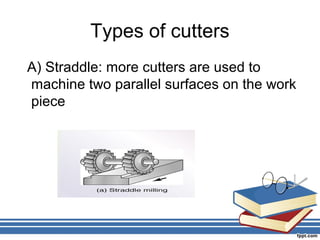
A) Straddle: more cutters are used to
machine two parallel surfaces on the work
piece
b)Form milling produces curved profiles
using cutters that have specially shaped
teeth
c ) Slotting and slitting operations are
performed with circular cutters. [T-slot
cutters,
Mechanism
• The different tooling used in milling machines is
based on material and desired shape. Because
materials like wood and steel have different
physical properties, different tool bits are needed
to properly machine the materials. If a milling
machine uses a tool bit that is not strong enough
to machine steel, the tooling and even the
machine itself can be damaged. Tooling that is
too strong for softer materials can damage the
workpiece
Basic components
• Worktable: on which the workpiece is clamped
using T-slots. The table moves longitudinally
relative to the saddle.
• Head: contains the spindle and cutter holders. In
vertical machines, the head may be fixed or can
be adjusted vertically, and it can be swiveled in a
vertical plane on the column for cutting tapered
surfaces.
• Knee: supports the saddle and gives the table
vertical movement so that thedepth of cut can be
adjusted and workpieces with various heights
can be accommodated.
• Overerarm: used on horizontal machines; it is
adjustable to accommodate different arbor
lengths.
• Saddle: supports the table and can move in the
transverse direction
Vertical and Horizontal Milling Machine
Types
Two types of milling machine:
1)Peripheral milling
2)Face milling:
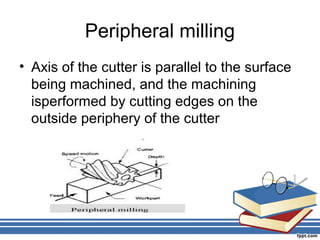
Peripheral milling
• Axis of the cutter is parallel to the surface
being machined, and the machining
isperformed by cutting edges on the
outside periphery of the cutter
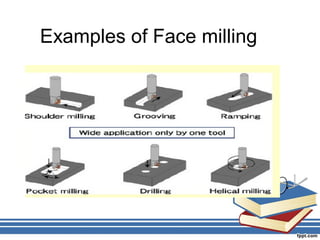
Face milling
• the axis of the cutter is perpendicular to
the surface being milled, and machining is
performed by cutting edges on both the
end and outside periphery of the cutter.
Examples of Peripheral milling
Examples of Face milling

Milling machine

  • 1.
  • 2.
  • 3.
    Outline • History • Introduction •Sensors • Actuators • Mechanical Elements • Mechanism • Basic Components • Types
  • 4.
    History • Milling machineswere first invented and developed by Eli Whitney(1798) to mass produce interchangeable musket parts. Although crude, these machines assisted man in maintaining accuracy and uniformity while duplicating parts that could not be manufactured with the use of a file.
  • 5.
    Introduction Of Milling •A milling machine is a tool found primarily in the metalworking industry. In general, these machines are used to shape solid products by eliminating excess material in order to form a finished product • A milling machine is usually capable of cutting a wide variety of metals, ranging from aluminum to stainless steel. Depending on the material being cut, the machine can be set to move at a faster or slower pace. Softer materials are generally milled at higher speeds while harder materials usually require slower speeds. In addition, harder materials often require smaller amounts of material to be milled off at one time.
  • 7.
    Sensors • Sensor Toolfor Automated Material Inspection in Milling Machines • Automatic tool changer • Coolant system • Encloser.
  • 8.
    Actuators •12 volt linearactuator for milling machine
  • 9.
    12 volt linearactuator • A linear actuator is an actuator that creates motion in a straight line, in contrast to the circular motion • When something needs to be raised, lowered, pushed, pulled, rotated, positioned, lifted, shifted or moved 12 volt linear actuators are used
  • 10.
    Mechanical elements • Millingcutters: The cutting tool in milling is called a milling cutter(to perform milling operation. Remove material by their movement) .Some tasks are drilling ,slot cutting,shapes of the edges. • Teeths: (cutting edges) the teeth enter and exit the work during each revolution.This subjects the teeth to a cycle of impact force and thermalshock on every revolution.The tooths cuts the material.
  • 12.
    Types of cutters A)Straddle: more cutters are used to machine two parallel surfaces on the work piece
  • 13.
    b)Form milling producescurved profiles using cutters that have specially shaped teeth
  • 14.
    c ) Slottingand slitting operations are performed with circular cutters. [T-slot cutters,
  • 15.
    Mechanism • The differenttooling used in milling machines is based on material and desired shape. Because materials like wood and steel have different physical properties, different tool bits are needed to properly machine the materials. If a milling machine uses a tool bit that is not strong enough to machine steel, the tooling and even the machine itself can be damaged. Tooling that is too strong for softer materials can damage the workpiece
  • 16.
    Basic components • Worktable:on which the workpiece is clamped using T-slots. The table moves longitudinally relative to the saddle. • Head: contains the spindle and cutter holders. In vertical machines, the head may be fixed or can be adjusted vertically, and it can be swiveled in a vertical plane on the column for cutting tapered surfaces.
  • 17.
    • Knee: supportsthe saddle and gives the table vertical movement so that thedepth of cut can be adjusted and workpieces with various heights can be accommodated. • Overerarm: used on horizontal machines; it is adjustable to accommodate different arbor lengths. • Saddle: supports the table and can move in the transverse direction
  • 18.
    Vertical and HorizontalMilling Machine
  • 19.
    Types Two types ofmilling machine: 1)Peripheral milling 2)Face milling:
  • 20.
    Peripheral milling • Axisof the cutter is parallel to the surface being machined, and the machining isperformed by cutting edges on the outside periphery of the cutter
  • 21.
    Face milling • theaxis of the cutter is perpendicular to the surface being milled, and machining is performed by cutting edges on both the end and outside periphery of the cutter.
  • 22.
  • 23.