Presented by-
Sharath S
01JST16PAE013
 A control system is a system of devices or set
of devices, that manages, commands, directs
or regulates the behaviour of other device(s)
or system(s) to achieve desire results.
Why CS?
 As the human civilization is being
modernized day by day the demand of
automation is increasing accordingly.
Automation highly requires control of
devices.
 Accuracy
 Sensitivity
 Noise
 Stability
 Bandwidth
 Speed
 Oscillation
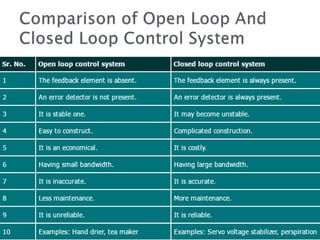
1. Open loop control system
2. Closed loop control system
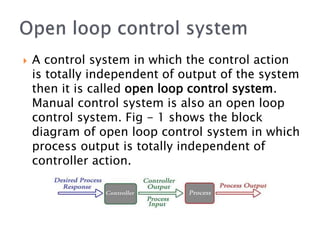
 A control system in which the control action
is totally independent of output of the system
then it is called open loop control system.
Manual control system is also an open loop
control system. Fig - 1 shows the block
diagram of open loop control system in which
process output is totally independent of
controller action.
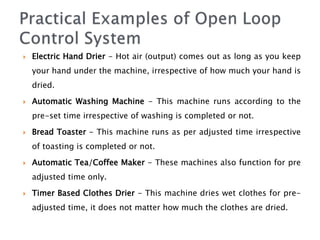
 Electric Hand Drier - Hot air (output) comes out as long as you keep
your hand under the machine, irrespective of how much your hand is
dried.
 Automatic Washing Machine - This machine runs according to the
pre-set time irrespective of washing is completed or not.
 Bread Toaster - This machine runs as per adjusted time irrespective
of toasting is completed or not.
 Automatic Tea/Coffee Maker - These machines also function for pre
adjusted time only.
 Timer Based Clothes Drier - This machine dries wet clothes for pre-
adjusted time, it does not matter how much the clothes are dried.
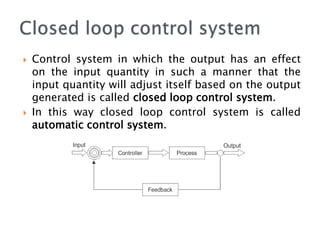
 Control system in which the output has an effect
on the input quantity in such a manner that the
input quantity will adjust itself based on the output
generated is called closed loop control system.
 In this way closed loop control system is called
automatic control system.
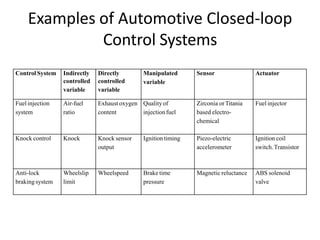
Examples of Automotive Closed-loop
Control Systems
Control System Indirectly
controlled
variable
Directly
controlled
variable
Manipulated
variable
Sensor Actuator
Fuel injection
system
Air-fuel
ratio
Exhaust oxygen
content
Qualityof
injectionfuel
Zirconia orTitania
based electro-
chemical
Fuel injector
Knock control Knock Knock sensor
output
Ignition timing Piezo-electric
accelerometer
Ignition coil
switch.Transistor
Anti-lock
brakingsystem
Wheelslip
limit
Wheelspeed Brake time
pressure
Magnetic reluctance ABS solenoid
valve
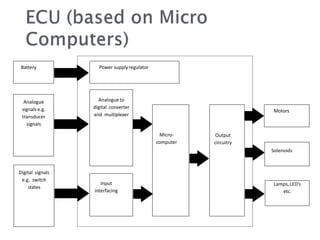
Battery
Analogue
signals e.g.
transducer
signals
Digital signals
e.g. switch
states
Power supplyregulator
Analogueto
digital converter
and multiplexer
Input
interfacing
Micro-
computer
Output
circuitry
Motors
Solenoids
Lamps,LED’s
etc.
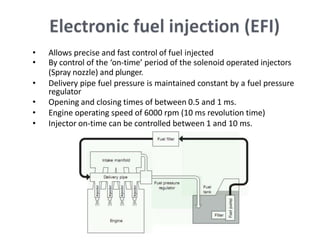
• Allows precise and fast control of fuel injected
• By control of the ‘on-time’ period of the solenoid operated injectors
(Spray nozzle) and plunger.
• Delivery pipe fuel pressure is maintained constant by a fuel pressure
regulator
• Opening and closing times of between 0.5 and 1 ms.
• Engine operating speed of 6000 rpm (10 ms revolution time)
• Injector on-time can be controlled between 1 and 10 ms.
• Multi-point or sequential fuel injection, with one fuel injector near the
intake valve (or valves) of each cylinder.
• At a device level, a fuel injector ic package
• Provides the high solenoid drive current required
• Incorporates both over-voltage and short-circuit protection,
• Fault reporting diagnostic routines also included
• Inlet manifold absolute pressure (MAP) sensor has an important role
• Fuel injection opening period or pulse width is related directly to the
mass of air flowing into the engine as fuel-air ratio must be maintained
constant in steady-state operation
• And the mass of air-flow is related to the manifold absolute pressure
by the equation
• where Vd is the displacement of the cylinder,
• nv is the volumetric efficiency or the fraction of Vd actually filled on
each stroke, [= f(speed)]
• pi is manifold absolute pressure,
• R is a constant and
• Ti is the intake air temperature.
am
RTi

Vd nv Pi
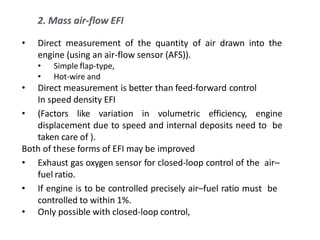
• Direct measurement of the quantity of air drawn into the
engine (using an air-flow sensor (AFS)).
• Simple flap-type,
• Hot-wire and
• Direct measurement is better than feed-forward control
In speed density EFI
• (Factors like variation in volumetric efficiency, engine
displacement due to speed and internal deposits need to be
taken care of ).
Both of these forms of EFI may be improved
• Exhaust gas oxygen sensor for closed-loop control of the air–
fuel ratio.
• If engine is to be controlled precisely air–fuel ratio must be
controlled to within 1%.
• Only possible with closed-loop control,
• The objective of low exhaust-gas
emission levels
• Maintain the air–fuel ratio at 14.7:1
[stoichiometrically / chemically perfect]
• Three-way catalytic converters to control
emission
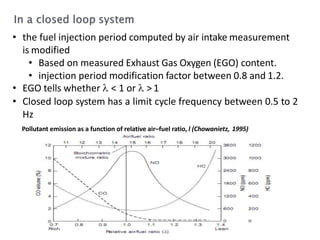
• the fuel injection period computed by air intake measurement
is modified
• Based on measured Exhaust Gas Oxygen (EGO) content.
• injection period modification factor between 0.8 and 1.2.
• EGO tells whether  < 1 or  >1
• Closed loop system has a limit cycle frequency between 0.5 to 2
Hz
Pollutant emission as a function of relative air–fuel ratio, l (Chowanietz, 1995)
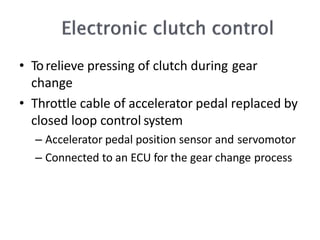
• Torelieve pressing of clutch during gear
change
• Throttle cable of accelerator pedal replaced by
closed loop control system
– Accelerator pedal position sensor and servomotor
– Connected to an ECU for the gear change process
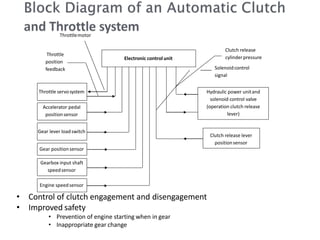
• Control of clutch engagement and disengagement
• Improved safety
• Prevention of engine starting when in gear
• Inappropriate gear change
Throttlemotor
Electronic control unit
Hydraulic power unitand
solenoid control valve
(operation clutch release
lever)
Clutch release lever
positionsensor
Throttle servosystem
Throttle
position
feedback
Accelerator pedal
positionsensor
Gear lever loadswitch
Gear positionsensor
Gearbox input shaft
speedsensor
Engine speedsensor
Clutch release
cylinderpressure
Solenoidcontrol
signal
Fuel injection
andignition
timing
 Throttleposition
sensor
 Throttle idleswitch
 Selector lever
positionsensor
 Hold mode switch
 Stoplightswitch
 Overdrive inhibit
switch
 Automatic
transmission fluid
temperaturesensor
 Torqueconverter
outputspeed
 Vehicle speed
 Enginer.p.m.
 Atmospheric
pressuresensor
Engine
control
unit
Solenoi
d valve
control
Handshake signals
betweenECUs
Transmission
controlunit
 Water
thermosensor
 Throttle
position
sensor
 Knock sensor
 Airflowsensor
 Intake air
thermosensor
 Enginer.p.m.
signal Engine Transmission
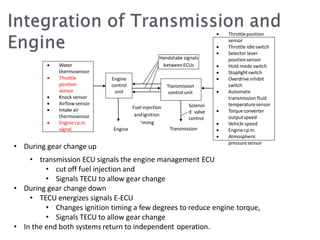
• During gear change up
• transmission ECU signals the engine management ECU
• cut off fuel injection and
• Signals TECU to allow gear change
• During gear change down
• TECU energizes signals E-ECU
• Changes ignition timing a few degrees to reduce engine torque,
• Signals TECU to allow gear change
• In the end both systems return to independent operation.
• Also includes
– Exhaust gas recirculation
system (circulating
exhaust into intake to
reduce max combustion
temp, and hence NOx)
• Controlled by
powertrainECU
• Engine temp, load,
speed
– Evaporative Emission
Control System (to
circulate fuel vapour
into intake and prevent
leakage into
atmosphere)
• Anti Lock Braking system
• Electronic Damping Control system
• Power Assisted Steering System
• Traction Control Systems
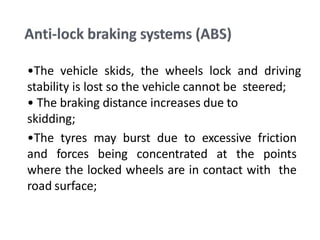
•The vehicle skids, the wheels lock and driving
stability is lost so the vehicle cannot be steered;
• The braking distance increases due to
skidding;
•The tyres may burst due to excessive friction
and forces being concentrated at the points
where the locked wheels are in contact with the
road surface;
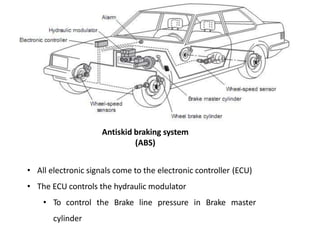
Antiskid braking system
(ABS)
• All electronic signals come to the electronic controller (ECU)
• The ECU controls the hydraulic modulator
• To control the Brake line pressure in Brake master
cylinder
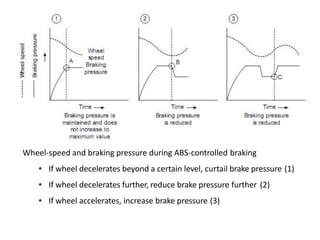
Wheel-speed and braking pressure during ABS-controlled braking
• If wheel decelerates beyond a certain level, curtail brake pressure (1)
• If wheel decelerates further, reduce brake pressure further (2)
• If wheel accelerates, increase brake pressure (3)
• Prevent drive wheels from wheel spinning during
starting or
– Accelerating on A wet or icy surface.
• Avoid reduction of either steering response in front- wheel-
drive (fwd) / vehicle stability on rear-wheel- drive (rwd)
vehicles.
Tcs operates-
• To maximize adhesion to the road surface during
Acceleration
• Same sensors as in ABS
• The actuation uses fuel, ignition and driven wheel braking
action
• This strategy employs the difference in wheel speeds of
the non-driven wheel speeds as a basis for reductions
in the slip setpoint to enhance stability in curves.
• High vehicle speeds and low acceleration requirements
on low coefficient of adhesion surfaces imply
– a control strategy of progressively lower slip threshold
setpoints as the vehicle speed increases,
– gives maximum lateral adhesion on the surface.
• The primary function of a shock absorber
– control vehicle movement against roll during turning and pitch during acceleration or braking.
– Requires hard suspension
• secondary role
– Toprevent vehicle vibration caused by a poor road surface.
– Requires a soft suspension
• Electronic damping control (EDC) used to attain these twin
objectives
• altering the characteristics of spring and oil-filled damper
arrangement
– difficult and expensive
• Simple option - Suspensions with at least three settings; ‘soft’,
’medium’ and ‘firm’
• OR electronically controlled suspension systems using air,
nitrogen gas and hydraulic oil as a suspension agent.
• Measured directly using an acceleration
sensor, or
• Inferred from brake system pressure and
throttle opening angle.
• Used to control pitching during acceleration /
Braking
• Lateral forces
• Inferred by the rate at which the steering
Wheel is being turned and the vehicle speed.
• Used by the ecu to prevent rolling.
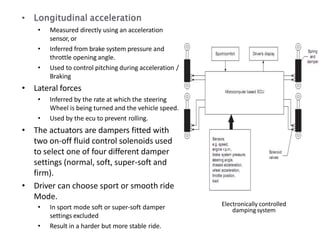
• The actuators are dampers fitted with
two on-off fluid control solenoids used
to select one of four different damper
settings (normal, soft, super-soft and
firm).
• Driver can choose sport or smooth ride
Mode.
• In sport mode soft or super-soft damper
settings excluded
• Result in a harder but more stable ride.
Electronically controlled
dampingsystem
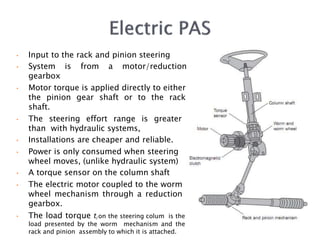
• Input to the rack and pinion steering
• System is from a motor/reduction
gearbox
• Motor torque is applied directly to either
the pinion gear shaft or to the rack
shaft.
• The steering effort range is greater
than with hydraulic systems,
• Installations are cheaper and reliable.
• Power is only consumed when steering
wheel moves, (unlike hydraulic system)
• A torque sensor on the column shaft
• The electric motor coupled to the worm
wheel mechanism through a reduction
gearbox.
• The load torque tl on the steering colum is the
load presented by the worm mechanism and the
rack and pinion assembly to which it is attached.
CONTROL SYSTEMS IN AUTOMOBILES

CONTROL SYSTEMS IN AUTOMOBILES

  • 1.
  • 2.
     A controlsystem is a system of devices or set of devices, that manages, commands, directs or regulates the behaviour of other device(s) or system(s) to achieve desire results. Why CS?  As the human civilization is being modernized day by day the demand of automation is increasing accordingly. Automation highly requires control of devices.
  • 3.
     Accuracy  Sensitivity Noise  Stability  Bandwidth  Speed  Oscillation
  • 4.
    1. Open loopcontrol system 2. Closed loop control system
  • 5.
     A controlsystem in which the control action is totally independent of output of the system then it is called open loop control system. Manual control system is also an open loop control system. Fig - 1 shows the block diagram of open loop control system in which process output is totally independent of controller action.
  • 6.
     Electric HandDrier - Hot air (output) comes out as long as you keep your hand under the machine, irrespective of how much your hand is dried.  Automatic Washing Machine - This machine runs according to the pre-set time irrespective of washing is completed or not.  Bread Toaster - This machine runs as per adjusted time irrespective of toasting is completed or not.  Automatic Tea/Coffee Maker - These machines also function for pre adjusted time only.  Timer Based Clothes Drier - This machine dries wet clothes for pre- adjusted time, it does not matter how much the clothes are dried.
  • 7.
     Control systemin which the output has an effect on the input quantity in such a manner that the input quantity will adjust itself based on the output generated is called closed loop control system.  In this way closed loop control system is called automatic control system.
  • 8.
    Examples of AutomotiveClosed-loop Control Systems Control System Indirectly controlled variable Directly controlled variable Manipulated variable Sensor Actuator Fuel injection system Air-fuel ratio Exhaust oxygen content Qualityof injectionfuel Zirconia orTitania based electro- chemical Fuel injector Knock control Knock Knock sensor output Ignition timing Piezo-electric accelerometer Ignition coil switch.Transistor Anti-lock brakingsystem Wheelslip limit Wheelspeed Brake time pressure Magnetic reluctance ABS solenoid valve
  • 10.
    Battery Analogue signals e.g. transducer signals Digital signals e.g.switch states Power supplyregulator Analogueto digital converter and multiplexer Input interfacing Micro- computer Output circuitry Motors Solenoids Lamps,LED’s etc.
  • 11.
    • Allows preciseand fast control of fuel injected • By control of the ‘on-time’ period of the solenoid operated injectors (Spray nozzle) and plunger. • Delivery pipe fuel pressure is maintained constant by a fuel pressure regulator • Opening and closing times of between 0.5 and 1 ms. • Engine operating speed of 6000 rpm (10 ms revolution time) • Injector on-time can be controlled between 1 and 10 ms.
  • 12.
    • Multi-point orsequential fuel injection, with one fuel injector near the intake valve (or valves) of each cylinder. • At a device level, a fuel injector ic package • Provides the high solenoid drive current required • Incorporates both over-voltage and short-circuit protection, • Fault reporting diagnostic routines also included
  • 13.
    • Inlet manifoldabsolute pressure (MAP) sensor has an important role • Fuel injection opening period or pulse width is related directly to the mass of air flowing into the engine as fuel-air ratio must be maintained constant in steady-state operation • And the mass of air-flow is related to the manifold absolute pressure by the equation • where Vd is the displacement of the cylinder, • nv is the volumetric efficiency or the fraction of Vd actually filled on each stroke, [= f(speed)] • pi is manifold absolute pressure, • R is a constant and • Ti is the intake air temperature. am RTi  Vd nv Pi
  • 14.
    • Direct measurementof the quantity of air drawn into the engine (using an air-flow sensor (AFS)). • Simple flap-type, • Hot-wire and • Direct measurement is better than feed-forward control In speed density EFI • (Factors like variation in volumetric efficiency, engine displacement due to speed and internal deposits need to be taken care of ). Both of these forms of EFI may be improved • Exhaust gas oxygen sensor for closed-loop control of the air– fuel ratio. • If engine is to be controlled precisely air–fuel ratio must be controlled to within 1%. • Only possible with closed-loop control,
  • 15.
    • The objectiveof low exhaust-gas emission levels • Maintain the air–fuel ratio at 14.7:1 [stoichiometrically / chemically perfect] • Three-way catalytic converters to control emission
  • 16.
    • the fuelinjection period computed by air intake measurement is modified • Based on measured Exhaust Gas Oxygen (EGO) content. • injection period modification factor between 0.8 and 1.2. • EGO tells whether  < 1 or  >1 • Closed loop system has a limit cycle frequency between 0.5 to 2 Hz Pollutant emission as a function of relative air–fuel ratio, l (Chowanietz, 1995)
  • 17.
    • Torelieve pressingof clutch during gear change • Throttle cable of accelerator pedal replaced by closed loop control system – Accelerator pedal position sensor and servomotor – Connected to an ECU for the gear change process
  • 18.
    • Control ofclutch engagement and disengagement • Improved safety • Prevention of engine starting when in gear • Inappropriate gear change Throttlemotor Electronic control unit Hydraulic power unitand solenoid control valve (operation clutch release lever) Clutch release lever positionsensor Throttle servosystem Throttle position feedback Accelerator pedal positionsensor Gear lever loadswitch Gear positionsensor Gearbox input shaft speedsensor Engine speedsensor Clutch release cylinderpressure Solenoidcontrol signal
  • 19.
    Fuel injection andignition timing  Throttleposition sensor Throttle idleswitch  Selector lever positionsensor  Hold mode switch  Stoplightswitch  Overdrive inhibit switch  Automatic transmission fluid temperaturesensor  Torqueconverter outputspeed  Vehicle speed  Enginer.p.m.  Atmospheric pressuresensor Engine control unit Solenoi d valve control Handshake signals betweenECUs Transmission controlunit  Water thermosensor  Throttle position sensor  Knock sensor  Airflowsensor  Intake air thermosensor  Enginer.p.m. signal Engine Transmission • During gear change up • transmission ECU signals the engine management ECU • cut off fuel injection and • Signals TECU to allow gear change • During gear change down • TECU energizes signals E-ECU • Changes ignition timing a few degrees to reduce engine torque, • Signals TECU to allow gear change • In the end both systems return to independent operation.
  • 20.
    • Also includes –Exhaust gas recirculation system (circulating exhaust into intake to reduce max combustion temp, and hence NOx) • Controlled by powertrainECU • Engine temp, load, speed – Evaporative Emission Control System (to circulate fuel vapour into intake and prevent leakage into atmosphere)
  • 21.
    • Anti LockBraking system • Electronic Damping Control system • Power Assisted Steering System • Traction Control Systems
  • 22.
    •The vehicle skids,the wheels lock and driving stability is lost so the vehicle cannot be steered; • The braking distance increases due to skidding; •The tyres may burst due to excessive friction and forces being concentrated at the points where the locked wheels are in contact with the road surface;
  • 23.
    Antiskid braking system (ABS) •All electronic signals come to the electronic controller (ECU) • The ECU controls the hydraulic modulator • To control the Brake line pressure in Brake master cylinder
  • 24.
    Wheel-speed and brakingpressure during ABS-controlled braking • If wheel decelerates beyond a certain level, curtail brake pressure (1) • If wheel decelerates further, reduce brake pressure further (2) • If wheel accelerates, increase brake pressure (3)
  • 25.
    • Prevent drivewheels from wheel spinning during starting or – Accelerating on A wet or icy surface. • Avoid reduction of either steering response in front- wheel- drive (fwd) / vehicle stability on rear-wheel- drive (rwd) vehicles. Tcs operates- • To maximize adhesion to the road surface during Acceleration • Same sensors as in ABS • The actuation uses fuel, ignition and driven wheel braking action
  • 26.
    • This strategyemploys the difference in wheel speeds of the non-driven wheel speeds as a basis for reductions in the slip setpoint to enhance stability in curves. • High vehicle speeds and low acceleration requirements on low coefficient of adhesion surfaces imply – a control strategy of progressively lower slip threshold setpoints as the vehicle speed increases, – gives maximum lateral adhesion on the surface.
  • 27.
    • The primaryfunction of a shock absorber – control vehicle movement against roll during turning and pitch during acceleration or braking. – Requires hard suspension • secondary role – Toprevent vehicle vibration caused by a poor road surface. – Requires a soft suspension • Electronic damping control (EDC) used to attain these twin objectives • altering the characteristics of spring and oil-filled damper arrangement – difficult and expensive • Simple option - Suspensions with at least three settings; ‘soft’, ’medium’ and ‘firm’ • OR electronically controlled suspension systems using air, nitrogen gas and hydraulic oil as a suspension agent.
  • 28.
    • Measured directlyusing an acceleration sensor, or • Inferred from brake system pressure and throttle opening angle. • Used to control pitching during acceleration / Braking • Lateral forces • Inferred by the rate at which the steering Wheel is being turned and the vehicle speed. • Used by the ecu to prevent rolling. • The actuators are dampers fitted with two on-off fluid control solenoids used to select one of four different damper settings (normal, soft, super-soft and firm). • Driver can choose sport or smooth ride Mode. • In sport mode soft or super-soft damper settings excluded • Result in a harder but more stable ride. Electronically controlled dampingsystem
  • 29.
    • Input tothe rack and pinion steering • System is from a motor/reduction gearbox • Motor torque is applied directly to either the pinion gear shaft or to the rack shaft. • The steering effort range is greater than with hydraulic systems, • Installations are cheaper and reliable. • Power is only consumed when steering wheel moves, (unlike hydraulic system) • A torque sensor on the column shaft • The electric motor coupled to the worm wheel mechanism through a reduction gearbox. • The load torque tl on the steering colum is the load presented by the worm mechanism and the rack and pinion assembly to which it is attached.