PRESENTATION ON
PNEUMATIC ACTUATOR
Submitted to: Prepared by:
Meghasham Raju Sir Manish Kumar Tiwari
(assistant professor) Mechanical Engineer
What is an actuator?
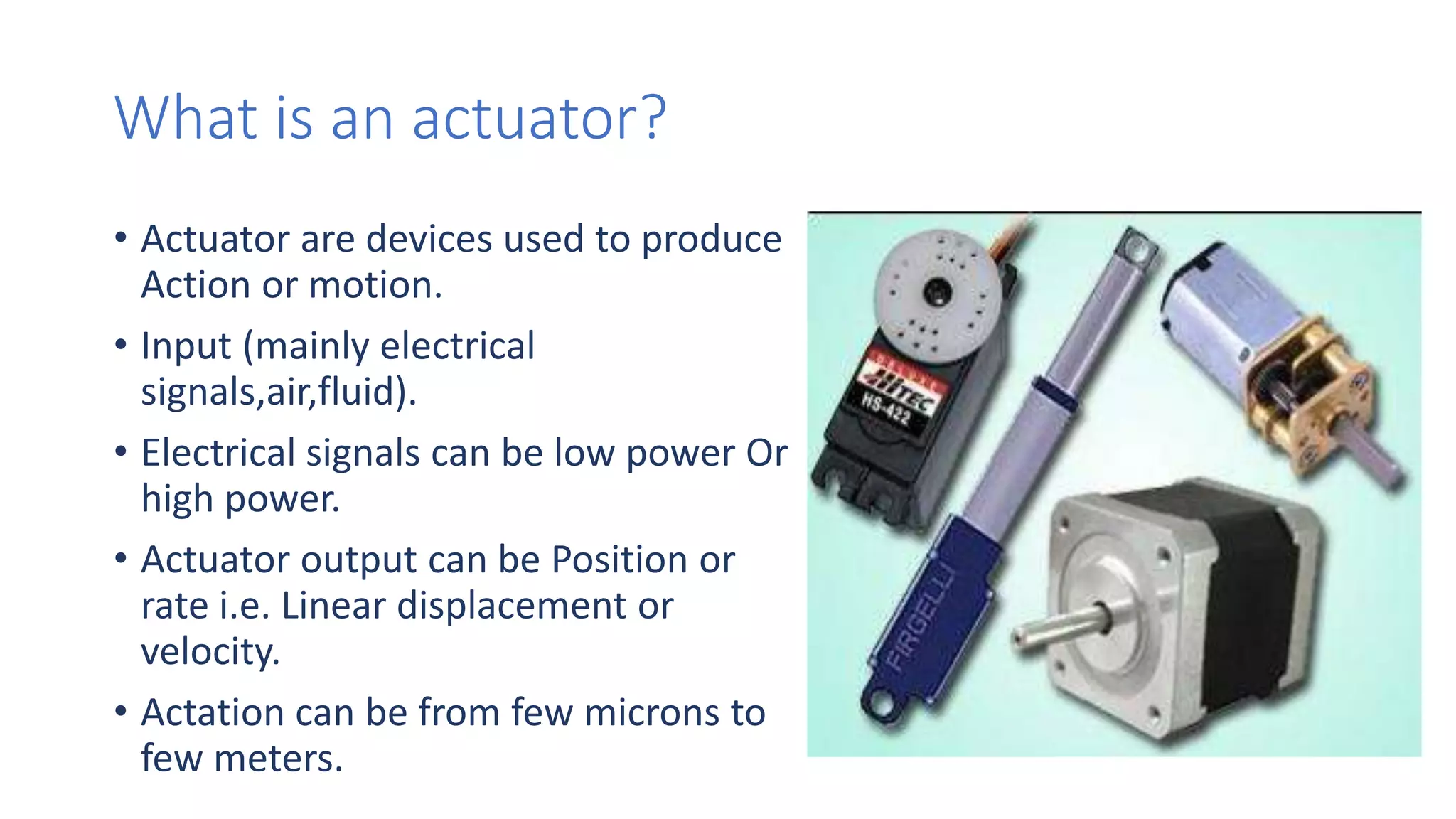
• Actuator are devices used to produce
Action or motion.
• Input (mainly electrical
signals,air,fluid).
• Electrical signals can be low power Or
high power.
• Actuator output can be Position or
rate i.e. Linear displacement or
velocity.
• Actation can be from few microns to
few meters.
Pneumatic actuator
• It converts energy formed by compressed air at high pressure into
either linear or rotary motion.
• Quickly respond in operation.
Principle of operation
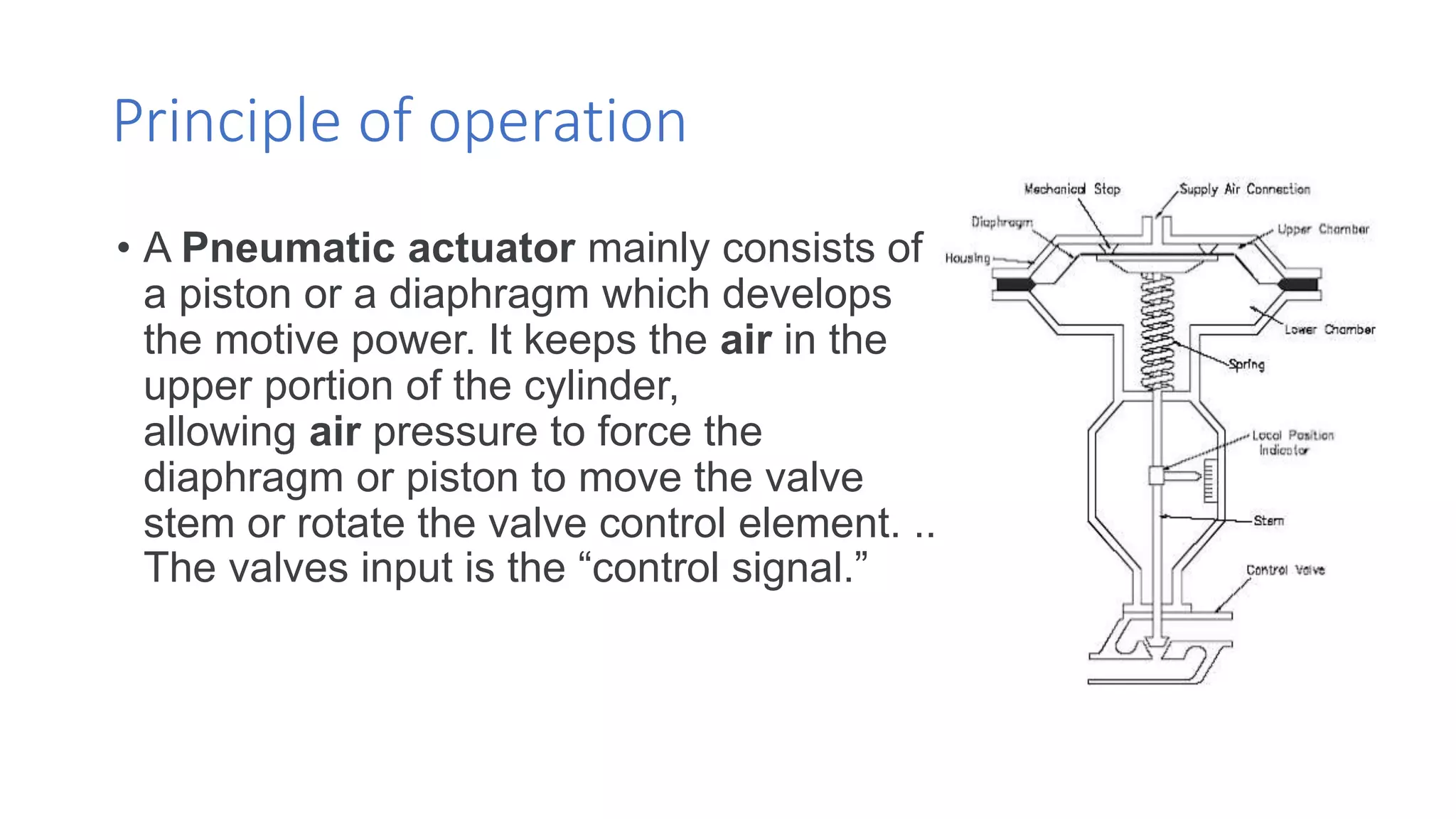
• A Pneumatic actuator mainly consists of
a piston or a diaphragm which develops
the motive power. It keeps the air in the
upper portion of the cylinder,
allowing air pressure to force the
diaphragm or piston to move the valve
stem or rotate the valve control element. ...
The valves input is the “control signal.”
Types
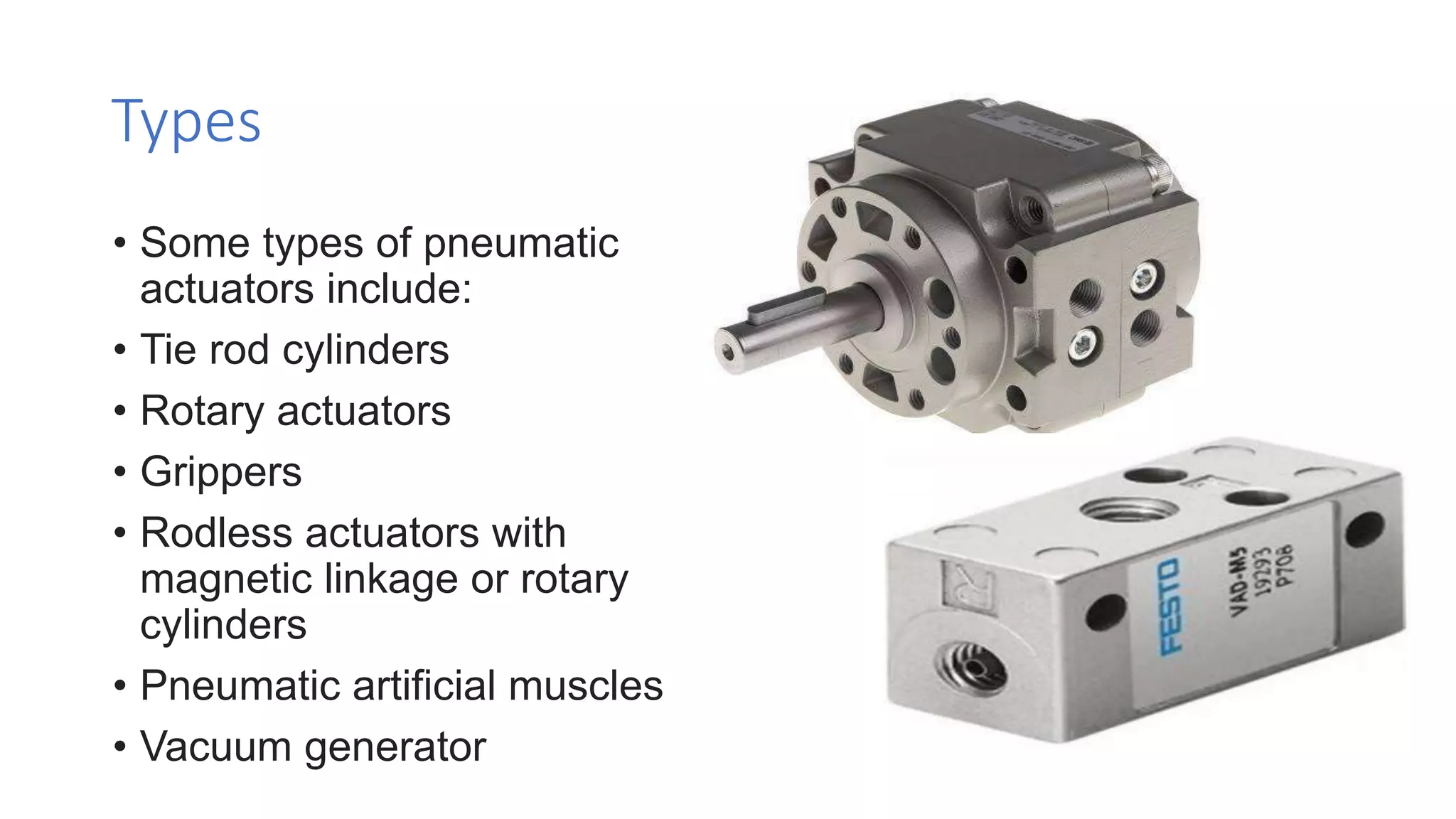
• Some types of pneumatic
actuators include:
• Tie rod cylinders
• Rotary actuators
• Grippers
• Rodless actuators with
magnetic linkage or rotary
cylinders
• Pneumatic artificial muscles
• Vacuum generator
Pneumatic cylinder
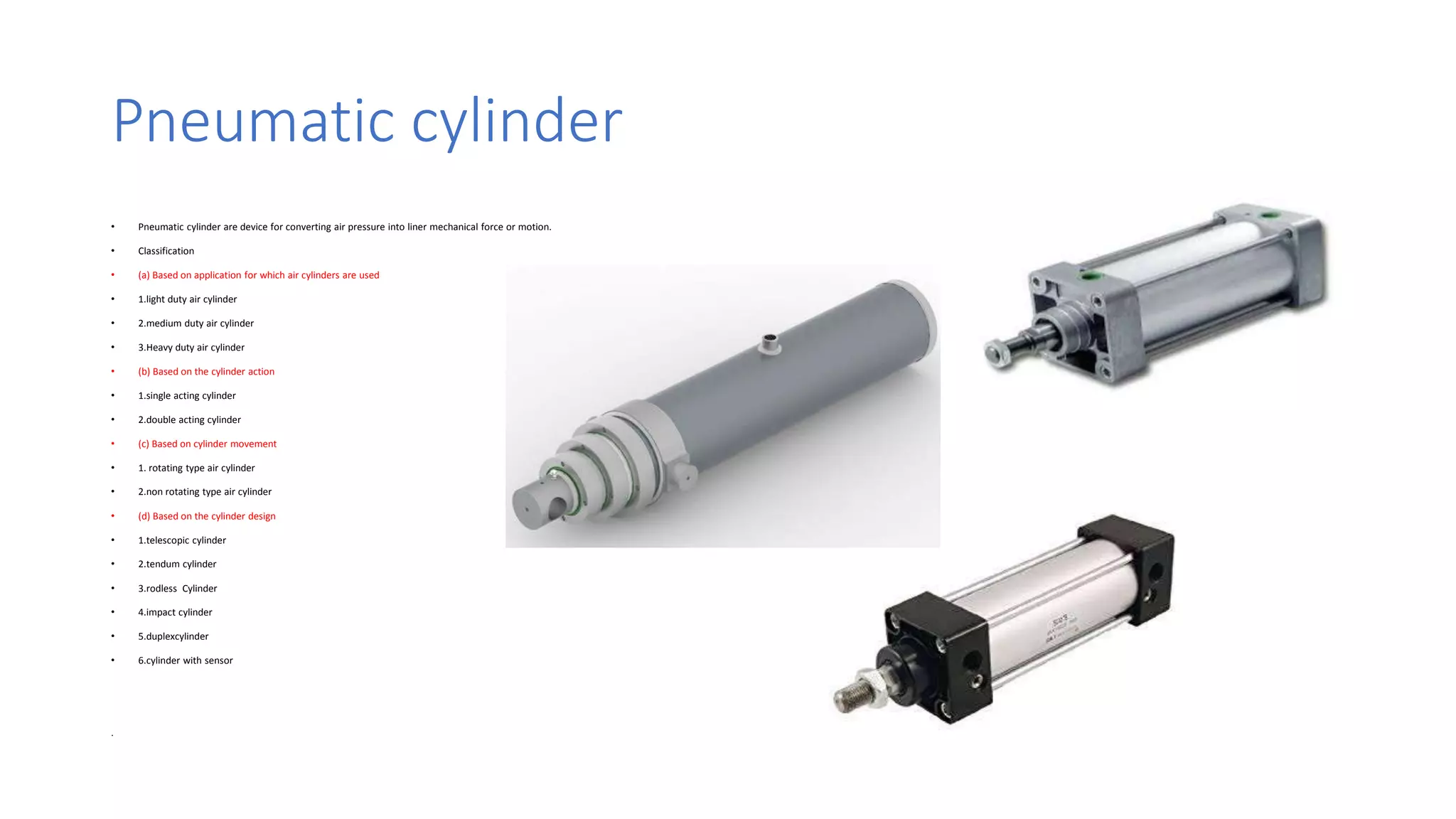
• Pneumatic cylinder are device for converting air pressure into liner mechanical force or motion.
• Classification
• (a) Based on application for which air cylinders are used
• 1.light duty air cylinder
• 2.medium duty air cylinder
• 3.Heavy duty air cylinder
• (b) Based on the cylinder action
• 1.single acting cylinder
• 2.double acting cylinder
• (c) Based on cylinder movement
• 1. rotating type air cylinder
• 2.non rotating type air cylinder
• (d) Based on the cylinder design
• 1.telescopic cylinder
• 2.tendum cylinder
• 3.rodless Cylinder
• 4.impact cylinder
• 5.duplexcylinder
• 6.cylinder with sensor
.
(a). Based on application for which air cylinder
are used
(b). Based on the cylinder action
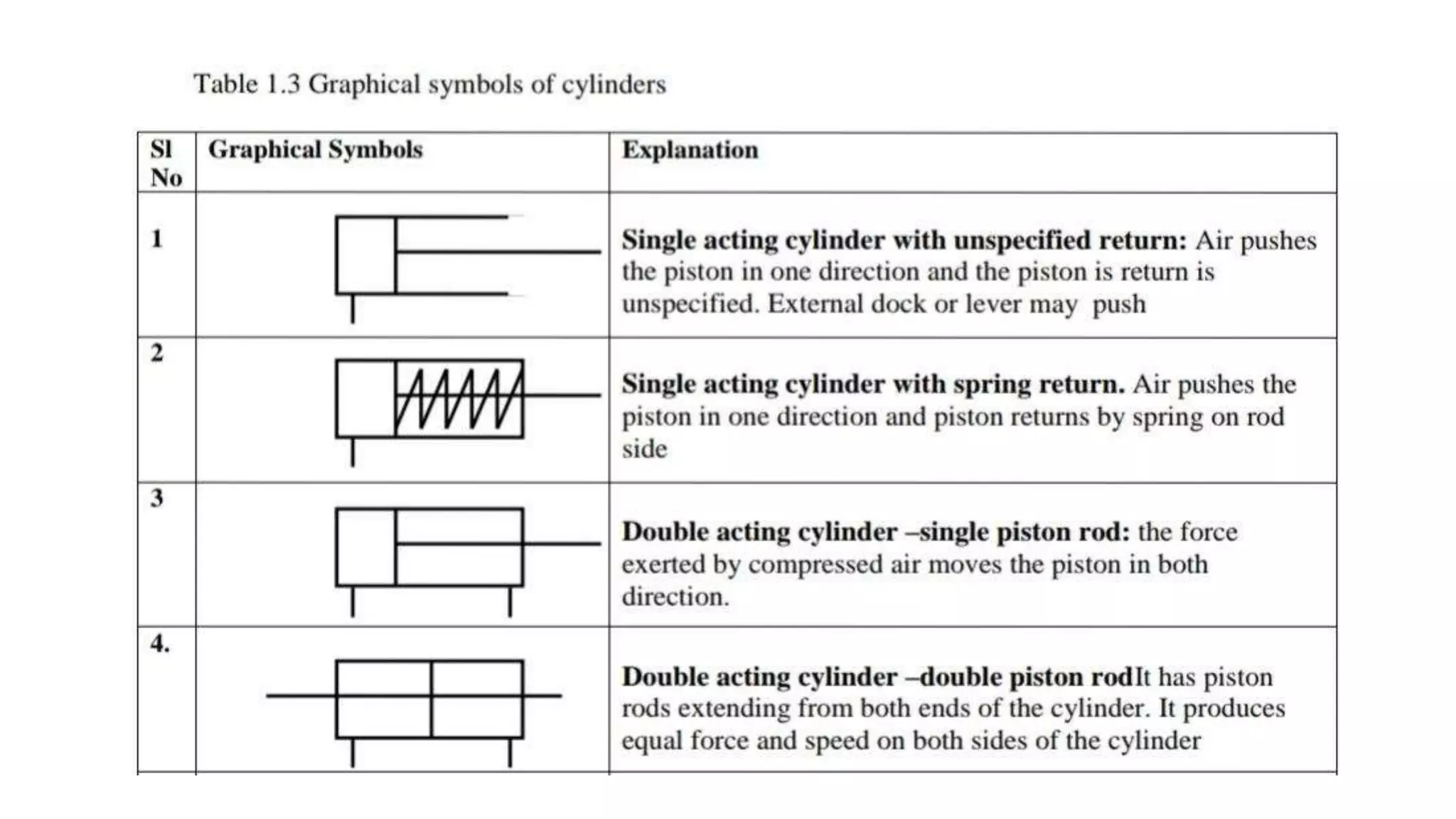
• (1) single acting cylinder
Single acting cylinder has one working port. Forward motion of
the piston is obtained by supplying
compressed air to working port. Return motion of piston is
obtained by spring placed on the rod side of the cylinder
Single acting cylinders are used where force is required to be
exerted only in one direction. Such as
clamping, feeding, sorting, locking, ejecting, braking etc.,
Single acting cylinder is usually available in short stroke lengths
[maximum length up to 80 mm] due
to the natural length of the spring. Single Acting Cylinder exert
force only in one direction. Single
acting cylinders require only about half the air volume
consumed by a double acting cylinder for one
operating cycle.
(2).double acting cylinder
• There is operation of a double acting
cylinder with piston rod on one side
to extend the Cylinder, pump flow is
sent to the blank end port as shown
in fig 1.8(a). Fluid from the rod end
por returnss to the reservoir to
retract the cylinder, the pump flow is
sent to the rod end port and fluid
From the blank end port returns to
the tank as in Figure 1.8 (b).
Applications
Presentation on pneumatic actuator

Presentation on pneumatic actuator

  • 1.
    PRESENTATION ON PNEUMATIC ACTUATOR Submittedto: Prepared by: Meghasham Raju Sir Manish Kumar Tiwari (assistant professor) Mechanical Engineer
  • 2.
    What is anactuator? • Actuator are devices used to produce Action or motion. • Input (mainly electrical signals,air,fluid). • Electrical signals can be low power Or high power. • Actuator output can be Position or rate i.e. Linear displacement or velocity. • Actation can be from few microns to few meters.
  • 3.
    Pneumatic actuator • Itconverts energy formed by compressed air at high pressure into either linear or rotary motion. • Quickly respond in operation.
  • 4.
    Principle of operation •A Pneumatic actuator mainly consists of a piston or a diaphragm which develops the motive power. It keeps the air in the upper portion of the cylinder, allowing air pressure to force the diaphragm or piston to move the valve stem or rotate the valve control element. ... The valves input is the “control signal.”
  • 5.
    Types • Some typesof pneumatic actuators include: • Tie rod cylinders • Rotary actuators • Grippers • Rodless actuators with magnetic linkage or rotary cylinders • Pneumatic artificial muscles • Vacuum generator
  • 6.
    Pneumatic cylinder • Pneumaticcylinder are device for converting air pressure into liner mechanical force or motion. • Classification • (a) Based on application for which air cylinders are used • 1.light duty air cylinder • 2.medium duty air cylinder • 3.Heavy duty air cylinder • (b) Based on the cylinder action • 1.single acting cylinder • 2.double acting cylinder • (c) Based on cylinder movement • 1. rotating type air cylinder • 2.non rotating type air cylinder • (d) Based on the cylinder design • 1.telescopic cylinder • 2.tendum cylinder • 3.rodless Cylinder • 4.impact cylinder • 5.duplexcylinder • 6.cylinder with sensor .
  • 7.
    (a). Based onapplication for which air cylinder are used
  • 8.
    (b). Based onthe cylinder action • (1) single acting cylinder Single acting cylinder has one working port. Forward motion of the piston is obtained by supplying compressed air to working port. Return motion of piston is obtained by spring placed on the rod side of the cylinder Single acting cylinders are used where force is required to be exerted only in one direction. Such as clamping, feeding, sorting, locking, ejecting, braking etc., Single acting cylinder is usually available in short stroke lengths [maximum length up to 80 mm] due to the natural length of the spring. Single Acting Cylinder exert force only in one direction. Single acting cylinders require only about half the air volume consumed by a double acting cylinder for one operating cycle.
  • 9.
    (2).double acting cylinder •There is operation of a double acting cylinder with piston rod on one side to extend the Cylinder, pump flow is sent to the blank end port as shown in fig 1.8(a). Fluid from the rod end por returnss to the reservoir to retract the cylinder, the pump flow is sent to the rod end port and fluid From the blank end port returns to the tank as in Figure 1.8 (b).
  • 13.