By Mohammad Osama Hassan Ally
Do you know what they are? Its is an individual living system, such as animals and plants, that is capable of  reproduction and growth ; and can only be  seen through using a  microscope . Micro-organisms include, and can be classified as  bacteria  , virus  and  fungi . Classification of micro-organisms: Bacteria:  A large group of single-cell (made of one cell) microorganisms. Some cause    infections and disease in animals and humans. The singular of bacteria is    bacterium. Virus:  Microscopic organism that relies on the genetic machinery of living cells to grow and  reproduce (enters other cells and infect them) causing infections. Fungi:  A group of organisms that lack chlorophyll (help in photosynthesis to make food) and  obtain nutrients from dead or living organic matter (natural material)
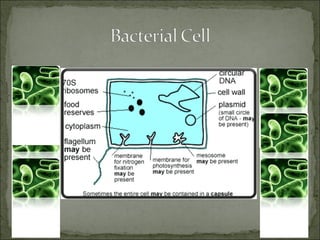
Bacteria:   Are a singular cellular micro-organism, that vary in shapes and sizes. Some cause  infections  and  disease , while others cure  infections  and  disease .  They reproduce  asexually. Bacterium grow on  soil, hot springs, radioactive material , sea water,  and  even  in the  Earth’s crust. Fact! There  are around  40 million  bacterial cells in a gram of  soil,  and  1 million  bacterial  cells in a  millimetre of water. Where can I find them:  M any foods and medicines involve bacteria produced;  EG insulin producing bacteria  genetically engineered  to cure illnesses such as diabetes .
Mitosis (Asexual Reproduction ) Don't Click Here!
 
Virus:  They are smaller than bacteria, and reproduce by effecting a host cell.  They have a protein coating rather than  a cell membrane. They contain DNA. Example:   AIDS:   Acquired immune deficiency syndrome is a set of symptoms and infections resulting to the damage of the human immune system caused by the human immunodeficiency (act of damaging the immune system) virus (HIV ).
Don't Click Here I MEAN IT!
 
Fungi: Organisms that use living or dead organisms as food by breaking them down and then absorbing the substances into their cells.  Fungi make up one of the five kingdoms of living things on Earth. Mushrooms, yeast and molds are types of fungi. Example:   Basidiomycetes:   They look a bit like clubs or baseball bats. This division includes mushrooms, puffballs and earth stars. They could be found in forests or farmed as vegetables, for eating.
 
Bacteria is involved in the decomposition of plants and animals. Its is done by  breaking down complex molecules into smaller simple molecules.  Bacteria is largely responsible for the recycling of carbon, nitrogen and sulphur. The Role of Bacteria In The  Nitrogen Cycle:
Help preserve food  Keep us healthy Breakdown harmful substances  Protect us from invading bacteria's  Provide us with chemicals we may be deficient of (insulin) Prepare foods such as yogurts and cheese. Yeast cells are used in the preparation of this yogurt.
THANK YOU FOR WATCHING 14/05/2008 By Mohammad Osama Hassan Ally

Micro Organisms

  • 1.
    By Mohammad OsamaHassan Ally
  • 2.
    Do you knowwhat they are? Its is an individual living system, such as animals and plants, that is capable of reproduction and growth ; and can only be seen through using a microscope . Micro-organisms include, and can be classified as bacteria , virus and fungi . Classification of micro-organisms: Bacteria: A large group of single-cell (made of one cell) microorganisms. Some cause infections and disease in animals and humans. The singular of bacteria is bacterium. Virus: Microscopic organism that relies on the genetic machinery of living cells to grow and reproduce (enters other cells and infect them) causing infections. Fungi: A group of organisms that lack chlorophyll (help in photosynthesis to make food) and obtain nutrients from dead or living organic matter (natural material)
  • 3.
    Bacteria: Are a singular cellular micro-organism, that vary in shapes and sizes. Some cause infections and disease , while others cure infections and disease . They reproduce asexually. Bacterium grow on soil, hot springs, radioactive material , sea water, and even in the Earth’s crust. Fact! There are around 40 million bacterial cells in a gram of soil, and 1 million bacterial cells in a millimetre of water. Where can I find them: M any foods and medicines involve bacteria produced; EG insulin producing bacteria genetically engineered to cure illnesses such as diabetes .
  • 4.
    Mitosis (Asexual Reproduction) Don't Click Here!
  • 5.
  • 6.
    Virus: Theyare smaller than bacteria, and reproduce by effecting a host cell. They have a protein coating rather than a cell membrane. They contain DNA. Example: AIDS: Acquired immune deficiency syndrome is a set of symptoms and infections resulting to the damage of the human immune system caused by the human immunodeficiency (act of damaging the immune system) virus (HIV ).
  • 7.
    Don't Click HereI MEAN IT!
  • 8.
  • 9.
    Fungi: Organisms thatuse living or dead organisms as food by breaking them down and then absorbing the substances into their cells. Fungi make up one of the five kingdoms of living things on Earth. Mushrooms, yeast and molds are types of fungi. Example: Basidiomycetes: They look a bit like clubs or baseball bats. This division includes mushrooms, puffballs and earth stars. They could be found in forests or farmed as vegetables, for eating.
  • 10.
  • 11.
    Bacteria is involvedin the decomposition of plants and animals. Its is done by breaking down complex molecules into smaller simple molecules. Bacteria is largely responsible for the recycling of carbon, nitrogen and sulphur. The Role of Bacteria In The Nitrogen Cycle:
  • 12.
    Help preserve food Keep us healthy Breakdown harmful substances Protect us from invading bacteria's Provide us with chemicals we may be deficient of (insulin) Prepare foods such as yogurts and cheese. Yeast cells are used in the preparation of this yogurt.
  • 13.
    THANK YOU FORWATCHING 14/05/2008 By Mohammad Osama Hassan Ally