Mycorrhizae
0 The most prevalent beneficial organisms associated with
 plants, however, are soil-inhabiting fungi that form mutualistic
 root–fungal associations referred to as mycorrhizas

0 All mycorrhizas have intimate contact between hyphae and
 plant cells in an interface where nutrient exchange occurs.

0 Majority of plants form mycorrhizas, it is likely to lie
 somewhere between 80% and 90%. In many of these
 associations between 10% and 30% of the food produced by the
 plant moves through to the fungi.
Mycorrhizae
0 Mycorrhizas are found in a wide range of habitats,
 including deserts, lowland tropical rainforests, high
 latitudes and altitudes

0 Uptake of nutrient and Mineral nutrient acquisition from
 soil is considered to be the primary function of
 mycorrhizas, in addition to it’s roles in ecology, and man
 economic uses..
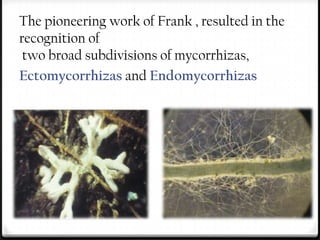
The pioneering work of Frank , resulted in the
recognition of
 two broad subdivisions of mycorrhizas,
Ectomycorrhizas and Endomycorrhizas
Mycorrhizae Types
Two major types of mycorrhiza occur in Nature

 Endomycorrhiza “vesicullar-arbuscular”
 (common in more than 80 % of terrestrial plant
 species)
 Ectomycorrhiza (specific to conifers and some
 broadleaved woody species) %15 of plants
 There exists other types: Ericoid, Orchid,
 monotropoid mycorrhiza of less ecological
 importance.
Ectomycorrhiza
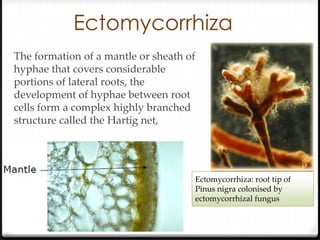
The formation of a mantle or sheath of
hyphae that covers considerable
portions of lateral roots, the
development of hyphae between root
cells form a complex highly branched
structure called the Hartig net,


                                         Ectomycorrhiza: root tip of
                                         Pinus nigra colonised by
                                         ectomycorrhizal fungus
Ectomycorrhiza
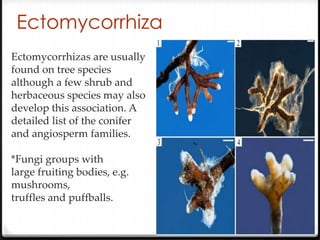
Ectomycorrhizas are usually
found on tree species
although a few shrub and
herbaceous species may also
develop this association. A
detailed list of the conifer
and angiosperm families.

*Fungi groups with
large fruiting bodies, e.g.
mushrooms,
truffles and puffballs.
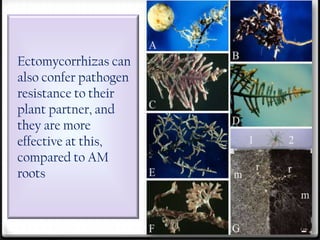
Ectomycorrhizas can
also confer pathogen
resistance to their
plant partner, and
they are more
effective at this,
compared to AM
roots
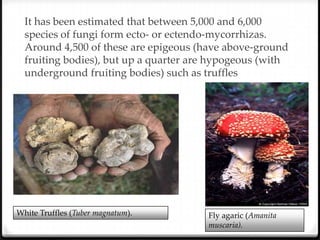
It has been estimated that between 5,000 and 6,000
  species of fungi form ecto- or ectendo-mycorrhizas.
  Around 4,500 of these are epigeous (have above-ground
  fruiting bodies), but up a quarter are hypogeous (with
  underground fruiting bodies) such as truffles


White Truffles (Tuber magnatum).       Fly agaric (Amanita
                                       muscaria).
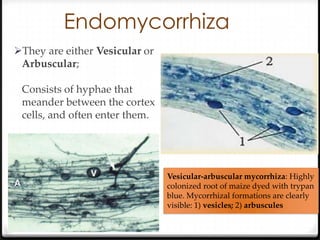
Endomycorrhiza
They are either Vesicular or
 Arbuscular;

 Consists of hyphae that
 meander between the cortex
 cells, and often enter them.


                                Vesicular-arbuscular mycorrhiza: Highly
                                colonized root of maize dyed with trypan
                                blue. Mycorrhizal formations are clearly
                                visible: 1) vesicles; 2) arbuscules
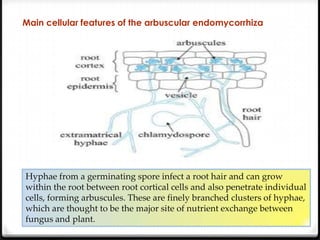
Main cellular features of the arbuscular endomycorrhiza


Hyphae from a germinating spore infect a root hair and can grow
within the root between root cortical cells and also penetrate individual
cells, forming arbuscules. These are finely branched clusters of hyphae,
which are thought to be the major site of nutrient exchange between
fungus and plant.
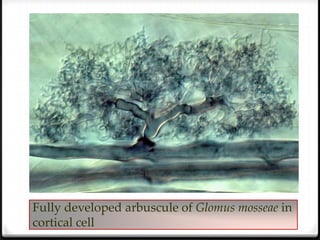
Fully developed arbuscule of Glomus mosseae in
cortical cell
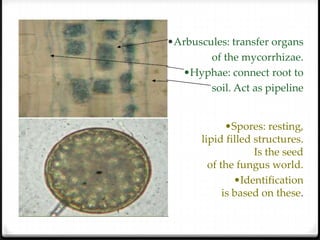
•Arbuscules: transfer organs
        of the mycorrhizae.
  •Hyphae: connect root to
        soil. Act as pipeline


              •Spores: resting,
       lipid filled structures.
                    Is the seed
         of the fungus world.
                •Identification
             is based on these.
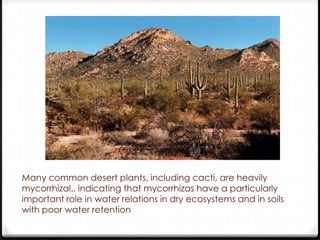
Many common desert plants, including cacti, are heavily
mycorrhizal.. indicating that mycorrhizas have a particularly
important role in water relations in dry ecosystems and in soils
with poor water retention
0 Mycorrhizas increase nutrient uptake from the soil.

0 Mycorrhizal fungi can be used in the biocontrol of
 pathogenic fungi and nematodes.

0 Some mycorrhizal fungi can bind heavy metals thus
 protecting plants from toxic levels of these substances.

0 Mycorrhizas have a positive effect on the establishment of
 plant communities.
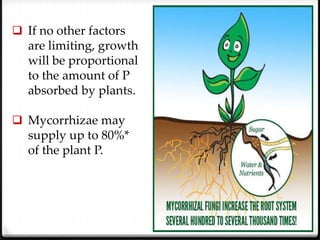
 If no other factors
  are limiting, growth
  will be proportional
  to the amount of P
  absorbed by plants.

 Mycorrhizae may
  supply up to 80%*
  of the plant P.
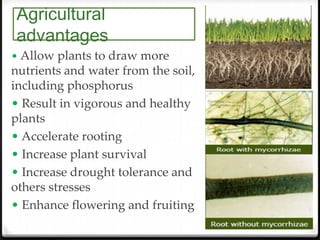
Agricultural
advantages
• Allow plants to draw more
nutrients and water from the soil,
including phosphorus
• Result in vigorous and healthy
plants
• Accelerate rooting
• Increase plant survival
• Increase drought tolerance and
others stresses
• Enhance flowering and fruiting
Ecological Importance
0 Improvement of soil structure • Stimulation of
  beneficial microbial activity
0 Water infiltration improvement • Reduction of erosion
  and nutrient leaching
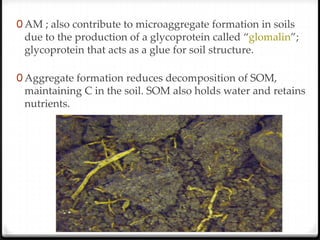
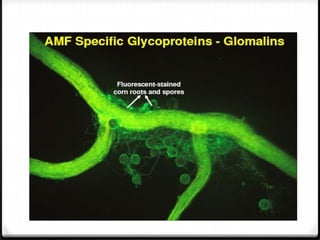
0 AM ; also contribute to microaggregate formation in soils
 due to the production of a glycoprotein called “glomalin”;
 glycoprotein that acts as a glue for soil structure.

0 Aggregate formation reduces decomposition of SOM,
 maintaining C in the soil. SOM also holds water and retains
 nutrients.
Reference:
0 Books:
 -Mycorrhiza anatomy and cell biology
 -Mycorrhiza symbiosis 2nd edition

0 Websites:
  -http://mycorrhizas.info/index.html
  -http://en.wikipedia.org/wiki/Mycorrhiza
   -http://www.mycorrhizae.com/
   -http://www.world-of-
fungi.org/Assets/Mostly_Mycology/Diane_Howarth/my
corrhizal%20types.htm
Mycorrhizal  association

Mycorrhizal association

  • 3.
    Mycorrhizae 0 The mostprevalent beneficial organisms associated with plants, however, are soil-inhabiting fungi that form mutualistic root–fungal associations referred to as mycorrhizas 0 All mycorrhizas have intimate contact between hyphae and plant cells in an interface where nutrient exchange occurs. 0 Majority of plants form mycorrhizas, it is likely to lie somewhere between 80% and 90%. In many of these associations between 10% and 30% of the food produced by the plant moves through to the fungi.
  • 4.
    Mycorrhizae 0 Mycorrhizas arefound in a wide range of habitats, including deserts, lowland tropical rainforests, high latitudes and altitudes 0 Uptake of nutrient and Mineral nutrient acquisition from soil is considered to be the primary function of mycorrhizas, in addition to it’s roles in ecology, and man economic uses..
  • 5.
    The pioneering workof Frank , resulted in the recognition of two broad subdivisions of mycorrhizas, Ectomycorrhizas and Endomycorrhizas
  • 6.
    Mycorrhizae Types Two majortypes of mycorrhiza occur in Nature  Endomycorrhiza “vesicullar-arbuscular” (common in more than 80 % of terrestrial plant species)  Ectomycorrhiza (specific to conifers and some broadleaved woody species) %15 of plants There exists other types: Ericoid, Orchid, monotropoid mycorrhiza of less ecological importance.
  • 7.
    Ectomycorrhiza The formation ofa mantle or sheath of hyphae that covers considerable portions of lateral roots, the development of hyphae between root cells form a complex highly branched structure called the Hartig net, Ectomycorrhiza: root tip of Pinus nigra colonised by ectomycorrhizal fungus
  • 8.
    Ectomycorrhiza Ectomycorrhizas are usually foundon tree species although a few shrub and herbaceous species may also develop this association. A detailed list of the conifer and angiosperm families. *Fungi groups with large fruiting bodies, e.g. mushrooms, truffles and puffballs.
  • 9.
    Ectomycorrhizas can also conferpathogen resistance to their plant partner, and they are more effective at this, compared to AM roots
  • 10.
    It has beenestimated that between 5,000 and 6,000 species of fungi form ecto- or ectendo-mycorrhizas. Around 4,500 of these are epigeous (have above-ground fruiting bodies), but up a quarter are hypogeous (with underground fruiting bodies) such as truffles White Truffles (Tuber magnatum). Fly agaric (Amanita muscaria).
  • 11.
    Endomycorrhiza They are eitherVesicular or Arbuscular; Consists of hyphae that meander between the cortex cells, and often enter them. Vesicular-arbuscular mycorrhiza: Highly colonized root of maize dyed with trypan blue. Mycorrhizal formations are clearly visible: 1) vesicles; 2) arbuscules
  • 12.
    Main cellular featuresof the arbuscular endomycorrhiza Hyphae from a germinating spore infect a root hair and can grow within the root between root cortical cells and also penetrate individual cells, forming arbuscules. These are finely branched clusters of hyphae, which are thought to be the major site of nutrient exchange between fungus and plant.
  • 13.
    Fully developed arbusculeof Glomus mosseae in cortical cell
  • 14.
    •Arbuscules: transfer organs of the mycorrhizae. •Hyphae: connect root to soil. Act as pipeline •Spores: resting, lipid filled structures. Is the seed of the fungus world. •Identification is based on these.
  • 15.
    Many common desertplants, including cacti, are heavily mycorrhizal.. indicating that mycorrhizas have a particularly important role in water relations in dry ecosystems and in soils with poor water retention
  • 16.
    0 Mycorrhizas increasenutrient uptake from the soil. 0 Mycorrhizal fungi can be used in the biocontrol of pathogenic fungi and nematodes. 0 Some mycorrhizal fungi can bind heavy metals thus protecting plants from toxic levels of these substances. 0 Mycorrhizas have a positive effect on the establishment of plant communities.
  • 17.
     If noother factors are limiting, growth will be proportional to the amount of P absorbed by plants.  Mycorrhizae may supply up to 80%* of the plant P.
  • 18.
    Agricultural advantages • Allow plantsto draw more nutrients and water from the soil, including phosphorus • Result in vigorous and healthy plants • Accelerate rooting • Increase plant survival • Increase drought tolerance and others stresses • Enhance flowering and fruiting
  • 19.
    Ecological Importance 0 Improvementof soil structure • Stimulation of beneficial microbial activity 0 Water infiltration improvement • Reduction of erosion and nutrient leaching
  • 20.
    0 AM ;also contribute to microaggregate formation in soils due to the production of a glycoprotein called “glomalin”; glycoprotein that acts as a glue for soil structure. 0 Aggregate formation reduces decomposition of SOM, maintaining C in the soil. SOM also holds water and retains nutrients.
  • 22.
    Reference: 0 Books: -Mycorrhizaanatomy and cell biology -Mycorrhiza symbiosis 2nd edition 0 Websites: -http://mycorrhizas.info/index.html -http://en.wikipedia.org/wiki/Mycorrhiza -http://www.mycorrhizae.com/ -http://www.world-of- fungi.org/Assets/Mostly_Mycology/Diane_Howarth/my corrhizal%20types.htm

Editor's Notes

  • #3 Most of the research on the interactions between plants, the environment, and other organismshas involved those parts of plants that are visible and easy to access. However, the undergroundsystem, mainly roots, interacts with the soil environment and with a multitude of organisms invery complex ways. The interaction of roots with mycorrhizal fungi is almost ubiquitous in bothnatural and man-made ecosystems. Because of this, there are a number of
  • #4 While the classical Greek word for mushroom is part of the word mycorrhiza, there are many mycorrhizal fungi which have fruiting bodies other than mushrooms. An example is Hydnumrepandum . It’s superficially mushroom-like (stem and cap), but below the cap there are spines rather than gills. There’s more about the fruiting bodies of mycorrhizal fungi later on
  • #5 Arbuscularmycorrhiza is the dominant type in the tropics, and in grasslands and deserts of temperate latitudes. Ectomycorrhizas predominate in temperate and boreal forests
  • #6 Ectomycorrhizas are characterized by theformation of a mantle and a Hartig net of intercellularhyphae on roots of predominantly treespecies. Endomycorrhizas are more variable thanectomycorrhizas in that herbaceous and treespecies are involved and there is a diversity of fungalgroups involved in forming these associations.Endomycorrhizas have, therefore, been furtherclassified as either arbuscularmycorrhizas, ericoidmycorrhizas, arbutoidmycorrhizas, monotropoidmycorrhizas, ectendomycorrhizas or orchid mycorrhizas.Each of these categories is characterizedby the invasion of root cells by fungal hyphae butprofound differences occur in the nature of intracellularhypha development.
  • #7 Compared to arbuscularmycorrhizas (AM), the range of plants colonised by ectomycorrhizas (ECM) is relatively small
  • #8 Someectomycorrhizas develop linear aggregations ofhyphae (rhizomorphs or strands), in the extraradicalmycelium that are specialized for rapid transport ofnutrients and water. A few ectomycorrhizal fungidevelop sclerotia consisting of compact storagehyphae surrounded by a rind. Hypogeous or epigeousreproductive bodies may also be formed periodicallyfrom extraradical mycelium.
  • #9 Fungal species involved ; Approximately 5,500 known species of fungi are able to form ectomycorrhizas,,The majority of fungal species involved in the ectomycorrhiza symbiosis belong to families in the Basidiomycotina (basidiomycetes), with a few species belonging to the Ascomycotina(ascomycetes).
  • #10 •excretion of antifungal and antibiotic substances - 80% of Trichloma spp. produce antibiotics and Boletus and Clitocybe produce antimycotic substances;•stimulation of other microorganism, which themselves limit pathogens;•production of antibiotics by the plant, under the control of the mycorrhizal fungi;•structural protection of the root by the thick fungal coat, the mechanical barrier of the sheath gives very effective protection, since pathogens attack plant tissue and cannot infect fungal tissue.
  • #12 Besides intraradical structures, AM fungi form also an extensive network of extraradical mycelium in soil that extends into bulk soil beyond the rhizosphere and enables the host plant to absorb nutrients, particularly relatively immobile phosphorus, from a considerably larger volume of the soil. By the differentiation of vegetative hyphae, AM reproductive structures - spores of different size, texture and colour (depending on the species) are formed asexually on extraradical mycelium in soil.
  • #13 All AM fungi are obligatelybiotrophic, as they are completely dependent on plants for their survival. This is not usually a problem for AM fungi, as they show little or no host specificity
  • #14 Short-life arbuscules with their main trunk and fine branches resembling small trees serve as a site of the intensive nutrient exchange between plant and fungus. In contrast, vesicles, i.e. globose or oval swellings formed terminally or intercalarly on intraradical hyphae, have a storage function.
  • #17 Generally fungi have in its cell wall structure chitin that is responsible for the adsorption of the heavy metals like Cd, Ni, Th and Ur
  • #18 Recent researchindicates that the fungi even help break down rock, increasing availability of the essentialnutrients within, such as potassium, calcium, zinc and magnesium.
  • #19 The fungal sheath can also aid plants growing in soils with high concentrations of heavy metals. Zinc, cadmium and arsenic have both been found in high concentrations in fungal sheaths and it is thought that certain mycorrhizal isolates accumulate and immobilise heavy metals in hyphae of their fungal sheaths. In this way, metals are unable to reach plant tissues and the plant remains undamaged.