Biological control
of plant pathogens
Christine Roath
Overview
• What is biological control, what are the
benefits to its use
• Mechanism of biological control
• Requirements of successful biocontrol
• Working example of biocontrol
What is biological
control?
• First coined by Harry Smith in relation to
the biological control of insects
– Suppression of insect populations by native
or introduced enemies
• Generic terms
– A population-leveling process in which the
population of one species lowers the number
of another
Why use biological
control?
WHEN :
• Biological control agents are
– Expensive
– Labor intensive
– Host specific
WHILE :
• Chemical pesticides are:
– cost-effective
– easy to apply
– Broad spectrum
Why use biological
control?
WILL:
• Chemical pesticides
– Implicated in ecological, environmental, and human health
problems
– Require yearly treatments
– Broad spectrum
• Toxic to both beneficial and pathogenic species
BUT:
• Biological control agents
– Non-toxic to human
– Not a water contaminant concern
– Once colonized may last for years
– Host specific
• Only effect one or few species
Mechanisms of biological control
of plant pathogens
• Antibiosis – inhibition of one organism by
another as a result of diffusion of an
antibiotic
– Antibiotic production common in soil-dwelling
bacteria and fungi
– Example: zwittermicin A production by B.
cereus against Phytophthora root rot in alfalfa
Mechanisms of biological
control of plant pathogens
• Nutrient competition – competition
between microorganisms for carbon,
nitrogen, O2, iron, and other nutrients
– Most common way organisms limit growth of
others
– Example
• P. fluorescens, VITCUS, prevents bacterial blotch
by competing with P. tolaasii
Mechanisms of biological
control of plant pathogens
• Destructive mycoparasitism – the
parasitism of one fungus by another
– Direct contact
– Cell wall degrading enzymes
– Some produce antibiotics
– Example
• Trichoderma harzianum, BioTrek, used as seed
treatment against pathogenic fungus
Requirements of
successful biocontrol
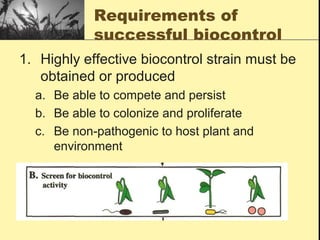
1. Highly effective biocontrol strain must be
obtained or produced
a. Be able to compete and persist
b. Be able to colonize and proliferate
c. Be non-pathogenic to host plant and
environment
Requirements of
successful biocontrol
2. Inexpensive production and formulation
of agent must be developed
a. Production must result in biomass with
excellent shelf live
b. To be successful as agricultural agent must
be
i. Inexpensive
ii. Able to produce in large quantities
iii. Maintain viability
Requirements of
successful biocontrol
3. Delivery and application must permit full
expression of the agent
a. Must ensure agents will grow and achieve
their purpose
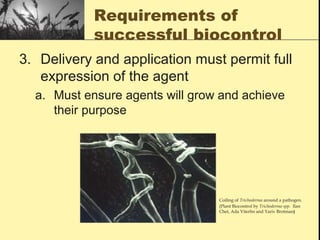
Coiling of Trichoderma around a pathogen.
(Plant Biocontrol by Trichoderma spp. Ilan
Chet, Ada Viterbo and Yariv Brotman)
Plant pathogen control by
Trichoderma spp.
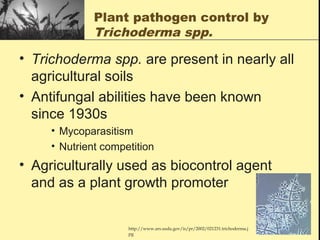
• Trichoderma spp. are present in nearly all
agricultural soils
• Antifungal abilities have been known
since 1930s
• Mycoparasitism
• Nutrient competition
• Agriculturally used as biocontrol agent
and as a plant growth promoter
http://www.ars.usda.gov/is/pr/2002/021231.trichoderma.j
pg
Plant pathogen control by
Trichoderma spp.
Why buy/develop a product that is
readily available in the soil?
Plant pathogen control by
Trichoderma spp.
• Genetic Modification
– Wild strains
• Heterokaryotic – contain nuclei of dissimilar
genotypes within a single organism
– Biocontrol strains
• Homokaryotic – contain nuclei which are similar or
identical
• Allows genetic distinction and non-variability
– IMPORTANT FOR QUALITY CONTROL
Plant pathogen control by
Trichoderma spp.
• Most strains have innate resistance to
some agricultural chemicals
– Resistance is variable
• Strains available for commercial use are
selected or modified for resistance to
specific chemicals
Plant pathogen control by
Trichoderma spp.
How is it applied?
• Favored by presence of high levels of
plant roots
• Some are highly rhizosphere competent
– Capable of colonizing the expanding root
surface
– Can be used as soil or seed treatment
http://www.nysaes.cornell.edu/ent/biocont
rol/pathogens/images/trichoderma3.jpg
Plant pathogen control by
Trichoderma spp.
• Action against pathogenic fungi
1. Attachment to the host
hyphae by coiling
a. Lectin-carbohydrate
interaction
(Hubbard et al., 1983. Phytopathology 73:655-659).
Plant pathogen control by
Trichoderma spp.
• Action against pathogenic fungi
2. Penetrate the host cell walls by
secreting lytic enzymes
a. Chitinases
b. Proteases
c. Glucanases
(Ilan Chet, Hebrew University of Jerusalem).
Plant pathogen control by
Trichoderma spp.
• Some strains colonize the root with
mycoparasitic properties
– Penetrate the root tissue
– Induce metabolic changes which induce
resistance
• Accumulation of antimicrobial compounds
Plant pathogen control
by Trichoderma spp.
• Commercial availability
T-22
• Seed coating, seed pieces, transplant starter
• Protects roots from diseases caused by Pythium,
Rhizoctonia and Fusarium
• Interacts with the Rhizosphere, near the root hairs
and increases the available form of nutrients
needed by plants.
Plant pathogen control by
Trichoderma spp.
• Future developments
 Transgenes
• Biocontrol microbes contain a large number of
genes which allow biocontrol to occur
• Cloned several genes from Trichoderma as
transgenes
– Produce crops which are resistant to plant diseases
• Currently not commercially available
Questions
References
• Current Microbiology Vol. 37 (1998), pp.6-11 Target Range of Zwittermicin A, and Aminopolyol antibiotic from
B. cereus
• Trichoderma  for Biocontrol of Plant Pathogens: From Basic Research to Commercialized Products Gary E.
Harman Departments of Horticultural Science and of Plant Pathology ,Cornell University
• Plant Biocontrol by Trichoderma spp. Ilan Chet, Ada Viterbo and Yariv Brotman. Department of Biological
Chemistry
• Trichoderma spp., including T. harzianum, T. viride, T. koningii, T. hamatum and other spp.
by G. E. Harman, Cornell University, Geneva, NY 14456
• The Plant Cell, Vol. 8, 1855-1869, October 1996 O 1996 American Society of Plant Physiologists Biocontrol of
Soilborne Plant Pathogens. Jo Handelsman‘ and Eric V. Stabb
• BioWorks products http://www.bioworksbiocontrol.com/productsections/agprod.html
• Trichoderma image http://www.ars.usda.gov/is/pr/2002/021231.trichoderma.jpg
• Trichoderma colonization image
http://www.nysaes.cornell.edu/ent/biocontrol/pathogens/images/trichoderma3.jpg
• www.weizmann.ac.il/Biological_Chemistry/scientist/Chet/Chet.html

Biological control-plant pathogen

  • 1.
    Biological control of plantpathogens Christine Roath
  • 2.
    Overview • What isbiological control, what are the benefits to its use • Mechanism of biological control • Requirements of successful biocontrol • Working example of biocontrol
  • 3.
    What is biological control? •First coined by Harry Smith in relation to the biological control of insects – Suppression of insect populations by native or introduced enemies • Generic terms – A population-leveling process in which the population of one species lowers the number of another
  • 4.
    Why use biological control? WHEN: • Biological control agents are – Expensive – Labor intensive – Host specific WHILE : • Chemical pesticides are: – cost-effective – easy to apply – Broad spectrum
  • 5.
    Why use biological control? WILL: •Chemical pesticides – Implicated in ecological, environmental, and human health problems – Require yearly treatments – Broad spectrum • Toxic to both beneficial and pathogenic species BUT: • Biological control agents – Non-toxic to human – Not a water contaminant concern – Once colonized may last for years – Host specific • Only effect one or few species
  • 6.
    Mechanisms of biologicalcontrol of plant pathogens • Antibiosis – inhibition of one organism by another as a result of diffusion of an antibiotic – Antibiotic production common in soil-dwelling bacteria and fungi – Example: zwittermicin A production by B. cereus against Phytophthora root rot in alfalfa
  • 7.
    Mechanisms of biological controlof plant pathogens • Nutrient competition – competition between microorganisms for carbon, nitrogen, O2, iron, and other nutrients – Most common way organisms limit growth of others – Example • P. fluorescens, VITCUS, prevents bacterial blotch by competing with P. tolaasii
  • 8.
    Mechanisms of biological controlof plant pathogens • Destructive mycoparasitism – the parasitism of one fungus by another – Direct contact – Cell wall degrading enzymes – Some produce antibiotics – Example • Trichoderma harzianum, BioTrek, used as seed treatment against pathogenic fungus
  • 9.
    Requirements of successful biocontrol 1.Highly effective biocontrol strain must be obtained or produced a. Be able to compete and persist b. Be able to colonize and proliferate c. Be non-pathogenic to host plant and environment
  • 10.
    Requirements of successful biocontrol 2.Inexpensive production and formulation of agent must be developed a. Production must result in biomass with excellent shelf live b. To be successful as agricultural agent must be i. Inexpensive ii. Able to produce in large quantities iii. Maintain viability
  • 11.
    Requirements of successful biocontrol 3.Delivery and application must permit full expression of the agent a. Must ensure agents will grow and achieve their purpose Coiling of Trichoderma around a pathogen. (Plant Biocontrol by Trichoderma spp. Ilan Chet, Ada Viterbo and Yariv Brotman)
  • 12.
    Plant pathogen controlby Trichoderma spp. • Trichoderma spp. are present in nearly all agricultural soils • Antifungal abilities have been known since 1930s • Mycoparasitism • Nutrient competition • Agriculturally used as biocontrol agent and as a plant growth promoter http://www.ars.usda.gov/is/pr/2002/021231.trichoderma.j pg
  • 13.
    Plant pathogen controlby Trichoderma spp. Why buy/develop a product that is readily available in the soil?
  • 14.
    Plant pathogen controlby Trichoderma spp. • Genetic Modification – Wild strains • Heterokaryotic – contain nuclei of dissimilar genotypes within a single organism – Biocontrol strains • Homokaryotic – contain nuclei which are similar or identical • Allows genetic distinction and non-variability – IMPORTANT FOR QUALITY CONTROL
  • 15.
    Plant pathogen controlby Trichoderma spp. • Most strains have innate resistance to some agricultural chemicals – Resistance is variable • Strains available for commercial use are selected or modified for resistance to specific chemicals
  • 16.
    Plant pathogen controlby Trichoderma spp. How is it applied? • Favored by presence of high levels of plant roots • Some are highly rhizosphere competent – Capable of colonizing the expanding root surface – Can be used as soil or seed treatment http://www.nysaes.cornell.edu/ent/biocont rol/pathogens/images/trichoderma3.jpg
  • 17.
    Plant pathogen controlby Trichoderma spp. • Action against pathogenic fungi 1. Attachment to the host hyphae by coiling a. Lectin-carbohydrate interaction (Hubbard et al., 1983. Phytopathology 73:655-659).
  • 18.
    Plant pathogen controlby Trichoderma spp. • Action against pathogenic fungi 2. Penetrate the host cell walls by secreting lytic enzymes a. Chitinases b. Proteases c. Glucanases (Ilan Chet, Hebrew University of Jerusalem).
  • 19.
    Plant pathogen controlby Trichoderma spp. • Some strains colonize the root with mycoparasitic properties – Penetrate the root tissue – Induce metabolic changes which induce resistance • Accumulation of antimicrobial compounds
  • 20.
    Plant pathogen control byTrichoderma spp. • Commercial availability T-22 • Seed coating, seed pieces, transplant starter • Protects roots from diseases caused by Pythium, Rhizoctonia and Fusarium • Interacts with the Rhizosphere, near the root hairs and increases the available form of nutrients needed by plants.
  • 21.
    Plant pathogen controlby Trichoderma spp. • Future developments  Transgenes • Biocontrol microbes contain a large number of genes which allow biocontrol to occur • Cloned several genes from Trichoderma as transgenes – Produce crops which are resistant to plant diseases • Currently not commercially available
  • 22.
  • 23.
    References • Current MicrobiologyVol. 37 (1998), pp.6-11 Target Range of Zwittermicin A, and Aminopolyol antibiotic from B. cereus • Trichoderma  for Biocontrol of Plant Pathogens: From Basic Research to Commercialized Products Gary E. Harman Departments of Horticultural Science and of Plant Pathology ,Cornell University • Plant Biocontrol by Trichoderma spp. Ilan Chet, Ada Viterbo and Yariv Brotman. Department of Biological Chemistry • Trichoderma spp., including T. harzianum, T. viride, T. koningii, T. hamatum and other spp. by G. E. Harman, Cornell University, Geneva, NY 14456 • The Plant Cell, Vol. 8, 1855-1869, October 1996 O 1996 American Society of Plant Physiologists Biocontrol of Soilborne Plant Pathogens. Jo Handelsman‘ and Eric V. Stabb • BioWorks products http://www.bioworksbiocontrol.com/productsections/agprod.html • Trichoderma image http://www.ars.usda.gov/is/pr/2002/021231.trichoderma.jpg • Trichoderma colonization image http://www.nysaes.cornell.edu/ent/biocontrol/pathogens/images/trichoderma3.jpg • www.weizmann.ac.il/Biological_Chemistry/scientist/Chet/Chet.html