University of Horticultural science, Bagalkot
College of Horticulture, Bagalkot, 587104
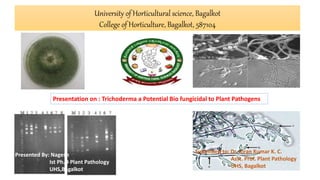
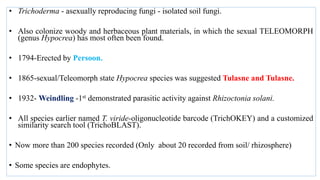
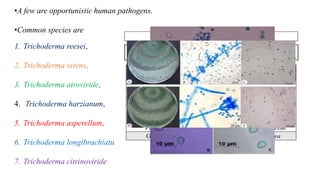
Presentation on : Trichoderma a Potential Bio fungicidal to Plant Pathogens
Submitted to: Dr. Kiran Kumar K. C.
Asst. Prof. Plant Pathology
UHS, Bagalkot
Presented By: Nagesh
Ist Ph.D Plant Pathology
UHS,Bagalkot
• Trichoderma - asexually reproducing fungi - isolated soil fungi.
• Also colonize woody and herbaceous plant materials, in which the sexual TELEOMORPH
(genus Hypocrea) has most often been found.
• 1794-Erected by Persoon.
• 1865-sexual/Teleomorph state Hypocrea species was suggested Tulasne and Tulasne.
• 1932- Weindling -1st demonstrated parasitic activity against Rhizoctonia solani.
• All species earlier named T. viride-oligonucleotide barcode (TrichOKEY) and a customized
similarity search tool (TrichoBLAST).
• Now more than 200 species recorded (Only about 20 recorded from soil/ rhizosphere)
• Some species are endophytes.
•A few are opportunistic human pathogens.
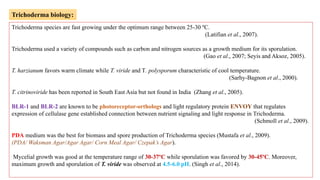
•Common species are
1. Trichoderma reesei,
2. Trichoderma virens,
3. Trichoderma atroviride,
4. Trichoderma harzianum,
5. Trichoderma asperellum,
6. Trichoderma longibrachiatum,
7. Trichoderma citrinoviride
Trichoderma biology:
Trichoderma species are fast growing under the optimum range between 25-30 ºC.
(Latifian et al., 2007).
Trichoderma used a variety of compounds such as carbon and nitrogen sources as a growth medium for its sporulation.
(Gao et al., 2007; Seyis and Aksoz, 2005).
T. harzianum favors warm climate while T. viride and T. polysporum characteristic of cool temperature.
(Sarhy-Bagnon et al., 2000).
T. citrinoviride has been reported in South East Asia but not found in India (Zhang et al., 2005).
BLR-1 and BLR-2 are known to be photoreceptor-orthologs and light regulatory protein ENVOY that regulates
expression of cellulase gene established connection between nutrient signaling and light response in Trichoderma.
(Schmoll et al., 2009).
PDA medium was the best for biomass and spore production of Trichoderma species (Mustafa et al., 2009).
(PDA/ Waksman Agar/Agar Agar/ Corn Meal Agar/ Czepak’s Agar).
Mycelial growth was good at the temperature range of 30-37ºC while sporulation was favored by 30-45ºC. Moreover,
maximum growth and sporulation of T. viride was observed at 4.5-6.0 pH. (Singh et al., 2014).
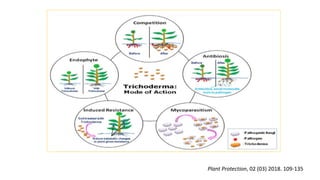
Plant Protection, 02 (03) 2018. 109-135
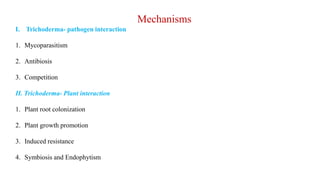
Mechanisms
I. Trichoderma- pathogen interaction
1. Mycoparasitism
2. Antibiosis
3. Competition
II. Trichoderma- Plant interaction
1. Plant root colonization
2. Plant growth promotion
3. Induced resistance
4. Symbiosis and Endophytism
Mycoparasitism :
1. Chemotropic growth of Trichoderma.
2. Recognition of the host.
3. coiling and appresoria formation.
4. secretion of hydrolytic enzymes. (glucanases, chitinases and proteases)
5. penetrations of the hyphae and lysis of the host.
Coilling
Root
A
A
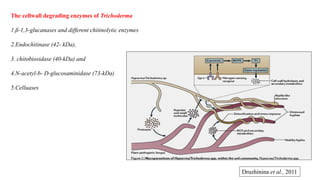
The cellwall degrading enzymes of Trichoderma
1.ß-1,3-glucanases and different chitinolytic enzymes
2.Endochitinase (42- kDa),
3. chitobiosidase (40-kDa) and
4.N-acetyl-b- D-glucosaminidase (73-kDa)
5.Celluases
Druzhinina et al., 2011
Antibiosis
Two different mechanisms of action.
1. The production of low molecular weight, non-polar, volatile compounds (i.e. 6PP) results in a high concentration of
antibiotics in the soil environment, that have a relatively long distance range of influence on the microbial
community.
2. Short distance effect may be due to the polar antibiotics and peptaibols acting in close proximity to the producing
hyphae.
(i)Volatile antibiotics, i.e. 6-pentyl-a-pyrone (6PP) and most of theisocyanide derivates.
(ii)Water-soluble compounds, i.e. heptelidic acid or koningic acid.
(iii)Peptaibols, which are linear oligopeptides of 12–22 amino acids rich in a-aminoisobutyric acid, N-acetylated at the N-
terminus and containing an amino alcohol (Pheol or Trpol) at the C-terminus.
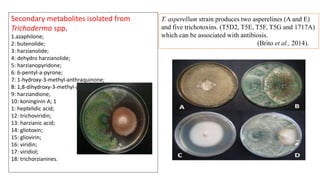
Secondary metabolites isolated from
Trichoderma spp.
1.azaphilone;
2: butenolide;
3: harzianolide;
4: dehydro harzianolide;
5: harzianopyridone;
6: 6-pentyl-a-pyrone;
7: 1-hydroxy-3-methyl-anthraquinone;
8: 1,8-dihydroxy-3-methyl-anthraquinone;
9: harziandione;
10: koninginin A; 1
1: heptelidic acid;
12: trichoviridin;
13: harzianic acid;
14: gliotoxin;
15: gliovirin;
16: viridin;
17: viridiol;
18: trichorzianines.
T. asperellum strain produces two asperelines (A and E)
and five trichotoxins. (T5D2, T5E, T5F, T5G and 1717A)
which can be associated with antibiosis.
(Brito et al., 2014).
1. Competition for substrates is the most important factor for fungi as is competition for light in the case of
evolution of plants (Garrett, 1956).
2. Root exudates and rhizosphere are rich source of nutrients such as sugar, amino acids, iron, vitamins,
organic acids etc.
3. The proficient mobilization of immobile nutrients and their utilization makes it more efficient and
competitive.
4. Production of organic acids, such as gluconic, citric and fumaric acids, which decrease soil pH and allow
the solubilization of phosphates, micronutrients and mineral cations like iron, manganese and magnesium.
(Vinale et al., 2008).
“In the aerobic environment (with oxygen and neutral pH) iron exists mainly as Fe3+ and tends to form
insoluble ferric oxide, making it unavailable for root absorption and microbial growth. (Miethke, 2013).
Iron act as cofactor of numerous enzymes
Trichoderma secrete siderophore, an iron chelating compounds which bind with insoluble iron (Fe+3) and
converted to soluble form (Fe+2) .
Competition
Trichoderma–plant interaction
Plant root colonization
The hyphae penetrate the root cortex but the colonization by Trichoderma is stopped, probably by the
deposition of callose barriers by the surrounding plant tissues. It appears that this interaction evolves into
a symbiotic rather than a parasitic relationship between the fungus and the plant, whereby the fungus
occupies a nutritional niche and the plant is protected from disease.
Direct molecular cross-talk occurs between the fungus and the plant.
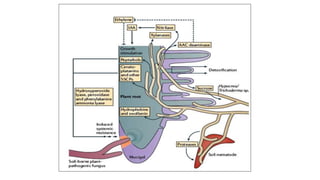
Elicitors from Trichoderma activate the expression of genes involved in the plant defence response system,
and promote the growth of the plant, root system and nutrient availability. This effect in turn augments
the zone for colonization and the nutrients available for the biocontrol fungus, subsequently increasing
the overall antagonism to plant pathogens.
Plant growth promotional activity :
Trichoderma Secondary Metabolites: Koninginins, 6pentyl-a-pyrone, trichocaranes A – D, harzianopyridone,
cyclonerodiol, harzianolide and harzianic acid are examples of isolated compounds that affect plant growth in a
concentration dependent manner.
(Vinale et al., 2014).
Effect on seed germination :
Seed biopriming and seed treatment with Trichoderma spp. trigger the release and/or production of enzymes and
phytohormones which are involved in seed germination.
T.harzianum produces a metabolite as gliotoxin that may mimic the plant growth hormone gibberellic acid which is
involved seed germination process.
Effect on plant morphology :
Many lines of evidence strongly support a role for auxin in the regulation of root system architecture. T. virens is able to
produce auxins as indole-3acetic acid (IAA), indole-3-acetaldehyde (IAAld), and indole-3-ethanol (IEt).
(Contreras-Cornejo et al., 2009)
Trichoderma spp. have three MAPK cascades comprising MAPKKK, MAPKK and MAPK and
MAPK signaling pathways may act in mycoparasitism and biocontrol.
Earlier evidences suggested the involvement of chit42, chit3, bgn13.1, Bgn2 Bgn3 and
prb1 are involved in chitinases, glucanases and proteases in biocontrol (Mondizar et. al.,
2011).
T. atroviride produce the volatile metabolite 6-pentyl-2H-pyran-2-one (6-PP) which plays
an important role in Trichoderma– fungal interactions. (Hasan et al., 2008, Vinale et al.,
2009).
Earlier evidences suggested the involvement of chit42, chit3, bgn13.1, Bgn2 Bgn3 and
prb1 are involved in chitinases, glucanases and proteases in biocontrol (Mondizar et. al.,
2011).
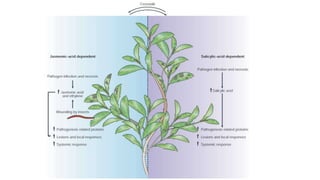
Induced-resistance
Interaction of Trichoderma with the plant, different classes of metabolites may act as elicitors
or resistance inducers.
These molecules include:
(i) proteins with enzymatic activity, such as xylanase
(ii) avirulence-like gene products able to induce defence reactions in plants
(iii) low-molecular-weight compounds released from fungal or plant cell walls by the activity
of Trichoderma enzymes.
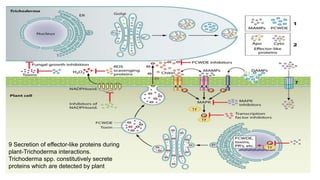
9 Secretion of effector-like proteins during
plant-Trichoderma interactions.
Trichoderma spp. constitutively secrete
proteins which are detected by plant
Biocontrol genes of Trichoderma :
The genome sequencing of Trichoderma species has provided exclusive data for phylogenetic and bioinformatic analyses
toward understanding the roles of these opportunists in agroecosystems.
At present the, genome sequences of seven species: Trichoderma harzianum, T. asperellum, T. reesei, T. virens,
T . atroviride, T. longibrachiatum and T. citrinoviride are available.
(Sharma et al., 2011).
Plant growth promotional activities and their environmental adaptation (drought, salt, heavy metal tolerance etc.).
Several laboratories have recently started or planned to use proteomic and genomic analysis to frame the changes that
occur in the Trichoderma.
Table.1 Biocontrol genes of Trichoderma spp
Symbiosis and Endophytism
Endophytism: a fungus, or a bacterium living within plant tissues for a part of its life without causing
apparent damage/injury.
The saprophytic fitness of Trichoderma species has enabled their establishment in soil and rhizosphere and
often within roots where hyphae grow between cortical cells
Although well known for their ability to colonize the rhizosphere with limited root penetration, some
Trichoderma species are known to reside in plants as typical endophytes, entering through trichomes by
producing appressoria-like structures.
T. Asperellum, T. virens, T. koningiopsis, T. stilbohypoxyli and T. stromaticum
Isolation of
Trichoderma
Precautions:
Some precautionary measures should be kept in mind regarding the application of Trichoderma inoculums in
the field condition.
1. Don’t settle treated Farm Yard Manure (FYM) for a longer time.
2. Don’t place Trichoderma treated seed in direct sunlight.
3. Don’t apply chemical pesticides or fungicides after application of Trichoderma for 5-6 days.
4. Moisture is an important factor for Trichoderma growth and reproduction so don’t try to use it in dry soil.
Singh. et al., 2018
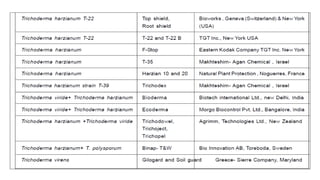
Trichoderma based commercial products against various diseases
Future Prospects :
Omic studies on Trichoderma spp. are regarded as a successful case of translational research, where data are
quickly applied to:
(a) improved agent-selection methods that provide new active principles for commercial products;
(b) new types of formulations;
(c) optimized application protocols;
(d) safer use, etc.
More than 100 Trichoderma-based agriculture products are today on the market, in spite of the difficulties
encountered with the registration process
Enhancement of Lytic Enzymes Activity and AntagonisticTraits of
Trichoderma harzianum
Using γ-Radiation Induced Mutation
J. Agr.Sci.Tech. (2019)Vol. 21(4): 1035-1048
Ghasemi. et al., 2019
MATERIAL AND METHODS:
Isolation and Identification of T. harzianum
Determination of Growth Rates of Fungi
Antagonistic Activity of T. harzianum and Its Mutants against R. solani
I= (1-Cn/Co)×100.
Chitinase and Cellulase Enzyme Production
Extracellular Enzyme Production
Estimation of Extracellular Protein Production and Enzyme Activity
Electrophoresis and Molecular Size Determination. (SDS– PAGE)
Table 1. Percentage of growth inhibition of R. solani by T. harzianum mutants after 7 days' incubation in dual culture assay
Table 2. Extracellular protein production assay and the rate of mycelial growth of T. harzianum wild type
(T. h control) and its mutant isolates
Table 3. Specific Cellulase (Endo- and Exo-glucanase) and Chitinase enzyme assay of T. harzianum and its
mutant isolates in TFM supernatant after 48 h incubation at 180 rpm and 28 ˚C
SDS-PAGE Analysis and Molecular Size Determination
Figure 1. The profile of chitinase enzyme protein and optical density measurement of protein bands in the T. harzianum
wild type and its mutant isolates by Gel –Pro (Ver. 6).
Figure 2. The profile of cellulase enzyme protein and optical density measurement of protein bands in the T. harzianum
wild type and its mutant isolates by Gel –Pro (Ver.6).

Trichoderma ppt

  • 1.
    University of Horticulturalscience, Bagalkot College of Horticulture, Bagalkot, 587104 Presentation on : Trichoderma a Potential Bio fungicidal to Plant Pathogens Submitted to: Dr. Kiran Kumar K. C. Asst. Prof. Plant Pathology UHS, Bagalkot Presented By: Nagesh Ist Ph.D Plant Pathology UHS,Bagalkot
  • 2.
    • Trichoderma -asexually reproducing fungi - isolated soil fungi. • Also colonize woody and herbaceous plant materials, in which the sexual TELEOMORPH (genus Hypocrea) has most often been found. • 1794-Erected by Persoon. • 1865-sexual/Teleomorph state Hypocrea species was suggested Tulasne and Tulasne. • 1932- Weindling -1st demonstrated parasitic activity against Rhizoctonia solani. • All species earlier named T. viride-oligonucleotide barcode (TrichOKEY) and a customized similarity search tool (TrichoBLAST). • Now more than 200 species recorded (Only about 20 recorded from soil/ rhizosphere) • Some species are endophytes.
  • 3.
    •A few areopportunistic human pathogens. •Common species are 1. Trichoderma reesei, 2. Trichoderma virens, 3. Trichoderma atroviride, 4. Trichoderma harzianum, 5. Trichoderma asperellum, 6. Trichoderma longibrachiatum, 7. Trichoderma citrinoviride
  • 4.
    Trichoderma biology: Trichoderma speciesare fast growing under the optimum range between 25-30 ºC. (Latifian et al., 2007). Trichoderma used a variety of compounds such as carbon and nitrogen sources as a growth medium for its sporulation. (Gao et al., 2007; Seyis and Aksoz, 2005). T. harzianum favors warm climate while T. viride and T. polysporum characteristic of cool temperature. (Sarhy-Bagnon et al., 2000). T. citrinoviride has been reported in South East Asia but not found in India (Zhang et al., 2005). BLR-1 and BLR-2 are known to be photoreceptor-orthologs and light regulatory protein ENVOY that regulates expression of cellulase gene established connection between nutrient signaling and light response in Trichoderma. (Schmoll et al., 2009). PDA medium was the best for biomass and spore production of Trichoderma species (Mustafa et al., 2009). (PDA/ Waksman Agar/Agar Agar/ Corn Meal Agar/ Czepak’s Agar). Mycelial growth was good at the temperature range of 30-37ºC while sporulation was favored by 30-45ºC. Moreover, maximum growth and sporulation of T. viride was observed at 4.5-6.0 pH. (Singh et al., 2014).
  • 5.
    Plant Protection, 02(03) 2018. 109-135
  • 6.
    Mechanisms I. Trichoderma- pathogeninteraction 1. Mycoparasitism 2. Antibiosis 3. Competition II. Trichoderma- Plant interaction 1. Plant root colonization 2. Plant growth promotion 3. Induced resistance 4. Symbiosis and Endophytism
  • 7.
    Mycoparasitism : 1. Chemotropicgrowth of Trichoderma. 2. Recognition of the host. 3. coiling and appresoria formation. 4. secretion of hydrolytic enzymes. (glucanases, chitinases and proteases) 5. penetrations of the hyphae and lysis of the host. Coilling Root A A
  • 8.
    The cellwall degradingenzymes of Trichoderma 1.ß-1,3-glucanases and different chitinolytic enzymes 2.Endochitinase (42- kDa), 3. chitobiosidase (40-kDa) and 4.N-acetyl-b- D-glucosaminidase (73-kDa) 5.Celluases Druzhinina et al., 2011
  • 9.
    Antibiosis Two different mechanismsof action. 1. The production of low molecular weight, non-polar, volatile compounds (i.e. 6PP) results in a high concentration of antibiotics in the soil environment, that have a relatively long distance range of influence on the microbial community. 2. Short distance effect may be due to the polar antibiotics and peptaibols acting in close proximity to the producing hyphae. (i)Volatile antibiotics, i.e. 6-pentyl-a-pyrone (6PP) and most of theisocyanide derivates. (ii)Water-soluble compounds, i.e. heptelidic acid or koningic acid. (iii)Peptaibols, which are linear oligopeptides of 12–22 amino acids rich in a-aminoisobutyric acid, N-acetylated at the N- terminus and containing an amino alcohol (Pheol or Trpol) at the C-terminus.
  • 10.
    Secondary metabolites isolatedfrom Trichoderma spp. 1.azaphilone; 2: butenolide; 3: harzianolide; 4: dehydro harzianolide; 5: harzianopyridone; 6: 6-pentyl-a-pyrone; 7: 1-hydroxy-3-methyl-anthraquinone; 8: 1,8-dihydroxy-3-methyl-anthraquinone; 9: harziandione; 10: koninginin A; 1 1: heptelidic acid; 12: trichoviridin; 13: harzianic acid; 14: gliotoxin; 15: gliovirin; 16: viridin; 17: viridiol; 18: trichorzianines. T. asperellum strain produces two asperelines (A and E) and five trichotoxins. (T5D2, T5E, T5F, T5G and 1717A) which can be associated with antibiosis. (Brito et al., 2014).
  • 11.
    1. Competition forsubstrates is the most important factor for fungi as is competition for light in the case of evolution of plants (Garrett, 1956). 2. Root exudates and rhizosphere are rich source of nutrients such as sugar, amino acids, iron, vitamins, organic acids etc. 3. The proficient mobilization of immobile nutrients and their utilization makes it more efficient and competitive. 4. Production of organic acids, such as gluconic, citric and fumaric acids, which decrease soil pH and allow the solubilization of phosphates, micronutrients and mineral cations like iron, manganese and magnesium. (Vinale et al., 2008). “In the aerobic environment (with oxygen and neutral pH) iron exists mainly as Fe3+ and tends to form insoluble ferric oxide, making it unavailable for root absorption and microbial growth. (Miethke, 2013). Iron act as cofactor of numerous enzymes Trichoderma secrete siderophore, an iron chelating compounds which bind with insoluble iron (Fe+3) and converted to soluble form (Fe+2) . Competition
  • 12.
    Trichoderma–plant interaction Plant rootcolonization The hyphae penetrate the root cortex but the colonization by Trichoderma is stopped, probably by the deposition of callose barriers by the surrounding plant tissues. It appears that this interaction evolves into a symbiotic rather than a parasitic relationship between the fungus and the plant, whereby the fungus occupies a nutritional niche and the plant is protected from disease. Direct molecular cross-talk occurs between the fungus and the plant. Elicitors from Trichoderma activate the expression of genes involved in the plant defence response system, and promote the growth of the plant, root system and nutrient availability. This effect in turn augments the zone for colonization and the nutrients available for the biocontrol fungus, subsequently increasing the overall antagonism to plant pathogens.
  • 13.
    Plant growth promotionalactivity : Trichoderma Secondary Metabolites: Koninginins, 6pentyl-a-pyrone, trichocaranes A – D, harzianopyridone, cyclonerodiol, harzianolide and harzianic acid are examples of isolated compounds that affect plant growth in a concentration dependent manner. (Vinale et al., 2014). Effect on seed germination : Seed biopriming and seed treatment with Trichoderma spp. trigger the release and/or production of enzymes and phytohormones which are involved in seed germination. T.harzianum produces a metabolite as gliotoxin that may mimic the plant growth hormone gibberellic acid which is involved seed germination process. Effect on plant morphology : Many lines of evidence strongly support a role for auxin in the regulation of root system architecture. T. virens is able to produce auxins as indole-3acetic acid (IAA), indole-3-acetaldehyde (IAAld), and indole-3-ethanol (IEt). (Contreras-Cornejo et al., 2009)
  • 15.
    Trichoderma spp. havethree MAPK cascades comprising MAPKKK, MAPKK and MAPK and MAPK signaling pathways may act in mycoparasitism and biocontrol. Earlier evidences suggested the involvement of chit42, chit3, bgn13.1, Bgn2 Bgn3 and prb1 are involved in chitinases, glucanases and proteases in biocontrol (Mondizar et. al., 2011). T. atroviride produce the volatile metabolite 6-pentyl-2H-pyran-2-one (6-PP) which plays an important role in Trichoderma– fungal interactions. (Hasan et al., 2008, Vinale et al., 2009). Earlier evidences suggested the involvement of chit42, chit3, bgn13.1, Bgn2 Bgn3 and prb1 are involved in chitinases, glucanases and proteases in biocontrol (Mondizar et. al., 2011).
  • 16.
    Induced-resistance Interaction of Trichodermawith the plant, different classes of metabolites may act as elicitors or resistance inducers. These molecules include: (i) proteins with enzymatic activity, such as xylanase (ii) avirulence-like gene products able to induce defence reactions in plants (iii) low-molecular-weight compounds released from fungal or plant cell walls by the activity of Trichoderma enzymes.
  • 18.
    9 Secretion ofeffector-like proteins during plant-Trichoderma interactions. Trichoderma spp. constitutively secrete proteins which are detected by plant
  • 19.
    Biocontrol genes ofTrichoderma : The genome sequencing of Trichoderma species has provided exclusive data for phylogenetic and bioinformatic analyses toward understanding the roles of these opportunists in agroecosystems. At present the, genome sequences of seven species: Trichoderma harzianum, T. asperellum, T. reesei, T. virens, T . atroviride, T. longibrachiatum and T. citrinoviride are available. (Sharma et al., 2011). Plant growth promotional activities and their environmental adaptation (drought, salt, heavy metal tolerance etc.). Several laboratories have recently started or planned to use proteomic and genomic analysis to frame the changes that occur in the Trichoderma.
  • 20.
    Table.1 Biocontrol genesof Trichoderma spp
  • 21.
    Symbiosis and Endophytism Endophytism:a fungus, or a bacterium living within plant tissues for a part of its life without causing apparent damage/injury. The saprophytic fitness of Trichoderma species has enabled their establishment in soil and rhizosphere and often within roots where hyphae grow between cortical cells Although well known for their ability to colonize the rhizosphere with limited root penetration, some Trichoderma species are known to reside in plants as typical endophytes, entering through trichomes by producing appressoria-like structures. T. Asperellum, T. virens, T. koningiopsis, T. stilbohypoxyli and T. stromaticum
  • 24.
  • 28.
    Precautions: Some precautionary measuresshould be kept in mind regarding the application of Trichoderma inoculums in the field condition. 1. Don’t settle treated Farm Yard Manure (FYM) for a longer time. 2. Don’t place Trichoderma treated seed in direct sunlight. 3. Don’t apply chemical pesticides or fungicides after application of Trichoderma for 5-6 days. 4. Moisture is an important factor for Trichoderma growth and reproduction so don’t try to use it in dry soil.
  • 29.
  • 30.
    Trichoderma based commercialproducts against various diseases
  • 32.
    Future Prospects : Omicstudies on Trichoderma spp. are regarded as a successful case of translational research, where data are quickly applied to: (a) improved agent-selection methods that provide new active principles for commercial products; (b) new types of formulations; (c) optimized application protocols; (d) safer use, etc. More than 100 Trichoderma-based agriculture products are today on the market, in spite of the difficulties encountered with the registration process
  • 33.
    Enhancement of LyticEnzymes Activity and AntagonisticTraits of Trichoderma harzianum Using γ-Radiation Induced Mutation J. Agr.Sci.Tech. (2019)Vol. 21(4): 1035-1048 Ghasemi. et al., 2019
  • 34.
    MATERIAL AND METHODS: Isolationand Identification of T. harzianum Determination of Growth Rates of Fungi Antagonistic Activity of T. harzianum and Its Mutants against R. solani I= (1-Cn/Co)×100. Chitinase and Cellulase Enzyme Production Extracellular Enzyme Production Estimation of Extracellular Protein Production and Enzyme Activity Electrophoresis and Molecular Size Determination. (SDS– PAGE)
  • 35.
    Table 1. Percentageof growth inhibition of R. solani by T. harzianum mutants after 7 days' incubation in dual culture assay
  • 36.
    Table 2. Extracellularprotein production assay and the rate of mycelial growth of T. harzianum wild type (T. h control) and its mutant isolates
  • 37.
    Table 3. SpecificCellulase (Endo- and Exo-glucanase) and Chitinase enzyme assay of T. harzianum and its mutant isolates in TFM supernatant after 48 h incubation at 180 rpm and 28 ˚C
  • 38.
    SDS-PAGE Analysis andMolecular Size Determination Figure 1. The profile of chitinase enzyme protein and optical density measurement of protein bands in the T. harzianum wild type and its mutant isolates by Gel –Pro (Ver. 6).
  • 39.
    Figure 2. Theprofile of cellulase enzyme protein and optical density measurement of protein bands in the T. harzianum wild type and its mutant isolates by Gel –Pro (Ver.6).