
By
Dr. HARINATHA REDDY, M.Sc, Ph.D.
On
11/07/2017
Dr. Aswartha Harinath Reddy
Department of Life Sciences
Srikrishnadevaraya University
Anantapur –A.P. India
Microbial associations
OR
Microbial Interactions
 Microorganisms can be physically associated with other organisms
in a variety of ways.
 One organism can be located on the surface of another, as an
ectosymbiont.
 In this case, the ectosymbiont usually is a smaller organism located
on the surface of a larger organism.
 In contrast, one organism can be located within another organism
as an endosymbiont.
 There also are many cases in which microorganisms live on both
the inside and the outside of another organism, a phenomenon
called ecto/ endosymbiosis.
 Fungi associated with plant roots (mycorrhizal fungi).
Symbiosis
 Symbiosis "living together", it is close and long-term/ short term
biological interaction between two different species.
 Symbiosis can be obligatory, which means that one or both of the
symbionts entirely depend on each other for survival, or facultative
(optional) when they can generally live independently.
 Symbiosis is also classified by physical attachment:
 Conjunctive symbiosis: in which the organisms have bodily union
each other.
 Disjunctive symbiosis: in which they are not in union.

 Symbiosis can vary between mutualism, commensalism, and
parasitism, though these grade into each other.
 It is often difficult to tell which is involved in a given
relationship.
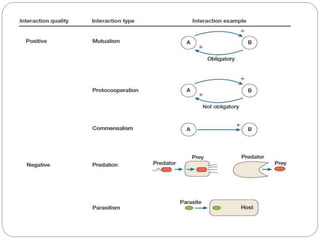
 In mutualism, both organisms benefit.
 In commensalism, one benefits and the other is unaffected;
 In parasitism, one benefits and the other is harmed.
 These microbial interactions can be Positive or
Negative:
 Positive interactions: Mutualism, proto-
cooperation, and commensalism and symbiosis.
 Negative interactions: Predation, Parasitism,
Amensalism, and Competition.
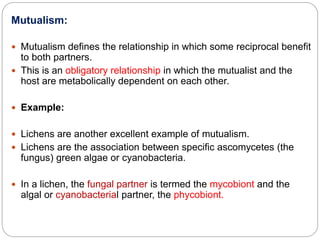
Mutualism:
 Mutualism defines the relationship in which some reciprocal benefit
to both partners.
 This is an obligatory relationship in which the mutualist and the
host are metabolically dependent on each other.
 Example:
 Lichens are another excellent example of mutualism.
 Lichens are the association between specific ascomycetes (the
fungus) green algae or cyanobacteria.
 In a lichen, the fungal partner is termed the mycobiont and the
algal or cyanobacterial partner, the phycobiont.
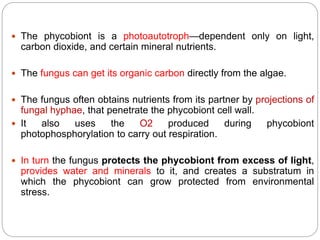
 The phycobiont is a photoautotroph—dependent only on light,
carbon dioxide, and certain mineral nutrients.
 The fungus can get its organic carbon directly from the algae.
 The fungus often obtains nutrients from its partner by projections of
fungal hyphae, that penetrate the phycobiont cell wall.
 It also uses the O2 produced during phycobiont
photophosphorylation to carry out respiration.
 In turn the fungus protects the phycobiont from excess of light,
provides water and minerals to it, and creates a substratum in
which the phycobiont can grow protected from environmental
stress.
The Rumen Ecosystem
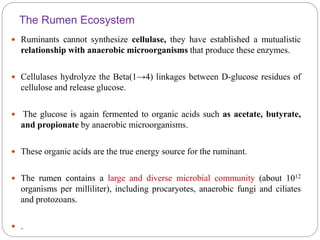
 Ruminants cannot synthesize cellulase, they have established a mutualistic
relationship with anaerobic microorganisms that produce these enzymes.
 Cellulases hydrolyze the Beta(1→4) linkages between D-glucose residues of
cellulose and release glucose.
 The glucose is again fermented to organic acids such as acetate, butyrate,
and propionate by anaerobic microorganisms.
 These organic acids are the true energy source for the ruminant.
 The rumen contains a large and diverse microbial community (about 1012
organisms per milliliter), including procaryotes, anaerobic fungi and ciliates
and protozoans.
 .
Legume–rhizobium association:
 The legume rhizobium association is a classic example of
mutualism rhizobia supply ammonia or amino acids to the
plant and in return receive organic acids (dicarboxylic acids,
malate and succinate) as a carbon and energy source.
 E. coli, which is one of the normal bacteria found in all human large
intestines.
 Humans provide food to E. coli and a place to live. In return, the E. coli
produce vitamin K.
E. coli and humans symbiotic relationship:
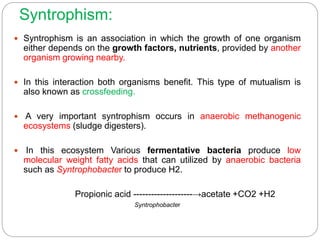
Syntrophism:
 Syntrophism is an association in which the growth of one organism
either depends on the growth factors, nutrients, provided by another
organism growing nearby.
 In this interaction both organisms benefit. This type of mutualism is
also known as crossfeeding.
 A very important syntrophism occurs in anaerobic methanogenic
ecosystems (sludge digesters).
 In this ecosystem Various fermentative bacteria produce low
molecular weight fatty acids that can utilized by anaerobic bacteria
such as Syntrophobacter to produce H2.
Propionic acid --------------------→acetate +CO2 +H2
Syntrophobacter
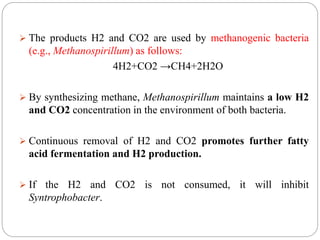
 The products H2 and CO2 are used by methanogenic bacteria
(e.g., Methanospirillum) as follows:
4H2+CO2 →CH4+2H2O
 By synthesizing methane, Methanospirillum maintains a low H2
and CO2 concentration in the environment of both bacteria.
 Continuous removal of H2 and CO2 promotes further fatty
acid fermentation and H2 production.
 If the H2 and CO2 is not consumed, it will inhibit
Syntrophobacter.
Proto-cooperation:
 Proto-cooperation or Synergism is a mutually
beneficial relationship, similar to that which occurs in
mutualism, in which both populations benefit from
each other.
 But in protocooperation, this relationship is not
obligatory.
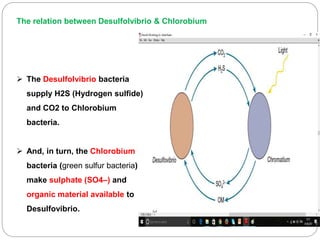
 The Desulfolvibrio bacteria
supply H2S (Hydrogen sulfide)
and CO2 to Chlorobium
bacteria.
 And, in turn, the Chlorobium
bacteria (green sulfur bacteria)
make sulphate (SO4–) and
organic material available to
Desulfovibrio.
The relation between Desulfolvibrio & Chlorobium
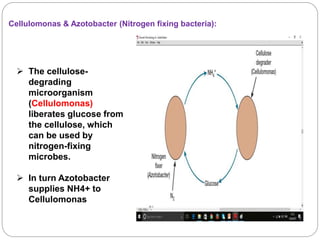
 The cellulose-
degrading
microorganism
(Cellulomonas)
liberates glucose from
the cellulose, which
can be used by
nitrogen-fixing
microbes.
 In turn Azotobacter
supplies NH4+ to
Cellulomonas
Cellulomonas & Azotobacter (Nitrogen fixing bacteria):
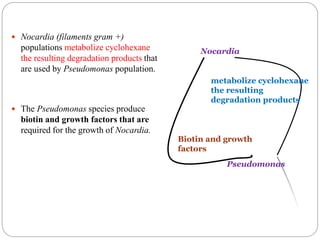
 Nocardia (filaments gram +)
populations metabolize cyclohexane
the resulting degradation products that
are used by Pseudomonas population.
 The Pseudomonas species produce
biotin and growth factors that are
required for the growth of Nocardia.
Nocardia
Pseudomonas
Biotin and growth
factors
metabolize cyclohexane
the resulting
degradation products
Commensalism:
 Commensalism is a relationship in which one symbiont,
the commensal, benefits while the other (sometimes
called the host) is neither harmed nor benefited.
 The commensalism is an unidirectional relationship
between two microbial populations. It is not ‘obligatory’.
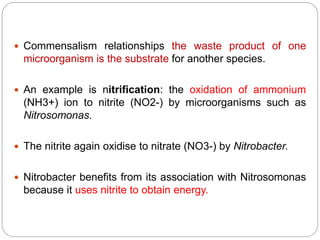
 Commensalism relationships the waste product of one
microorganism is the substrate for another species.
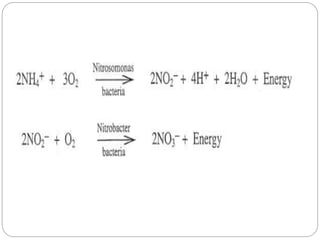
 An example is nitrification: the oxidation of ammonium
(NH3+) ion to nitrite (NO2-) by microorganisms such as
Nitrosomonas.
 The nitrite again oxidise to nitrate (NO3-) by Nitrobacter.
 Nitrobacter benefits from its association with Nitrosomonas
because it uses nitrite to obtain energy.
 Commensalism also is important in the colonization of the
human body and the surfaces of other animals and
plants.
 The microorganisms associated with an animal skin use
soluble, and particulate organic compounds from the host.
Under most conditions these microbes do not cause harm.
 Fungi can degrade cellulose and Lignin to glucose, which is
utilized by many bacteria.
 Many bacteria are unable to utilize cellulose, but they can
utilize the fungal breakdown products of cellulose, e.g.,
glucose and organic acids.
Negative interactions:
1. Amensalism,
2. predation,
3. parasitism,
4. competition.
Ammensalism:
 In this interaction /association one partner suppress the growth of other
partner by producing toxins like antibiotics and harmful gases like
ethylene or Nitrite etc.
Examples:
 E. coli cannot grow in the rumen due to presence of high amounts of
lactic acid produced by rumen anaerobes.
 Fatty acids produced on the skin by skin microflora inhibits the growth of
unwanted pathogens.
 O2 production by algae inhibits growth of anaerobes.
 High concentrations of ethanol (eg wine production) inhibits most
microbes other than the yeasts.
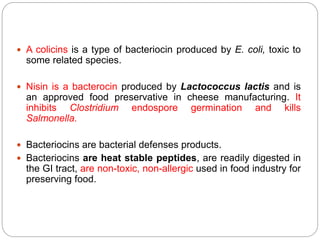
 A colicins is a type of bacteriocin produced by E. coli, toxic to
some related species.
 Nisin is a bacterocin produced by Lactococcus lactis and is
an approved food preservative in cheese manufacturing. It
inhibits Clostridium endospore germination and kills
Salmonella.
 Bacteriocins are bacterial defenses products.
 Bacteriocins are heat stable peptides, are readily digested in
the GI tract, are non-toxic, non-allergic used in food industry for
preserving food.
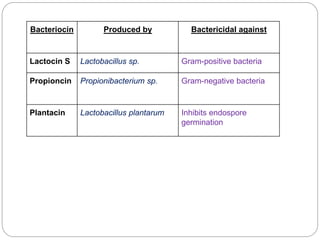
Bacteriocin Produced by Bactericidal against
Lactocin S Lactobacillus sp. Gram-positive bacteria
Propioncin Propionibacterium sp. Gram-negative bacteria
Plantacin Lactobacillus plantarum Inhibits endospore
germination
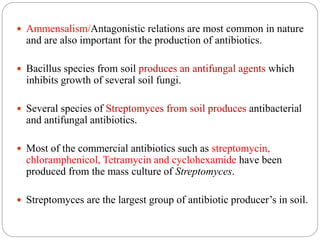
 Ammensalism/Antagonistic relations are most common in nature
and are also important for the production of antibiotics.
 Bacillus species from soil produces an antifungal agents which
inhibits growth of several soil fungi.
 Several species of Streptomyces from soil produces antibacterial
and antifungal antibiotics.
 Most of the commercial antibiotics such as streptomycin,
chloramphenicol, Tetramycin and cyclohexamide have been
produced from the mass culture of Streptomyces.
 Streptomyces are the largest group of antibiotic producer’s in soil.
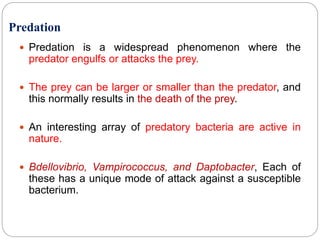
Predation
 Predation is a widespread phenomenon where the
predator engulfs or attacks the prey.
 The prey can be larger or smaller than the predator, and
this normally results in the death of the prey.
 An interesting array of predatory bacteria are active in
nature.
 Bdellovibrio, Vampirococcus, and Daptobacter, Each of
these has a unique mode of attack against a susceptible
bacterium.
 Bdellovibrio: penetrates the cell wall and multiplies
between the wall and the plasma membrane, a
periplasmic mode of attack, followed by lysis of the
prey and release of progeny.
 Vampirococcus: Nonlytic forms also are observed in
Vampirococcus. It attaches to the surface of the prey
(an epibiotic relationship) and then secretes enzymes
to release the cell contents.
 Daptobacter: penetrates a susceptible bacterial cell
and uses the cytoplasmic contents as a nutrient
source.
 Ciliates are excellent examples of predators that
engulf their prey bacteria, a single ciliate can ingest
60 to 70 prey bacteria per hour!.
 Predation on bacteria is important in the aquatic
environment and in sewage treatment where the
ciliates remove suspended bacteria that have not
settled.
 Many species of the soil-myxobacteria are predators
of other microbes.
 Many myxobacteria, e.g., Myxococcus xanthus, exhibit
predation on both bacteria and fungi.
 Myxobacteria produce a wide range of antibiotics and
lytic compounds that kill and decompose prey cells
and break down complex polymers are substrates for
growth.
Competition:
 Competition arises when different microorganisms within a
population or community try to acquire the same resource,
whether this is a physical location or a particular limiting nutrient.
Example:
 Exogenous nutrients are required for the germination of
chlamydospores, Oospores and conidia in soil.
 But other fungi and soil bacteria deplete these critical nutrients
required for spore germination and thereby hinder the spore
germination resulting into the decrease in population.
 Soil bacteria compete for space and suppress the growth of the
fungal population.
Parasitism:
 Parasitism is one of the most complex microbial interactions; the
line between parasitism and predation is difficult to define.
 This is a relationship in which one microorganism benefits from
the other, and the host is usually harmed.
 Parasitism is the relationship between two organisms, in which one
organism lives in or on another organism (Ecto and Endoparasite).
 The parasite completely dependent upon the host and feed on the
host cells, tissues and fluids.
 The parasite make physical and metabolic association with the
host.
 All major groups of plants, animals, and microorganisms are
sensitive to attack by microbial parasites.
Example:
 Viruses which attack bacteria (bacteriophages), fungi, and algae
are strict intracellular parasites since they cannot be cultivated as
free-living forms.
 There are also many strains of fungi which are parasitic on algae
and other fungi by penetration into the host.
Saprophytes or Saprotrophic nutrition
 Saprotrophic nutrition or lysotrophic nutrition is a process of
chemoheterotrophic extracellular digestion involved in the
processing of dead or decayed organic matter (Decomposers).
 It occurs in saprotrophytes or heterotrophs, and is most often
associated with fungi, soil bacteria and protozoa.
 Saprotrophic microscopic fungi are sometimes called saprobes
and bacterial flora are called saprophytes.
 The dead matter decomposes by saprotrophytes and breaks
such matter into its composites or simple organic molecules.
 Proteins are broken down into their amino acid composites
through the breaking of peptide bonds by proteases.
 Lipids are broken down into fatty acids and glycerol by lipases.
 Starch is broken down into pieces of simple disaccharides by
amylases.
 These products are re-absorbed by fungi and bacteria
through the cell wall via endocytosis.
Endozoic microbes:
 The microorganisms can be located within another organism are
called Endozoic microbes.
 Rhizobia- Rhizobia are bacteria that conduct Nitrogen fixation
for legume plants. Rhizobia supply ammonia or amino acids to
the plant and in return receive organic acids (principally as the
dicarboxylic acids, malate and succinate) as a carbon and
energy source.
 Mycorrhizae- Mycorrhizae are similar to rhizobia in that they
interact with plants roots. Whereas Rhizobia are bacteria that fix
nitrogen, Mycorrhizas are fungi that bring nutrients to the plants
in return for carbon.
Microbial associations or microbial interactions

Microbial associations or microbial interactions

  • 1.
    By Dr. HARINATHA REDDY,M.Sc, Ph.D. On 11/07/2017 Dr. Aswartha Harinath Reddy Department of Life Sciences Srikrishnadevaraya University Anantapur –A.P. India Microbial associations OR Microbial Interactions
  • 2.
     Microorganisms canbe physically associated with other organisms in a variety of ways.  One organism can be located on the surface of another, as an ectosymbiont.  In this case, the ectosymbiont usually is a smaller organism located on the surface of a larger organism.  In contrast, one organism can be located within another organism as an endosymbiont.  There also are many cases in which microorganisms live on both the inside and the outside of another organism, a phenomenon called ecto/ endosymbiosis.  Fungi associated with plant roots (mycorrhizal fungi).
  • 3.
    Symbiosis  Symbiosis "livingtogether", it is close and long-term/ short term biological interaction between two different species.  Symbiosis can be obligatory, which means that one or both of the symbionts entirely depend on each other for survival, or facultative (optional) when they can generally live independently.  Symbiosis is also classified by physical attachment:  Conjunctive symbiosis: in which the organisms have bodily union each other.  Disjunctive symbiosis: in which they are not in union. 
  • 4.
     Symbiosis canvary between mutualism, commensalism, and parasitism, though these grade into each other.  It is often difficult to tell which is involved in a given relationship.  In mutualism, both organisms benefit.  In commensalism, one benefits and the other is unaffected;  In parasitism, one benefits and the other is harmed.
  • 5.
     These microbialinteractions can be Positive or Negative:  Positive interactions: Mutualism, proto- cooperation, and commensalism and symbiosis.  Negative interactions: Predation, Parasitism, Amensalism, and Competition.
  • 7.
    Mutualism:  Mutualism definesthe relationship in which some reciprocal benefit to both partners.  This is an obligatory relationship in which the mutualist and the host are metabolically dependent on each other.  Example:  Lichens are another excellent example of mutualism.  Lichens are the association between specific ascomycetes (the fungus) green algae or cyanobacteria.  In a lichen, the fungal partner is termed the mycobiont and the algal or cyanobacterial partner, the phycobiont.
  • 8.
     The phycobiontis a photoautotroph—dependent only on light, carbon dioxide, and certain mineral nutrients.  The fungus can get its organic carbon directly from the algae.  The fungus often obtains nutrients from its partner by projections of fungal hyphae, that penetrate the phycobiont cell wall.  It also uses the O2 produced during phycobiont photophosphorylation to carry out respiration.  In turn the fungus protects the phycobiont from excess of light, provides water and minerals to it, and creates a substratum in which the phycobiont can grow protected from environmental stress.
  • 9.
    The Rumen Ecosystem Ruminants cannot synthesize cellulase, they have established a mutualistic relationship with anaerobic microorganisms that produce these enzymes.  Cellulases hydrolyze the Beta(1→4) linkages between D-glucose residues of cellulose and release glucose.  The glucose is again fermented to organic acids such as acetate, butyrate, and propionate by anaerobic microorganisms.  These organic acids are the true energy source for the ruminant.  The rumen contains a large and diverse microbial community (about 1012 organisms per milliliter), including procaryotes, anaerobic fungi and ciliates and protozoans.  .
  • 10.
    Legume–rhizobium association:  Thelegume rhizobium association is a classic example of mutualism rhizobia supply ammonia or amino acids to the plant and in return receive organic acids (dicarboxylic acids, malate and succinate) as a carbon and energy source.
  • 11.
     E. coli,which is one of the normal bacteria found in all human large intestines.  Humans provide food to E. coli and a place to live. In return, the E. coli produce vitamin K. E. coli and humans symbiotic relationship:
  • 12.
    Syntrophism:  Syntrophism isan association in which the growth of one organism either depends on the growth factors, nutrients, provided by another organism growing nearby.  In this interaction both organisms benefit. This type of mutualism is also known as crossfeeding.  A very important syntrophism occurs in anaerobic methanogenic ecosystems (sludge digesters).  In this ecosystem Various fermentative bacteria produce low molecular weight fatty acids that can utilized by anaerobic bacteria such as Syntrophobacter to produce H2. Propionic acid --------------------→acetate +CO2 +H2 Syntrophobacter
  • 13.
     The productsH2 and CO2 are used by methanogenic bacteria (e.g., Methanospirillum) as follows: 4H2+CO2 →CH4+2H2O  By synthesizing methane, Methanospirillum maintains a low H2 and CO2 concentration in the environment of both bacteria.  Continuous removal of H2 and CO2 promotes further fatty acid fermentation and H2 production.  If the H2 and CO2 is not consumed, it will inhibit Syntrophobacter.
  • 14.
    Proto-cooperation:  Proto-cooperation orSynergism is a mutually beneficial relationship, similar to that which occurs in mutualism, in which both populations benefit from each other.  But in protocooperation, this relationship is not obligatory.
  • 15.
     The Desulfolvibriobacteria supply H2S (Hydrogen sulfide) and CO2 to Chlorobium bacteria.  And, in turn, the Chlorobium bacteria (green sulfur bacteria) make sulphate (SO4–) and organic material available to Desulfovibrio. The relation between Desulfolvibrio & Chlorobium
  • 16.
     The cellulose- degrading microorganism (Cellulomonas) liberatesglucose from the cellulose, which can be used by nitrogen-fixing microbes.  In turn Azotobacter supplies NH4+ to Cellulomonas Cellulomonas & Azotobacter (Nitrogen fixing bacteria):
  • 17.
     Nocardia (filamentsgram +) populations metabolize cyclohexane the resulting degradation products that are used by Pseudomonas population.  The Pseudomonas species produce biotin and growth factors that are required for the growth of Nocardia. Nocardia Pseudomonas Biotin and growth factors metabolize cyclohexane the resulting degradation products
  • 18.
    Commensalism:  Commensalism isa relationship in which one symbiont, the commensal, benefits while the other (sometimes called the host) is neither harmed nor benefited.  The commensalism is an unidirectional relationship between two microbial populations. It is not ‘obligatory’.
  • 19.
     Commensalism relationshipsthe waste product of one microorganism is the substrate for another species.  An example is nitrification: the oxidation of ammonium (NH3+) ion to nitrite (NO2-) by microorganisms such as Nitrosomonas.  The nitrite again oxidise to nitrate (NO3-) by Nitrobacter.  Nitrobacter benefits from its association with Nitrosomonas because it uses nitrite to obtain energy.
  • 21.
     Commensalism alsois important in the colonization of the human body and the surfaces of other animals and plants.  The microorganisms associated with an animal skin use soluble, and particulate organic compounds from the host. Under most conditions these microbes do not cause harm.  Fungi can degrade cellulose and Lignin to glucose, which is utilized by many bacteria.  Many bacteria are unable to utilize cellulose, but they can utilize the fungal breakdown products of cellulose, e.g., glucose and organic acids.
  • 22.
    Negative interactions: 1. Amensalism, 2.predation, 3. parasitism, 4. competition.
  • 23.
    Ammensalism:  In thisinteraction /association one partner suppress the growth of other partner by producing toxins like antibiotics and harmful gases like ethylene or Nitrite etc. Examples:  E. coli cannot grow in the rumen due to presence of high amounts of lactic acid produced by rumen anaerobes.  Fatty acids produced on the skin by skin microflora inhibits the growth of unwanted pathogens.  O2 production by algae inhibits growth of anaerobes.  High concentrations of ethanol (eg wine production) inhibits most microbes other than the yeasts.
  • 24.
     A colicinsis a type of bacteriocin produced by E. coli, toxic to some related species.  Nisin is a bacterocin produced by Lactococcus lactis and is an approved food preservative in cheese manufacturing. It inhibits Clostridium endospore germination and kills Salmonella.  Bacteriocins are bacterial defenses products.  Bacteriocins are heat stable peptides, are readily digested in the GI tract, are non-toxic, non-allergic used in food industry for preserving food.
  • 25.
    Bacteriocin Produced byBactericidal against Lactocin S Lactobacillus sp. Gram-positive bacteria Propioncin Propionibacterium sp. Gram-negative bacteria Plantacin Lactobacillus plantarum Inhibits endospore germination
  • 26.
     Ammensalism/Antagonistic relationsare most common in nature and are also important for the production of antibiotics.  Bacillus species from soil produces an antifungal agents which inhibits growth of several soil fungi.  Several species of Streptomyces from soil produces antibacterial and antifungal antibiotics.  Most of the commercial antibiotics such as streptomycin, chloramphenicol, Tetramycin and cyclohexamide have been produced from the mass culture of Streptomyces.  Streptomyces are the largest group of antibiotic producer’s in soil.
  • 27.
    Predation  Predation isa widespread phenomenon where the predator engulfs or attacks the prey.  The prey can be larger or smaller than the predator, and this normally results in the death of the prey.  An interesting array of predatory bacteria are active in nature.  Bdellovibrio, Vampirococcus, and Daptobacter, Each of these has a unique mode of attack against a susceptible bacterium.
  • 28.
     Bdellovibrio: penetratesthe cell wall and multiplies between the wall and the plasma membrane, a periplasmic mode of attack, followed by lysis of the prey and release of progeny.  Vampirococcus: Nonlytic forms also are observed in Vampirococcus. It attaches to the surface of the prey (an epibiotic relationship) and then secretes enzymes to release the cell contents.  Daptobacter: penetrates a susceptible bacterial cell and uses the cytoplasmic contents as a nutrient source.
  • 30.
     Ciliates areexcellent examples of predators that engulf their prey bacteria, a single ciliate can ingest 60 to 70 prey bacteria per hour!.  Predation on bacteria is important in the aquatic environment and in sewage treatment where the ciliates remove suspended bacteria that have not settled.
  • 31.
     Many speciesof the soil-myxobacteria are predators of other microbes.  Many myxobacteria, e.g., Myxococcus xanthus, exhibit predation on both bacteria and fungi.  Myxobacteria produce a wide range of antibiotics and lytic compounds that kill and decompose prey cells and break down complex polymers are substrates for growth.
  • 32.
    Competition:  Competition ariseswhen different microorganisms within a population or community try to acquire the same resource, whether this is a physical location or a particular limiting nutrient. Example:  Exogenous nutrients are required for the germination of chlamydospores, Oospores and conidia in soil.  But other fungi and soil bacteria deplete these critical nutrients required for spore germination and thereby hinder the spore germination resulting into the decrease in population.  Soil bacteria compete for space and suppress the growth of the fungal population.
  • 33.
    Parasitism:  Parasitism isone of the most complex microbial interactions; the line between parasitism and predation is difficult to define.  This is a relationship in which one microorganism benefits from the other, and the host is usually harmed.  Parasitism is the relationship between two organisms, in which one organism lives in or on another organism (Ecto and Endoparasite).
  • 34.
     The parasitecompletely dependent upon the host and feed on the host cells, tissues and fluids.  The parasite make physical and metabolic association with the host.  All major groups of plants, animals, and microorganisms are sensitive to attack by microbial parasites.
  • 35.
    Example:  Viruses whichattack bacteria (bacteriophages), fungi, and algae are strict intracellular parasites since they cannot be cultivated as free-living forms.  There are also many strains of fungi which are parasitic on algae and other fungi by penetration into the host.
  • 36.
    Saprophytes or Saprotrophicnutrition  Saprotrophic nutrition or lysotrophic nutrition is a process of chemoheterotrophic extracellular digestion involved in the processing of dead or decayed organic matter (Decomposers).  It occurs in saprotrophytes or heterotrophs, and is most often associated with fungi, soil bacteria and protozoa.  Saprotrophic microscopic fungi are sometimes called saprobes and bacterial flora are called saprophytes.
  • 37.
     The deadmatter decomposes by saprotrophytes and breaks such matter into its composites or simple organic molecules.  Proteins are broken down into their amino acid composites through the breaking of peptide bonds by proteases.  Lipids are broken down into fatty acids and glycerol by lipases.  Starch is broken down into pieces of simple disaccharides by amylases.  These products are re-absorbed by fungi and bacteria through the cell wall via endocytosis.
  • 38.
    Endozoic microbes:  Themicroorganisms can be located within another organism are called Endozoic microbes.  Rhizobia- Rhizobia are bacteria that conduct Nitrogen fixation for legume plants. Rhizobia supply ammonia or amino acids to the plant and in return receive organic acids (principally as the dicarboxylic acids, malate and succinate) as a carbon and energy source.  Mycorrhizae- Mycorrhizae are similar to rhizobia in that they interact with plants roots. Whereas Rhizobia are bacteria that fix nitrogen, Mycorrhizas are fungi that bring nutrients to the plants in return for carbon.