Microbial interaction refers to the various ways microorganisms affect each other's growth, survival, and activity. These interactions can be beneficial, harmful, or neutral, including mutualism, commensalism, parasitism, competition, and predation.
VIVEKANANDHAARTS AND SCIENCECOLLEGEFOR WOMEN
VEERACHIPALAYAM,SANKAGIRI-6366007
DEPARTMENT OF MICROBIOLOGY
SUBJECT: SOIL AND ENVIROMENTAL MICROBIOLOGY
TOPIC: Microbial Interaction- Mutualism, Commensalism, Amensalism, Synergism, Competition
SUBJECT INCHARGE PRESENTED BY;
Dr.R.DINESH KUMAR JEEVITHA.S
ASSISTANT PROFESSOR II MSc MICROBIOLOGY
DEPARTMENT OF MICROBIOLOGY DEPARTMENTOFMICROBIOLOGY
VIAAS,SANKAGIRI VIAAS,SANKAGIRI
2.
MICROBIAL INTERACTIONS INSOIL
INTRODUCTION:
Soil microorganisms engage in a complex web of interactions that are crucial for
ecosystem health and plant growth. These interactions include both beneficial and
detrimental relationships, impacting nutrient cycling, plant health, and soil structure.
Microbial interactions are ubiquitous, diverse, critically important in the function
of any biological community, and are crucial in global biogeochemistry.
Soil microbial interaction through microbial volatile production leads to the
suppression of microbial communities which results in soil suppressiveness. Soil
suppressiveness results in microbial interaction and shift in microbial communities, which
further affects microbial volatile production.
3.
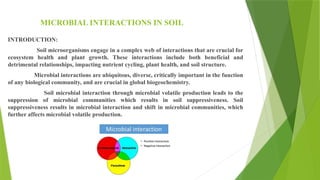
TYPES OF MICROBIALINTERACTIONS IN SOIL
They are two types of microbial interaction
Positive interaction
Negative interaction
POSITIVE INTERACTION
Mutualism
Syntrophism
Commensalism
Proto cooperation
NEGATIVE INTERACTION
Ammensalism
Competition
Parasitism
Predation
4.
MUTUALSIM :
It isdefined as the relationship in which each organism in interaction gets
benefits from the association.
A mutualistic relationship is very specific where one member of the association
cannot be replaced by another species . Mutualism requires close physical contact
between interacting organisms
It is an obligatory relationship in which mutualist and host are metabolically
dependent on each other.
The mutualistic relationship between organisms allows them to act as a single
organism.
Examples of mutualism:
Lichens: Lichens are an excellent example of mutualism. They are the association
of specific fungi and certain genus of algae. In lichen, the fungal partner is called
mycobiont and algal partner is called phycobiont is a member of cyanobacteria and
green algae (Trabauxua).
5.
COMMENSALISM
It is arelationship in which one organism (commensal) in the association is
benefited while another organism (host) of the association is neither benefited nor
harmed.It is a unidirectional association and if the commensal is separated from the
host, it can survive.
Examples of commensalism:
Non-pathogenic E. coli in the intestinal tract of humans:
E. coli is a facultative anaerobe that uses oxygen and lowers the O2
concentration in the gut which creates a suitable environment for obligate anaerobes
such as Bacteroides. E. coli is a host which remains unaffected by Bacteroides.
Association of Nitrosomonas (host) and Nitrobacter (commensal) in Nitrification:
Nitrosomonas oxidize Ammonia into Nitrite and finally, Nitrobacter uses nitrite
toobtain energy and oxidize it into Nitrate.
6.
AMENSALISM :
One microbialpopulation produces substances that are inhibitory to other
microbial population then this interpopulation relationship is known as
Ammensalism or Antagonism.
It is a negative relationship.
The first population which produces inhibitory substances are unaffected or
may gain competition and survive in the habitat while other populations get
inhibited. This chemical inhibition is known as antibiosis.
Example of Amensalism:
Skin normal flora:
Fatty acid produced by skin flora inhibits many pathogenic bacteria in the
skin.
Lactic acid produced by lactic acid bacteria in the vaginal tract:
Lactic acid produced by many normal floras in the vaginal tract is inhibitory to
many pathogenic organisms such as Candida albicans.
7.
PROTOCOOPERATION(Synergism) :
It isa relationship in which an organism in an association is mutually benefited with each
other.This interaction is similar to mutualism but the relationships between the organisms in
protocooperation are not obligatory as in mutualism.
Examples of Protocooperation:
Association of Desulfovibrio and Chromatium:
It is a protocooperation between the carbon cycle and the sulfur cycle.
Interaction between N2-fixing bacteria and cellulolytic bacteria such as Cellulomonas.
COMPETITION :
The competition represents a negative relationship between two microbial populations in
which both the population are adversely affected with respect to their survival and
growth.Competition occurs when both populations use the same resources such as the same
space or same nutrition, so, the microbial population achieves lower maximum density or
growth rate.
Examples of competition:
Competition between Paramecium caudatum and Paramecium aurelia:
Both species of Paramecium feeds on the same bacteria population when these protozoa
are placed together. P. aurelia grow at a better rate than P. caudatum due to competition.
8.
PARASITISM:
It is arelationship in which one population (parasite) get benefited and derive
its nutrition from other population (host) in the association which is harmed.
The host-parasite relationship is characterized by a relatively long period of
contact which may be physical or metabolic.
Some parasite lives outside the host cell, known as ectoparasite while other
parasite lives inside the host cell, known as endoparasite.
Examples of parasitism:
Viruses:
Viruses are an obligate intracellular parasite that exhibits great host
specificity. There are many viruses that are parasite to bacteria (bacteriophage),
fungi, algae, protozoa etc.
Bdellovibrio:
Bdellavibrio is ectoparasite to many gram-negative bacteria.
9.
PREDATION :
It isa widespread phenomenon when one organism (predator) engulf or attack
other organisms (prey).
The prey can be larger or smaller than the predator and this normally results in
the death of the prey.
Normally predator-prey interaction is of short duration.
Examples of Predation:
Protozoan-bacteria in soil:
Many protozoans can feed on various bacterial population which helps to
maintain the count of soil bacteria at optimum level
Bdellovibrio, Vamparococcus, Daptobacter, etc are examples of predator bacteria that
can feed on a wide range of the bacterial population.
10.
SYNTROPHISMIT:
It is anassociation in which the growth of one organism either depends on or improved
by the substrate provided by another organism.In syntrophism, both organisms in
association get to benefit from each other.
Compound A
Utilized by population 1
Compound B
Utilized by population 2
Compound C
Examples of syntrophism:
. Methanogenic ecosystem in a sludge digeste
Methane produced by methanogenic bacteria depends upon interspecies hydrogen
transfer by other fermentative bacteria.
Anaerobic fermentative bacteria generate CO2 and H2 utilizing carbohydrates
which are then utilized by methanogenic bacteria (Methanobacter) to produce methane.