Plant Microbe-Interaction
Plant microbe interaction
Microbe-plant interactions are critical to plant health, growth, and
development.
It mainly constitutes the association of microorganism with plants little
in a positive way or in a negative way.
• The positive approach is mainly the symbiotic relationships and
• the negative approach constituents mainly pathogen plant
interactions.
Beneficial / positive interactions
Neutralism
Symbiosis / Mutualism
Protoco-operation
Communalism
a) Neutralism
• It is a type of neutral association, in two microorganisms behaves entirely independently
• Each could utilize different nutrients without producing metabolic end products that are
inhibitory.
• This might be transitory as the condition change in the environment, particularly the
availability of nutrients, the relationship might change.
Mutualism
• It is defined as the relationship in which each organism in
interaction gets benefits from the association.
• It is an obligatory relationship in which mutualist and host are
metabolically dependent on each other.
• A mutualistic relationship is very specific where one member of
the association cannot be replaced by another species.
• Mutualism requires close physical contact between interacting
organisms.
• The relationship of mutualism allows organisms to exist in a
habitat that could not be occupied by either species alone.
• The mutualistic relationship between organisms allows them to
act as a single organism.
Examples of mutualism:
• Lichens: Lichens are an excellent example of mutualism. They
are the association of specific fungi and certain genus of algae.
• Rhizobium in Root nodules
Protocooperation (Synergism)
• It is a relationship in which an organism in an association is mutually
benefited with each other.
• This interaction is similar to mutualism but the relationships between
the organisms in protocooperation are not obligatory as in
mutualism.
• Examples of Protocooperation:
• a. Association of Desulfovibrio and Chromatium: It is a
protocooperation between the carbon cycle and the sulfur cycle.
• b. Interaction between N2-fixing bacteria and cellulolytic
bacteria such as Cellulomonas.
Commensalism
• It is a relationship in which one organism (commensal) in the
association is benefited while another organism (host) of the
association is neither benefited nor harmed.
• It is a unidirectional association and if the commensal is
separated from the host, it can survive.
• Examples of commensalism:
Association of Nitrosomonas (host)
and Nitrobacter (commensal) in
Nitrification: Nitrosomonas oxidize Ammonia into Nitrite and
finally, Nitrobacter uses nitrite to obtain energy and oxidize it into
Nitrate.
Negative / harmful / deleterious interactions
• Detrimental effects of one species on its neighbours are quite common in soil, and they
are ditched by the decreases in abundance or metabolic activities of the susceptible
organisms.
• This include
a) Competition
b) Amensalism
c) Parasitism and
d) predation
Amensalism (antagonism)
• When one microbial population produces substances that are
inhibitory to other microbial population then this interpopulation
relationship is known as Ammensalism or Antagonism.
• The first population which produces inhibitory substances are
unaffected or may gain competition and survive in the habitat
while other populations get inhibited. This chemical inhibition is
known as antibiosis.
Competition
• The competition represents a negative relationship between two
microbial populations in which both the population are
adversely affected with respect to their survival and growth.
• Competition occurs when both populations use the same
resources such as the same space or same nutrition, so, the
microbial population achieves lower maximum density or growth
rate.
• Microbial population competes for any growth-limiting resources
such as carbon source, nitrogen source, phosphorus, vitamins,
growth factors etc.
• Competition inhibits both populations from occupying exactly
the same ecological niche because one will win the competition
and the other one is eliminated.
Parasitism
• It is a relationship in which one population (parasite) get
benefited and derive its nutrition from other population (host) in
the association which is harmed.
• The host-parasite relationship is characterized by a relatively
long period of contact which may be physical or metabolic.
• Some parasite lives outside the host cell, known as ectoparasite
while other parasite lives inside the host cell, known as
endoparasite.
Predation
• It is a widespread phenomenon when one organism (predator)
engulf or attack other organisms (prey).
• The prey can be larger or smaller than the predator and this
normally results in the death of the prey.
• Normally predator-prey interaction is of short duration.
• Examples of Predation:
a. Protozoan-bacteria in soil: Many protozoans can feed on
various bacterial population which helps to maintain the count of
soil bacteria at optimum level
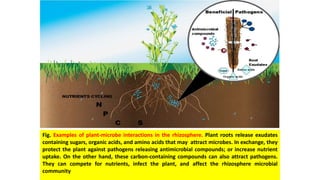
Fig. Examples of plant-microbe interactions in the rhizosphere. Plant roots release exudates
containing sugars, organic acids, and amino acids that may attract microbes. In exchange, they
protect the plant against pathogens releasing antimicrobial compounds; or increase nutrient
uptake. On the other hand, these carbon-containing compounds can also attract pathogens.
They can compete for nutrients, infect the plant, and affect the rhizosphere microbial
community
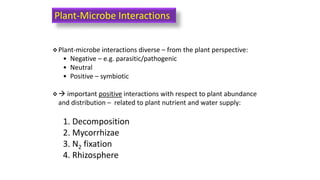
Plant-Microbe Interactions
Plant-microbe interactions diverse – from the plant perspective:
• Negative – e.g. parasitic/pathogenic
• Neutral
• Positive – symbiotic
 important positive interactions with respect to plant abundance
and distribution – related to plant nutrient and water supply:
1. Decomposition
2. Mycorrhizae
3. N2 fixation
4. Rhizosphere
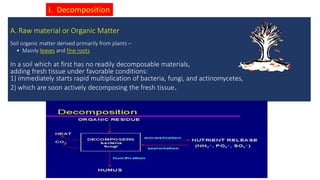
I. Decomposition
A. Raw material or Organic Matter
Soil organic matter derived primarily from plants –
• Mainly leaves and fine roots
In a soil which at first has no readily decomposable materials,
adding fresh tissue under favorable conditions:
1) immediately starts rapid multiplication of bacteria, fungi, and actinomycetes,
2) which are soon actively decomposing the fresh tissue.
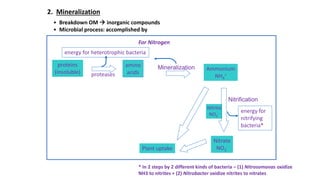
2. Mineralization
• Breakdown OM  inorganic compounds
• Microbial process: accomplished by enzymes excreted into the soil
Plant uptake
Nitrite
NO2
-
Nitrate
NO3
-
energy for
nitrifying
bacteria*
Nitrification
For Nitrogen
proteins
(insoluble)
amino
acids
energy for heterotrophic bacteria
proteases
Ammonium
NH4
+
Mineralization
* In 2 steps by 2 different kinds of bacteria – (1) Nitrosomonas oxidize
NH3 to nitrites + (2) Nitrobacter oxidize nitrites to nitrates
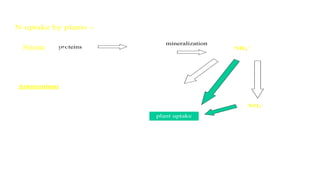
NH4
+
proteins
mineralization
NO3
-
plant uptake
1) Nitrate (NO3
-)
• Preferred by most plants, easier to take up
• Even though requires conversion to NH4
+
before be used ß lots of energy
N uptake by plants – Chemical form taken up can vary
2) Ammonium (NH4
+ ) –
• Used directly by plants in soils with
low nitrification rates (e.g. wet
soils)
• vs. taking up & storing NH4
+
problematic
• More strongly bound to soil
particles
• Acidifies the soil
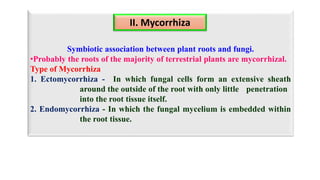
Symbiotic association between plant roots and fungi.
•Probably the roots of the majority of terrestrial plants are mycorrhizal.
Type of Mycorrhiza
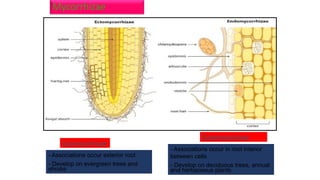
1. Ectomycorrhiza - In which fungal cells form an extensive sheath
around the outside of the root with only little penetration
into the root tissue itself.
2. Endomycorrhiza - In which the fungal mycelium is embedded within
the root tissue.
II. Mycorrhiza
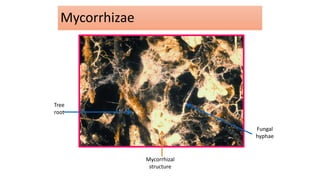
Mycorrhizae
Tree
root
Mycorrhizal
structure
Fungal
hyphae
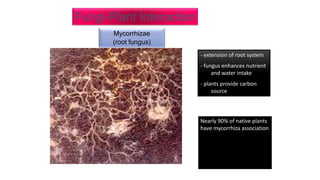
Fungi-Plant Interaction
Mycorrhizae
(root fungus)
Nearly 90% of native plants
have mycorrhiza association
Mycorrhiza: Symbiotic
relationship between plants
(roots) & soil fungi
- extension of root system
- fungus enhances nutrient
and water intake
- plants provide carbon
source
Mycorrhizae
- Associations occur exterior root
- Develop on evergreen trees and
shrubs
Ectomycorrhizae
Endomycorrhizae
- Associations occur in root interior
between cells
- Develop on deciduous trees, annual
and herbaceous plants
C. Function of mycorrhizae:
1) Roles in plant-soil interface –
a) Increase surface area & reach for absorption of soil water & nutrients
b) Increase mobility and uptake of soil P
c) Provides plant with access to organic N
d) Protect roots from toxic heavy metals
e) Protect roots from pathogens
2) Effect of soil nutrient levels on mycorrhizae
• Intermediate soil P concentrations favorable
• Extremely low P – poor fungal infection
• Hi P – plants suppress fungal growth
– taking up P directly
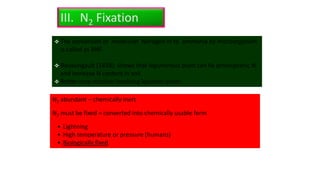
III. N2 Fixation
N2 abundant – chemically inert
N2 must be fixed = converted into chemically usable form
• Lightning
• High temperature or pressure (humans)
• Biologically fixed
 The conversion of molecular Nitrogen in to ammonia by microorganism
is called as BNF
 Boussingault (1838). Shows that leguminous plant can fix atmospheric N
and increase N content in soil.
 Better crop rotation involving legumes plant .
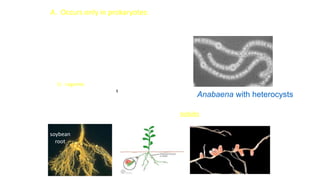
Examples of plant–N2-fixing symbiotic systems –
1) Legumes
eg. Peas, Soybeans, Clovers
• Widespread
• bacteria = e.g., Rhizobium spp.
• Those with N2-fixing symbionts form root “nodules”
A. Occurs only in prokaryotes:
• Bacteria (e.g. Rhizobium, Frankia)
• Cyanobacteria (e.g. Nostoc, Anabaena)
 Free-living in soil/water – heterocysts
 Symbiotic with plants – root nodules
 Loose association with plants
Anabaena with heterocysts
soybean
root
IV. Rhizosphere
Rhozospere is the soil region in close contact with plant roots
Rhizosphere Components –
1.Rhizosphere- The zone of soil influenced by roots through the release of
substrates that affect microbial activity.
2. Rhizoplane - Surface of the plant roots in the soil. Rhizoplane is the
site of the water & nutrient uptake & the release of
exudates in to the soil.
3. Root Itself - It is the part of the system, because certain endophytic
microorganisms are able to colonize inner root tissues .
The rhizosphere effect can thus be viewed as the creation
of a dynamic environment where microbes can develop and interact. This
microorganisms play important roles in the growth and ecological fitness
of their host.
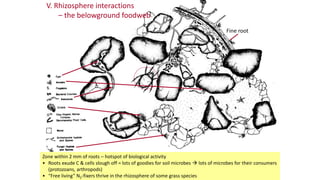
V. Rhizosphere interactions
– the belowground foodweb
Zone within 2 mm of roots – hotspot of biological activity
• Roots exude C & cells slough off = lots of goodies for soil microbes  lots of microbes for their consumers
(protozoans, arthropods)
• “Free living” N2-fixers thrive in the rhizosphere of some grass species
Fine root
(1) Removing hydrogen sulfide, which is toxic to
the plant roots
(2) Increasing solubilization of mineral nutrients
(3) Synthesizing vitamins, amino acids,auxins,
gibberellins that stimulate plant growth
(4) Antagonizing potential plant pathogens through
competition and the production of antibiotics
Microbial populations in the Rhizosphere
may benefit the plant by:
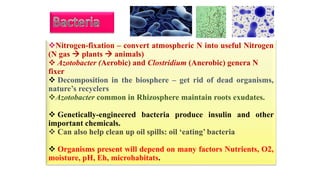
Nitrogen-fixation – convert atmospheric N into useful Nitrogen
(N gas  plants  animals)
 Azotobacter (Aerobic) and Clostridium (Anerobic) genera N
fixer
 Decomposition in the biosphere – get rid of dead organisms,
nature’s recyclers
Azotobacter common in Rhizosphere maintain roots exudates.
 Genetically-engineered bacteria produce insulin and other
important chemicals.
 Can also help clean up oil spills: oil ‘eating’ bacteria
 Organisms present will depend on many factors Nutrients, O2,
moisture, pH, Eh, microhabitats.
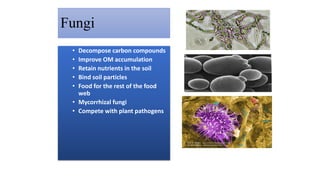
Fungi
• Decompose carbon compounds
• Improve OM accumulation
• Retain nutrients in the soil
• Bind soil particles
• Food for the rest of the food
web
• Mycorrhizal fungi
• Compete with plant pathogens
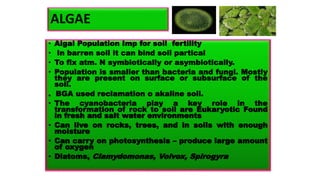
ALGAE
• Algal Population Imp for soil fertility
• In barren soil it can bind soil partical
• To fix atm. N symbiotically or asymbiotically.
• Population is smaller than bacteria and fungi. Mostly
they are present on surface or subsurface of the
soil.
. BGA used reclamation o akaline soil.
• The cyanobacteria play a key role in the
transformation of rock to soil are Eukaryotic Found
in fresh and salt water environments
• Can live on rocks, trees, and in soils with enough
moisture
• Can carry on photosynthesis – produce large amount
of oxygen
• Diatoms, Clamydomonas, Volvox, Spirogyra
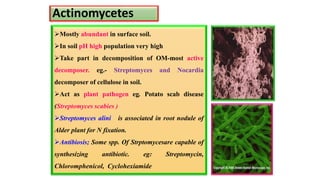
Actinomycetes
Mostly abundant in surface soil.
In soil pH high population very high
Take part in decomposition of OM-most active
decomposer. eg.- Streptomyces and Nocardia
decomposer of cellulose in soil.
Act as plant pathogen eg. Potato scab disease
(Streptomyces scabies )
Streptomyces alini is associated in root nodule of
Alder plant for N fixation.
Antibiosis; Some spp. Of Strptomycesare capable of
synthesizing antibiotic. eg: Streptomycin,
Chloromphenicol, Cyclohexiamide

Microbial-plant interaction in the environment

  • 1.
  • 2.
    Plant microbe interaction Microbe-plantinteractions are critical to plant health, growth, and development. It mainly constitutes the association of microorganism with plants little in a positive way or in a negative way. • The positive approach is mainly the symbiotic relationships and • the negative approach constituents mainly pathogen plant interactions.
  • 3.
    Beneficial / positiveinteractions Neutralism Symbiosis / Mutualism Protoco-operation Communalism a) Neutralism • It is a type of neutral association, in two microorganisms behaves entirely independently • Each could utilize different nutrients without producing metabolic end products that are inhibitory. • This might be transitory as the condition change in the environment, particularly the availability of nutrients, the relationship might change.
  • 4.
    Mutualism • It isdefined as the relationship in which each organism in interaction gets benefits from the association. • It is an obligatory relationship in which mutualist and host are metabolically dependent on each other. • A mutualistic relationship is very specific where one member of the association cannot be replaced by another species. • Mutualism requires close physical contact between interacting organisms. • The relationship of mutualism allows organisms to exist in a habitat that could not be occupied by either species alone. • The mutualistic relationship between organisms allows them to act as a single organism.
  • 5.
    Examples of mutualism: •Lichens: Lichens are an excellent example of mutualism. They are the association of specific fungi and certain genus of algae. • Rhizobium in Root nodules
  • 6.
    Protocooperation (Synergism) • Itis a relationship in which an organism in an association is mutually benefited with each other. • This interaction is similar to mutualism but the relationships between the organisms in protocooperation are not obligatory as in mutualism. • Examples of Protocooperation: • a. Association of Desulfovibrio and Chromatium: It is a protocooperation between the carbon cycle and the sulfur cycle. • b. Interaction between N2-fixing bacteria and cellulolytic bacteria such as Cellulomonas.
  • 7.
    Commensalism • It isa relationship in which one organism (commensal) in the association is benefited while another organism (host) of the association is neither benefited nor harmed. • It is a unidirectional association and if the commensal is separated from the host, it can survive. • Examples of commensalism: Association of Nitrosomonas (host) and Nitrobacter (commensal) in Nitrification: Nitrosomonas oxidize Ammonia into Nitrite and finally, Nitrobacter uses nitrite to obtain energy and oxidize it into Nitrate.
  • 8.
    Negative / harmful/ deleterious interactions • Detrimental effects of one species on its neighbours are quite common in soil, and they are ditched by the decreases in abundance or metabolic activities of the susceptible organisms. • This include a) Competition b) Amensalism c) Parasitism and d) predation
  • 9.
    Amensalism (antagonism) • Whenone microbial population produces substances that are inhibitory to other microbial population then this interpopulation relationship is known as Ammensalism or Antagonism. • The first population which produces inhibitory substances are unaffected or may gain competition and survive in the habitat while other populations get inhibited. This chemical inhibition is known as antibiosis.
  • 10.
    Competition • The competitionrepresents a negative relationship between two microbial populations in which both the population are adversely affected with respect to their survival and growth. • Competition occurs when both populations use the same resources such as the same space or same nutrition, so, the microbial population achieves lower maximum density or growth rate. • Microbial population competes for any growth-limiting resources such as carbon source, nitrogen source, phosphorus, vitamins, growth factors etc. • Competition inhibits both populations from occupying exactly the same ecological niche because one will win the competition and the other one is eliminated.
  • 11.
    Parasitism • It isa relationship in which one population (parasite) get benefited and derive its nutrition from other population (host) in the association which is harmed. • The host-parasite relationship is characterized by a relatively long period of contact which may be physical or metabolic. • Some parasite lives outside the host cell, known as ectoparasite while other parasite lives inside the host cell, known as endoparasite.
  • 12.
    Predation • It isa widespread phenomenon when one organism (predator) engulf or attack other organisms (prey). • The prey can be larger or smaller than the predator and this normally results in the death of the prey. • Normally predator-prey interaction is of short duration. • Examples of Predation: a. Protozoan-bacteria in soil: Many protozoans can feed on various bacterial population which helps to maintain the count of soil bacteria at optimum level
  • 13.
    Fig. Examples ofplant-microbe interactions in the rhizosphere. Plant roots release exudates containing sugars, organic acids, and amino acids that may attract microbes. In exchange, they protect the plant against pathogens releasing antimicrobial compounds; or increase nutrient uptake. On the other hand, these carbon-containing compounds can also attract pathogens. They can compete for nutrients, infect the plant, and affect the rhizosphere microbial community
  • 14.
    Plant-Microbe Interactions Plant-microbe interactionsdiverse – from the plant perspective: • Negative – e.g. parasitic/pathogenic • Neutral • Positive – symbiotic  important positive interactions with respect to plant abundance and distribution – related to plant nutrient and water supply: 1. Decomposition 2. Mycorrhizae 3. N2 fixation 4. Rhizosphere
  • 15.
    I. Decomposition A. Rawmaterial or Organic Matter Soil organic matter derived primarily from plants – • Mainly leaves and fine roots In a soil which at first has no readily decomposable materials, adding fresh tissue under favorable conditions: 1) immediately starts rapid multiplication of bacteria, fungi, and actinomycetes, 2) which are soon actively decomposing the fresh tissue.
  • 16.
    2. Mineralization • BreakdownOM  inorganic compounds • Microbial process: accomplished by enzymes excreted into the soil Plant uptake Nitrite NO2 - Nitrate NO3 - energy for nitrifying bacteria* Nitrification For Nitrogen proteins (insoluble) amino acids energy for heterotrophic bacteria proteases Ammonium NH4 + Mineralization * In 2 steps by 2 different kinds of bacteria – (1) Nitrosomonas oxidize NH3 to nitrites + (2) Nitrobacter oxidize nitrites to nitrates
  • 17.
    NH4 + proteins mineralization NO3 - plant uptake 1) Nitrate(NO3 -) • Preferred by most plants, easier to take up • Even though requires conversion to NH4 + before be used ß lots of energy N uptake by plants – Chemical form taken up can vary 2) Ammonium (NH4 + ) – • Used directly by plants in soils with low nitrification rates (e.g. wet soils) • vs. taking up & storing NH4 + problematic • More strongly bound to soil particles • Acidifies the soil
  • 18.
    Symbiotic association betweenplant roots and fungi. •Probably the roots of the majority of terrestrial plants are mycorrhizal. Type of Mycorrhiza 1. Ectomycorrhiza - In which fungal cells form an extensive sheath around the outside of the root with only little penetration into the root tissue itself. 2. Endomycorrhiza - In which the fungal mycelium is embedded within the root tissue. II. Mycorrhiza
  • 19.
  • 20.
    Fungi-Plant Interaction Mycorrhizae (root fungus) Nearly90% of native plants have mycorrhiza association Mycorrhiza: Symbiotic relationship between plants (roots) & soil fungi - extension of root system - fungus enhances nutrient and water intake - plants provide carbon source
  • 21.
    Mycorrhizae - Associations occurexterior root - Develop on evergreen trees and shrubs Ectomycorrhizae Endomycorrhizae - Associations occur in root interior between cells - Develop on deciduous trees, annual and herbaceous plants
  • 22.
    C. Function ofmycorrhizae: 1) Roles in plant-soil interface – a) Increase surface area & reach for absorption of soil water & nutrients b) Increase mobility and uptake of soil P c) Provides plant with access to organic N d) Protect roots from toxic heavy metals e) Protect roots from pathogens 2) Effect of soil nutrient levels on mycorrhizae • Intermediate soil P concentrations favorable • Extremely low P – poor fungal infection • Hi P – plants suppress fungal growth – taking up P directly
  • 23.
    III. N2 Fixation N2abundant – chemically inert N2 must be fixed = converted into chemically usable form • Lightning • High temperature or pressure (humans) • Biologically fixed  The conversion of molecular Nitrogen in to ammonia by microorganism is called as BNF  Boussingault (1838). Shows that leguminous plant can fix atmospheric N and increase N content in soil.  Better crop rotation involving legumes plant .
  • 24.
    Examples of plant–N2-fixingsymbiotic systems – 1) Legumes eg. Peas, Soybeans, Clovers • Widespread • bacteria = e.g., Rhizobium spp. • Those with N2-fixing symbionts form root “nodules” A. Occurs only in prokaryotes: • Bacteria (e.g. Rhizobium, Frankia) • Cyanobacteria (e.g. Nostoc, Anabaena)  Free-living in soil/water – heterocysts  Symbiotic with plants – root nodules  Loose association with plants Anabaena with heterocysts soybean root
  • 25.
    IV. Rhizosphere Rhozospere isthe soil region in close contact with plant roots Rhizosphere Components – 1.Rhizosphere- The zone of soil influenced by roots through the release of substrates that affect microbial activity. 2. Rhizoplane - Surface of the plant roots in the soil. Rhizoplane is the site of the water & nutrient uptake & the release of exudates in to the soil. 3. Root Itself - It is the part of the system, because certain endophytic microorganisms are able to colonize inner root tissues . The rhizosphere effect can thus be viewed as the creation of a dynamic environment where microbes can develop and interact. This microorganisms play important roles in the growth and ecological fitness of their host.
  • 26.
    V. Rhizosphere interactions –the belowground foodweb Zone within 2 mm of roots – hotspot of biological activity • Roots exude C & cells slough off = lots of goodies for soil microbes  lots of microbes for their consumers (protozoans, arthropods) • “Free living” N2-fixers thrive in the rhizosphere of some grass species Fine root
  • 27.
    (1) Removing hydrogensulfide, which is toxic to the plant roots (2) Increasing solubilization of mineral nutrients (3) Synthesizing vitamins, amino acids,auxins, gibberellins that stimulate plant growth (4) Antagonizing potential plant pathogens through competition and the production of antibiotics Microbial populations in the Rhizosphere may benefit the plant by:
  • 29.
    Nitrogen-fixation – convertatmospheric N into useful Nitrogen (N gas  plants  animals)  Azotobacter (Aerobic) and Clostridium (Anerobic) genera N fixer  Decomposition in the biosphere – get rid of dead organisms, nature’s recyclers Azotobacter common in Rhizosphere maintain roots exudates.  Genetically-engineered bacteria produce insulin and other important chemicals.  Can also help clean up oil spills: oil ‘eating’ bacteria  Organisms present will depend on many factors Nutrients, O2, moisture, pH, Eh, microhabitats.
  • 30.
    Fungi • Decompose carboncompounds • Improve OM accumulation • Retain nutrients in the soil • Bind soil particles • Food for the rest of the food web • Mycorrhizal fungi • Compete with plant pathogens
  • 31.
    ALGAE • Algal PopulationImp for soil fertility • In barren soil it can bind soil partical • To fix atm. N symbiotically or asymbiotically. • Population is smaller than bacteria and fungi. Mostly they are present on surface or subsurface of the soil. . BGA used reclamation o akaline soil. • The cyanobacteria play a key role in the transformation of rock to soil are Eukaryotic Found in fresh and salt water environments • Can live on rocks, trees, and in soils with enough moisture • Can carry on photosynthesis – produce large amount of oxygen • Diatoms, Clamydomonas, Volvox, Spirogyra
  • 32.
    Actinomycetes Mostly abundant insurface soil. In soil pH high population very high Take part in decomposition of OM-most active decomposer. eg.- Streptomyces and Nocardia decomposer of cellulose in soil. Act as plant pathogen eg. Potato scab disease (Streptomyces scabies ) Streptomyces alini is associated in root nodule of Alder plant for N fixation. Antibiosis; Some spp. Of Strptomycesare capable of synthesizing antibiotic. eg: Streptomycin, Chloromphenicol, Cyclohexiamide