DEPARTMENT OF MICROBIOLOGY
SUBJECT: ENVIRONMENTAL MICROBIOLOGY
VIVEKANANDHA ARTS AND SCIENCE
COLLEGE FOR WOMEN
Veerachipalayam-637 303, Sankagiri, Salem Dt.,Tamil Nadu India.
Affiliated to Periyar University, Salem; Recognised Under Section 2(f) & 12(B) of the UGC Act,1956)
SUBJECT INCHARGE: SUBMITTED BY:
Dr. R. Mythili, Kaviya .A.R
Assistant professor, III. B.Sc., Microbiology,
Department of Microbiology Department of Microbiology,
VIAAS, Sankagiri. VIAAS, Sankagiri
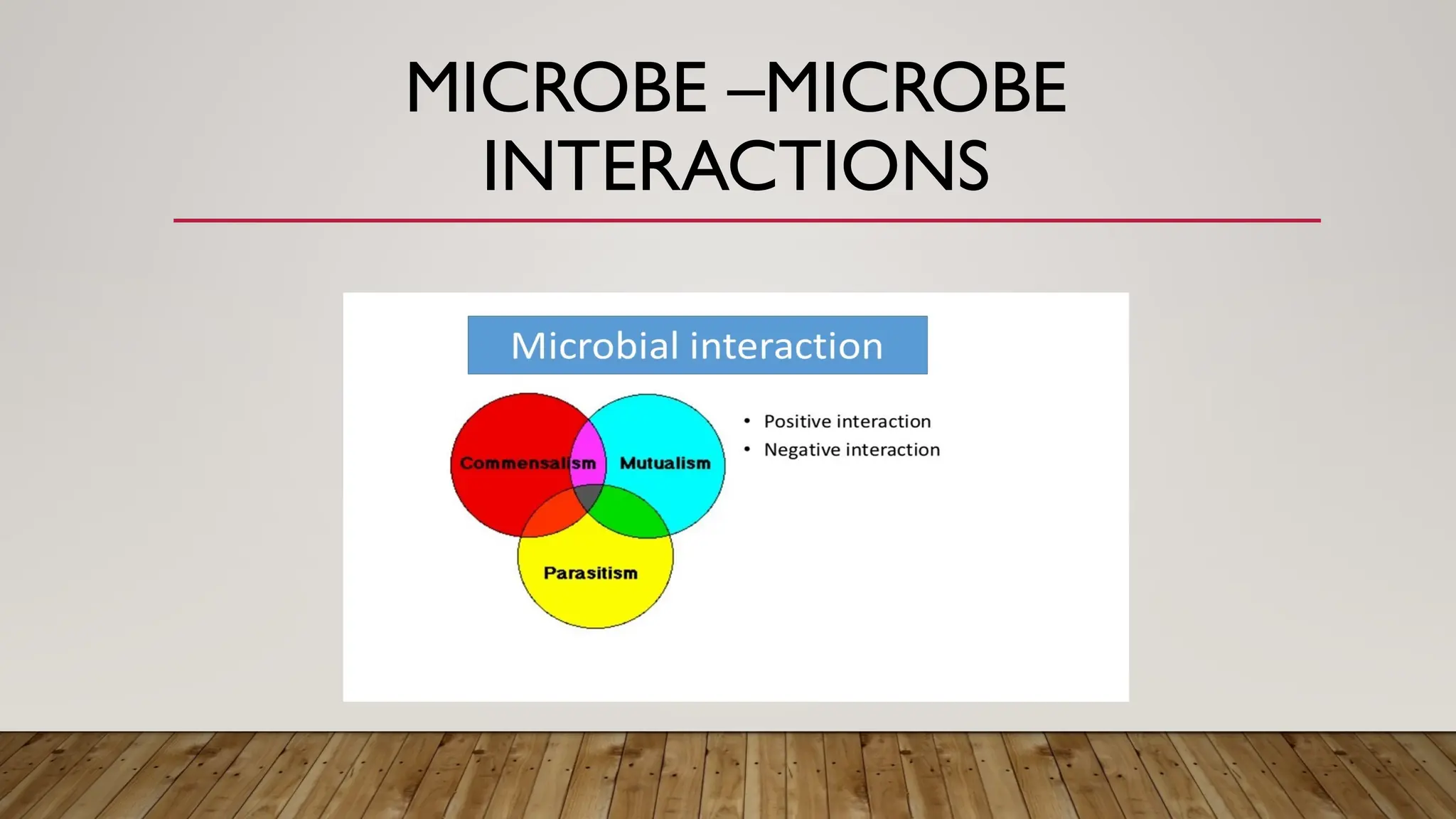
MICROBE –MICROBE
INTERACTIONS
TYPES OF INTERACTIONS:
• Organisms don not exist alone in nature but in
a matrix of organisms of many species.
• When one or more types of organisms
reciprocate each others effect, it is calles interaction.
• Interactions are broadly classified based on
their effects on each other as positive interaction and
negative interactions.
POSITIVE INTERACTIONS:
NAME OF INTERACTIONS EFFECT OF
INTERACTIONS
POPULATION I POPULATION II
 Neutralism
0 0
 Commensalism
0 +
 Synergism
+ +
NEGATIVE INTERACTIONS:
NAME OF INTERACTIONS EFFECTS
OF INTERACTIONS
POPULATION I POPULATIO II
 Amensalism
0/ + -
 Competition
+ -
 Parasitism
+ -
Lets we see the positive interactions commensalism and synergism
COMMENSALISM:
• Commensalism defines the interaction in which two or
more population benefits and the other one is unaffected.
• It is a unidirectional relationship between populations.
• These kinds of interactions are quite common and they
occur when the uaffected population modifies the habitat in such a way
that a second population benefits,
• e.g, the removal of oxygen from a habitat, as a result of the
metabolic activities of a population facultatibe anaerobes, creates an
environment that is favourable for the growth of obligately anaerobic
populations.
Commensalism is exhibited in a number of ways
Production of growth factor :
 flavobacterium brevis excretes cysteine which is taken
up by legionella pneumophila.
Transformation of insoluble compounds to soluble one and further
into gaseous componets:
 Methane from sediment benefits methane oxidising
population in the overlying water .
 Hydrogen sulphide production in buried sediments
which helps the photo-autotrophic sulphur bacteria on the
sediment surface.
Conversion of organic molecules :
o convert organic molecules which become substrates for
other population is also commonly seen.
o e.g fungi release extracellular enzyme which decomposes
lignin to form simple glucose moieties which benefit the other
microorganisms.
Metabolic needs:
o Mycobacterium vaccae, growing on propane as a source of
carbon and energy , that oxidise cyclohexane to cyclohexanone which is
readily used up by other microorganisms like pseudomonas.
Neutralisation of a toxic material :
o oxidation of hydrogen sulphide by Beggiatoa and
benefited by the hydrogen sulphide sensitive aerobic organism .
SYNERGISM:
 synergism between two population
indicates that both populations benefits from the
relationship but the association is obligatory.
 Both populations are capable of surviving
independently, although they both gain advantage from
the synergistic relationship.
 Supply each other’s nutritional needs.
Synergism exhibited in a number of ways:
Convert amino acids:
 Arginine is converted to putrescience by E.coli
and Enterococcus faecalis both working together. E.faecalis can
convert arginine into ornithine and e.coli further converts
ornithine to putrescience,
 A task which cannot be performed by either of
the organisms alone.
 Both organisms allow the completion of a
metabolic pathway that otherwise would not be completed.
Suppy of growth factors :
 Suppy of growth factors by one population to
another.
Example,
 Nocardia and pseudomonas together can
degrade cyclohexane wherein Nocardia acts on cyclohexane
and supplies metabolic products to pseudomonas and in turn
the bacterium supplies biotin to nocardia.
 Lactobacillus arabinosus and Streptococcus
faecalis based on the mutual exchange of required growth
factors. L.arabinosus requires phenylalanine for growth, which is
produced by S.faecalis which is turn requires folic acid
produced by L.arabinosus.
Enzyme produced in synergistic relationship:
• The enzyme produced by microorganism that
are not produced by either population alone.
• Pseudomonas strains produce lecithinase
when grown together but not alone.
Degradation of agricultural pesticides:
• Athrobacter and Streptomyces together
degrade organophosphate insecticide diazinon, a task which
they cannot perform alone.
• Penicillium piscarium and geotrichum candidum
which remove toxic factors and produce useful substrates
from insecticides . Both together detoxify the pesticide
propanil.
• Penicillium cleaves propanil into propionic acid and 3,4-
dichloroaniline (toxic) ,Which is further detoxified by geotrichum.
Methane production by microorganism:
 Archaeal population involved in methane production
(methanogens) have interestin synergistic relationships with bacterial genera
indicate their syntrophic relationships with hydrogen consuming methanogenic
archaea.
 Syntrophomonas species oxidise butyric acid and caproic acid to
acetate and H2. Syntrophobacter oxidises propionic acid to acetate,co2 and H2 .
The acetate and H2 produced by these bacteria are used by methanogic
archaea to produce methane.
 Thus the metabolism of the methanogens maintains very low
concentrations of H2 thus increasing the growth rates of Syntrophomonas and
Syntrophobacter species.
Thank you
KAVIYA .A.R
III.B.sc.,Microbiology
Department of microbiology,
VIAASS, Sankagiri.

microbial interactions commensalism synergism .pptx

  • 1.
    DEPARTMENT OF MICROBIOLOGY SUBJECT:ENVIRONMENTAL MICROBIOLOGY VIVEKANANDHA ARTS AND SCIENCE COLLEGE FOR WOMEN Veerachipalayam-637 303, Sankagiri, Salem Dt.,Tamil Nadu India. Affiliated to Periyar University, Salem; Recognised Under Section 2(f) & 12(B) of the UGC Act,1956) SUBJECT INCHARGE: SUBMITTED BY: Dr. R. Mythili, Kaviya .A.R Assistant professor, III. B.Sc., Microbiology, Department of Microbiology Department of Microbiology, VIAAS, Sankagiri. VIAAS, Sankagiri
  • 2.
  • 3.
    TYPES OF INTERACTIONS: •Organisms don not exist alone in nature but in a matrix of organisms of many species. • When one or more types of organisms reciprocate each others effect, it is calles interaction. • Interactions are broadly classified based on their effects on each other as positive interaction and negative interactions.
  • 4.
    POSITIVE INTERACTIONS: NAME OFINTERACTIONS EFFECT OF INTERACTIONS POPULATION I POPULATION II  Neutralism 0 0  Commensalism 0 +  Synergism + +
  • 5.
    NEGATIVE INTERACTIONS: NAME OFINTERACTIONS EFFECTS OF INTERACTIONS POPULATION I POPULATIO II  Amensalism 0/ + -  Competition + -  Parasitism + -
  • 6.
    Lets we seethe positive interactions commensalism and synergism
  • 7.
    COMMENSALISM: • Commensalism definesthe interaction in which two or more population benefits and the other one is unaffected. • It is a unidirectional relationship between populations. • These kinds of interactions are quite common and they occur when the uaffected population modifies the habitat in such a way that a second population benefits, • e.g, the removal of oxygen from a habitat, as a result of the metabolic activities of a population facultatibe anaerobes, creates an environment that is favourable for the growth of obligately anaerobic populations.
  • 8.
    Commensalism is exhibitedin a number of ways Production of growth factor :  flavobacterium brevis excretes cysteine which is taken up by legionella pneumophila. Transformation of insoluble compounds to soluble one and further into gaseous componets:  Methane from sediment benefits methane oxidising population in the overlying water .  Hydrogen sulphide production in buried sediments which helps the photo-autotrophic sulphur bacteria on the sediment surface.
  • 9.
    Conversion of organicmolecules : o convert organic molecules which become substrates for other population is also commonly seen. o e.g fungi release extracellular enzyme which decomposes lignin to form simple glucose moieties which benefit the other microorganisms. Metabolic needs: o Mycobacterium vaccae, growing on propane as a source of carbon and energy , that oxidise cyclohexane to cyclohexanone which is readily used up by other microorganisms like pseudomonas. Neutralisation of a toxic material : o oxidation of hydrogen sulphide by Beggiatoa and benefited by the hydrogen sulphide sensitive aerobic organism .
  • 10.
    SYNERGISM:  synergism betweentwo population indicates that both populations benefits from the relationship but the association is obligatory.  Both populations are capable of surviving independently, although they both gain advantage from the synergistic relationship.  Supply each other’s nutritional needs.
  • 11.
    Synergism exhibited ina number of ways: Convert amino acids:  Arginine is converted to putrescience by E.coli and Enterococcus faecalis both working together. E.faecalis can convert arginine into ornithine and e.coli further converts ornithine to putrescience,  A task which cannot be performed by either of the organisms alone.  Both organisms allow the completion of a metabolic pathway that otherwise would not be completed.
  • 12.
    Suppy of growthfactors :  Suppy of growth factors by one population to another. Example,  Nocardia and pseudomonas together can degrade cyclohexane wherein Nocardia acts on cyclohexane and supplies metabolic products to pseudomonas and in turn the bacterium supplies biotin to nocardia.  Lactobacillus arabinosus and Streptococcus faecalis based on the mutual exchange of required growth factors. L.arabinosus requires phenylalanine for growth, which is produced by S.faecalis which is turn requires folic acid produced by L.arabinosus.
  • 13.
    Enzyme produced insynergistic relationship: • The enzyme produced by microorganism that are not produced by either population alone. • Pseudomonas strains produce lecithinase when grown together but not alone. Degradation of agricultural pesticides: • Athrobacter and Streptomyces together degrade organophosphate insecticide diazinon, a task which they cannot perform alone. • Penicillium piscarium and geotrichum candidum which remove toxic factors and produce useful substrates from insecticides . Both together detoxify the pesticide propanil.
  • 14.
    • Penicillium cleavespropanil into propionic acid and 3,4- dichloroaniline (toxic) ,Which is further detoxified by geotrichum. Methane production by microorganism:  Archaeal population involved in methane production (methanogens) have interestin synergistic relationships with bacterial genera indicate their syntrophic relationships with hydrogen consuming methanogenic archaea.  Syntrophomonas species oxidise butyric acid and caproic acid to acetate and H2. Syntrophobacter oxidises propionic acid to acetate,co2 and H2 . The acetate and H2 produced by these bacteria are used by methanogic archaea to produce methane.  Thus the metabolism of the methanogens maintains very low concentrations of H2 thus increasing the growth rates of Syntrophomonas and Syntrophobacter species.
  • 15.