Microbial Interaction
& Its relationship Jateen (AEM-MA-09-04)
Introduction
• Microorganisms or microbes includes bacteria, archaea, viruses and many unicellular eukaryotes
(e.g., some fungi and protists). Microorganisms were the first cellular life forms and they were
critical for creating the conditions for the evolution of more complex multicellular forms.
• Microbial interactions are ubiquitous, diverse, critically important in the function of any
biological community and are crucial in global biogeochemistry.
• The interactions between the two populations are classified according to whether both
populations or one of them are getting benefited from the associationship, or one or both
populations are negatively affected.
• There are many sorts of symbiotic relationship such as mutualism, parasitism, amensalism,
commensalism and competition, predation, protocooperation between the organisms. Mutualism
and parasitism have been most extensively studied in microbial relationships.
• There are completely different kinds of microbial interactions which in-corporates interaction
with different microbes for example, Plant-Germ interactions promoting plant growth,
interaction with animals and interaction with humans.
Fate of Viral infection
1. Abortive viral infection
• No progeny virus is developed
• No visible symptoms because
protein synthesis is aborted
2. Productive viral infection
• Develops progeny virus after which
release is due to membrane budding
• No host cell killing
3. Latent viral infection (Retroviral infection)
• Viral-host DNA integration
• Take months or years (Latent)
• HIV
4. Destructive viral infection
• Viral proteins (Destructive)
• More progeny virus
• Host cell lysis
• Killing of host cells (Lethal)
• The interactions between the two
populations are classified according to
whether both populations or one of them
are benefited from the associationship, or
one or both populations are negatively
affected.
Positive Interaction
1. Mutualism
• It is defined as the relationship in which each organism in interaction gets benefits
from the association.
• It is an obligatory relationship in which mutualist and host are metabolically
dependent on each other.
• Mutualistic relationship is very specific where one member of association cannot be
replaced by another species.
• Mutualism requires close physical contact between interacting organisms.
• Relationship of mutualism allows organisms to exist in habitat that could not be
occupied by either species alone.
• Mutualistic relationship between organisms allows them to act as a single organism.
Examples of mutualism:
Lichens: Lichens are an excellent example of mutualism. They are the association of
specific fungi and certain genus of algae. In lichen, the fungal partner is
called mycobiont and algal partner is called phycobiont is the member of cyanobacteria
and green algae.
2. Syntrophism
• It is an association in which the growth of one organism either depends on or improved by the
substrate provided by another organism.
• In syntrophism, both organisms in association get to benefit from each other.
Compound A Compound B Compound C
Utilized by population 1 Utilized by population 2 Utilized by both Population 1+2
Products
In this theoretical example of syntrophism, population 1 is able to utilize and metabolize compound
A, forming compound B but cannot metabolize beyond compound B without co-operation of
population 2. Population 2 is unable to utilize compound A but it can metabolize compound B
forming compound C. Then both population 1 and 2 are able to carry out a metabolic reaction which
leads to the formation of the end product that neither population could produce alone.
Examples of syntrophism:
a. Methanogenic ecosystem in sludge digester
• Methane produced by methanogenic bacteria depends upon interspecies hydrogen transfer by
other fermentative bacteria.
• Anaerobic fermentative bacteria generate CO2 and H2 utilizing carbohydrates which are then
utilized by methanogenic bacteria (Methanobacter) to produce methane.
3. Protocooperation
• It is a relationship in which an organism in an association is mutually benefited with each other.
• This interaction is similar to mutualism but the relationships between the organisms in
protocooperation are not obligatory as in mutualism.
Examples of Protocooperation:
a. Association of Desulfovibrio vulgaris (sulfate reducers) and Chromatium vinosum
(phototrophic bacteria): It is a protocooperation between the carbon cycle and the sulfur cycle.
• The major products of cellulose fermentation were formic, acetic and lactic acids, ethanol,
hydrogen and carbon dioxide.
• Desulfovibrio oxidized the organic acids, alcohol and hydrogen by dissimilatory sulfate reduction
and sulfide and acetate were accumulated in the medium.
• The rate of sulfate reduction depends on the rate of cellulose fermentation. In the presence of
phototrophic bacteria, the end products of cellulose degradation and sulfate reduction disappeared
from the medium and the protein content increased highly.
• The growth yield constant increased five times when the cellulolytic organism was associated with
the two sulfur bacteria. The absence of Desulfovibrio perturbed the functioning of the trophic
chain, as the rate of sulfate reduction partly determines the growth of Chromatium. Chromatium
seems to hinder the anaerobic degradation of cellulose, whereas Desulfovibrio seems to enhance it.
b. Interaction between N2-fixing bacteria and cellulolytic bacteria such as Cellulomonas.
4. Commensalism
• It is a relationship in which one organism (commensal) in the association is benefited while
another organism (host) of the association is neither benefited nor harmed.
• It is a unidirectional association and if the commensal is separated from the host, it can
survive.
Examples of commensalism:
a. Non-pathogenic E. coli in the intestinal tract of human: E. coli is a facultative anaerobe that
uses oxygen and lowers the O2 concentration in the gut which creates a suitable environment for
obligate anaerobes such as Bacteroides. E. coli is a host which remains unaffected by Bacteroides.
b. Flavobacterium (host) and Legionella pneumophila (commensal): Flavobacterium excretes
cystine which is used by Legionella pneumophila and survives in the aquatic habitat.
c. Association of Nitrosomonas (host) and Nitrobacter (commensal) in Nitrification:
Nitrosomonas oxidize Ammonia into Nitrite and finally, Nitrobacter uses nitrite to obtain energy
and oxidize it into Nitrate.
Negative Interaction
5. Amensalism (antagonism)
• When one microbial population produces substances that are inhibitory to other microbial
population then this interpopulation relationship is known as Ammensalism or Antagonism.
• It is a negative relationship.
• The first population which produces inhibitory substances are unaffected or may gain
competition and survive in the habitat while other populations get inhibited. This chemical
inhibition is known as antibiosis.
Examples of antagonism (amensalism):
a. Lactic acid produced by lactic acid bacteria in the vaginal tract: Lactic acid produced by
many normal floras in the vaginal tract is inhibitory to many pathogenic organisms such
as Candida albicans.
b. Skin normal flora: Fatty acid produced by skin flora inhibits many pathogenic bacteria in skin.
c. Thiobacillus thiooxidant: Thiobacillus thioxidant produces sulfuric acid by oxidation of sulfur
which is responsible for lowering of pH in the culture media which inhibits the growth of most
other bacteria.
6. Competition
• The competition represents a negative relationship between two microbial population in
which both the population are adversely affected with respect to their survival and growth.
• Competition occurs when both populations use the same resources such as the same space
or same nutrition, so, the microbial population achieves lower maximum density or growth
rate.
• Microbial population competes for any growth-limiting resources such as carbon source,
nitrogen source, phosphorus, vitamins, growth factors etc.
• Competition inhibits both populations from occupying exactly the same ecological niche
because one will win the competition and the other one is eliminated.
Examples of competition:
a. Competition between Paramecium cadatum and Paramecium aurelia: Both species of
Paramecium feeds on the same bacteria population when these protozoa are placed together. P.
aurelia grow at a better rate than P. caudatum due to competition.
7. Parasitism
• It is a relationship in which one population (parasite) get benefited and derive its nutrition
from other population (host) in the association which is harmed.
• The host-parasite relationship is characterized by a relatively long period of contact which
may be physical or metabolic.
• Some parasite lives outside the host cell, known as ectoparasite while other parasite lives
inside the host cell, known as endoparasite.
Examples of parasitism:
a. Viruses: Viruses are an obligate intracellular parasite that exhibits great host specificity.
There are many viruses that are parasite to bacteria (bacteriophage), fungi, algae, protozoa etc.
b. Bdellovibrio: Bdellavibrio is ectoparasite to many gram-negative bacteria.
8. Predation
• It is a widespread phenomenon when one organism (predator) engulf or attack other
organisms (prey).
• The prey can be larger or smaller than predator and this normally results in the death of
prey.
• Normally predator-prey interaction is of short duration.
Examples of Predation:
a. Protozoan-bacteria in soil: Many protozoans can feed on various bacterial population
which helps to maintain the count of soil bacteria at optimum level.
b. Bdellovibrio, Vamparococcus, Daptobacter, etc are examples of predator bacteria that can
feed on a wide range of the bacterial population.
The importance of understanding the microbial interactions
(Research focus )
• Understanding the underlying governing principles that shape a microbial community is key
for microbial ecology engineering synthetic microbiomes for various biotechnological
applications.
Examples
• the bioconversion of unprocessed cellulolytic feedstocks into biofuel isobutanol using
fungal–bacterial communities
• biosensing and bioremediation against environmental toxins such as arsenic and pathogens
such as Pseudomonas aeruginosa and Vibrio cholerae have been demonstrated using
engineered quorum-sensing Escherichia coli
• utilizing microorganisms to reduce the concentration and toxicity of various chemical
pollutants, such as petroleum hydrocarbons pesticides and metals Biodegradation and its
application in bioremediation of organic pollutants have benefited from the biochemical and
molecular studies of microbial processes
Quorum sensing
• One way that microbes communicate and organize with each other in order to take part in more
advanced cooperative interactions is through quorum sensing.
• Quorum sensing describes the phenomenon in which the accumulation of signaling molecules in
the surrounding environment enables a single cell to assess the number of individuals (cell density)
so that the population as a whole can make a coordinated response.
• This interaction is fairly common among bacterial taxa, and involves the secretion by individual
cells of 'signaling' molecules, called autoinducers or pheromones.These bacteria also have a
receptor that can specifically detect the signaling molecule. When the inducer binds the receptor, it
activates transcription of certain genes, including those for inducer synthesis.
• The opportunistic bacteria Pseudomonas aeruginosa also uses quorum sensing to coordinate the
formation of biofilms, swarming motility, exopolysaccharide production, and cell aggregation.
These bacteria can grow within a host without harming it, until they reach a certain concentration.
Then they become aggressive, their numbers sufficient to overcome the host's immune system, and
form a biofilm, leading to disease within the host.
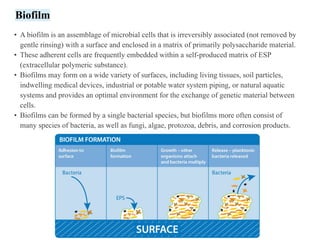
Biofilm
• A biofilm is an assemblage of microbial cells that is irreversibly associated (not removed by
gentle rinsing) with a surface and enclosed in a matrix of primarily polysaccharide material.
• These adherent cells are frequently embedded within a self-produced matrix of ESP
(extracellular polymeric substance).
• Biofilms may form on a wide variety of surfaces, including living tissues, soil particles,
indwelling medical devices, industrial or potable water system piping, or natural aquatic
systems and provides an optimal environment for the exchange of genetic material between
cells.
• Biofilms can be formed by a single bacterial species, but biofilms more often consist of
many species of bacteria, as well as fungi, algae, protozoa, debris, and corrosion products.
• Bharati, P.L., Baulaigue, R. and Matheron, R., 1982. Degradation of cellulose
by mixed cultures of fermentative bacteria and anaerobic sulfur bacteria.
Zentralblatt für Bakteriologie Mikrobiologie und Hygiene: I. Abt. Originale
C: Allgemeine, angewandte und ökologische Mikrobiologie, 3(4), pp.466-474.
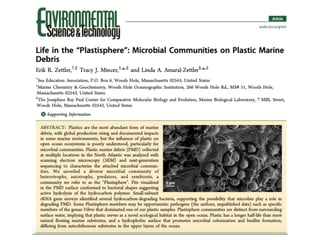
• Zettler, E.R., Mincer, T.J. and Amaral-Zettler, L.A., 2013. Life in the
“plastisphere”: microbial communities on plastic marine debris.
Environmental science & technology, 47(13), pp.7137-7146.
• https://youtu.be/X8KaJb-vcbo 1:40
• https://microbenotes.com/microbial-interaction-and-its-types-with-examples/
• https://youtu.be/ExY5yUn7mwU Quorum sensing
• https://microbialinteraction.conferenceseries.com/2017/call-for-abstracts.php
Reference:
Thank You!!!
Specific explanations of key interactions:
(1) Bacteria can prevent phage infection by mutational modification of surface receptors or by enzymatic
degradation of the incoming phage DNA;
(2) Alternatively, protection of cells in aggregates or biofilms can be a defense strategy against phage infection;
(3) Infection by temperate phages can result in the integration of the phage DNA in the host genome as
prophage; The integrated prophage can prevent infection by similar phages (Superinfection exclusion
mechanism) and
(4) contribute with important genetic information to the host that may expand its metabolic or virulence
properties. Prophage induction leads to the release of new phages and may also stimulate biofilm formation;
(5) Phages can manipulate host gene expression in cyanobacteria for improved infection efficiency, either by
exploiting the host genes or by encoding host photosynthesis genes which are then expressed during infection;
(6) Phage interaction with their bacterial hosts contributes to shaping the gut microbiome of invertebrates (e.g.,
tunicates), thus affecting the symbiotic relationship between gut microbes and their hosts;
(7) In the coccolithophorid phytoplankton Emiliania huxleyi the diploid virally infected cells may undergo viral
induced lysis or re-emerge (dotted arrow) as haploid cells containing viral RNA and lipids. These haploid cells
are thought to resist virus infection (as indicated with the X) and develop into the diploid cells by karyogamy;
(8) The large and diverse group of nucleocytoplasmic large DNA viruses (NCLDV) infects a range of
photosynthetic protists such as the prasinophytes Micromonas pusilla and Ostreococcus tauri and, as
exemplified in the figure, the toxin-producing haptophyte Prymnesium parvum, thus affecting mortality, diversity
and production of phytoplankton.
These interactions are strongly controlled by environmental factors such as temperature, nutrient availability
and light. As for bacteria, several mechanisms of resistance (indicated with an X) to viruses have been
described in the photosynthetic protists."