DEPARTMENT OF MICROBIOLOGY
SUBJECT
SOIL AND ENVIRONMENTAL MICROBIOLOGY
SUMMITED BY:
G.KEERTHANA GOPAL,
II - M.SC MICROBIOLOGY,
VIVEKANANDHA ARTS AND SCIENCE
COLLEGE FOR WOMEN,
SANKAGIRI, SALEM,TAMILNADU.
SUBJECT INCHARGE:
Dr. R.DINESHKUMAR,
ASSISTANT PROFESSOR,
DEPARTMENT OF MICROBIOLOGY,
VIVEKANANDHA ARTS AND SCIENCE
COLLEGE FOR WOMEN,
SANKAGIRI, SALEM, TAMILNADU.
TOPIC: MICROBIAL INTERACTIONS
 INTRODUCTION.
 HISTORY
 TYPES :
I.POSITIVE INTERACTIONS.
II.NEGATIVE INTERACTIONS.
 SIGNIFICANCE OF MICROBIAL INTERACTIONS.
 CONCIUSION.
INTEX
 Soil acts a excellent culture media for the growth of many
kinds of microorganisms and the microscopic life of the soil
includes bacteria, yeasts , molds, algae , diatoms and
protozoa.
 The inter- and intra-relationships between various
microorganisms. This can include both positive and negative
interactions.
 They are ubiquitous, diverse and critically important in the
function of any biological community
 In 1964, Hamilton described interaction as indirect
interaction.
 Symbiotic relationships between plants and microorganisms
were first reported in 1697, when Malpighi described the
formation of galls on roots.
 In 1971, Odom divided all symbiotic relationship into
2 groups :
I. Positive interaction.
II. Negative interaction.
 In 1879, de Bary coined the term Symbiosis to describe any
situation where two different organisms live together
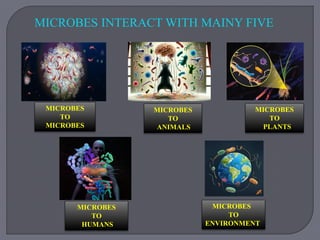
MICROBES INTERACT WITH MAINY FIVE
MICROBES
TO
MICROBES
MICROBES
TO
ANIMALS
MICROBES
TO
PLANTS
MICROBES
TO
HUMANS
MICROBES
TO
ENVIRONMENT
POSITIVE INTERACTIONS
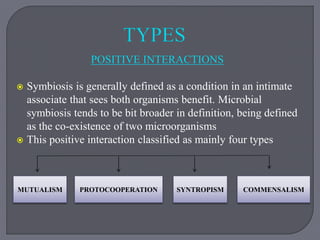
 Symbiosis is generally defined as a condition in an intimate
associate that sees both organisms benefit. Microbial
symbiosis tends to be bit broader in definition, being defined
as the co-existence of two microorganisms
 This positive interaction classified as mainly four types
MUTUALISM PROTOCOOPERATION COMMENSALISM
SYNTROPISM
MUTUALISM
 This interaction is beneficial to both the organisms which
are involved.
 Mutualism was first discovered by Pierre Van Benden.
 This relationship is very specific where one member of
association cannot be replaced by the other.
 This interaction is beneficial to both the organisms which
are involved.
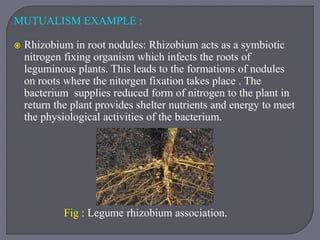
MUTUALISM EXAMPLE :
 Rhizobium in root nodules: Rhizobium acts as a symbiotic
nitrogen fixing organism which infects the roots of
leguminous plants. This leads to the formations of nodules
on roots where the nitorgen fixation takes place . The
bacterium supplies reduced form of nitrogen to the plant in
return the plant provides shelter nutrients and energy to meet
the physiological activities of the bacterium.
Fig : Legume rhizobium association.
PROTO-COOPERATION
 It is a positive inter specific interaction in which both the
partners are mutually benefitted and increase the chance of
their survival.
 However, the interaction is not obligatory for their survival as
both can live without this interaction.
 Benefits both organisms in relationship
 Differs from mutualism because cooperative relationship is
not obligatory.
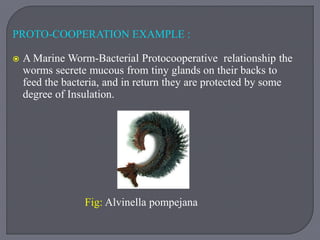
PROTO-COOPERATION EXAMPLE :
 A Marine Worm-Bacterial Protocooperative relationship the
worms secrete mucous from tiny glands on their backs to
feed the bacteria, and in return they are protected by some
degree of Insulation.
Fig: Alvinella pompejana
SYNTROPISM
 In this association the growth of one organism is improved
by various components produced by the other organism such
as growth factors, nutrients (or) substrates.
 In certain conditions both the organisms will benefit.
 Also known as cross-feeding or the satellite phenomenon.
 Syntrophic microbial food webs play an important role in
breakdown of organic pollutants such as oils, aromatic
compounds and amino acids.
 Compound A -utilised by population 1, Compound B-
utilised by population 2, Compound C- utilised by both the
populations.
 Here population 1 utilises compound A ,forming compound
B but cannot utilise beyond compound B without the
cooperation of population 2.Populaton 2 is unable to utilise
compound A but it has the ability to metabolize compound B
forming compound C. Both these populations 1 and 2 are
able to carry out metabolic reaction which leads to the
formation of end product that neither population could
produce alone.
 Example : Methane ecosystem in sludge digester-Methane
production depends upon the interspecies hydrogen transfer
by other fermentative bacteria. Anaerobic fermentative
bacteria generate CO2 and H2 utilizing carbohydrates which
are then utilized by methanogenic bacteria to produce
methane.
COMMENSALISM
 It is a positive interaction in which one organism
(Commensal) is benefitted .While the another organism
(host) is neitherr benefitted nor harmed.
 Commensal may obtain nutrients, shelter, support or
locomotion from the host species
 The various growth promoting substances like enzymes,
vitamins , auxins etc.., produced by the host enhances the
growth of the commensal.
 Example : Chlorella pyrenoidosa produces certain growth
promoting substances which enhances the growth of
pseudomonas and Xanthomonas.
 Refers to the action of any organism that suppresses or
interferes with the normal growth and activity of a plant
pathogen, such as the main parts of bacteria or fungi.
 This positive interaction classified as mainly four types
AMENSALISM
COMPETITION
PARASITISM
PREDATION
NEGATIVE INTERACTIONS
AMMENSALISM OR ANTAGONISM OR ANTIBIOSIS
 It is a non beneficial interaction in which one of the partner
is highly affected while un affecting the other.
 Affected one is suscept.
 Unaffected one is ammensal .
 One microbial population produces certain
substances(antibiotics) that can inhibit the gorwth of other
microbial population which is termed as antibiosis. Along
with the antibiotics some of the organisms produce acids
and microbial enzymes which are detrimental to other
population.
 Example : lactic acid bacteria produces large amounts of
acids which are harmful to other bacteria
COMPETITION
 It is a non beneficial interaction in which the organisms have
common requirements among which only one population
survives eliminating the other.
 Here the competition occurs for nutrients and energy
resources.
 This principle of competition was studied by E. F. Gause,
who in 1934 described this as the competitive exclusion
principle . When competition between species results in the
elimination of one species from a given habitat or region
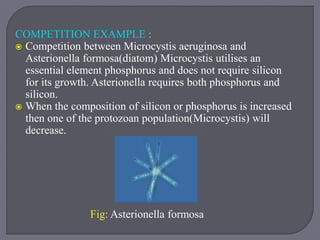
COMPETITION EXAMPLE :
 Competition between Microcystis aeruginosa and
Asterionella formosa(diatom) Microcystis utilises an
essential element phosphorus and does not require silicon
for its growth. Asterionella requires both phosphorus and
silicon.
 When the composition of silicon or phosphorus is increased
then one of the protozoan population(Microcystis) will
decrease.
Fig: Asterionella formosa
PARASITISM
 In this type of interaction one of the organism(parasite) is
benefitted while the other population is drastically affected (host).
 The host parasite interaction is long term which may be physical
or metabolic contact.
1. Ectoparasites: They attach outside the host.
2. Endoparasites: They live inside the host cell.
 Some of the microorganisms that are themselves parasites may
serve as host for other parasites known as hyperparasitism.
 Example : Bdellovibrio lives as an ectoparasite on several gram
negative bacteria but serves as a host for the bacteriophages
(hyperparasitism).
PREDATION
 In this type of interaction one organism (predator) attack the
other organism(prey)and it is a short term interaction. The
predatory mechanism helps to control the harmful microbial
 species and enhances the growth of useful ones . Simple
ingestion and assimilation of a prey bacterium leads to increased
rates of nutrient cycling.
 Some of the fungal members they exhibit a typical predatory
skills i.e they can form a network of hyphae by producing a
sticky hyphae or knobs by which they can trap protozoa.
 Example : Ciliates ingests legionella and protects this pathogen
from chlorine which often used as an attempt to control
Legionella in cooling towers and in air conditioning units.
 A microbial community is a key for microial ecology in
engineering synthetic microbiomes for various
biotechnological applications.
 Microorganisms interact with each other in nutrient cycling
which includes carbon , sulfur , nitrogen, phosphorus , etc
(biogeochemical cycling) nd enhances uptake of nutrients.
 These interactions leads to resistance to numerous plant pests
which includes pathogens, nematodes, and herbivorous
insects.
 These interactions(quorum sensing) add great advantages to
the same organisms in host colonization, formation of
biofilms, enhanced competition, and acclimatization to the
altered environment.
SIGNIFICANCE CONTINUE :
 Increased resistance to abiotic stresses i;e drought , salts,
soil pollutants etc..,
 The predatory mechanism potentially provides basis for
controlling harmful microbial species and enhancing useful
ones.
 Most significantly, several QS-controlled activities are
involved in virulence and possible pathogenic effects of
bacteria.
 Some of the bacterial associations helps to reduce the
toxicity of certain pollutants such as petroleum
hydrocarbons, pesticides and metals.
 Microorganisms engage in a wide variety of social
interactions, including cooperation.
 The role of microbes in plant growth, nutrient availability,
disease resistance, yield and quality of medicinal
compounds is demonstrated in medicinal plants.
 There are increasing interests in the research of the
interaction between medicinal plant and their rhizosphere
microbes for the improvement of medicinal plants.
விதை சிறிது..!!
விதை பெரிது..!!
THANKYOU

MICROBIAL INTERACTIONS AND TYPE OF INTERACTION

  • 1.
    DEPARTMENT OF MICROBIOLOGY SUBJECT SOILAND ENVIRONMENTAL MICROBIOLOGY SUMMITED BY: G.KEERTHANA GOPAL, II - M.SC MICROBIOLOGY, VIVEKANANDHA ARTS AND SCIENCE COLLEGE FOR WOMEN, SANKAGIRI, SALEM,TAMILNADU. SUBJECT INCHARGE: Dr. R.DINESHKUMAR, ASSISTANT PROFESSOR, DEPARTMENT OF MICROBIOLOGY, VIVEKANANDHA ARTS AND SCIENCE COLLEGE FOR WOMEN, SANKAGIRI, SALEM, TAMILNADU. TOPIC: MICROBIAL INTERACTIONS
  • 2.
     INTRODUCTION.  HISTORY TYPES : I.POSITIVE INTERACTIONS. II.NEGATIVE INTERACTIONS.  SIGNIFICANCE OF MICROBIAL INTERACTIONS.  CONCIUSION. INTEX
  • 3.
     Soil actsa excellent culture media for the growth of many kinds of microorganisms and the microscopic life of the soil includes bacteria, yeasts , molds, algae , diatoms and protozoa.  The inter- and intra-relationships between various microorganisms. This can include both positive and negative interactions.  They are ubiquitous, diverse and critically important in the function of any biological community
  • 4.
     In 1964,Hamilton described interaction as indirect interaction.  Symbiotic relationships between plants and microorganisms were first reported in 1697, when Malpighi described the formation of galls on roots.  In 1971, Odom divided all symbiotic relationship into 2 groups : I. Positive interaction. II. Negative interaction.  In 1879, de Bary coined the term Symbiosis to describe any situation where two different organisms live together
  • 5.
    MICROBES INTERACT WITHMAINY FIVE MICROBES TO MICROBES MICROBES TO ANIMALS MICROBES TO PLANTS MICROBES TO HUMANS MICROBES TO ENVIRONMENT
  • 6.
    POSITIVE INTERACTIONS  Symbiosisis generally defined as a condition in an intimate associate that sees both organisms benefit. Microbial symbiosis tends to be bit broader in definition, being defined as the co-existence of two microorganisms  This positive interaction classified as mainly four types MUTUALISM PROTOCOOPERATION COMMENSALISM SYNTROPISM
  • 7.
    MUTUALISM  This interactionis beneficial to both the organisms which are involved.  Mutualism was first discovered by Pierre Van Benden.  This relationship is very specific where one member of association cannot be replaced by the other.  This interaction is beneficial to both the organisms which are involved.
  • 8.
    MUTUALISM EXAMPLE : Rhizobium in root nodules: Rhizobium acts as a symbiotic nitrogen fixing organism which infects the roots of leguminous plants. This leads to the formations of nodules on roots where the nitorgen fixation takes place . The bacterium supplies reduced form of nitrogen to the plant in return the plant provides shelter nutrients and energy to meet the physiological activities of the bacterium. Fig : Legume rhizobium association.
  • 9.
    PROTO-COOPERATION  It isa positive inter specific interaction in which both the partners are mutually benefitted and increase the chance of their survival.  However, the interaction is not obligatory for their survival as both can live without this interaction.  Benefits both organisms in relationship  Differs from mutualism because cooperative relationship is not obligatory.
  • 10.
    PROTO-COOPERATION EXAMPLE : A Marine Worm-Bacterial Protocooperative relationship the worms secrete mucous from tiny glands on their backs to feed the bacteria, and in return they are protected by some degree of Insulation. Fig: Alvinella pompejana
  • 11.
    SYNTROPISM  In thisassociation the growth of one organism is improved by various components produced by the other organism such as growth factors, nutrients (or) substrates.  In certain conditions both the organisms will benefit.  Also known as cross-feeding or the satellite phenomenon.  Syntrophic microbial food webs play an important role in breakdown of organic pollutants such as oils, aromatic compounds and amino acids.  Compound A -utilised by population 1, Compound B- utilised by population 2, Compound C- utilised by both the populations.
  • 12.
     Here population1 utilises compound A ,forming compound B but cannot utilise beyond compound B without the cooperation of population 2.Populaton 2 is unable to utilise compound A but it has the ability to metabolize compound B forming compound C. Both these populations 1 and 2 are able to carry out metabolic reaction which leads to the formation of end product that neither population could produce alone.  Example : Methane ecosystem in sludge digester-Methane production depends upon the interspecies hydrogen transfer by other fermentative bacteria. Anaerobic fermentative bacteria generate CO2 and H2 utilizing carbohydrates which are then utilized by methanogenic bacteria to produce methane.
  • 13.
    COMMENSALISM  It isa positive interaction in which one organism (Commensal) is benefitted .While the another organism (host) is neitherr benefitted nor harmed.  Commensal may obtain nutrients, shelter, support or locomotion from the host species  The various growth promoting substances like enzymes, vitamins , auxins etc.., produced by the host enhances the growth of the commensal.  Example : Chlorella pyrenoidosa produces certain growth promoting substances which enhances the growth of pseudomonas and Xanthomonas.
  • 14.
     Refers tothe action of any organism that suppresses or interferes with the normal growth and activity of a plant pathogen, such as the main parts of bacteria or fungi.  This positive interaction classified as mainly four types AMENSALISM COMPETITION PARASITISM PREDATION NEGATIVE INTERACTIONS
  • 15.
    AMMENSALISM OR ANTAGONISMOR ANTIBIOSIS  It is a non beneficial interaction in which one of the partner is highly affected while un affecting the other.  Affected one is suscept.  Unaffected one is ammensal .  One microbial population produces certain substances(antibiotics) that can inhibit the gorwth of other microbial population which is termed as antibiosis. Along with the antibiotics some of the organisms produce acids and microbial enzymes which are detrimental to other population.  Example : lactic acid bacteria produces large amounts of acids which are harmful to other bacteria
  • 16.
    COMPETITION  It isa non beneficial interaction in which the organisms have common requirements among which only one population survives eliminating the other.  Here the competition occurs for nutrients and energy resources.  This principle of competition was studied by E. F. Gause, who in 1934 described this as the competitive exclusion principle . When competition between species results in the elimination of one species from a given habitat or region
  • 17.
    COMPETITION EXAMPLE : Competition between Microcystis aeruginosa and Asterionella formosa(diatom) Microcystis utilises an essential element phosphorus and does not require silicon for its growth. Asterionella requires both phosphorus and silicon.  When the composition of silicon or phosphorus is increased then one of the protozoan population(Microcystis) will decrease. Fig: Asterionella formosa
  • 18.
    PARASITISM  In thistype of interaction one of the organism(parasite) is benefitted while the other population is drastically affected (host).  The host parasite interaction is long term which may be physical or metabolic contact. 1. Ectoparasites: They attach outside the host. 2. Endoparasites: They live inside the host cell.  Some of the microorganisms that are themselves parasites may serve as host for other parasites known as hyperparasitism.  Example : Bdellovibrio lives as an ectoparasite on several gram negative bacteria but serves as a host for the bacteriophages (hyperparasitism).
  • 19.
    PREDATION  In thistype of interaction one organism (predator) attack the other organism(prey)and it is a short term interaction. The predatory mechanism helps to control the harmful microbial  species and enhances the growth of useful ones . Simple ingestion and assimilation of a prey bacterium leads to increased rates of nutrient cycling.  Some of the fungal members they exhibit a typical predatory skills i.e they can form a network of hyphae by producing a sticky hyphae or knobs by which they can trap protozoa.  Example : Ciliates ingests legionella and protects this pathogen from chlorine which often used as an attempt to control Legionella in cooling towers and in air conditioning units.
  • 20.
     A microbialcommunity is a key for microial ecology in engineering synthetic microbiomes for various biotechnological applications.  Microorganisms interact with each other in nutrient cycling which includes carbon , sulfur , nitrogen, phosphorus , etc (biogeochemical cycling) nd enhances uptake of nutrients.  These interactions leads to resistance to numerous plant pests which includes pathogens, nematodes, and herbivorous insects.  These interactions(quorum sensing) add great advantages to the same organisms in host colonization, formation of biofilms, enhanced competition, and acclimatization to the altered environment.
  • 21.
    SIGNIFICANCE CONTINUE : Increased resistance to abiotic stresses i;e drought , salts, soil pollutants etc..,  The predatory mechanism potentially provides basis for controlling harmful microbial species and enhancing useful ones.  Most significantly, several QS-controlled activities are involved in virulence and possible pathogenic effects of bacteria.  Some of the bacterial associations helps to reduce the toxicity of certain pollutants such as petroleum hydrocarbons, pesticides and metals.
  • 22.
     Microorganisms engagein a wide variety of social interactions, including cooperation.  The role of microbes in plant growth, nutrient availability, disease resistance, yield and quality of medicinal compounds is demonstrated in medicinal plants.  There are increasing interests in the research of the interaction between medicinal plant and their rhizosphere microbes for the improvement of medicinal plants.
  • 23.