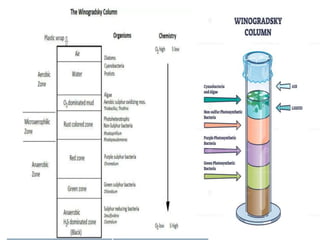
Winogradsky columns allow the study of microbial communities and nutrient cycling. They contain a mixture of soil, water, and various carbon and nutrient sources. As different microbes metabolize these components at different depths, distinct layers form over time that are dominated by specific bacteria, cyanobacteria, or algae such as Clostridium, Chlorobium, and Chromatium. The columns were developed by Sergei Winogradsky in the 1880s to observe mixed microbial cultures interacting in their natural environment, rather than isolated species in pure culture.