Microbial Interactions
By- Dr Ekta Khare
Department of Microbiology,
Chhatrapati Shahu Ji Maharaj University, Kanpur
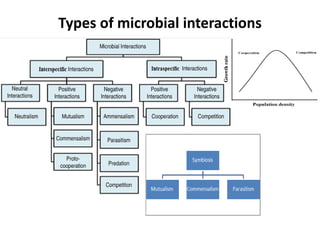
Types of microbial interactions
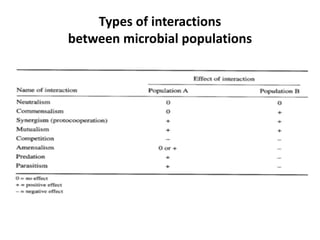
Types of interactions
between microbial populations
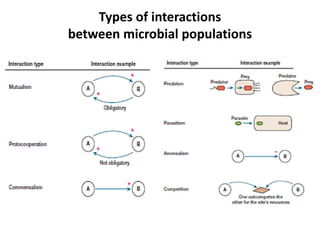
Types of interactions
between microbial populations
Mutualism
• Mutualism is most commonly defined as interactions between
individuals of different species that benefit both of them.
• However, mutualism can be more precisely defined as an
interaction between individuals of different species that results in
positive (beneficial) effects on per capita reproduction and/or
survival of the interacting populations.
• The degree of dependency of each mutualist upon the other ranges
from obligate to facultative; hence, they can be:
– obligate–obligate interactions
– obligate–facultative interaction
– facultative–facultative interactions
• Facultative mutualists are ones whose populations persist in the
absence of a mutualist, whereas obligate mutualists are ones
whose populations go extinct in the absence of a mutualist.
...Mutualism
interaction between rhizobia and legumes in root nodule
(obligate mutualist, both members can not live freely in
that environment thus can be considered as mutualistic
symbiosis.
pollinator mutualisms (facultative mutualist as both partner
species are free-living) can not considered as symbiosis.
• The term mutualism is not synonymous with symbiosis.
Mutualistic interactions need not necessarily be symbiotic.
(Symbiosis is along term intimate, close association
between species).
• Beneficial rhizobacteria and plants mutualism, plant–
• Interactions between algae and fungi that comprise lichens,
Examples of mutualism
• Lichens: They are the association of specific fungi and algae.
– In lichen, fungal partner is called mycobiont and algal partner is called Phycobiont is
member of cyanobacteria ad green algae (Trabauxua).
– Because phycobionts are photoautotrophs, the fungus get its organic carbon directly from
algal partner, in turn fungi protects the phycobiont from extreme conditions and also
provide water and minerals to algae.
– Lichen are able to colonies habitat that do not permit the growth of other organisms.
– Most lichens are resistant to high temperature and drying
• Paramecium-Chlorella: Paramecium (protozoa) can host Chlorella (algae)
within its cytoplasm.
– The algae Chlorella provide the protozoan partner with organism carbon and O2, in turn
protozoa provide protection, mortility, CO2 and other growth factors.
– The presence of Chlorella within Paramecium helps to survive protozoa in anaerobic
condition as long as there is sufficient light.
• Protozoan-termite: Protozoan-termite relationship is the classical example
of mutualism in which flagellated protozoan lives in the gut of termites.
– Theses flagellated protozoan feeds on diet of carbohydrates acquired as cellulose or lignin
by their host termites, metabolize into acetic acid which is utilized by termites.
Commensalism
• The word “commensalism” is derived from the
word “commensal”, meaning “eating at the
same table”.
• In commensalism, one interacting organism
derives benefit from the association while the
other partner remains unaffected.
• It is an unidirectional association and if the
commensal is separated from the host, they
can survive.
Examples of commensalism
• E. coli is a facultative anaerobe that uses oxygen and lower the O2
concentration in gut which creates suitable environment for
obligate anaerobes such as Bacteroides. E. coli is a host which
remains unaffected by Bacteroides.
• Flavobacterium excrete cystine which is used
by Legionella pneumophila and survive in aquatic habitat.
• Association of Nitrosomonas and Nitrobacter in Nitrification:
Nitrosomonas oxidize Ammonia into Nitrite and
finally Nitrobacter uses nitrite to obtain energy and oxidize it into
Nitrate.
• In Swiss-type cheeses, propionic acid bacteria make use of lactic
acid produced by LAB which acts as a starter.
Proto-cooperation (Synergism)
• Protocooperation is a class of interaction where participating
partners benefit; however, the association is not obligatory and
both populations can survive on their own.
• Nevertheless, such association provides a mutual benefit to the
interacting partners.
• It is not at all necessary for protocooperation to occur; growth and
survival is possible in the absence of the interaction.
• Some examples of synergistic interaction include:
– formation of a product where none of the population can
function on its own: eg., pathway completion (syntrophy)
– Interactions among yogurt bacteria (eg. Streptococcus,
Lactobacillus sp.) are also often referred to as synergism or
protocooperation, interactions in which enhanced growth rate is
the main mutual benefit.
Ammensalism/ Antagonism
• Simply stated, ‘amensalism’ is the term used to
describe the (0,−) term in the familiar two-
species-interaction matrix.
• When one microbial population produces
substances that is inhibitory to other microbial
population then this inter population relationship
is known as Ammensalism or Antagonism.
• It is a negative relationship.
• This chemical inhibition is known as antibiosis.
Examples of antagonism (amensalism)
• Lactic acid produced by many normal floras in
vaginal tract is inhibitory to many pathogenic
organisms such as Candida albicans.
• Fatty acid produced by skin flora inhibits many
pathogenic bacteria in skin.
• Thiobacillus thioxidant produces sulfuric acid
by oxidation of sulfur which is responsible to
lowering of pH in the culture media which
inhibits the growth of most other bacteria.
Competition
• The competition represents a negative relationship between two microbial
population in which both the population are adversely affected with
respect to their survival and growth.
• Competition occurs when both population uses same resources such as
same space or same nutrition, so, the microbial population achieve lower
maximum density or growth rate.
• Microbial population competes for any growth limiting resources such as
carbon source, nitrogen source, phosphorus, vitamins, growth factors etc.
• Competition inhibits both population from occupying exactly same
ecological niche because one will win the competition and the other one is
eliminated.
• The competitive exclusion principle or Gause’s principle tells us that two
species can't have exactly the same niche in a habitat and stably coexist.
That's because species with identical niches also have identical needs,
which means they would compete for precisely the same resources.
Example of competition
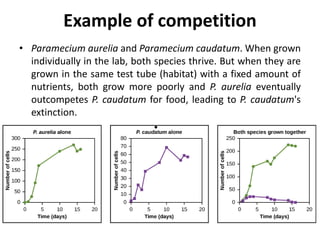
• Paramecium aurelia and Paramecium caudatum. When grown
individually in the lab, both species thrive. But when they are
grown in the same test tube (habitat) with a fixed amount of
nutrients, both grow more poorly and P. aurelia eventually
outcompetes P. caudatum for food, leading to P. caudatum's
extinction.
•
...Competition
• Competitive exclusion may be avoided if one
or both of the competing species evolves to
use a different resource, occupy a different
area of the habitat, or feed during a different
time of day.
• This is called resource partitioning, and it
helps the species coexist because there is less
direct competition between them.
Parasitism
• It is a relationship in which one population
(parasite) get benefited and derive its nutrition
from other population (host) in the association
which is harmed.
• The host-parasite relationship is characterized by
a relatively a long period of contact which may be
physical or metabolic.
• Some parasite lives outside host cell, known as
ectoparasite while other parasite lives inside host
cell, known as endoparasite.
Examples of parasitism
• Parasitic fungi include Rhizophydium sphaerocarpum
with the alga Spyrogyra.
• Rhizoctonia solani is a parasite of Mucor and Pythium,
which is important in biocontrol processes, the use of
one microorganism to control another.
• Viruses are obligate intracellular parasite that exhibit
great host specificity.
– There are may viruses that are parasite to bacteria
(bacteriophage), fungi, algae, protozoa etc.
– Bacteriophages are the commonly known examples of
microbial parasitism in nature.
Predation
• It is a wide spread phenomenon when one
organism (predator) engulf or attack other
organism (prey).
Or
• The prey-predator relationships where
predator (hunter) feeds on its prey (hunted).
• Normally predator-prey interaction is of short
duration.
Examples of Predation
• Many protozoans can feed on
various bacterial population
which helps to maintain count of
soil bacteria at optimum level.
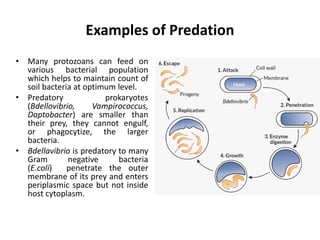
• Predatory prokaryotes
(Bdellovibrio, Vampirococcus,
Daptobacter) are smaller than
their prey, they cannot engulf,
or phagocytize, the larger
bacteria.
• Bdellavibrio is predatory to many
Gram negative bacteria
(E.coli) penetrate the outer
membrane of its prey and enters
periplasmic space but not inside
host cytoplasm.
Examples of Predation
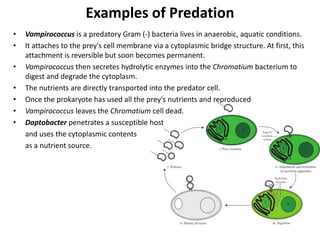
• Vampirococcus is a predatory Gram (-) bacteria lives in anaerobic, aquatic conditions.
• It attaches to the prey's cell membrane via a cytoplasmic bridge structure. At first, this
attachment is reversible but soon becomes permanent.
• Vampirococcus then secretes hydrolytic enzymes into the Chromatium bacterium to
digest and degrade the cytoplasm.
• The nutrients are directly transported into the predator cell.
• Once the prokaryote has used all the prey's nutrients and reproduced
• Vampirococcus leaves the Chromatium cell dead.
• Daptobacter penetrates a susceptible host
and uses the cytoplasmic contents
as a nutrient source.
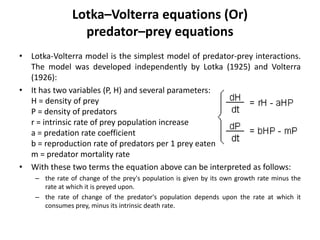
Lotka–Volterra equations (Or)
predator–prey equations
• Lotka-Volterra model is the simplest model of predator-prey interactions.
The model was developed independently by Lotka (1925) and Volterra
(1926):
• It has two variables (P, H) and several parameters:
H = density of prey
P = density of predators
r = intrinsic rate of prey population increase
a = predation rate coefficient
b = reproduction rate of predators per 1 prey eaten
m = predator mortality rate
• With these two terms the equation above can be interpreted as follows:
– the rate of change of the prey's population is given by its own growth rate minus the
rate at which it is preyed upon.
– the rate of change of the predator's population depends upon the rate at which it
consumes prey, minus its intrinsic death rate.
Symbiosis
• Ecologists sometimes use the terms “mutualism” and “symbiosis”
interchangeably, but this not exactly the case.
• The main difference between symbiotic and mutualistic organisms
is that some symbiotic organisms benefit, suffer or are unaffected
by the relationship whereas mutualistic organisms are benefited.
• The term symbiosis identifies an intimate, close association
between species in which the large majority or entire life cycle
of one species occurs within or in very close association with
another.
• Often, one species (the symbiont) is not free-living, but
inhabits the body of another species (the host).
• A mutualism can also be a symbiosis, and many symbioses are
also mutualistic, but not all symbioses are mutualisms and not
all mutualisms are symbioses.
Symbiosis
• Symbiotic relationships are categorized by the benefits and physical
relationships experienced by each species.
• Common types of symbiosis are categorized by the degree to which each
species benefits from the interaction:
– Mutualism: both species benefit from the relationship. Eg. Lichen,
rhizobia-legume (root nodule)
– Commensalism: one species benefits and the other species is not
affected. (eg. E. coli and Bacteroides in gut)
– Parasitism: one species benefits at the expense of the second species.
(eg. Bacteriophage)
• Symbiosis can also be characterized by an organism’s physical relationship
with its partner:
– Endosymbiosis (gutless marine worms of the genus Riftia, which get
nutrition from their endosymbiotic bacteria, lysogenic bacteriophage)
– Ectosymbiosis (anaerobic sulfate-reducing chemolithoautotrophs that
likely reduce sulfate with hydrogen produced by hydrogenosome-like
organelles underlying the plasma membrane of the protist.)
Questions
• Write an essay on microbial interaction between species.
• Explain intra-species and interspecies microbial interaction with
examples.
• Differentiate between mutualism and symbiosis
• Write short notes on:
– Mutualism
– Symbiosis
– Commensalism
– Parasitism
– Predation
– Competition
– Competitive exclusion principle
– Lotka–Volterra equations
– predator–prey equations

Microbial-Interactions xvdjdkkdkdkdkdldk

  • 1.
    Microbial Interactions By- DrEkta Khare Department of Microbiology, Chhatrapati Shahu Ji Maharaj University, Kanpur
  • 2.
    Types of microbialinteractions
  • 3.
    Types of interactions betweenmicrobial populations
  • 4.
    Types of interactions betweenmicrobial populations
  • 5.
    Mutualism • Mutualism ismost commonly defined as interactions between individuals of different species that benefit both of them. • However, mutualism can be more precisely defined as an interaction between individuals of different species that results in positive (beneficial) effects on per capita reproduction and/or survival of the interacting populations. • The degree of dependency of each mutualist upon the other ranges from obligate to facultative; hence, they can be: – obligate–obligate interactions – obligate–facultative interaction – facultative–facultative interactions • Facultative mutualists are ones whose populations persist in the absence of a mutualist, whereas obligate mutualists are ones whose populations go extinct in the absence of a mutualist.
  • 6.
    ...Mutualism interaction between rhizobiaand legumes in root nodule (obligate mutualist, both members can not live freely in that environment thus can be considered as mutualistic symbiosis. pollinator mutualisms (facultative mutualist as both partner species are free-living) can not considered as symbiosis. • The term mutualism is not synonymous with symbiosis. Mutualistic interactions need not necessarily be symbiotic. (Symbiosis is along term intimate, close association between species). • Beneficial rhizobacteria and plants mutualism, plant– • Interactions between algae and fungi that comprise lichens,
  • 7.
    Examples of mutualism •Lichens: They are the association of specific fungi and algae. – In lichen, fungal partner is called mycobiont and algal partner is called Phycobiont is member of cyanobacteria ad green algae (Trabauxua). – Because phycobionts are photoautotrophs, the fungus get its organic carbon directly from algal partner, in turn fungi protects the phycobiont from extreme conditions and also provide water and minerals to algae. – Lichen are able to colonies habitat that do not permit the growth of other organisms. – Most lichens are resistant to high temperature and drying • Paramecium-Chlorella: Paramecium (protozoa) can host Chlorella (algae) within its cytoplasm. – The algae Chlorella provide the protozoan partner with organism carbon and O2, in turn protozoa provide protection, mortility, CO2 and other growth factors. – The presence of Chlorella within Paramecium helps to survive protozoa in anaerobic condition as long as there is sufficient light. • Protozoan-termite: Protozoan-termite relationship is the classical example of mutualism in which flagellated protozoan lives in the gut of termites. – Theses flagellated protozoan feeds on diet of carbohydrates acquired as cellulose or lignin by their host termites, metabolize into acetic acid which is utilized by termites.
  • 8.
    Commensalism • The word“commensalism” is derived from the word “commensal”, meaning “eating at the same table”. • In commensalism, one interacting organism derives benefit from the association while the other partner remains unaffected. • It is an unidirectional association and if the commensal is separated from the host, they can survive.
  • 9.
    Examples of commensalism •E. coli is a facultative anaerobe that uses oxygen and lower the O2 concentration in gut which creates suitable environment for obligate anaerobes such as Bacteroides. E. coli is a host which remains unaffected by Bacteroides. • Flavobacterium excrete cystine which is used by Legionella pneumophila and survive in aquatic habitat. • Association of Nitrosomonas and Nitrobacter in Nitrification: Nitrosomonas oxidize Ammonia into Nitrite and finally Nitrobacter uses nitrite to obtain energy and oxidize it into Nitrate. • In Swiss-type cheeses, propionic acid bacteria make use of lactic acid produced by LAB which acts as a starter.
  • 10.
    Proto-cooperation (Synergism) • Protocooperationis a class of interaction where participating partners benefit; however, the association is not obligatory and both populations can survive on their own. • Nevertheless, such association provides a mutual benefit to the interacting partners. • It is not at all necessary for protocooperation to occur; growth and survival is possible in the absence of the interaction. • Some examples of synergistic interaction include: – formation of a product where none of the population can function on its own: eg., pathway completion (syntrophy) – Interactions among yogurt bacteria (eg. Streptococcus, Lactobacillus sp.) are also often referred to as synergism or protocooperation, interactions in which enhanced growth rate is the main mutual benefit.
  • 11.
    Ammensalism/ Antagonism • Simplystated, ‘amensalism’ is the term used to describe the (0,−) term in the familiar two- species-interaction matrix. • When one microbial population produces substances that is inhibitory to other microbial population then this inter population relationship is known as Ammensalism or Antagonism. • It is a negative relationship. • This chemical inhibition is known as antibiosis.
  • 12.
    Examples of antagonism(amensalism) • Lactic acid produced by many normal floras in vaginal tract is inhibitory to many pathogenic organisms such as Candida albicans. • Fatty acid produced by skin flora inhibits many pathogenic bacteria in skin. • Thiobacillus thioxidant produces sulfuric acid by oxidation of sulfur which is responsible to lowering of pH in the culture media which inhibits the growth of most other bacteria.
  • 13.
    Competition • The competitionrepresents a negative relationship between two microbial population in which both the population are adversely affected with respect to their survival and growth. • Competition occurs when both population uses same resources such as same space or same nutrition, so, the microbial population achieve lower maximum density or growth rate. • Microbial population competes for any growth limiting resources such as carbon source, nitrogen source, phosphorus, vitamins, growth factors etc. • Competition inhibits both population from occupying exactly same ecological niche because one will win the competition and the other one is eliminated. • The competitive exclusion principle or Gause’s principle tells us that two species can't have exactly the same niche in a habitat and stably coexist. That's because species with identical niches also have identical needs, which means they would compete for precisely the same resources.
  • 14.
    Example of competition •Paramecium aurelia and Paramecium caudatum. When grown individually in the lab, both species thrive. But when they are grown in the same test tube (habitat) with a fixed amount of nutrients, both grow more poorly and P. aurelia eventually outcompetes P. caudatum for food, leading to P. caudatum's extinction. •
  • 15.
    ...Competition • Competitive exclusionmay be avoided if one or both of the competing species evolves to use a different resource, occupy a different area of the habitat, or feed during a different time of day. • This is called resource partitioning, and it helps the species coexist because there is less direct competition between them.
  • 16.
    Parasitism • It isa relationship in which one population (parasite) get benefited and derive its nutrition from other population (host) in the association which is harmed. • The host-parasite relationship is characterized by a relatively a long period of contact which may be physical or metabolic. • Some parasite lives outside host cell, known as ectoparasite while other parasite lives inside host cell, known as endoparasite.
  • 17.
    Examples of parasitism •Parasitic fungi include Rhizophydium sphaerocarpum with the alga Spyrogyra. • Rhizoctonia solani is a parasite of Mucor and Pythium, which is important in biocontrol processes, the use of one microorganism to control another. • Viruses are obligate intracellular parasite that exhibit great host specificity. – There are may viruses that are parasite to bacteria (bacteriophage), fungi, algae, protozoa etc. – Bacteriophages are the commonly known examples of microbial parasitism in nature.
  • 18.
    Predation • It isa wide spread phenomenon when one organism (predator) engulf or attack other organism (prey). Or • The prey-predator relationships where predator (hunter) feeds on its prey (hunted). • Normally predator-prey interaction is of short duration.
  • 19.
    Examples of Predation •Many protozoans can feed on various bacterial population which helps to maintain count of soil bacteria at optimum level. • Predatory prokaryotes (Bdellovibrio, Vampirococcus, Daptobacter) are smaller than their prey, they cannot engulf, or phagocytize, the larger bacteria. • Bdellavibrio is predatory to many Gram negative bacteria (E.coli) penetrate the outer membrane of its prey and enters periplasmic space but not inside host cytoplasm.
  • 20.
    Examples of Predation •Vampirococcus is a predatory Gram (-) bacteria lives in anaerobic, aquatic conditions. • It attaches to the prey's cell membrane via a cytoplasmic bridge structure. At first, this attachment is reversible but soon becomes permanent. • Vampirococcus then secretes hydrolytic enzymes into the Chromatium bacterium to digest and degrade the cytoplasm. • The nutrients are directly transported into the predator cell. • Once the prokaryote has used all the prey's nutrients and reproduced • Vampirococcus leaves the Chromatium cell dead. • Daptobacter penetrates a susceptible host and uses the cytoplasmic contents as a nutrient source.
  • 21.
    Lotka–Volterra equations (Or) predator–preyequations • Lotka-Volterra model is the simplest model of predator-prey interactions. The model was developed independently by Lotka (1925) and Volterra (1926): • It has two variables (P, H) and several parameters: H = density of prey P = density of predators r = intrinsic rate of prey population increase a = predation rate coefficient b = reproduction rate of predators per 1 prey eaten m = predator mortality rate • With these two terms the equation above can be interpreted as follows: – the rate of change of the prey's population is given by its own growth rate minus the rate at which it is preyed upon. – the rate of change of the predator's population depends upon the rate at which it consumes prey, minus its intrinsic death rate.
  • 22.
    Symbiosis • Ecologists sometimesuse the terms “mutualism” and “symbiosis” interchangeably, but this not exactly the case. • The main difference between symbiotic and mutualistic organisms is that some symbiotic organisms benefit, suffer or are unaffected by the relationship whereas mutualistic organisms are benefited. • The term symbiosis identifies an intimate, close association between species in which the large majority or entire life cycle of one species occurs within or in very close association with another. • Often, one species (the symbiont) is not free-living, but inhabits the body of another species (the host). • A mutualism can also be a symbiosis, and many symbioses are also mutualistic, but not all symbioses are mutualisms and not all mutualisms are symbioses.
  • 23.
    Symbiosis • Symbiotic relationshipsare categorized by the benefits and physical relationships experienced by each species. • Common types of symbiosis are categorized by the degree to which each species benefits from the interaction: – Mutualism: both species benefit from the relationship. Eg. Lichen, rhizobia-legume (root nodule) – Commensalism: one species benefits and the other species is not affected. (eg. E. coli and Bacteroides in gut) – Parasitism: one species benefits at the expense of the second species. (eg. Bacteriophage) • Symbiosis can also be characterized by an organism’s physical relationship with its partner: – Endosymbiosis (gutless marine worms of the genus Riftia, which get nutrition from their endosymbiotic bacteria, lysogenic bacteriophage) – Ectosymbiosis (anaerobic sulfate-reducing chemolithoautotrophs that likely reduce sulfate with hydrogen produced by hydrogenosome-like organelles underlying the plasma membrane of the protist.)
  • 24.
    Questions • Write anessay on microbial interaction between species. • Explain intra-species and interspecies microbial interaction with examples. • Differentiate between mutualism and symbiosis • Write short notes on: – Mutualism – Symbiosis – Commensalism – Parasitism – Predation – Competition – Competitive exclusion principle – Lotka–Volterra equations – predator–prey equations