E. coli changes gene expression to utilize
different nutrient sources
Lac Operon (Negative Regulation)
Catabolic Enzyme
Repressor
Inducer
Operon
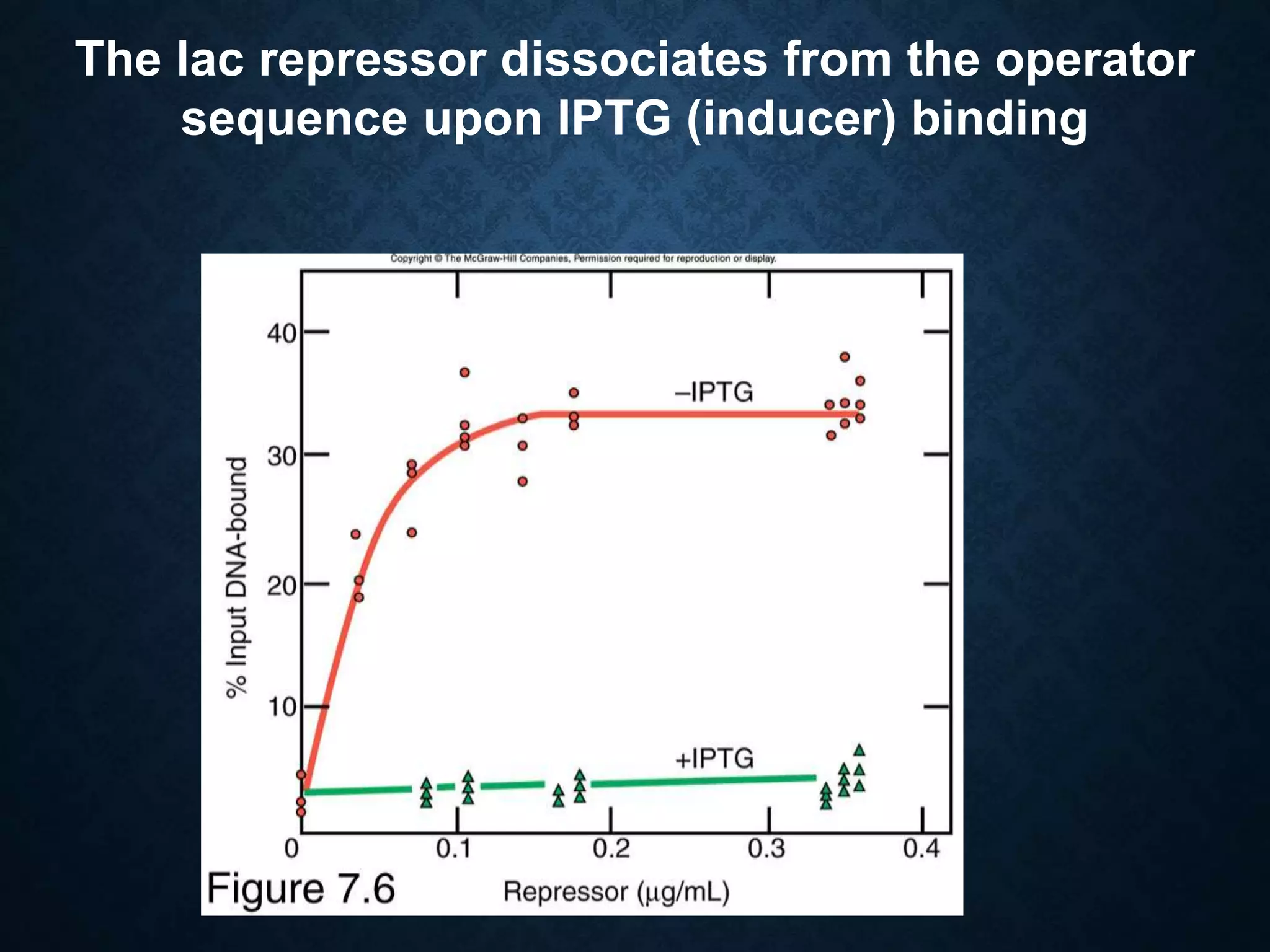
The lac repressor dissociates from the operator
sequence upon IPTG (inducer) binding
Cis versus Trans
Cis versus Trans
Dominant versus Recessive
Operator Mutations Reduce Repressor
Binding
Fig. 7.12
The lac repressor tetramer binds two operators
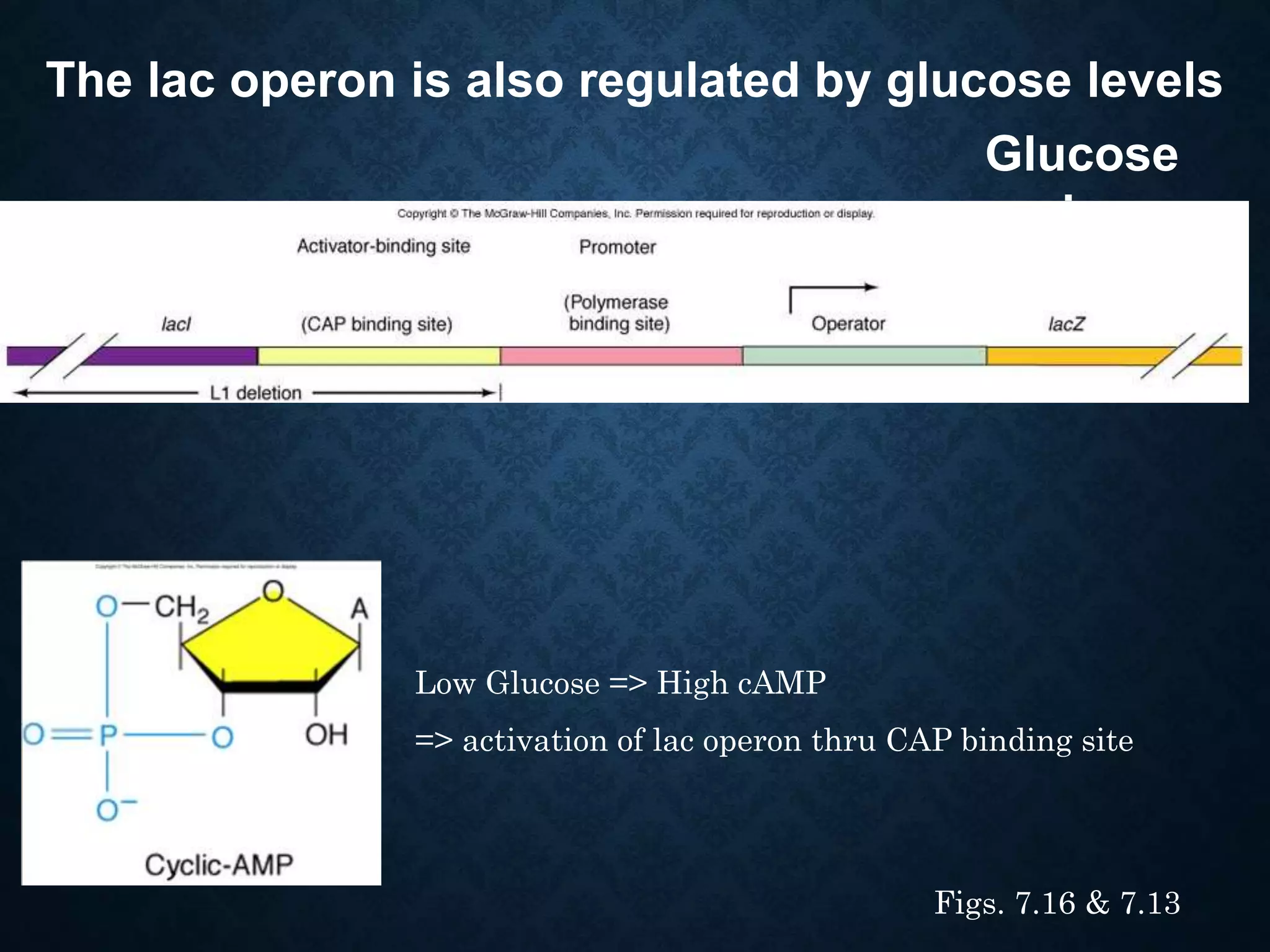
Figs. 7.16 & 7.13
The lac operon is also regulated by glucose levels
Low Glucose => High cAMP
=> activation of lac operon thru CAP binding site
Glucose
is
Sweeter
cAMP is Needed for
Activation
Catabolite Repression
Figs. 7.17 & 7.19
CAP-cAMP binding creates DNA bending and
activates lac operon transcription
Trp Operon
(Anabolic Enzyme)Apo
Co-repressor
Figs. 7.28 &7.31
The trp operon attenuator
Termination
No termination
Fig. 7.30
Alternative
structures of the
trp operon
attenuator RNA
How a Terminator Loop is Formed
Negative regulation:
Substrate induction
Positive regulation of the lac operon
LAC OPERON
No food
• Glucose?
• Lactose?
• Low: cAMP high, CRP
attaches
• Low: Repressor attached
Operon is ready to be enhanced but is shu
LAC OPERON
Milk
• Glucose?
• Lactose?
• Low: cAMP high, CRP
attaches
• High: Repressor removed
Operon is on and enhanced
LAC OPERON
Milkshake
• Glucose?
• Lactose?
• High: cAMP low, CRP off
• Low: Repressor removed
Operon is on but un-enhanced
LAC OPERON
Powerade
• Glucose?
• Lactose?
• High: cAMP low, CRP off
• Low: Repressor attached
Operon is off and un-enhanced
LAC OPERON
• No food: ready to be enhanced but off
• Milk: enhanced transcription
• Milkshake: un-enhanced transcription
• Powerade: off and un-enhanced
Negative regulation: end-product repression
LACTOSE OPERON
• Structural genes
• lac z, lac y, & lac
a
• Promoter
• Polycistronic
mRNA
• Regulatory gene
• Repressor
• Operator
• Operon
• Inducer - lactose
i
Operon
Regulatory
Gene
p o z y a DNA
m-RNA
-Galactosidase
Permease
Transacetylase
Protein
LACTOSE OPERON
• Inducer -- lactose
• Absence
• Active repressor
• No expression
i p o z y a
No lac mRNA
Absence of lactose
Active
i p o z y a
-GalactosidasePermease Transacetylase
Presence of lactose
Inactive
– Presence
• Inactivation of
repressor
• Expression
• Negative control
CATABOLITE REPRESSION
(GLUCOSE EFFECT)
• Definition: Control of an
operon by glucose
+ glucose
- glucose
Time (hr)
Unitsof-
galactosidase
+ lactose
Glucose
added
• Catabolic
operons
MECHANISM OF CATABOLITE
REPRESSION
• c-AMP
• CAP (CRP) protein
• CAP-cAMP complex
• Promoter activation
• Positive control
Absence of glucose
i p o z y a
Active
-GalactosidasePermease Transacetylase
CAP
Inactive
ATP
Adenyl cyclase
c-AMP
Maximum expression
MECHANISM OF CATABOLITE
REPRESSION
• Glucose:cAMP
• CAP (CRP) protein
• No CAP-cAMP complex
• No Promoter activation
Presence of glucose
i p o z y a
Inactive
ATP
Adenyl cyclase
CAP X
-GalactosidasePermease Transacetylase
Low level expression
REPRESSIBLE GENES - OPERON
MODEL
• Definition: Genes whose expression is turned off by the
presence of some substance (co-repressor)
• Tryptophan represses the trp genes
• Biosynthetic pathways
• Co-repressor is typically the end product of the pathway
TRYPTOPHAN OPERON
• Structural genes
• trp E, trpD, trpC
trpB & trpA
• Common promoter
• Regulatory Gene
• Apo-Repressor
• Inactive
• Operator
• Leader
• Operon
• Co-repressor
• Tryptophan
R
Operon
Regulatory
Gene
P O E D C
5 Proteins
B AL
Inactive repressor
(apo-repressor)
TRYPTOPHAN OPERON
• Co-repressor --
tryptophan
• Absence of tryptophan
• Gene expression
R P O E D C
5 Proteins
B AL
Inactive repressor
(apo-repressor)
Absence of Tryptophan
R P O E D C
No trp mRNA
B AL
Presence of Tryptophan
Inactive repressor
(apo-repressor)
Trp
(co-repressor)
– Presence of
tryptophan
• Activates
repressor
• No gene
expression
• Negative control
ATTENUATION
• Definition: Premature
termination of
transcription
P O E4321
L
DNA
RNA
ATG TGA
2 trp codons
1 432
• Leader region
– Leader transcript
– Translation start
– Translation stop
– Tryptophan codons
1
4
3
2
UUUUUUU
1
4
3
2
UUUUUUU
ATTENUATION
• Mutually exclusive
mRNA secondary
structure
• region 1 : region 2
• region 2 : region 3
• region 3 : region 4
• Coupled transcription and
translation
ATTENUATION
1 2
4
3
UUUUUUU
ATG TGA
2 trp codons
1 432
High tryptophanyl-t-RNA
Attenuation
ATG TGA
2 trp codons
1 432
1
4
3
2
UUUUUUU
Low tryptophanyl-t-RNA
No Attenuation
REGULATION OF ENZYME
ACTIVITY
• Feed back inhibition
• Epigenetic modification
• Post translational modifications
• Phosphorylation/dephosphorylation
• Adenylation/deadenylation

Lac & Trp operon