MICROARRAY
PRINCIPLE
• It is based on the principle of hybridization between the nucleotide.
• This allows screening of 1,00,000 or more stable cDNA at a time
• If the sample ssDNA and the probe are complementary to each other,
they form hydrogen bonds leads to base pairing. This elicit signals which
can be recorded.
TYPES OF DNA MICROARRAY
• cDNA microarray
• Oligiucleotide microarray
cDNA MICROARRAY
• Glass slides or similar supports containing cDNA sequences that serve as probes for
measuring mRNA levels in target samples
• cDNAs are arrayed on each slide in a grid of spots.
• Each spot contains thousands of copies of a sequence that matches a segment of a gene’s
coding sequence.
• A sequence and its complement are present in the same spot.
• Different spots typically represent different Genes
• The spotted sequences are known (or can be determined) and their locations on the array
are known
• The sequence locations do not change from slide to slide.
• A single slide typically contains thousands of spots
SPOTTING CDNA PROBES ON
MICROARRAYS
• Solutions containing probes are transferred from a plate to a microarray
slide by a robotic arrayer.
• The robot picks up a small amount of solution containing a probe by
dipping a pin into a well on a plate.
• The robot then deposits a small drop of the solution on the microarray
slide by touching the pin onto the slide.
• The pin is washed and the process is repeated for a different probe.
• Most arrayers use several pins so that multiple probes are spotted
simultaneously on a slide.
• Most arrayers print multiple slides together so that probes are deposited
on several slides prior to washing.
STEPS INVOVED IN MICROARRAY
• RNA is extracted from a target sample of interest.
• mRNA are reverse transcribed into cDNA.
• The resulting cDNA are labeled with a fluorescent dye.
• The dyed cDNA are placed on a microarray slide.
• Dyed cDNA sequences hybridize to complementary probes spotted on the array.
• A laser excites the dye and a scanner records an image of the slide.
• The image is quantified to obtain measures of fluorescence intensity for each pixel.
• Pixel values are processed to obtain measures of mRNA abundance for each probe spotted on the
array.
• Usually two samples, dyed with different dyes, are hybridized to a single slide.
• The dyes fluoresce at different wavelengths so it is possible to get separate images for each dye.
• Cyanine 3 (Cy3) and Cyanine 5 (Cy5) are currently the two most commonly used dyes.
• Images from the scanner are black and white, but it is typical to display Cy3 images as green and
Cy5 images are displayed as red.
• It is common to superimpose the two images using yellow to indicate a mixture of green and red.
ADVANTAGE AND
DISADVANTAGE
ADVANTAGE:
• Prior knowledge of gene sequence is not necessary: good choice for
gene discovery
• Large cDNA size is great for hybridization
• Glass or membrane spotting technology is readily available
DISADVATAGE:
• Processing cDNAs to generate “spotting-ready” material is
cumbersome
• Low density compared to oligonucleotide arrays
• cDNAs may contain repetitive sequences (like Alu in humans)
OLIGONUCLEOTIDE
MICROAARAY
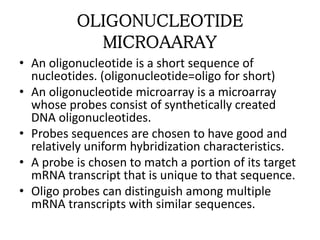
• An oligonucleotide is a short sequence of
nucleotides. (oligonucleotide=oligo for short)
• An oligonucleotide microarray is a microarray
whose probes consist of synthetically created
DNA oligonucleotides.
• Probes sequences are chosen to have good and
relatively uniform hybridization characteristics.
• A probe is chosen to match a portion of its target
mRNA transcript that is unique to that sequence.
• Oligo probes can distinguish among multiple
mRNA transcripts with similar sequences.
OLIGO MICROARRAY
FABRICATION
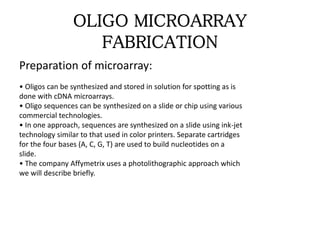
Preparation of microarray:
• Oligos can be synthesized and stored in solution for spotting as is
done with cDNA microarrays.
• Oligo sequences can be synthesized on a slide or chip using various
commercial technologies.
• In one approach, sequences are synthesized on a slide using ink-jet
technology similar to that used in color printers. Separate cartridges
for the four bases (A, C, G, T) are used to build nucleotides on a
slide.
• The company Affymetrix uses a photolithographic approach which
we will describe briefly.
AFFYMETRIX GENECHIPS
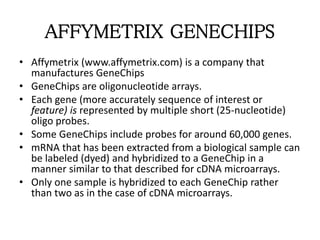
• Affymetrix (www.affymetrix.com) is a company that
manufactures GeneChips
• GeneChips are oligonucleotide arrays.
• Each gene (more accurately sequence of interest or
feature) is represented by multiple short (25-nucleotide)
oligo probes.
• Some GeneChips include probes for around 60,000 genes.
• mRNA that has been extracted from a biological sample can
be labeled (dyed) and hybridized to a GeneChip in a
manner similar to that described for cDNA microarrays.
• Only one sample is hybridized to each GeneChip rather
than two as in the case of cDNA microarrays.
AFFYMETRIX PROBE SETS
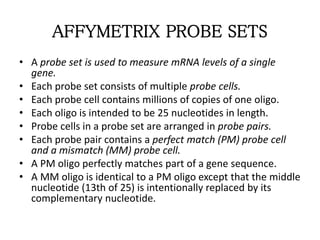
• A probe set is used to measure mRNA levels of a single
gene.
• Each probe set consists of multiple probe cells.
• Each probe cell contains millions of copies of one oligo.
• Each oligo is intended to be 25 nucleotides in length.
• Probe cells in a probe set are arranged in probe pairs.
• Each probe pair contains a perfect match (PM) probe cell
and a mismatch (MM) probe cell.
• A PM oligo perfectly matches part of a gene sequence.
• A MM oligo is identical to a PM oligo except that the middle
nucleotide (13th of 25) is intentionally replaced by its
complementary nucleotide.

Microarray

  • 1.
  • 2.
    PRINCIPLE • It isbased on the principle of hybridization between the nucleotide. • This allows screening of 1,00,000 or more stable cDNA at a time • If the sample ssDNA and the probe are complementary to each other, they form hydrogen bonds leads to base pairing. This elicit signals which can be recorded.
  • 3.
    TYPES OF DNAMICROARRAY • cDNA microarray • Oligiucleotide microarray
  • 4.
    cDNA MICROARRAY • Glassslides or similar supports containing cDNA sequences that serve as probes for measuring mRNA levels in target samples • cDNAs are arrayed on each slide in a grid of spots. • Each spot contains thousands of copies of a sequence that matches a segment of a gene’s coding sequence. • A sequence and its complement are present in the same spot. • Different spots typically represent different Genes • The spotted sequences are known (or can be determined) and their locations on the array are known • The sequence locations do not change from slide to slide. • A single slide typically contains thousands of spots
  • 5.
    SPOTTING CDNA PROBESON MICROARRAYS • Solutions containing probes are transferred from a plate to a microarray slide by a robotic arrayer. • The robot picks up a small amount of solution containing a probe by dipping a pin into a well on a plate. • The robot then deposits a small drop of the solution on the microarray slide by touching the pin onto the slide. • The pin is washed and the process is repeated for a different probe. • Most arrayers use several pins so that multiple probes are spotted simultaneously on a slide. • Most arrayers print multiple slides together so that probes are deposited on several slides prior to washing.
  • 6.
    STEPS INVOVED INMICROARRAY • RNA is extracted from a target sample of interest. • mRNA are reverse transcribed into cDNA. • The resulting cDNA are labeled with a fluorescent dye. • The dyed cDNA are placed on a microarray slide. • Dyed cDNA sequences hybridize to complementary probes spotted on the array. • A laser excites the dye and a scanner records an image of the slide. • The image is quantified to obtain measures of fluorescence intensity for each pixel. • Pixel values are processed to obtain measures of mRNA abundance for each probe spotted on the array. • Usually two samples, dyed with different dyes, are hybridized to a single slide. • The dyes fluoresce at different wavelengths so it is possible to get separate images for each dye. • Cyanine 3 (Cy3) and Cyanine 5 (Cy5) are currently the two most commonly used dyes. • Images from the scanner are black and white, but it is typical to display Cy3 images as green and Cy5 images are displayed as red. • It is common to superimpose the two images using yellow to indicate a mixture of green and red.
  • 7.
    ADVANTAGE AND DISADVANTAGE ADVANTAGE: • Priorknowledge of gene sequence is not necessary: good choice for gene discovery • Large cDNA size is great for hybridization • Glass or membrane spotting technology is readily available DISADVATAGE: • Processing cDNAs to generate “spotting-ready” material is cumbersome • Low density compared to oligonucleotide arrays • cDNAs may contain repetitive sequences (like Alu in humans)
  • 8.
    OLIGONUCLEOTIDE MICROAARAY • An oligonucleotideis a short sequence of nucleotides. (oligonucleotide=oligo for short) • An oligonucleotide microarray is a microarray whose probes consist of synthetically created DNA oligonucleotides. • Probes sequences are chosen to have good and relatively uniform hybridization characteristics. • A probe is chosen to match a portion of its target mRNA transcript that is unique to that sequence. • Oligo probes can distinguish among multiple mRNA transcripts with similar sequences.
  • 9.
    OLIGO MICROARRAY FABRICATION Preparation ofmicroarray: • Oligos can be synthesized and stored in solution for spotting as is done with cDNA microarrays. • Oligo sequences can be synthesized on a slide or chip using various commercial technologies. • In one approach, sequences are synthesized on a slide using ink-jet technology similar to that used in color printers. Separate cartridges for the four bases (A, C, G, T) are used to build nucleotides on a slide. • The company Affymetrix uses a photolithographic approach which we will describe briefly.
  • 10.
    AFFYMETRIX GENECHIPS • Affymetrix(www.affymetrix.com) is a company that manufactures GeneChips • GeneChips are oligonucleotide arrays. • Each gene (more accurately sequence of interest or feature) is represented by multiple short (25-nucleotide) oligo probes. • Some GeneChips include probes for around 60,000 genes. • mRNA that has been extracted from a biological sample can be labeled (dyed) and hybridized to a GeneChip in a manner similar to that described for cDNA microarrays. • Only one sample is hybridized to each GeneChip rather than two as in the case of cDNA microarrays.
  • 11.
    AFFYMETRIX PROBE SETS •A probe set is used to measure mRNA levels of a single gene. • Each probe set consists of multiple probe cells. • Each probe cell contains millions of copies of one oligo. • Each oligo is intended to be 25 nucleotides in length. • Probe cells in a probe set are arranged in probe pairs. • Each probe pair contains a perfect match (PM) probe cell and a mismatch (MM) probe cell. • A PM oligo perfectly matches part of a gene sequence. • A MM oligo is identical to a PM oligo except that the middle nucleotide (13th of 25) is intentionally replaced by its complementary nucleotide.