


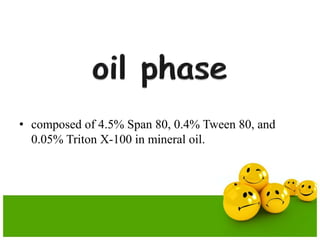





• composed of 4.5% Span 80, 0.4% Tween 80, and
0.05% Triton X-100 in mineral oil.
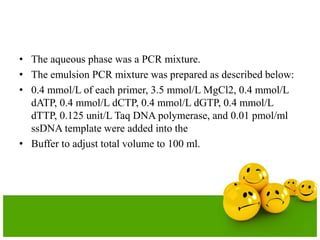
• The aqueous phase was a PCR mixture.
• The emulsion PCR mixture was prepared as described below:
• 0.4 mmol/L of each primer, 3.5 mmol/L MgCl2, 0.4 mmol/L
dATP, 0.4 mmol/L dCTP, 0.4 mmol/L dGTP, 0.4 mmol/L
dTTP, 0.125 unit/L Taq DNA polymerase, and 0.01 pmol/ml
ssDNA template were added into the
• Buffer to adjust total volume to 100 ml.
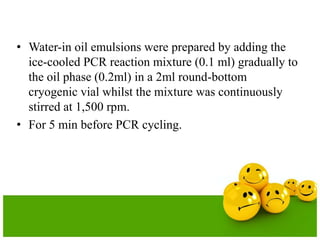
• Water-in oil emulsions were prepared by adding the
ice-cooled PCR reaction mixture (0.1 ml) gradually to
the oil phase (0.2ml) in a 2ml round-bottom
cryogenic vial whilst the mixture was continuously
stirred at 1,500 rpm.
• For 5 min before PCR cycling.
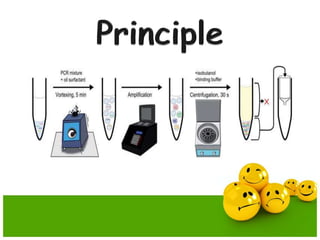
• The water-in-oil emulsion from the PCR tube was pooled and
spun at 9000 g for 5 min to remove the oil phase, leaving the
concentrated emulsion at the bottom of the vial.
• Two volumes of water-saturated ether were added to one
volume of the concentrated emulsion, and the mixture was
vortexes and centrifuged briefly to remove the ether phase.
• The aqueous phase was washed two times with ether and dried
at room temperature.
• Polyacrylamide gel electrophoresis silver staining and
• Agarose electrophoresis were used for analysis of the PCR
products.
• AM40_261.pdf
• Recombination between homologous regions, which results in
the formation of chimeric DNA molecules .
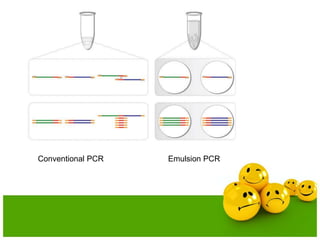
• short fragments tend to be amplified more efficiently in
comparison to longer ones
• Also, highly diverse nucleic acids may not be able to form
perfect duplexes following denaturation steps in PCR
Conventional PCR Emulsion PCR
• PCR amplification of random DNA libraries in aptamer
selection.
• Aptamer ?????????????
• Aptamers are single-stranded DNA or RNA oligonucleotides
capable of binding to other target molecules with high
specificity, affinity and stability
• The 454, the Polonator and SOLiD platforms rely on emulsion
PCR to amplify clonal sequencing.
• Next generation sequencing.
Bacterial genomes are compacted by
• Histones
• Other proteins than histones
• Supercoiling
• DNA polymerases
• DNA topoisomerases
• CP proteins
DNA polymerases
• join DNA fragments
• replicate RNA
• replicate DNA
• synthesize DNA in 5’->3’ direction
• synthesize DNA in 3’->5’ direction
• require a primer to function
• require nucleotides to function
• require ATP
• Opposite to conventional PCR surface amplification is
performed on constant temperature (60°C).
• Formamide works as a denaturing agent.
– formamide (at 60°C formamide melts DNA duplexes;
equivalent to "denaturation step" in normal PCR);
– extension buffer (non-denaturating conditions, equivalent
to "anealing step" in normal PCR);
– extension mixture (primer extension step, equivalent to
"extension step" in normal PCR);
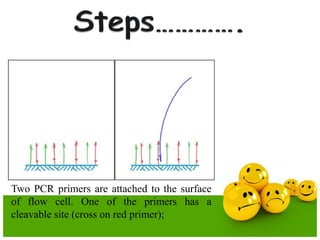
Two PCR primers are attached to the surface
of flow cell. One of the primers has a
cleavable site (cross on red primer);
• Pre amplified library is denaturated in NaOH, then hybridization
buffer is added to shift pH to neutral value.
• Library is loaded into the channel in neutral aquatious solution. DNA
molecules can hybridize to the PCR primers.
• Red primer hybridize with a library molecule on the picture.
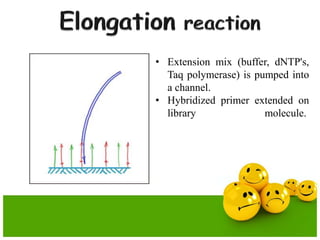
• Extension mix (buffer, dNTP's,
Taq polymerase) is pumped into
a channel.
• Hybridized primer extended on
library molecule.
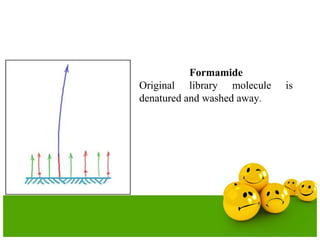
Formamide
Original library molecule is
denatured and washed away.
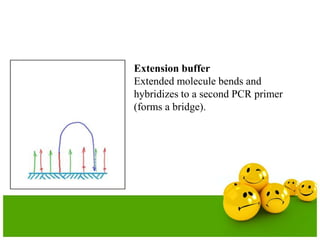
Extension buffer
Extended molecule bends and
hybridizes to a second PCR primer
(forms a bridge).
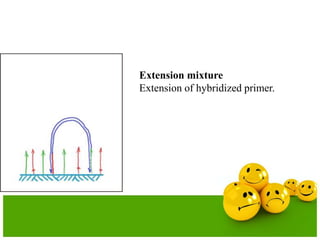
Extension mixture
Extension of hybridized primer.
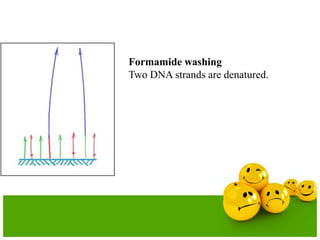
Formamide washing
Two DNA strands are denatured.
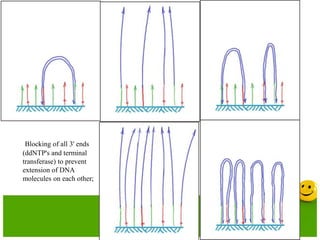
Blocking of all 3' ends
(ddNTP's and terminal
transferase) to prevent
extension of DNA
molecules on each other;
• The focus is on gene discovery or SNP. The sheer volume of
data allows greater comparative genomics to be performed e.g.
methicillin-sensitive and methicillin-resistant strains of
Staphylococcus aureus (Francois et al, 2007, Future
Microbiology).
• Re-sequencing allows specific areas to be checked, especially
as a cost effective way of discovering SNPs e.g.Bacillus
subtilis re-sequencing identified new mutations and suppressor
mutations (Srivatsan et al, 2008, PLOS Genetics).
• Surface PCR has lower efficiency if compare with PCR in solution. 35 cycles
result in ~1000 copies of the original molecule (in ideal PCR 35 cycles should give
~1010x amplification).
– DNA duplex has high chances to renaturate again instead of hybridising with a
new PCR primer.
WHY??????????????
?????????????????
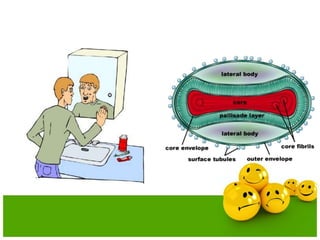
PROBLEM
• Bioterror attack
• The release of number of viruses, such as the variola virus and
those causing haemorrhagic fever.
• The clinical symptoms in the early stages of these viral
infections are all very similar and resemble a flu-like illness.
Early testing is, therefore, important to establish an accurate
diagnosis, but existing diagnostic techniques are either not
rapid enough, require high virus concentrations, or lack
accuracy.
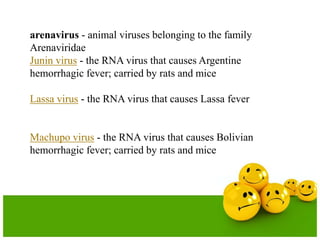
arenavirus - animal viruses belonging to the family
Arenaviridae
Junin virus - the RNA virus that causes Argentine
hemorrhagic fever; carried by rats and mice
Lassa virus - the RNA virus that causes Lassa fever
Machupo virus - the RNA virus that causes Bolivian
hemorrhagic fever; carried by rats and mice
• Common methods for laboratory diagnosis of smallpox and VHF are
isolation of the virus in cell culture or laboratory animals
• polymerase chain reaction (PCR)
• virus antigen detection
• electron microscopy
• as well as detection of specific antibodies in the serum of the patient.
• Virus detection and isolation in cell culture is still the gold standard for
establishing a definitive diagnosis. However, it takes days to weeks to
isolate a virus. In contrast to classical diagnostic methods, which are based
on the detection and identification of the intact organism, PCR detects the
genetic material of a pathogen and thus reduces the contact with infectious
material to a minimum. So, even laboratories of lower security level than P4
can perform PCR diagnostics for VHF and smallpox.
• In order to design reliable primers and hybridisation probes for
real-time PCR, additional sequences of the PCR target regions
were generated:
• 30 sequences for Lassa virus GPC gene PCR
• 22 sequences for Lassa virus L gene PCR
• 7 sequences for Ebola/Marburg virus L gene PCR
• 14 sequences for variola virus 14-kDa fusion protein gene
PCR.
• Prototypes of the Orthopox PCR kit
• Ebola/ Marburg virus L gene PCR kit
• CCHF virus NP gene PCR kit
• In order to facilitate wide distribution and safe handling of
PCR assays for the most relevant viruses (variola virus, Ebola
and Marburg viruses, Lassa virus, and CCHF virus),
prototypes of ready-to-use kits were developed by a small or
medium-sized enterprise (SME).
• They will also be made available to experienced laboratories in
Member States (e.g. those of the European Network of
Imported Viral Diseases (ENIVD))
The sample DNA is placed in a solution containing free nucleotides
and the appropriate enzyme
The complementary DNA strands are separated
New complementary strands are formed using nucleotides from the
solution
The cycle is repeated(usually 20-30times)
• At the end of onecycle,two molecules of DNA has been
produced from each original molecule. How many DNA
molecules will have been produced from one molecule of
DNA after 4 complete cycles?????
• State the enzyme meant by” the appropriate enzyme “in
step1.And explain why a specialized form of this enzyme
required for PCR??????
• The separation of the DNA strands (step2) is normally caused
by the enzyme helicase, explain what causes the strand to
separation in PCR??????
• Suggest one use for PCR technique??????????????
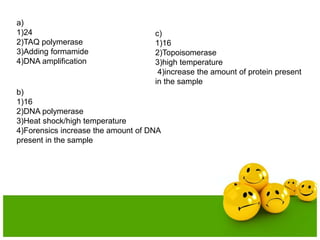
a)
1)24
2)TAQ polymerase
3)Adding formamide
4)DNA amplification
b)
1)16
2)DNA polymerase
3)Heat shock/high temperature
4)Forensics increase the amount of DNA
present in the sample
c)
1)16
2)Topoisomerase
3)high temperature
4)increase the amount of protein present
in the sample
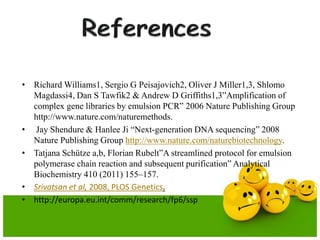
• Richard Williams1, Sergio G Peisajovich2, Oliver J Miller1,3, Shlomo
Magdassi4, Dan S Tawfik2 & Andrew D Griffiths1,3”Amplification of
complex gene libraries by emulsion PCR” 2006 Nature Publishing Group
http://www.nature.com/naturemethods.
• Jay Shendure & Hanlee Ji “Next-generation DNA sequencing” 2008
Nature Publishing Group http://www.nature.com/naturebiotechnology.
• Tatjana Schütze a,b, Florian Rubelt”A streamlined protocol for emulsion
polymerase chain reaction and subsequent purification” Analytical
Biochemistry 410 (2011) 155–157.
• Srivatsan et al, 2008, PLOS Genetics.
• http://europa.eu.int/comm/research/fp6/ssp

EMULSION PCR,VARIOLA PCR,BRIDGE PCR

  • 5.
    • composed of4.5% Span 80, 0.4% Tween 80, and 0.05% Triton X-100 in mineral oil.
  • 6.
    • The aqueousphase was a PCR mixture. • The emulsion PCR mixture was prepared as described below: • 0.4 mmol/L of each primer, 3.5 mmol/L MgCl2, 0.4 mmol/L dATP, 0.4 mmol/L dCTP, 0.4 mmol/L dGTP, 0.4 mmol/L dTTP, 0.125 unit/L Taq DNA polymerase, and 0.01 pmol/ml ssDNA template were added into the • Buffer to adjust total volume to 100 ml.
  • 7.
    • Water-in oilemulsions were prepared by adding the ice-cooled PCR reaction mixture (0.1 ml) gradually to the oil phase (0.2ml) in a 2ml round-bottom cryogenic vial whilst the mixture was continuously stirred at 1,500 rpm. • For 5 min before PCR cycling.
  • 8.
    • The water-in-oilemulsion from the PCR tube was pooled and spun at 9000 g for 5 min to remove the oil phase, leaving the concentrated emulsion at the bottom of the vial. • Two volumes of water-saturated ether were added to one volume of the concentrated emulsion, and the mixture was vortexes and centrifuged briefly to remove the ether phase. • The aqueous phase was washed two times with ether and dried at room temperature.
  • 9.
    • Polyacrylamide gelelectrophoresis silver staining and • Agarose electrophoresis were used for analysis of the PCR products.
  • 10.
  • 12.
    • Recombination betweenhomologous regions, which results in the formation of chimeric DNA molecules . • short fragments tend to be amplified more efficiently in comparison to longer ones • Also, highly diverse nucleic acids may not be able to form perfect duplexes following denaturation steps in PCR
  • 13.
  • 14.
    • PCR amplificationof random DNA libraries in aptamer selection. • Aptamer ????????????? • Aptamers are single-stranded DNA or RNA oligonucleotides capable of binding to other target molecules with high specificity, affinity and stability • The 454, the Polonator and SOLiD platforms rely on emulsion PCR to amplify clonal sequencing. • Next generation sequencing.
  • 16.
    Bacterial genomes arecompacted by • Histones • Other proteins than histones • Supercoiling • DNA polymerases • DNA topoisomerases • CP proteins
  • 17.
    DNA polymerases • joinDNA fragments • replicate RNA • replicate DNA • synthesize DNA in 5’->3’ direction • synthesize DNA in 3’->5’ direction • require a primer to function • require nucleotides to function • require ATP
  • 19.
    • Opposite toconventional PCR surface amplification is performed on constant temperature (60°C). • Formamide works as a denaturing agent. – formamide (at 60°C formamide melts DNA duplexes; equivalent to "denaturation step" in normal PCR); – extension buffer (non-denaturating conditions, equivalent to "anealing step" in normal PCR); – extension mixture (primer extension step, equivalent to "extension step" in normal PCR);
  • 20.
    Two PCR primersare attached to the surface of flow cell. One of the primers has a cleavable site (cross on red primer);
  • 21.
    • Pre amplifiedlibrary is denaturated in NaOH, then hybridization buffer is added to shift pH to neutral value. • Library is loaded into the channel in neutral aquatious solution. DNA molecules can hybridize to the PCR primers. • Red primer hybridize with a library molecule on the picture.
  • 22.
    • Extension mix(buffer, dNTP's, Taq polymerase) is pumped into a channel. • Hybridized primer extended on library molecule.
  • 23.
    Formamide Original library moleculeis denatured and washed away.
  • 24.
    Extension buffer Extended moleculebends and hybridizes to a second PCR primer (forms a bridge).
  • 25.
  • 26.
    Formamide washing Two DNAstrands are denatured.
  • 27.
    Blocking of all3' ends (ddNTP's and terminal transferase) to prevent extension of DNA molecules on each other;
  • 28.
    • The focusis on gene discovery or SNP. The sheer volume of data allows greater comparative genomics to be performed e.g. methicillin-sensitive and methicillin-resistant strains of Staphylococcus aureus (Francois et al, 2007, Future Microbiology). • Re-sequencing allows specific areas to be checked, especially as a cost effective way of discovering SNPs e.g.Bacillus subtilis re-sequencing identified new mutations and suppressor mutations (Srivatsan et al, 2008, PLOS Genetics).
  • 29.
    • Surface PCRhas lower efficiency if compare with PCR in solution. 35 cycles result in ~1000 copies of the original molecule (in ideal PCR 35 cycles should give ~1010x amplification). – DNA duplex has high chances to renaturate again instead of hybridising with a new PCR primer.
  • 30.
  • 32.
    PROBLEM • Bioterror attack •The release of number of viruses, such as the variola virus and those causing haemorrhagic fever. • The clinical symptoms in the early stages of these viral infections are all very similar and resemble a flu-like illness. Early testing is, therefore, important to establish an accurate diagnosis, but existing diagnostic techniques are either not rapid enough, require high virus concentrations, or lack accuracy.
  • 34.
    arenavirus - animalviruses belonging to the family Arenaviridae Junin virus - the RNA virus that causes Argentine hemorrhagic fever; carried by rats and mice Lassa virus - the RNA virus that causes Lassa fever Machupo virus - the RNA virus that causes Bolivian hemorrhagic fever; carried by rats and mice
  • 35.
    • Common methodsfor laboratory diagnosis of smallpox and VHF are isolation of the virus in cell culture or laboratory animals • polymerase chain reaction (PCR) • virus antigen detection • electron microscopy • as well as detection of specific antibodies in the serum of the patient. • Virus detection and isolation in cell culture is still the gold standard for establishing a definitive diagnosis. However, it takes days to weeks to isolate a virus. In contrast to classical diagnostic methods, which are based on the detection and identification of the intact organism, PCR detects the genetic material of a pathogen and thus reduces the contact with infectious material to a minimum. So, even laboratories of lower security level than P4 can perform PCR diagnostics for VHF and smallpox.
  • 36.
    • In orderto design reliable primers and hybridisation probes for real-time PCR, additional sequences of the PCR target regions were generated: • 30 sequences for Lassa virus GPC gene PCR • 22 sequences for Lassa virus L gene PCR • 7 sequences for Ebola/Marburg virus L gene PCR • 14 sequences for variola virus 14-kDa fusion protein gene PCR.
  • 37.
    • Prototypes ofthe Orthopox PCR kit • Ebola/ Marburg virus L gene PCR kit • CCHF virus NP gene PCR kit
  • 38.
    • In orderto facilitate wide distribution and safe handling of PCR assays for the most relevant viruses (variola virus, Ebola and Marburg viruses, Lassa virus, and CCHF virus), prototypes of ready-to-use kits were developed by a small or medium-sized enterprise (SME). • They will also be made available to experienced laboratories in Member States (e.g. those of the European Network of Imported Viral Diseases (ENIVD))
  • 40.
    The sample DNAis placed in a solution containing free nucleotides and the appropriate enzyme The complementary DNA strands are separated New complementary strands are formed using nucleotides from the solution The cycle is repeated(usually 20-30times)
  • 41.
    • At theend of onecycle,two molecules of DNA has been produced from each original molecule. How many DNA molecules will have been produced from one molecule of DNA after 4 complete cycles????? • State the enzyme meant by” the appropriate enzyme “in step1.And explain why a specialized form of this enzyme required for PCR?????? • The separation of the DNA strands (step2) is normally caused by the enzyme helicase, explain what causes the strand to separation in PCR?????? • Suggest one use for PCR technique??????????????
  • 42.
    a) 1)24 2)TAQ polymerase 3)Adding formamide 4)DNAamplification b) 1)16 2)DNA polymerase 3)Heat shock/high temperature 4)Forensics increase the amount of DNA present in the sample c) 1)16 2)Topoisomerase 3)high temperature 4)increase the amount of protein present in the sample
  • 44.
    • Richard Williams1,Sergio G Peisajovich2, Oliver J Miller1,3, Shlomo Magdassi4, Dan S Tawfik2 & Andrew D Griffiths1,3”Amplification of complex gene libraries by emulsion PCR” 2006 Nature Publishing Group http://www.nature.com/naturemethods. • Jay Shendure & Hanlee Ji “Next-generation DNA sequencing” 2008 Nature Publishing Group http://www.nature.com/naturebiotechnology. • Tatjana Schütze a,b, Florian Rubelt”A streamlined protocol for emulsion polymerase chain reaction and subsequent purification” Analytical Biochemistry 410 (2011) 155–157. • Srivatsan et al, 2008, PLOS Genetics. • http://europa.eu.int/comm/research/fp6/ssp