REGENERATION
Regeneration is the reactivation of developmentin
postembryonic life to restore missingtissues.
• Theability to regenerate lost part is present throughout the
animal kingdom but to variousextent.
• Among invertebrate regeneration power is especiallymore in
sponges, coelenterates, flatworms, & tunicates.
• Among vertebrates the power of regeneration is limited tothe
regeneration of limbs, jaws , gills & tail while in higher
vertebrates it is limited to healing of damaged tissueonly.
1. 1.Physiological or Stem cell mediated Regeneration-Regular
replacement of cells that are lost due to day to day activities
.Replacement of RBC.,Cells in the epidermis of skin or lining of GIT
stem cell allow an organism to regrow certain organs or
tissues that have been lost. Examples: continual
replacement of blood cells from the hematopoietic stem cells
in the bone marrow.
2.Reparative regeneration—It is the process of replacement of lost
parts or repairing damaged parts.
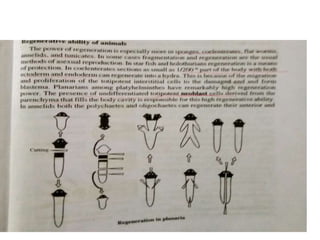
Regeneration does in fact take place in different species
& can occur in four major ways:
1. Super regeneration—Devt,of superfluous no of organs or parts
of body .Planaria and earth worm small wound or incision near
head initiatesdevp.of additional head.same tail..
2. Epimorphosis: In some species, adult structure can undergo
dedifferentiation to form a relatively undifferentiated mass of
cells that redifferentiates to form the new structure .Example
: planarian flatworm regeneration & regeneration
of amphibians limbs.star fish.
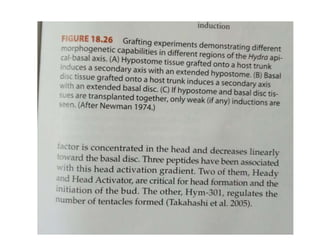
3. Morphallaxis: Here, regeneration occurs through the
repatterning of existing tissues, & there is little newgrowth.
Example: regeneration in Hydra 1/200.Regeneration of
whole sponge body from few archaeocytes .only in lower
organisms
Archaeocytes are very important to the functioning of a sponge.
These cells are totipotent, which means that they can change
into all of the other types of sponge cells. Archaeocytes ingest
and digest food caught by the choanocyte collars and transport
nutrients to the other cells of the sponge.
4..Heteromorphosis—Regenerated organ is dif from one that has
been removed..Shrimp Palinurus the eye regenerate only when
eye alone is removed.But when the eye is removed along with
the optic ganglion ,the will not be regenerated ,intead an antinna
like organ develops.
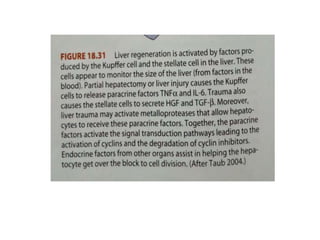
5.. Compensatory regeneration:Here, the differentiated cell divide
but maintain theirdifferentiated functions.Each cell produce cells
similar to itself ; no mass of undifferentiated tissues forms.This
type of regeneration is characteristicof the mammalian liver.
Of glycogen increases in the blasema,it is derived from injured muscle and
nerve cells.
Anabolic phase –increase in oxidation,ph to normal,,higherRQ.decrease lactic
acid,
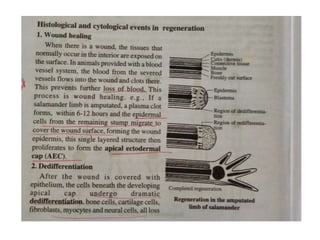
Proliferation of the blastema cells:
The requirement for nerve & the AEC
• Thegrowth of the regeneration blastema depends on the presence
of both the apical ectodermal cap &nerves.
• The AEC stimulates the growth of the blastema by secreting Fgf8
(just as the apical ectodermal ridges does in normal limb
development). But the effect of AEC is only possibleif nerves are
present.
• Regeneration of newt limbdepends on newt anterior gradient
protein (nAG).
• This protein can cause blastema cell to proliferate in culture, &
it permits normal regeneration in limbs that have been
denervated.
How Do the Blastema Cells Know TheirProximal and
Distal Levels ?
• Theanterior-posterioraxis isestablished by Sonic hedgehog
activation & thegraded expression of the HoxD series of genes.
• The proximal-distal axis is reestablished using retinoicacid (RA),
HoxA genes, & fibroblast growth factors, just as in the
developing limbs.
• The retinoic acid is synthesized in the wound epidermis of the
regenerating limb & forms a gradient along the proximal-distal
& anterior-posterior axes of theblastema.
• This RA gradient inform cells of their position along that axis in
the limb.
(A)
(B)
Regeneration of newt limbs
depend on nAG
(A) The limb is denervated
& aweek later isamputated.
After 5 days, nAG is
electroporated into blastema.
(B) Result: denervated
amputated limbremain
a stump.
if, (not giving nAG).
The limb that is given nAG
Regenerates tissue &
proximal- distal polarity.
Factors effecting regeneration
-Temp
-Food
-X-rays
-Age
-NS
Nasanove 1932-tight ligature on salamander limb –damaged and
disintegrating tissue releases substance,
Beryllium nitrate amputation surface of tadpole tail
transdifferentiation-eye lens urodele-epidermis eye cup inductor
normal devt.
Regeneration-part of eye cup.
One mature differentiated cell type covert to a different cell type.
Gilbert, S.F. Developmental Biology. 10th ed.
Sunderland, MA: Sinauer Associates, 2010.
The ependyma is the thin neuroepithelial (simple columnar ciliated
epithelium) lining of the ventricular system of the brain and the central
canal of the spinal cord.[1] The ependyma is one of the four types
of neuroglia in the central nervous system (CNS). It is involved in the
production of cerebrospinal fluid (CSF), and is shown to serve as a
reservoir for neuroregeneration.

regenerationsat-.pptx

  • 1.
  • 2.
    Regeneration is thereactivation of developmentin postembryonic life to restore missingtissues. • Theability to regenerate lost part is present throughout the animal kingdom but to variousextent. • Among invertebrate regeneration power is especiallymore in sponges, coelenterates, flatworms, & tunicates. • Among vertebrates the power of regeneration is limited tothe regeneration of limbs, jaws , gills & tail while in higher vertebrates it is limited to healing of damaged tissueonly.
  • 3.
    1. 1.Physiological orStem cell mediated Regeneration-Regular replacement of cells that are lost due to day to day activities .Replacement of RBC.,Cells in the epidermis of skin or lining of GIT stem cell allow an organism to regrow certain organs or tissues that have been lost. Examples: continual replacement of blood cells from the hematopoietic stem cells in the bone marrow. 2.Reparative regeneration—It is the process of replacement of lost parts or repairing damaged parts.
  • 4.
    Regeneration does infact take place in different species & can occur in four major ways: 1. Super regeneration—Devt,of superfluous no of organs or parts of body .Planaria and earth worm small wound or incision near head initiatesdevp.of additional head.same tail.. 2. Epimorphosis: In some species, adult structure can undergo dedifferentiation to form a relatively undifferentiated mass of cells that redifferentiates to form the new structure .Example : planarian flatworm regeneration & regeneration of amphibians limbs.star fish. 3. Morphallaxis: Here, regeneration occurs through the repatterning of existing tissues, & there is little newgrowth. Example: regeneration in Hydra 1/200.Regeneration of whole sponge body from few archaeocytes .only in lower organisms
  • 5.
    Archaeocytes are veryimportant to the functioning of a sponge. These cells are totipotent, which means that they can change into all of the other types of sponge cells. Archaeocytes ingest and digest food caught by the choanocyte collars and transport nutrients to the other cells of the sponge. 4..Heteromorphosis—Regenerated organ is dif from one that has been removed..Shrimp Palinurus the eye regenerate only when eye alone is removed.But when the eye is removed along with the optic ganglion ,the will not be regenerated ,intead an antinna like organ develops. 5.. Compensatory regeneration:Here, the differentiated cell divide but maintain theirdifferentiated functions.Each cell produce cells similar to itself ; no mass of undifferentiated tissues forms.This type of regeneration is characteristicof the mammalian liver.
  • 12.
    Of glycogen increasesin the blasema,it is derived from injured muscle and nerve cells. Anabolic phase –increase in oxidation,ph to normal,,higherRQ.decrease lactic acid,
  • 13.
    Proliferation of theblastema cells: The requirement for nerve & the AEC • Thegrowth of the regeneration blastema depends on the presence of both the apical ectodermal cap &nerves. • The AEC stimulates the growth of the blastema by secreting Fgf8 (just as the apical ectodermal ridges does in normal limb development). But the effect of AEC is only possibleif nerves are present. • Regeneration of newt limbdepends on newt anterior gradient protein (nAG). • This protein can cause blastema cell to proliferate in culture, & it permits normal regeneration in limbs that have been denervated.
  • 14.
    How Do theBlastema Cells Know TheirProximal and Distal Levels ? • Theanterior-posterioraxis isestablished by Sonic hedgehog activation & thegraded expression of the HoxD series of genes. • The proximal-distal axis is reestablished using retinoicacid (RA), HoxA genes, & fibroblast growth factors, just as in the developing limbs. • The retinoic acid is synthesized in the wound epidermis of the regenerating limb & forms a gradient along the proximal-distal & anterior-posterior axes of theblastema. • This RA gradient inform cells of their position along that axis in the limb.
  • 15.
    (A) (B) Regeneration of newtlimbs depend on nAG (A) The limb is denervated & aweek later isamputated. After 5 days, nAG is electroporated into blastema. (B) Result: denervated amputated limbremain a stump. if, (not giving nAG). The limb that is given nAG Regenerates tissue & proximal- distal polarity.
  • 16.
    Factors effecting regeneration -Temp -Food -X-rays -Age -NS Nasanove1932-tight ligature on salamander limb –damaged and disintegrating tissue releases substance, Beryllium nitrate amputation surface of tadpole tail transdifferentiation-eye lens urodele-epidermis eye cup inductor normal devt. Regeneration-part of eye cup. One mature differentiated cell type covert to a different cell type.
  • 27.
    Gilbert, S.F. DevelopmentalBiology. 10th ed. Sunderland, MA: Sinauer Associates, 2010.
  • 33.
    The ependyma isthe thin neuroepithelial (simple columnar ciliated epithelium) lining of the ventricular system of the brain and the central canal of the spinal cord.[1] The ependyma is one of the four types of neuroglia in the central nervous system (CNS). It is involved in the production of cerebrospinal fluid (CSF), and is shown to serve as a reservoir for neuroregeneration.