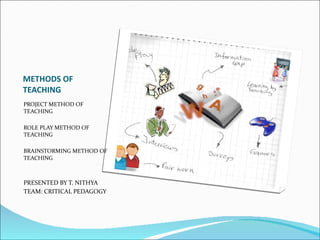
METHODS OF TEACHING PROJECT METHOD OF TEACHING ROLE PLAY METHOD OF TEACHING BRAINSTORMING METHOD OF TEACHING PRESENTED BY T. NITHYA TEAM: CRITICAL PEDAGOGY
 
PROJECT METHOD OF TEACHING According to Kilpatrick “ A project is a whole- hearted purposeful activity proceeding in a social environment”.   According to Stevenson (1908) “ A project is a problematic act carried to completion in its natural setting”.   According to Ballard “ A project is a bit of real life that has been imparted into the school”.
PROJECT METHOD IS BASED ON THE FOLLOWING PRINCIPLES Learning by doing. Learning by living. Children learn better through association, cooperation and activity
TYPES OF PROJECT  Individual and Social (Group) projects:   Simple and Complex project: Constructive project: Aesthetic project: Problematic project: Drill project:
PRINCIPLES OF PROJECT METHOD Principle of Purposefulness  Principle of Utility  Principle of Freedom  Principle of Activity  Principle of Reality  Principle of Social Development  Principle of Planning
STEPS 1. Creating Situation  2. Selection of the problem  3. Planning  4. Execution  5. Evaluation  6. Reporting and Recording
ROLE OF THE TEACHER  A  guide, friend and philosopher. Helps the students in solving their problems. Encourages his students to work collectively, and co-operatively. Helps his students to avoid mistakes. He makes it a point that each member of the group contributed something to the completion of the project. Teacher should always remain alert and active during execution step and see that the project goes to completion successfully. During execution of the project teacher should maintain a democratic atmosphere. Teacher must be well – read and well-informed so that he can help the students to the successful completion of the project
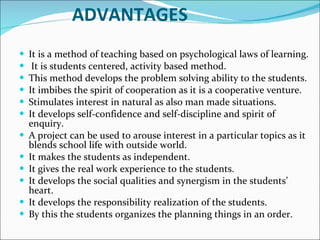
ADVANTAGES It is a method of teaching based on psychological laws of learning. It is students centered, activity based method.  This method develops the problem solving ability to the students.  It imbibes the spirit of cooperation as it is a cooperative venture.  Stimulates interest in natural as also man made situations.  It develops self-confidence and self-discipline and spirit of enquiry. A project can be used to arouse interest in a particular topics as it blends school life with outside world. It makes the students as independent.  It gives the real work experience to the students.  It develops the social qualities and synergism in the students’ heart.  It develops the responsibility realization of the students.  By this the students organizes the planning things in an order. 
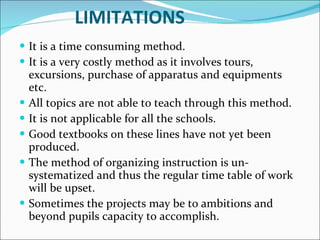
LIMITATIONS It is a time consuming method.  It is a very costly method as it involves tours, excursions, purchase of apparatus and equipments etc. All topics are not able to teach through this method.  It is not applicable for all the schools.  Good textbooks on these lines have not yet been produced. The method of organizing instruction is un-systematized and thus the regular time table of work will be upset. Sometimes the projects may be to ambitions and beyond pupils capacity to accomplish.
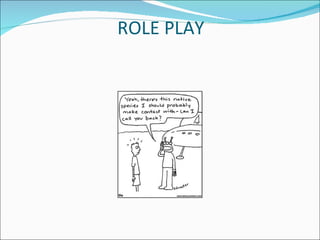
ROLE PLAY
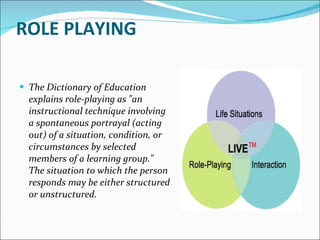
ROLE PLAYING The Dictionary of Education explains role-playing as "an instructional technique involving a spontaneous portrayal (acting out) of a situation, condition, or circumstances by selected members of a learning group." The situation to which the person responds may be either structured or unstructured.
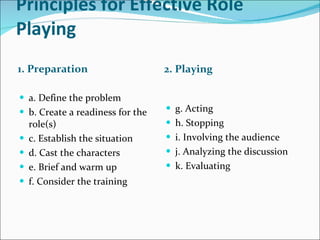
Principles for Effective Role Playing 1. Preparation 2. Playing a. Define the problem b. Create a readiness for the role(s) c. Establish the situation d. Cast the characters e. Brief and warm up f. Consider the training g. Acting h. Stopping i. Involving the audience j. Analyzing the discussion k. Evaluating
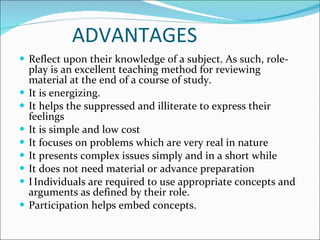
ADVANTAGES Reflect upon their knowledge of a subject. As such, role-play is an excellent teaching method for reviewing material at the end of a course of study. It is energizing.  It helps the suppressed and illiterate to express their feelings It is simple and low cost It focuses on problems which are very real in nature  It presents complex issues simply and in a short while It does not need material or advance preparation  Individuals are required to use appropriate concepts and arguments as defined by their role. Participation helps embed concepts.
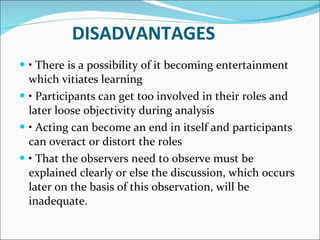
DISADVANTAGES •  There is a possibility of it becoming entertainment which vitiates learning •  Participants can get too involved in their roles and later loose objectivity during analysis •  Acting can become an end in itself and participants can overact or distort the roles •  That the observers need to observe must be explained clearly or else the discussion, which occurs later on the basis of this observation, will be inadequate.
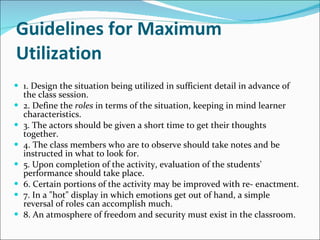
Guidelines for Maximum Utilization 1. Design the situation being utilized in sufficient detail in advance of the class session. 2. Define the  roles  in terms of the situation, keeping in mind learner characteristics.  3. The actors should be given a short time to get their thoughts together. 4. The class members who are to observe should take notes and be instructed in what to look for. 5. Upon completion of the activity, evaluation of the students' performance should take place. 6. Certain portions of the activity may be improved with re- enactment. 7. In a "hot" display in which emotions get out of hand, a simple reversal of roles can accomplish much.  8. An atmosphere of freedom and security must exist in the classroom.
At the end of role-playing •  Engaging in discussion of a totally unrelated topic to promote interaction that brings the group back to the 'here and now' •  Allowing further discussion of any issue of concern •  Allowing objective feedback on aspects of the portrayal of the roles and how real the situation felt •  Asking actors and observers what they liked about the interaction and what might have been done differently •  Asking the class what they learnt from the role-play •  Drawing the class' attention back to the objective, or to the main points that the role-play was to demonstrate
BRAINSTORMING
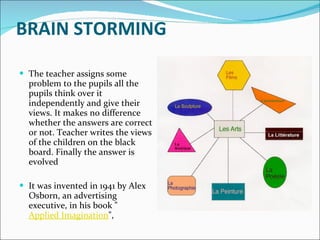
BRAIN STORMING The teacher assigns some problem to the pupils all the pupils think over it independently and give their views. It makes no difference whether the answers are correct or not. Teacher writes the views of the children on the black board. Finally the answer is evolved It was invented in 1941 by Alex Osborn, an advertising executive, in his book " Applied Imagination ",
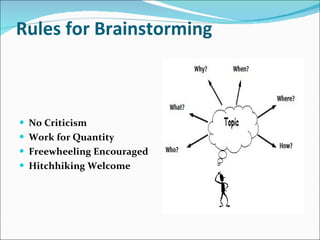
Rules for Brainstorming No Criticism Work for Quantity Freewheeling Encouraged Hitchhiking Welcome
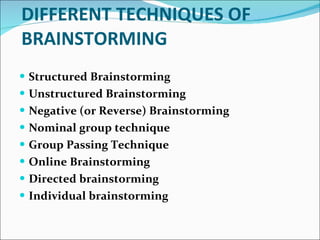
DIFFERENT TECHNIQUES OF BRAINSTORMING Structured Brainstorming  Unstructured Brainstorming Negative (or Reverse) Brainstorming  Nominal group technique  Group Passing Technique  Online Brainstorming  Directed brainstorming   Individual brainstorming
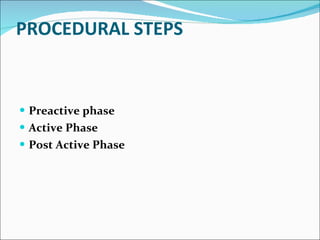
PROCEDURAL STEPS Preactive phase  Active Phase  Post Active Phase
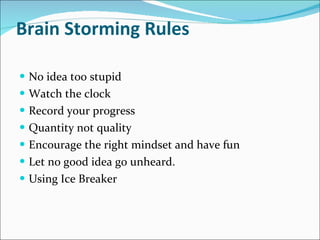
Brain Storming Rules  No idea too stupid  Watch the clock  Record your progress  Quantity not quality  Encourage the right mindset and have fun  Let no good idea go unheard.  Using Ice Breaker
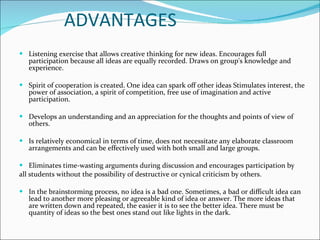
ADVANTAGES Listening exercise that allows creative thinking for new ideas. Encourages full participation because all ideas are equally recorded. Draws on group's knowledge and experience.    Spirit of cooperation is created. One idea can spark off other ideas Stimulates interest, the power of association, a spirit of competition, free use of imagination and active participation.    Develops an understanding and an appreciation for the thoughts and points of view of others.  Is relatively economical in terms of time, does not necessitate any elaborate classroom arrangements and can be effectively used with both small and large groups.    Eliminates time-wasting arguments during discussion and encourages participation by  all students without the possibility of destructive or cynical criticism by others. In the brainstorming process, no idea is a bad one. Sometimes, a bad or difficult idea can lead to another more pleasing or agreeable kind of idea or answer. The more ideas that are written down and repeated, the easier it is to see the better idea. There must be quantity of ideas so the best ones stand out like lights in the dark.    
LIMITATIONS Can be unfocused. Students may have difficulty getting away from known reality. Value to students depends in part on their maturity level  The enthusiasm of individual members could cause the group to get out of hand or the discussion to be monopolized and necessitate certain control measures.  Successful brainstorming depends in part upon the understanding of the procedure by the participants and the careful selection of a topic and qualified chairman and secretary.  Little evaluation and constructive criticism of individual ideas takes place during the discussion.  The recording of all comments and statements during the session could slow the spontaneous generation of ideas and the overall procedure.
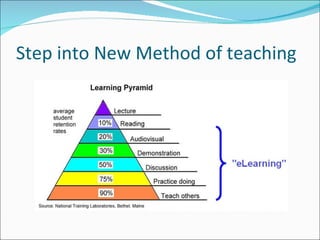
Step into New Method of teaching
 

Methods of teaching nithi

  • 1.
    METHODS OF TEACHINGPROJECT METHOD OF TEACHING ROLE PLAY METHOD OF TEACHING BRAINSTORMING METHOD OF TEACHING PRESENTED BY T. NITHYA TEAM: CRITICAL PEDAGOGY
  • 2.
  • 3.
    PROJECT METHOD OFTEACHING According to Kilpatrick “ A project is a whole- hearted purposeful activity proceeding in a social environment”.   According to Stevenson (1908) “ A project is a problematic act carried to completion in its natural setting”.   According to Ballard “ A project is a bit of real life that has been imparted into the school”.
  • 4.
    PROJECT METHOD ISBASED ON THE FOLLOWING PRINCIPLES Learning by doing. Learning by living. Children learn better through association, cooperation and activity
  • 5.
    TYPES OF PROJECT Individual and Social (Group) projects:   Simple and Complex project: Constructive project: Aesthetic project: Problematic project: Drill project:
  • 6.
    PRINCIPLES OF PROJECTMETHOD Principle of Purposefulness Principle of Utility Principle of Freedom Principle of Activity Principle of Reality Principle of Social Development Principle of Planning
  • 7.
    STEPS 1. CreatingSituation 2. Selection of the problem 3. Planning 4. Execution 5. Evaluation 6. Reporting and Recording
  • 8.
    ROLE OF THETEACHER A guide, friend and philosopher. Helps the students in solving their problems. Encourages his students to work collectively, and co-operatively. Helps his students to avoid mistakes. He makes it a point that each member of the group contributed something to the completion of the project. Teacher should always remain alert and active during execution step and see that the project goes to completion successfully. During execution of the project teacher should maintain a democratic atmosphere. Teacher must be well – read and well-informed so that he can help the students to the successful completion of the project
  • 9.
    ADVANTAGES It isa method of teaching based on psychological laws of learning. It is students centered, activity based method. This method develops the problem solving ability to the students. It imbibes the spirit of cooperation as it is a cooperative venture. Stimulates interest in natural as also man made situations. It develops self-confidence and self-discipline and spirit of enquiry. A project can be used to arouse interest in a particular topics as it blends school life with outside world. It makes the students as independent. It gives the real work experience to the students. It develops the social qualities and synergism in the students’ heart. It develops the responsibility realization of the students. By this the students organizes the planning things in an order. 
  • 10.
    LIMITATIONS It isa time consuming method. It is a very costly method as it involves tours, excursions, purchase of apparatus and equipments etc. All topics are not able to teach through this method. It is not applicable for all the schools. Good textbooks on these lines have not yet been produced. The method of organizing instruction is un-systematized and thus the regular time table of work will be upset. Sometimes the projects may be to ambitions and beyond pupils capacity to accomplish.
  • 11.
  • 12.
    ROLE PLAYING TheDictionary of Education explains role-playing as "an instructional technique involving a spontaneous portrayal (acting out) of a situation, condition, or circumstances by selected members of a learning group." The situation to which the person responds may be either structured or unstructured.
  • 13.
    Principles for EffectiveRole Playing 1. Preparation 2. Playing a. Define the problem b. Create a readiness for the role(s) c. Establish the situation d. Cast the characters e. Brief and warm up f. Consider the training g. Acting h. Stopping i. Involving the audience j. Analyzing the discussion k. Evaluating
  • 14.
    ADVANTAGES Reflect upontheir knowledge of a subject. As such, role-play is an excellent teaching method for reviewing material at the end of a course of study. It is energizing. It helps the suppressed and illiterate to express their feelings It is simple and low cost It focuses on problems which are very real in nature  It presents complex issues simply and in a short while It does not need material or advance preparation  Individuals are required to use appropriate concepts and arguments as defined by their role. Participation helps embed concepts.
  • 15.
    DISADVANTAGES • There is a possibility of it becoming entertainment which vitiates learning • Participants can get too involved in their roles and later loose objectivity during analysis • Acting can become an end in itself and participants can overact or distort the roles • That the observers need to observe must be explained clearly or else the discussion, which occurs later on the basis of this observation, will be inadequate.
  • 16.
    Guidelines for MaximumUtilization 1. Design the situation being utilized in sufficient detail in advance of the class session. 2. Define the roles in terms of the situation, keeping in mind learner characteristics. 3. The actors should be given a short time to get their thoughts together. 4. The class members who are to observe should take notes and be instructed in what to look for. 5. Upon completion of the activity, evaluation of the students' performance should take place. 6. Certain portions of the activity may be improved with re- enactment. 7. In a "hot" display in which emotions get out of hand, a simple reversal of roles can accomplish much. 8. An atmosphere of freedom and security must exist in the classroom.
  • 17.
    At the endof role-playing • Engaging in discussion of a totally unrelated topic to promote interaction that brings the group back to the 'here and now' • Allowing further discussion of any issue of concern • Allowing objective feedback on aspects of the portrayal of the roles and how real the situation felt • Asking actors and observers what they liked about the interaction and what might have been done differently • Asking the class what they learnt from the role-play • Drawing the class' attention back to the objective, or to the main points that the role-play was to demonstrate
  • 18.
  • 19.
    BRAIN STORMING Theteacher assigns some problem to the pupils all the pupils think over it independently and give their views. It makes no difference whether the answers are correct or not. Teacher writes the views of the children on the black board. Finally the answer is evolved It was invented in 1941 by Alex Osborn, an advertising executive, in his book " Applied Imagination ",
  • 20.
    Rules for BrainstormingNo Criticism Work for Quantity Freewheeling Encouraged Hitchhiking Welcome
  • 21.
    DIFFERENT TECHNIQUES OFBRAINSTORMING Structured Brainstorming Unstructured Brainstorming Negative (or Reverse) Brainstorming Nominal group technique Group Passing Technique Online Brainstorming Directed brainstorming Individual brainstorming
  • 22.
    PROCEDURAL STEPS Preactivephase Active Phase Post Active Phase
  • 23.
    Brain Storming Rules No idea too stupid Watch the clock Record your progress Quantity not quality Encourage the right mindset and have fun Let no good idea go unheard. Using Ice Breaker
  • 24.
    ADVANTAGES Listening exercisethat allows creative thinking for new ideas. Encourages full participation because all ideas are equally recorded. Draws on group's knowledge and experience.   Spirit of cooperation is created. One idea can spark off other ideas Stimulates interest, the power of association, a spirit of competition, free use of imagination and active participation.   Develops an understanding and an appreciation for the thoughts and points of view of others. Is relatively economical in terms of time, does not necessitate any elaborate classroom arrangements and can be effectively used with both small and large groups.   Eliminates time-wasting arguments during discussion and encourages participation by all students without the possibility of destructive or cynical criticism by others. In the brainstorming process, no idea is a bad one. Sometimes, a bad or difficult idea can lead to another more pleasing or agreeable kind of idea or answer. The more ideas that are written down and repeated, the easier it is to see the better idea. There must be quantity of ideas so the best ones stand out like lights in the dark.    
  • 25.
    LIMITATIONS Can beunfocused. Students may have difficulty getting away from known reality. Value to students depends in part on their maturity level The enthusiasm of individual members could cause the group to get out of hand or the discussion to be monopolized and necessitate certain control measures. Successful brainstorming depends in part upon the understanding of the procedure by the participants and the careful selection of a topic and qualified chairman and secretary. Little evaluation and constructive criticism of individual ideas takes place during the discussion. The recording of all comments and statements during the session could slow the spontaneous generation of ideas and the overall procedure.
  • 26.
    Step into NewMethod of teaching
  • 27.